Another Round of Damaging Storms Could Hit Southern Ontario Thursday With Tornado Risk Increasing

THIS FORECAST IS SPONSORED BY:

NOTE: YOU CAN CLICK ON THE MAP TO OPEN A ZOOMABLE IMAGE

After an active Canada Day that saw storms sweep through Southern Ontario, causing damage and power outages from widespread damaging wind gusts, Thursday may feel like déjà vu for some areas. For parts of the province, this could be the third severe weather risk of the week.

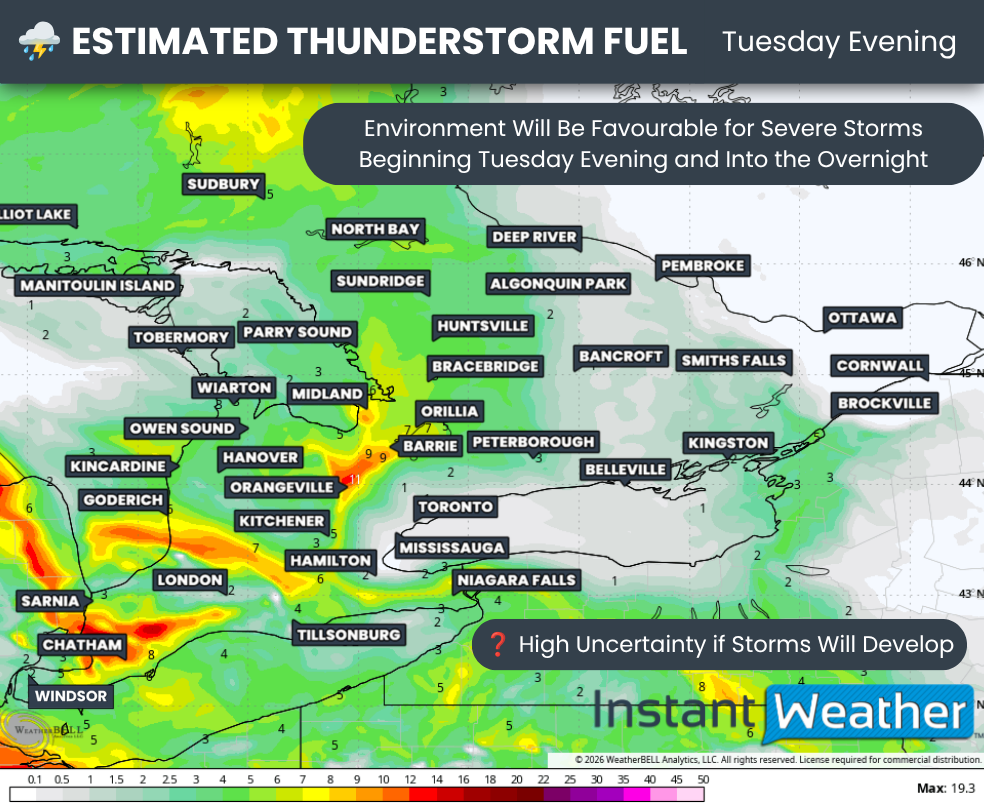
Fueling all of this active weather is the ongoing heat event, which has led to temperatures soaring into the mid to upper 30s across many locations. Thursday is expected to be similarly hot, creating more than enough instability for another round of severe weather.

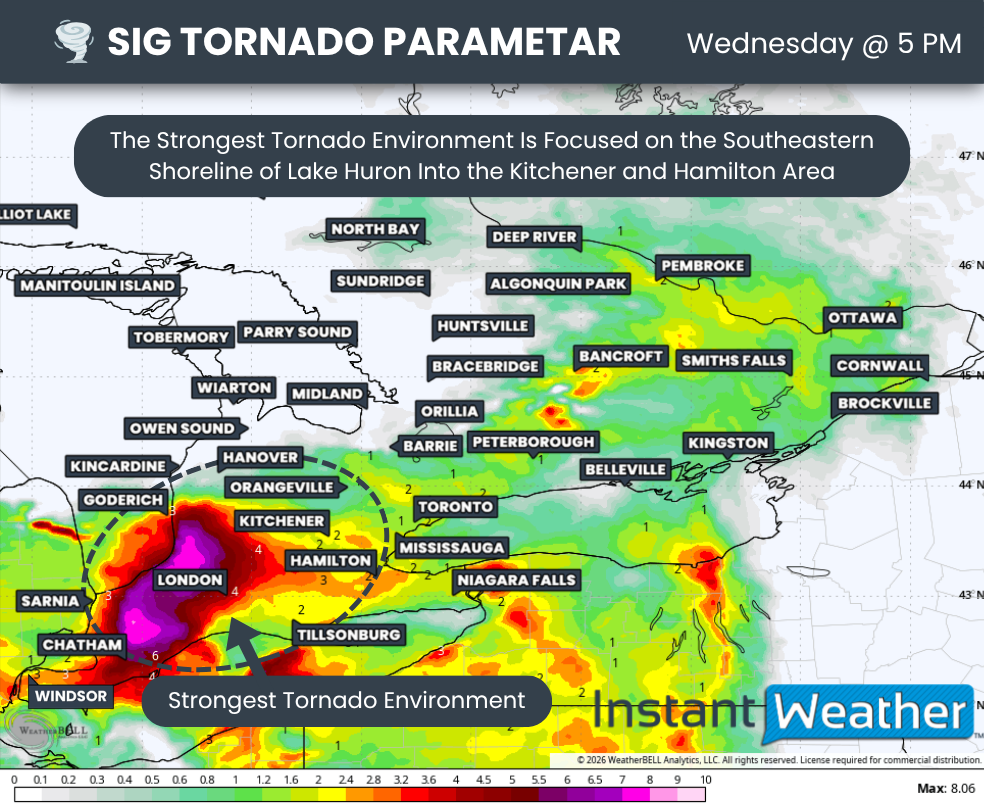
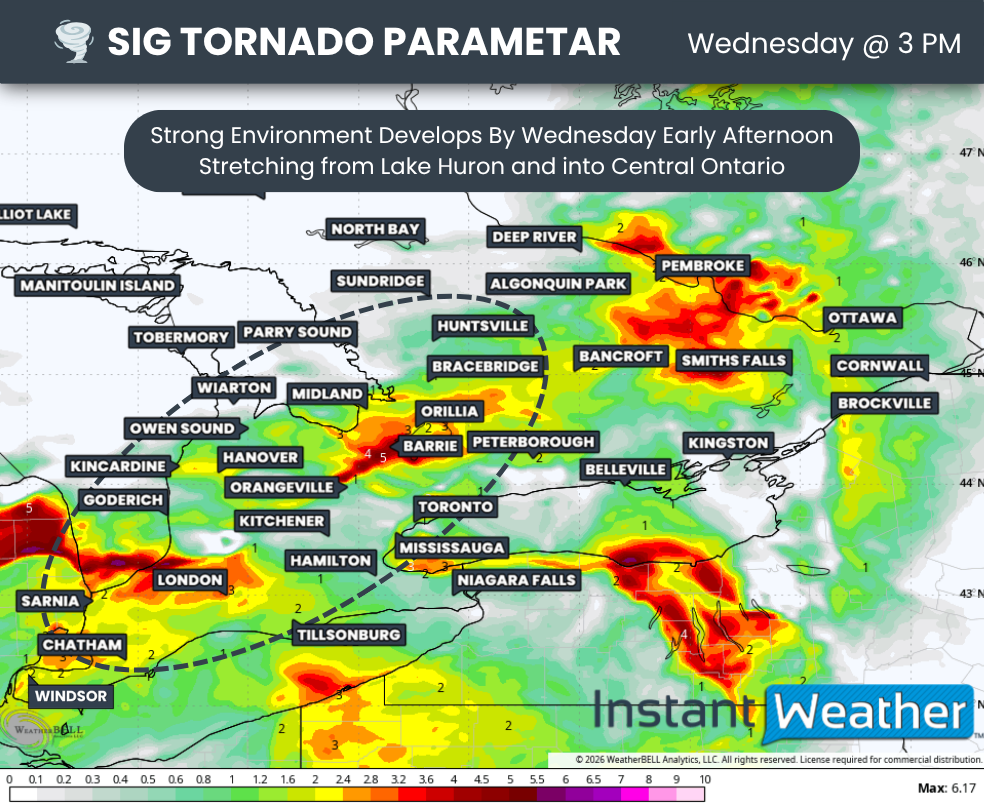
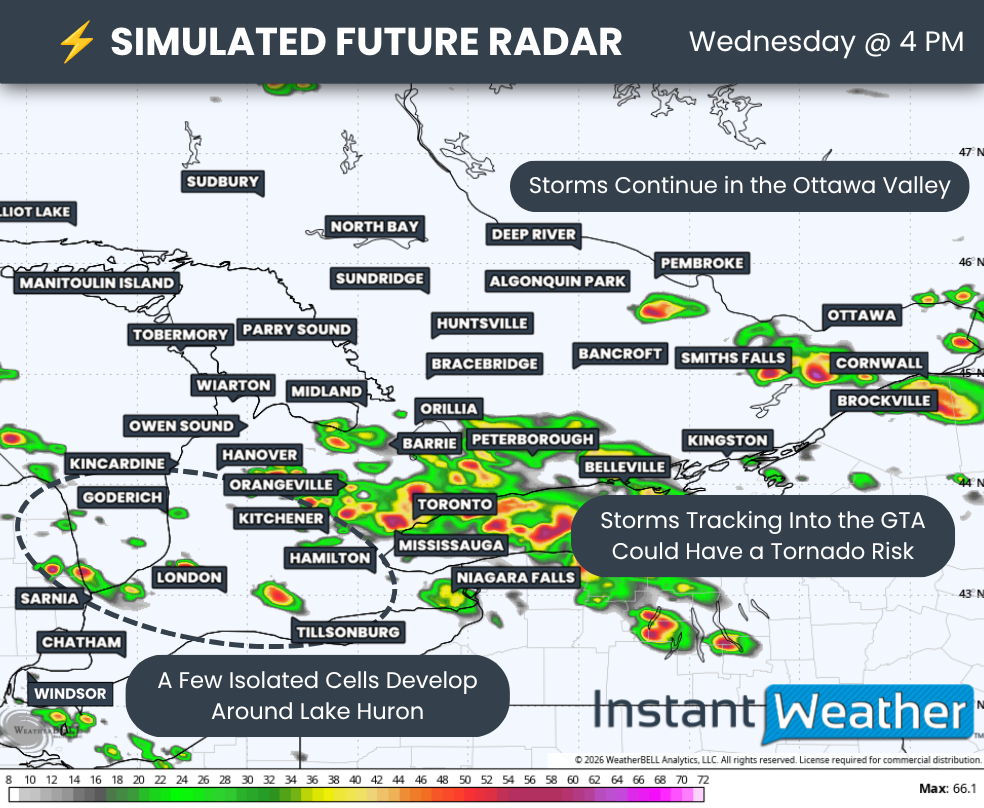
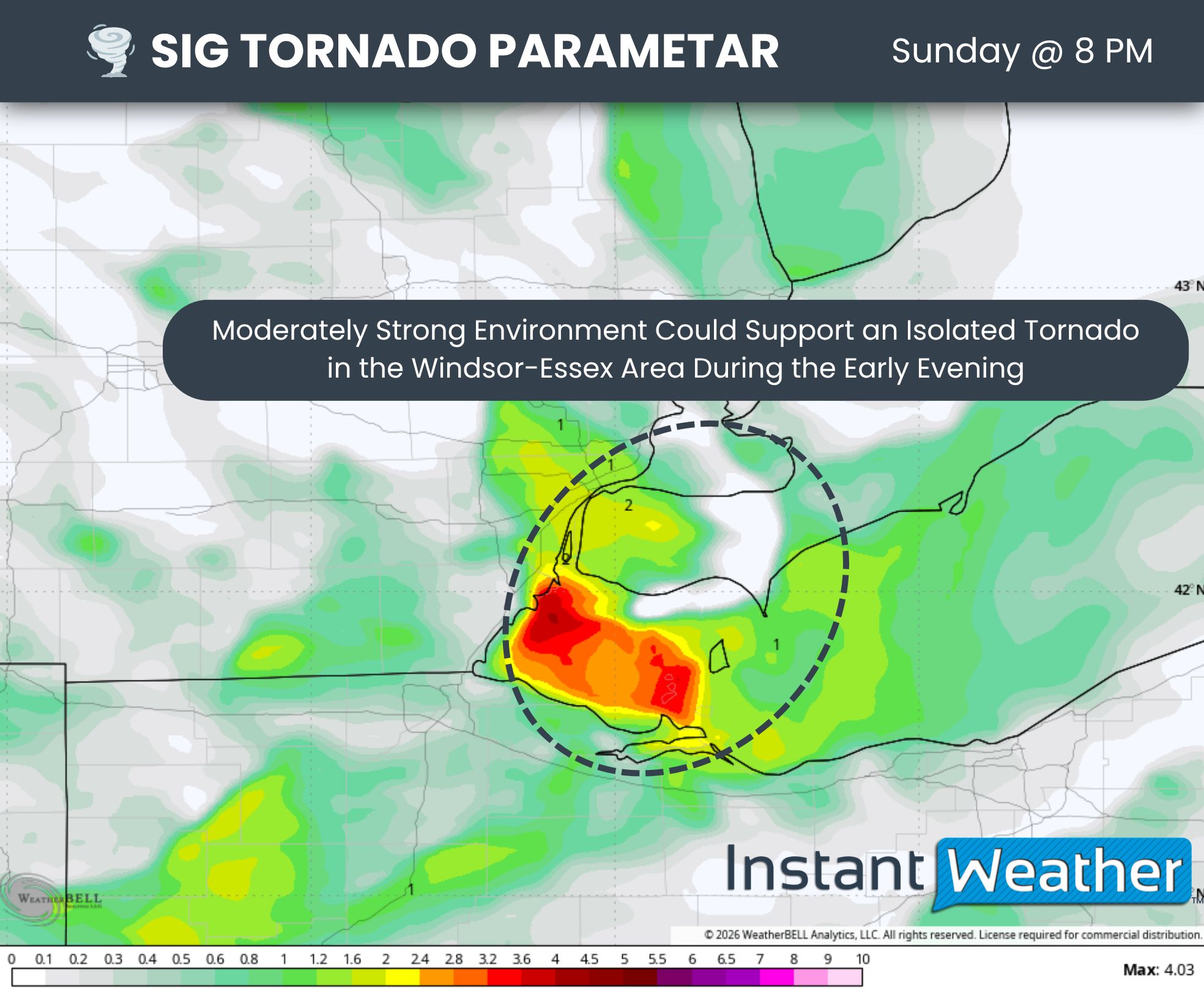
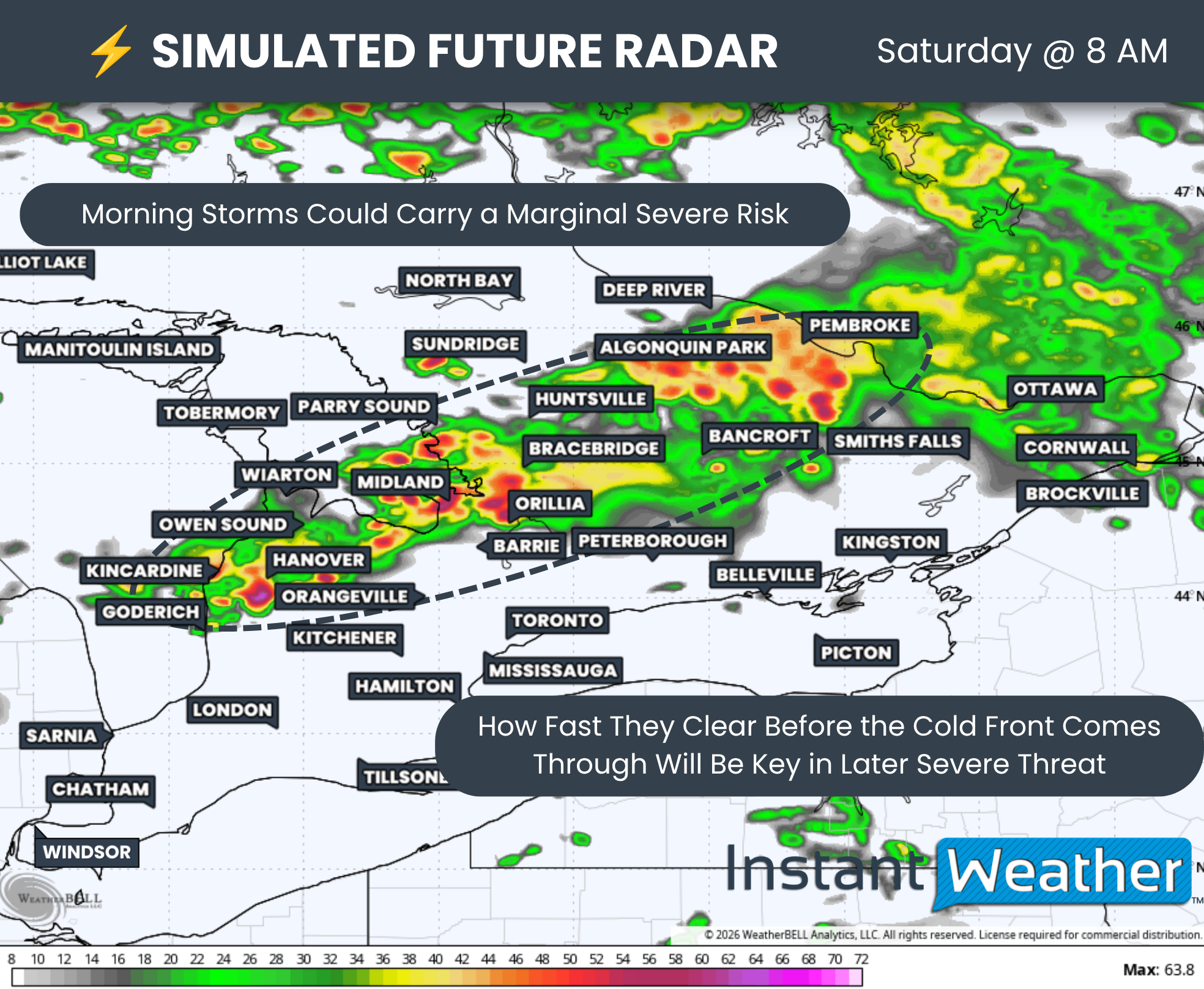
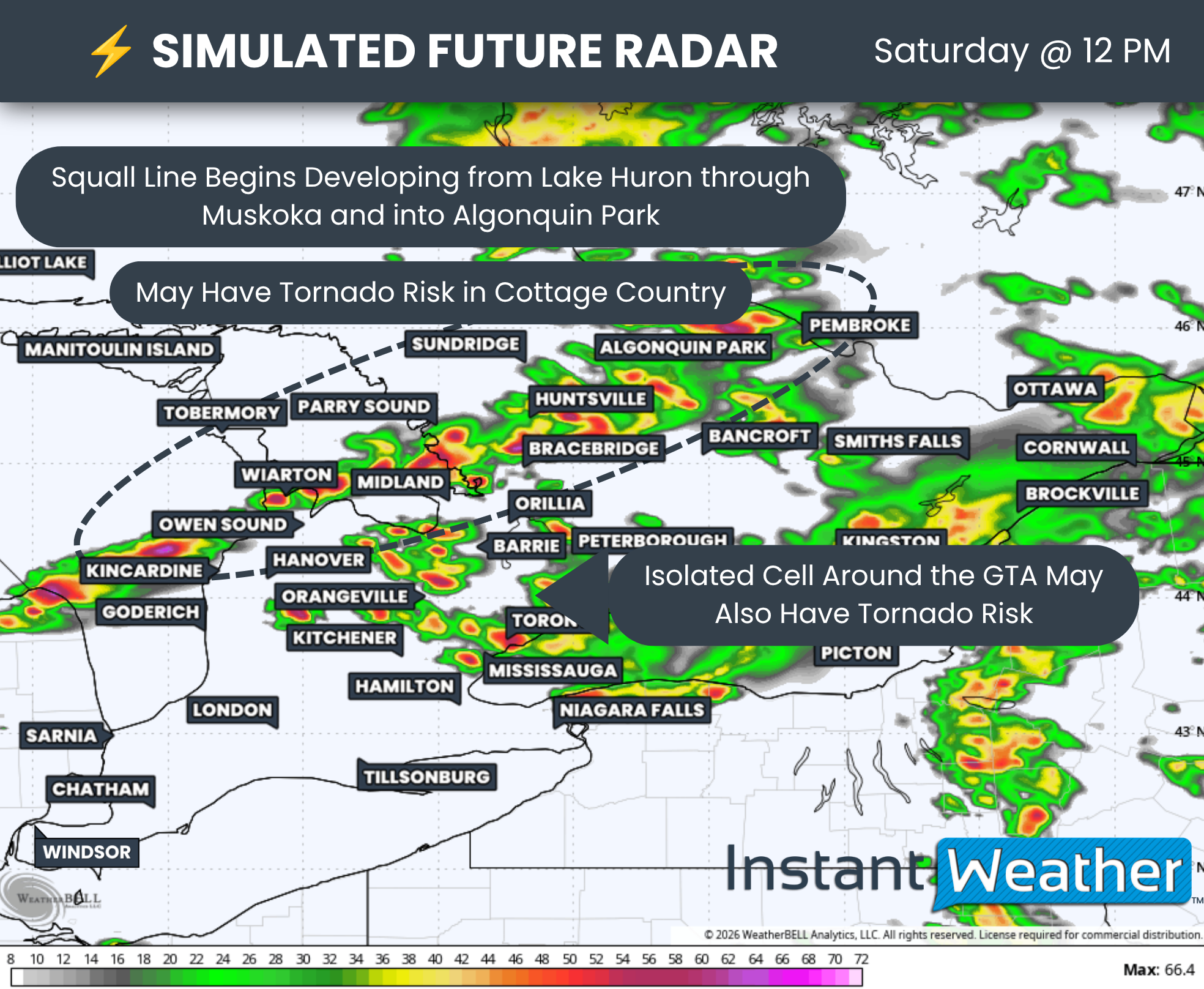
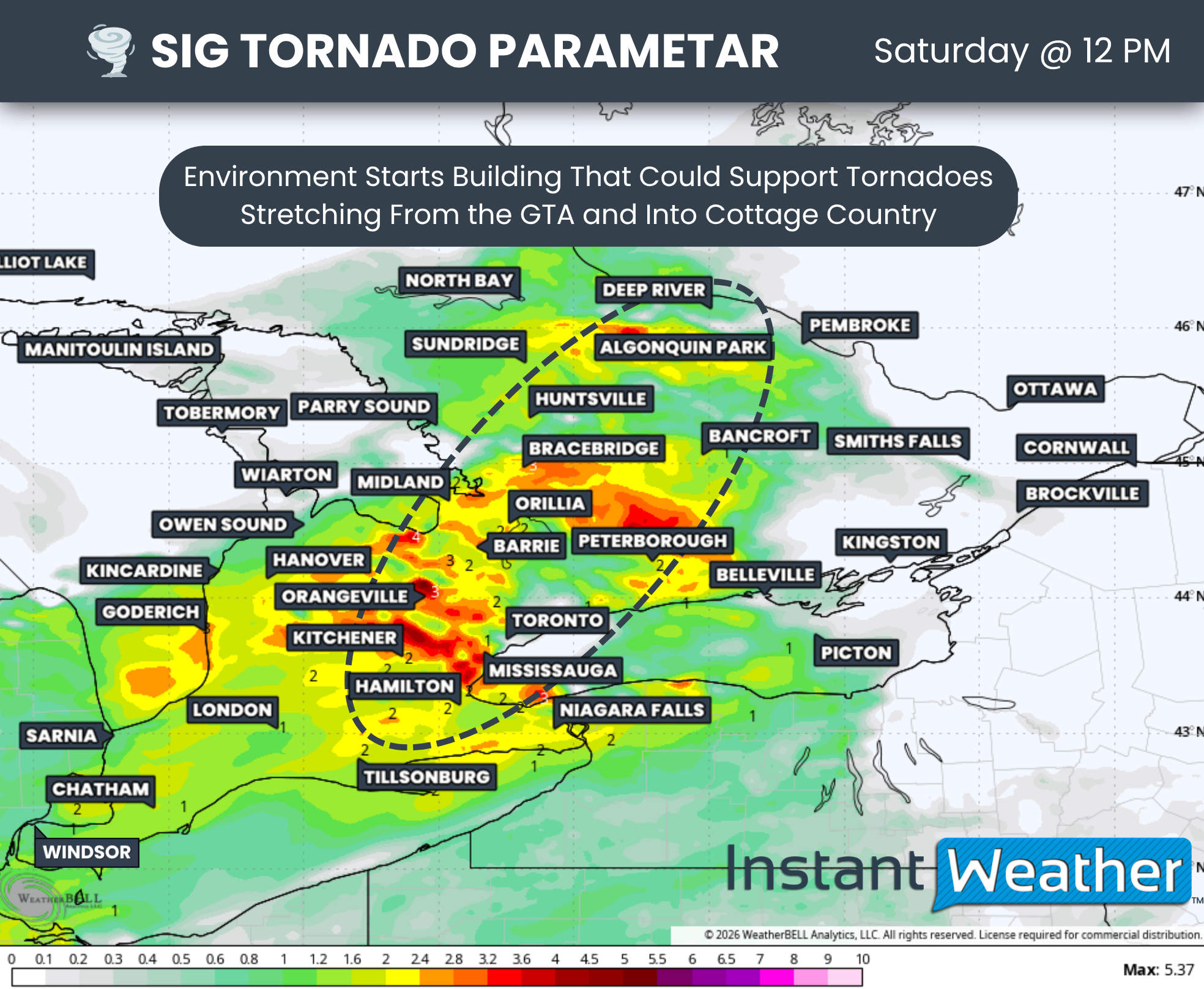
While Wednesday’s risk was mainly focused on damaging wind gusts, Thursday could feature a more defined tornado risk, with one or two tornadoes possible. The focus of this tornado risk appears to be in Southwestern Ontario near the Lake Huron shoreline, along with parts of Eastern Ontario, including the Ottawa Valley.

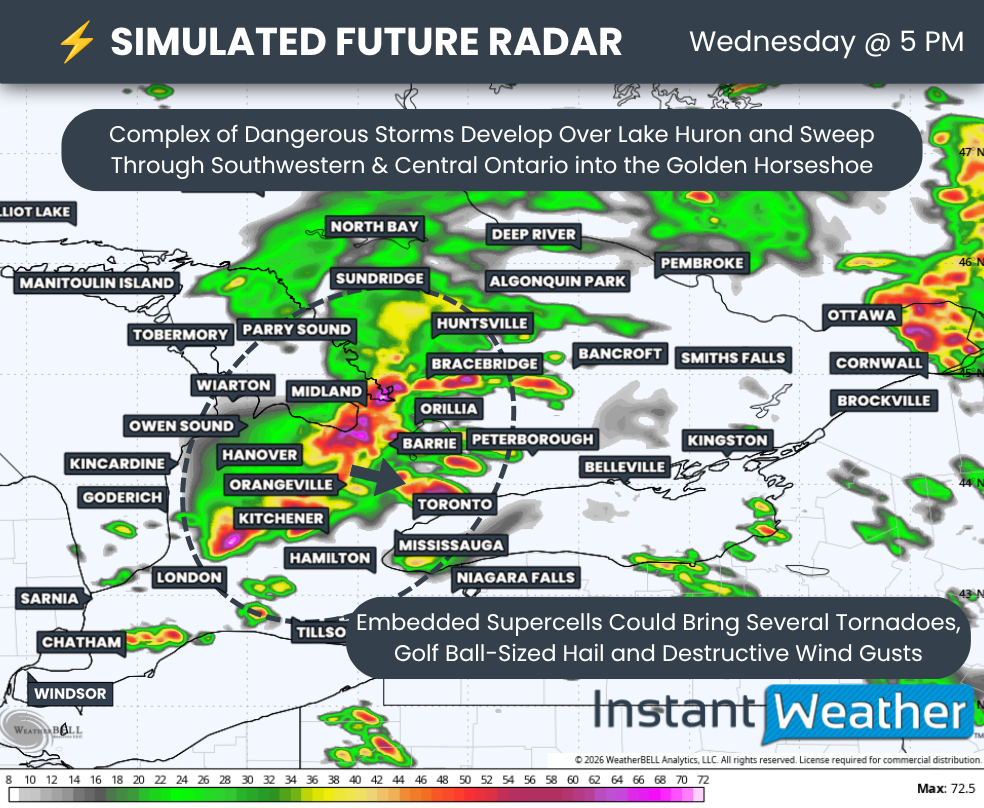
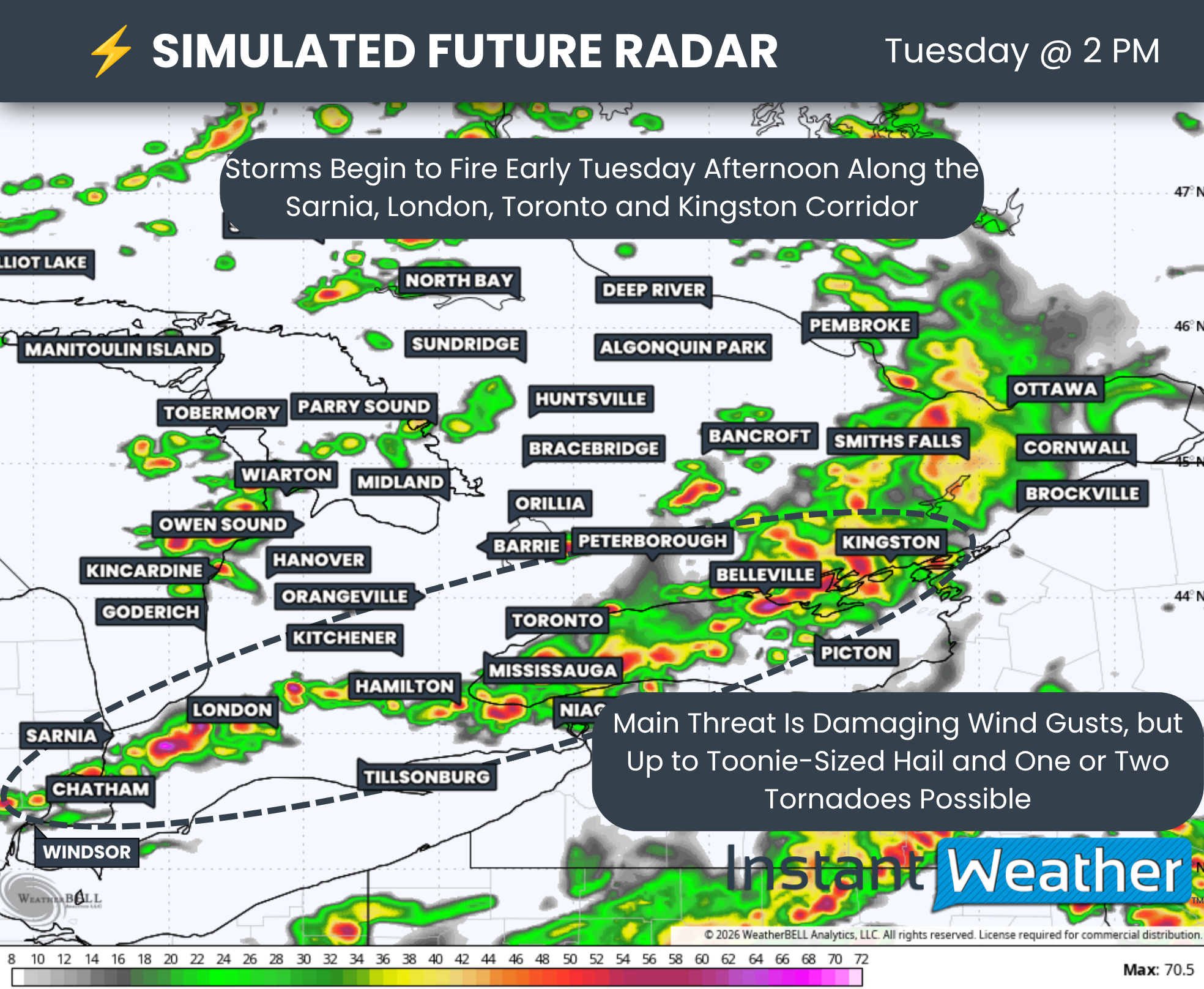
The damaging wind gust threat also remains very present. Similar linear-like storms could sweep through a corridor from Lake Huron into the GTA, and then toward the Lake Simcoe, Peterborough and Kingston areas.

Up to Timbit-sized hail is also possible, especially across Eastern Ontario, along the Lake Huron shoreline and around the London area. In these regions, a more isolated storm mode could support a few supercell thunderstorms.

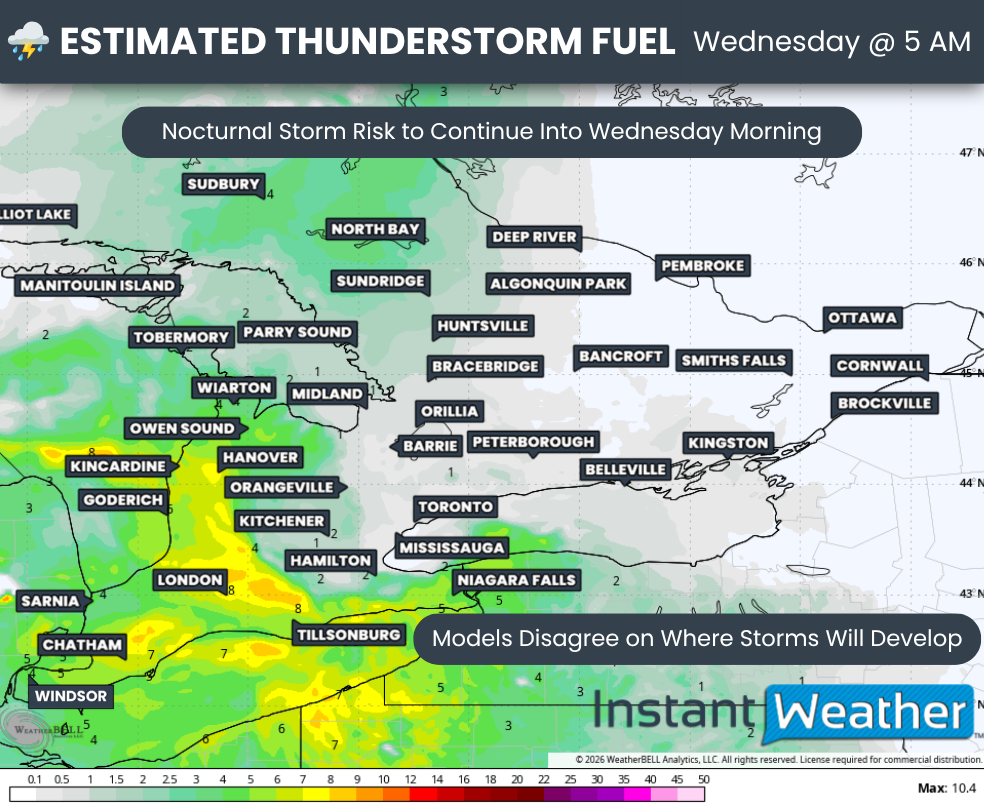
Once again, models are struggling to pinpoint exactly when and where storm development will happen. They tend to perform poorly in these types of dynamic setups, especially when storms are triggered by smaller-scale features such as lake breezes and outflow boundaries from other storms.

What we do know is where the strongest environment is located, along with a rough idea of where models are most likely to develop storms.

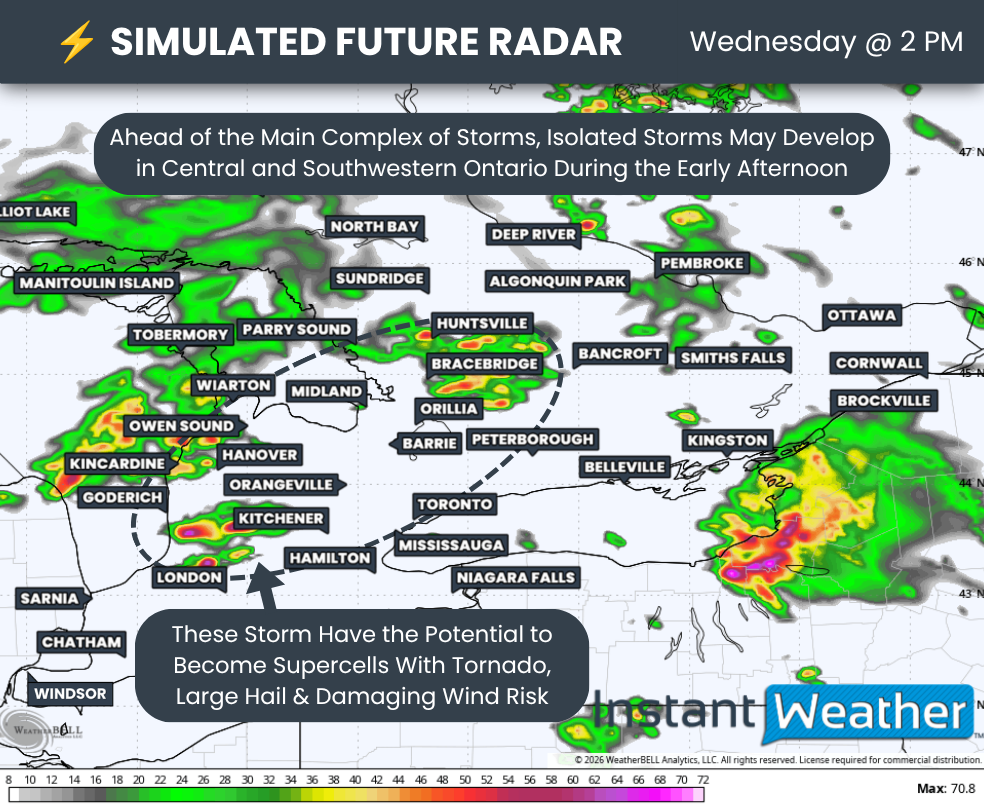
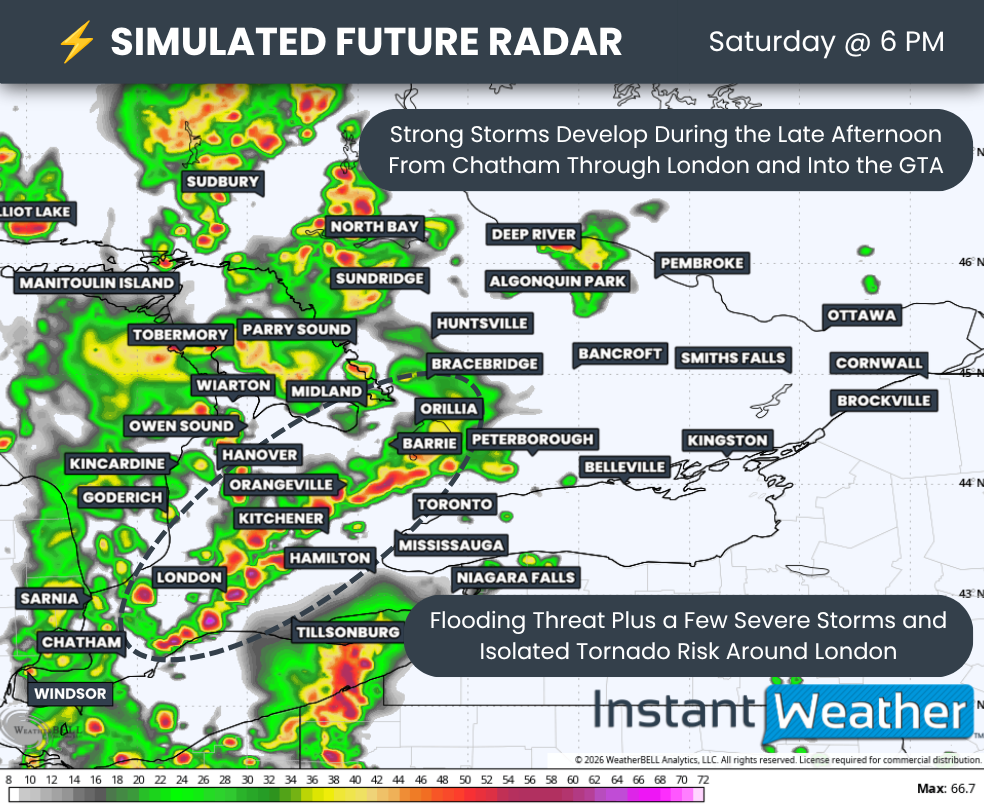
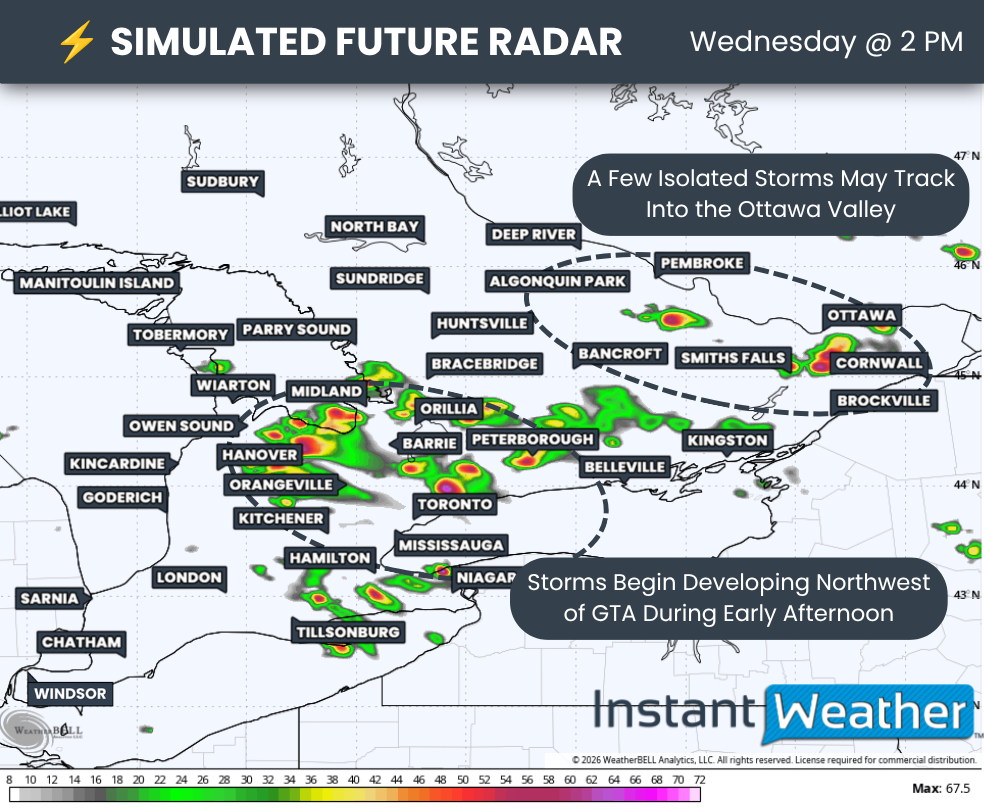
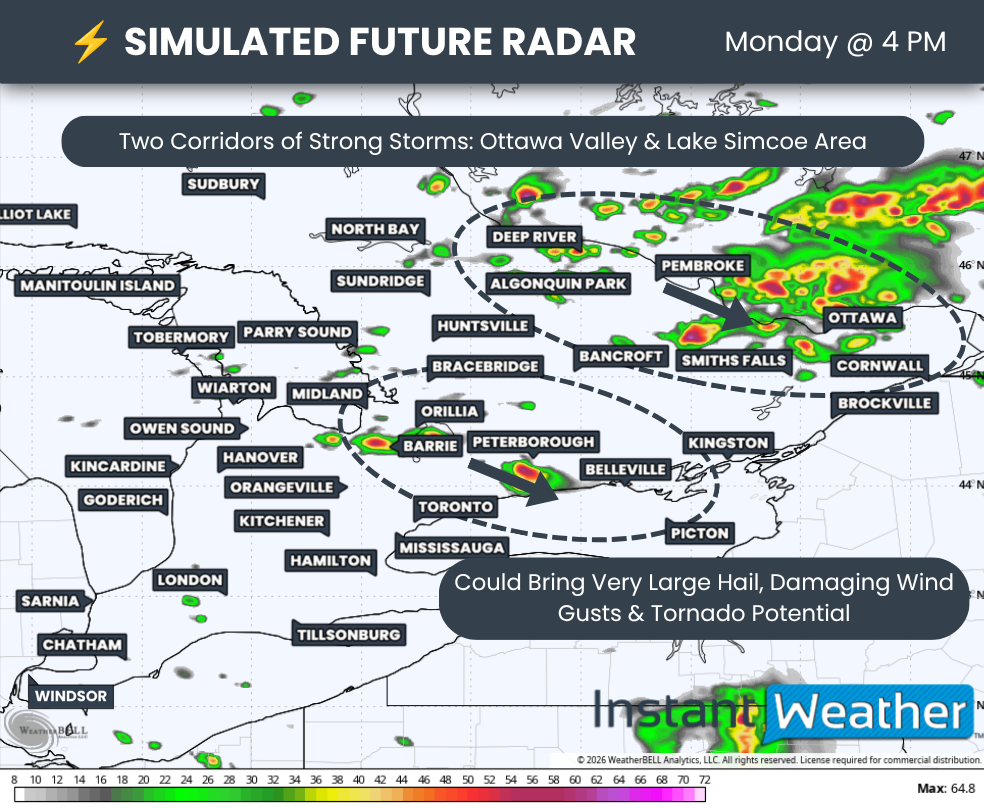
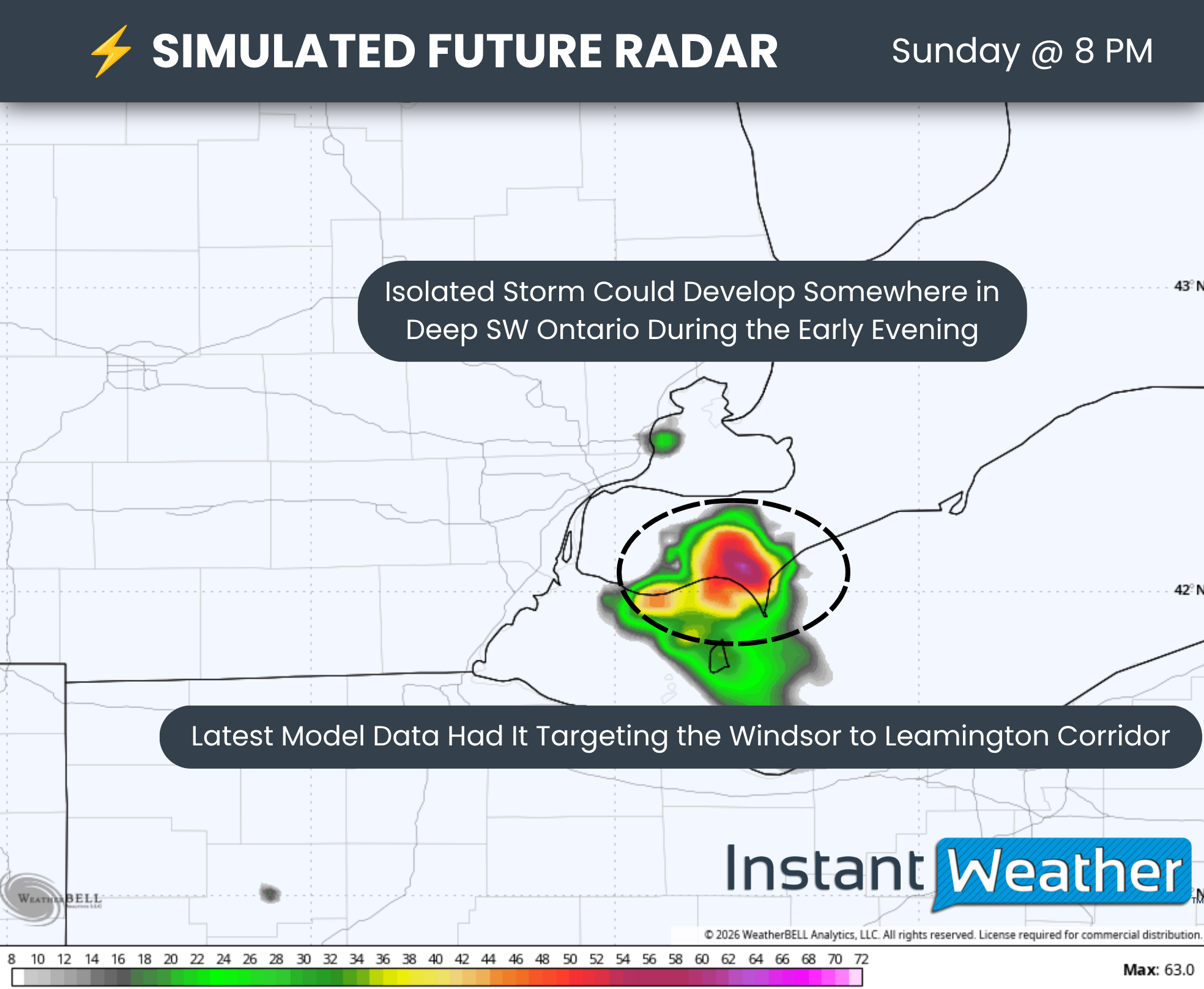
That begins during the afternoon, when we could see isolated cells develop from the Lake Simcoe area down toward Kingston. These storms could support a tornado risk, which is why this corridor is also highlighted on our map for tornado potential.

However, confidence is lower in this area. Not every model shows storm development, so this part of the forecast will depend heavily on whether the right triggers are in place.

Another zone of possible storm development can be found across the Ottawa Valley and Eastern Ontario during the evening. A strong shear environment could support rotation if storms are able to develop.

Similar to the afternoon Lake Simcoe risk, confidence is lower here because not all models show storm development. The threat will depend on whether storms can actually form and take advantage of the environment.

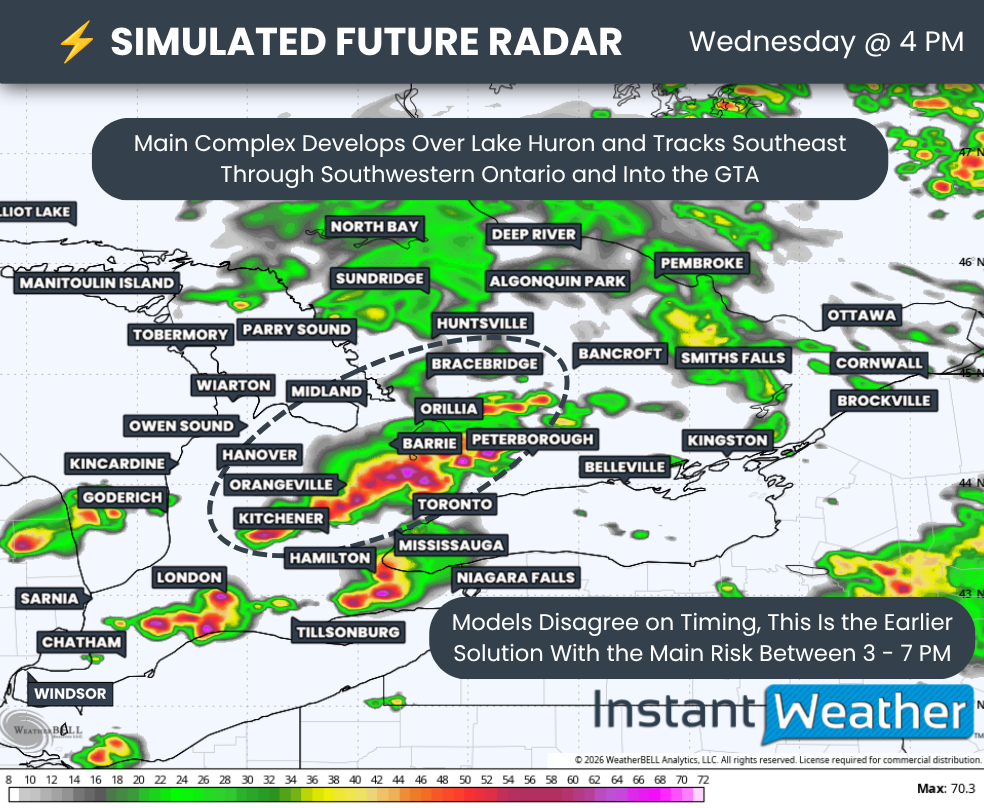
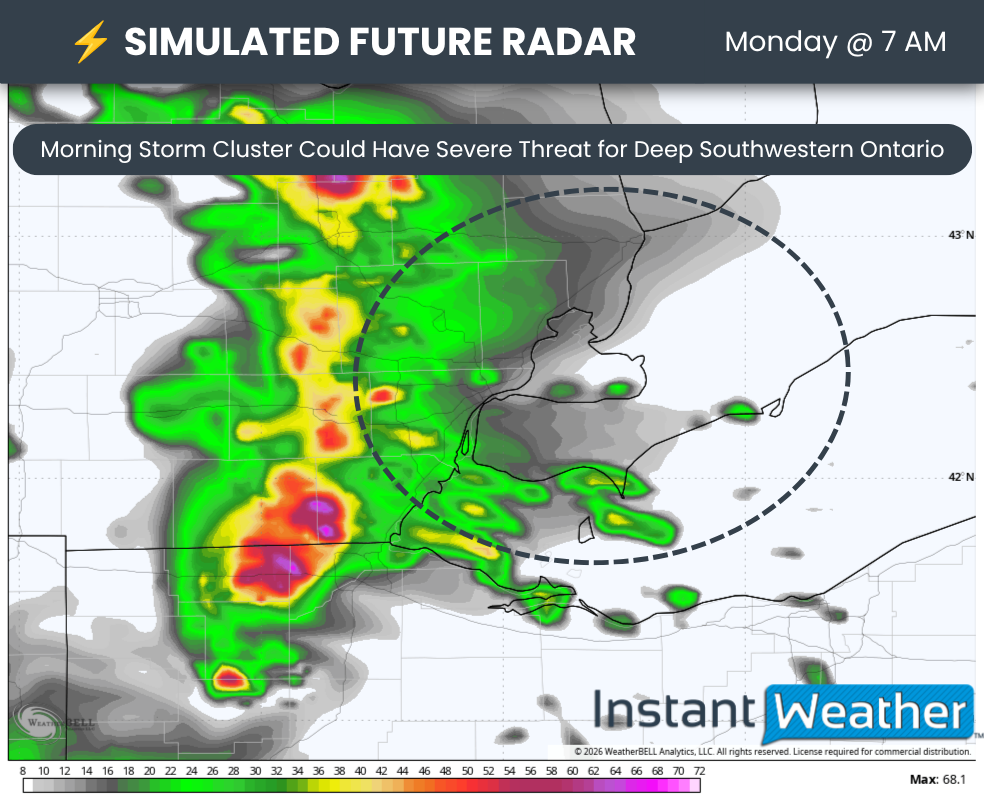
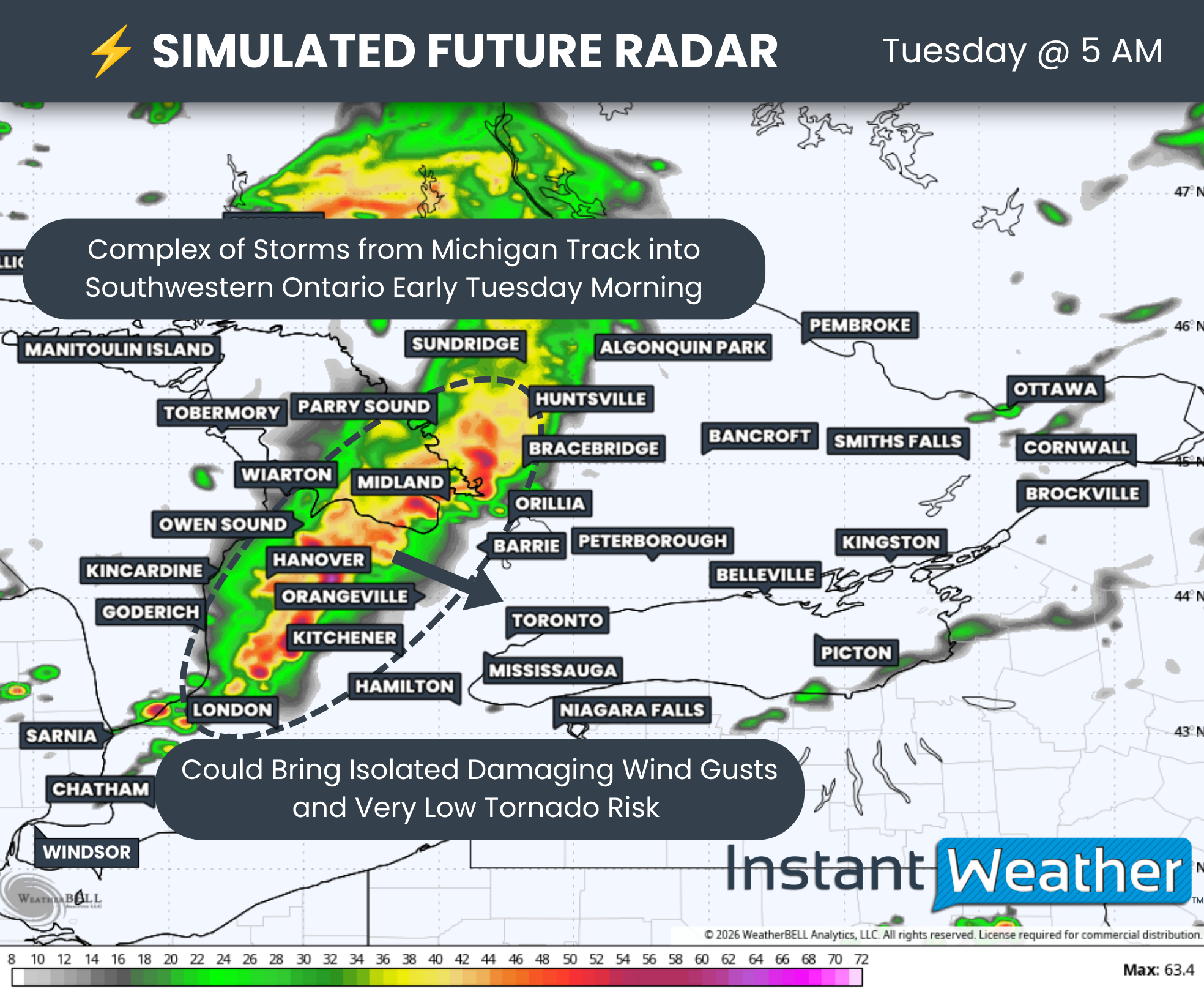
The Lake Huron storms may eventually merge into a larger complex and bring a potential late-night damaging wind gust risk through the GTA and Niagara region.

There is still some question about how long this complex would be able to maintain its strength, especially once we lose daytime heating. However, if it holds together, damaging wind gusts could once again become a concern.

NOTE: YOU CAN CLICK ON THE GRAPHIC TO OPEN A ZOOMABLE IMAGE

THIS FORECAST IS SPONSORED BY:


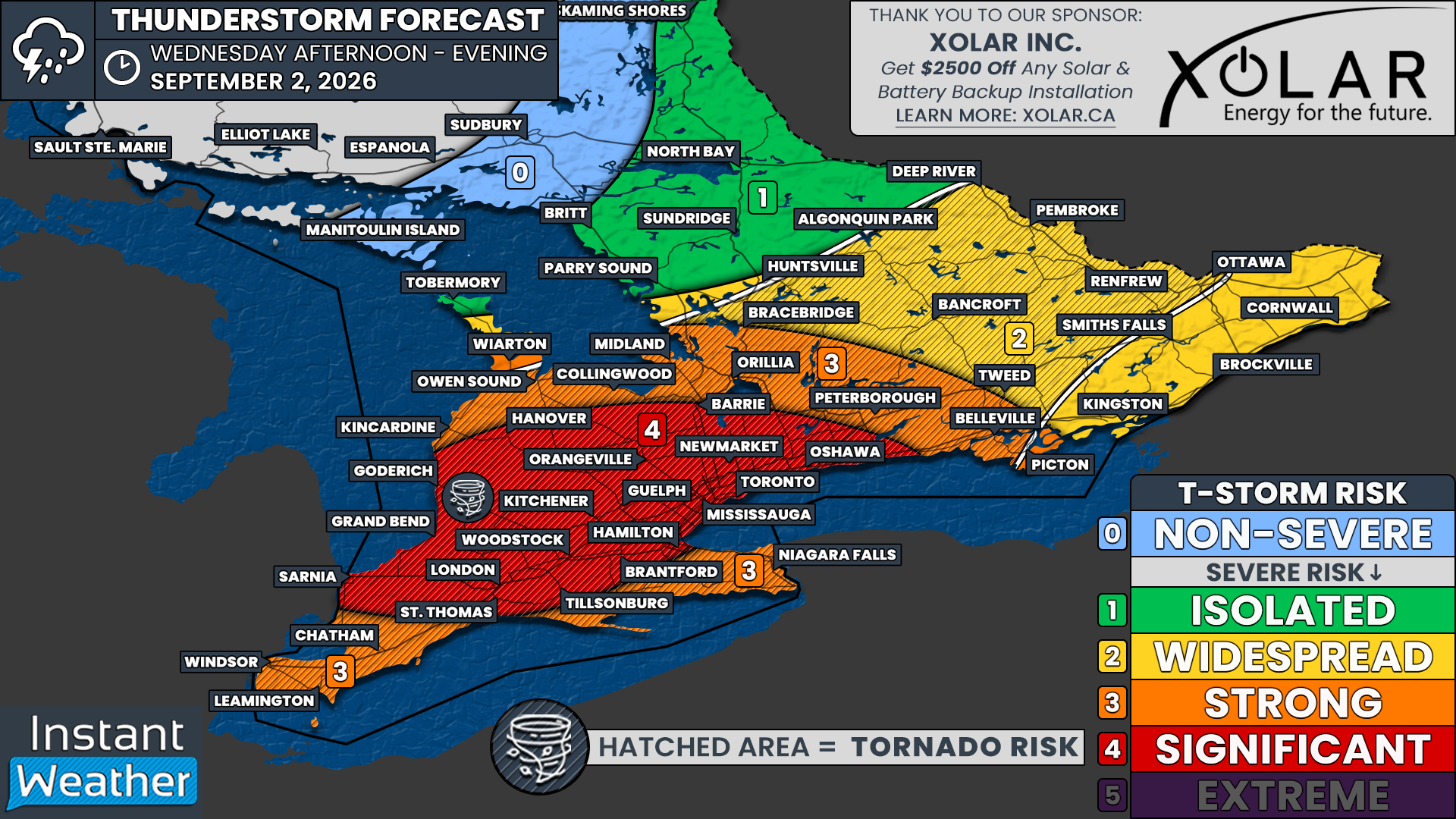
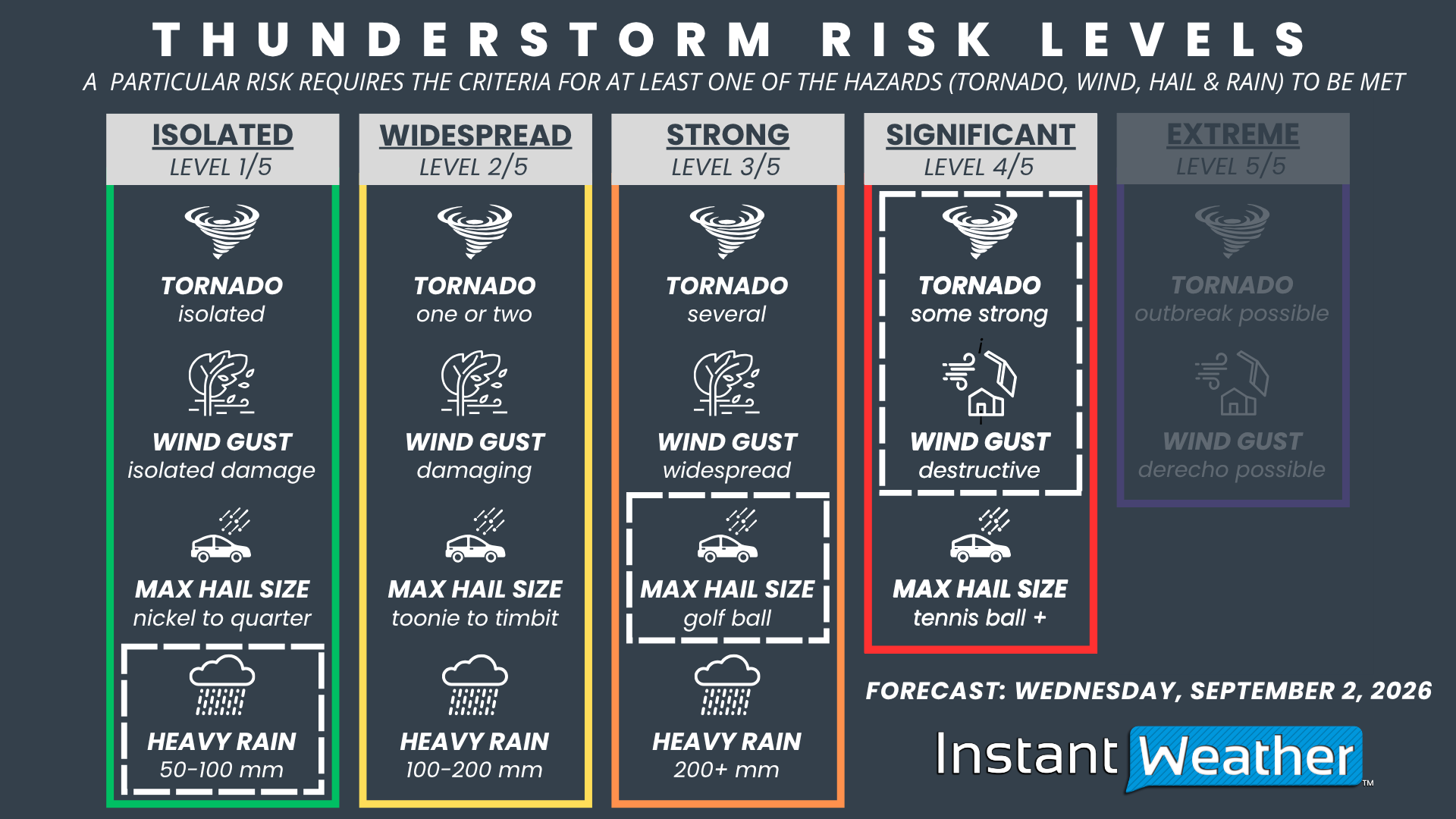
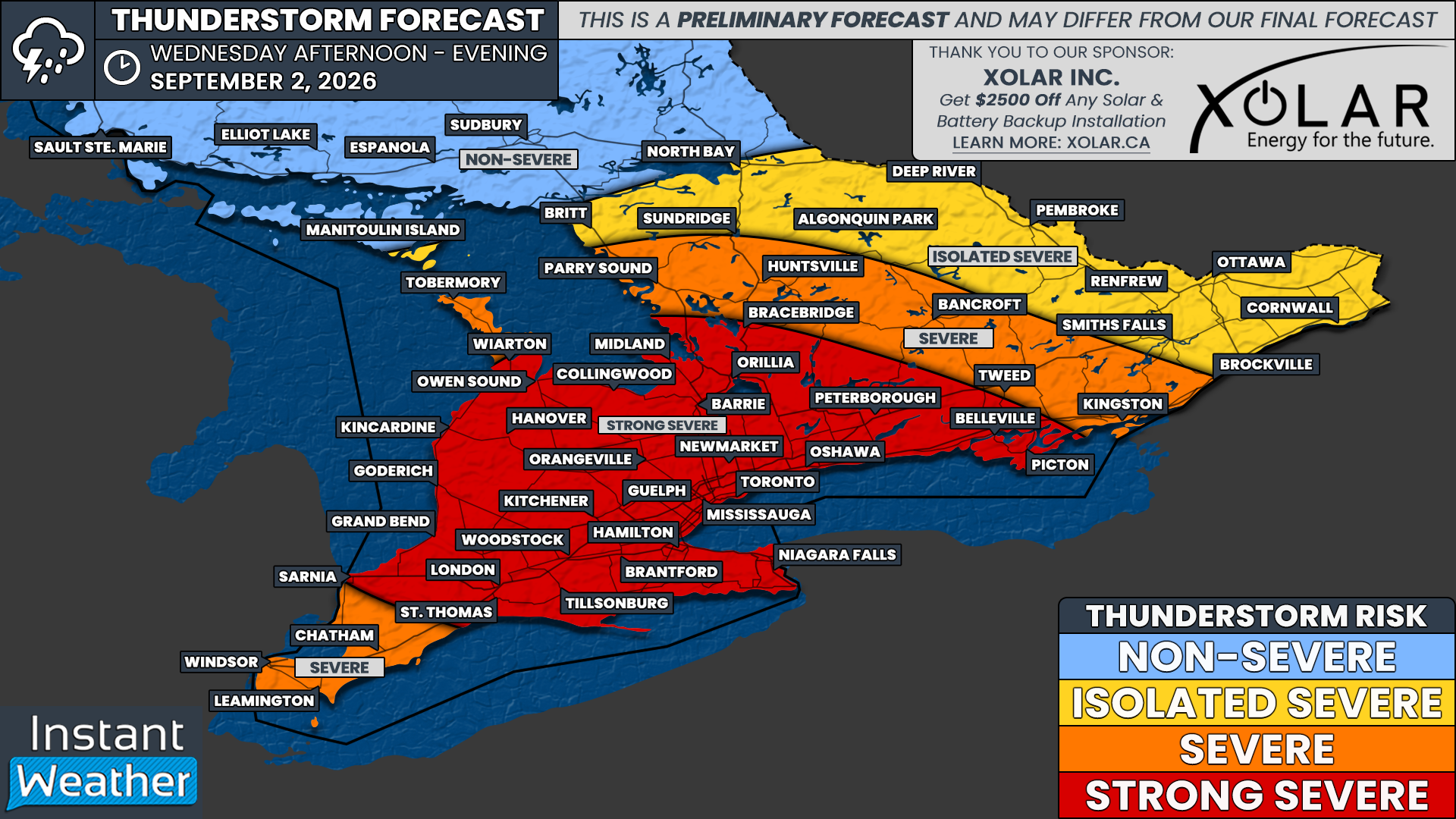
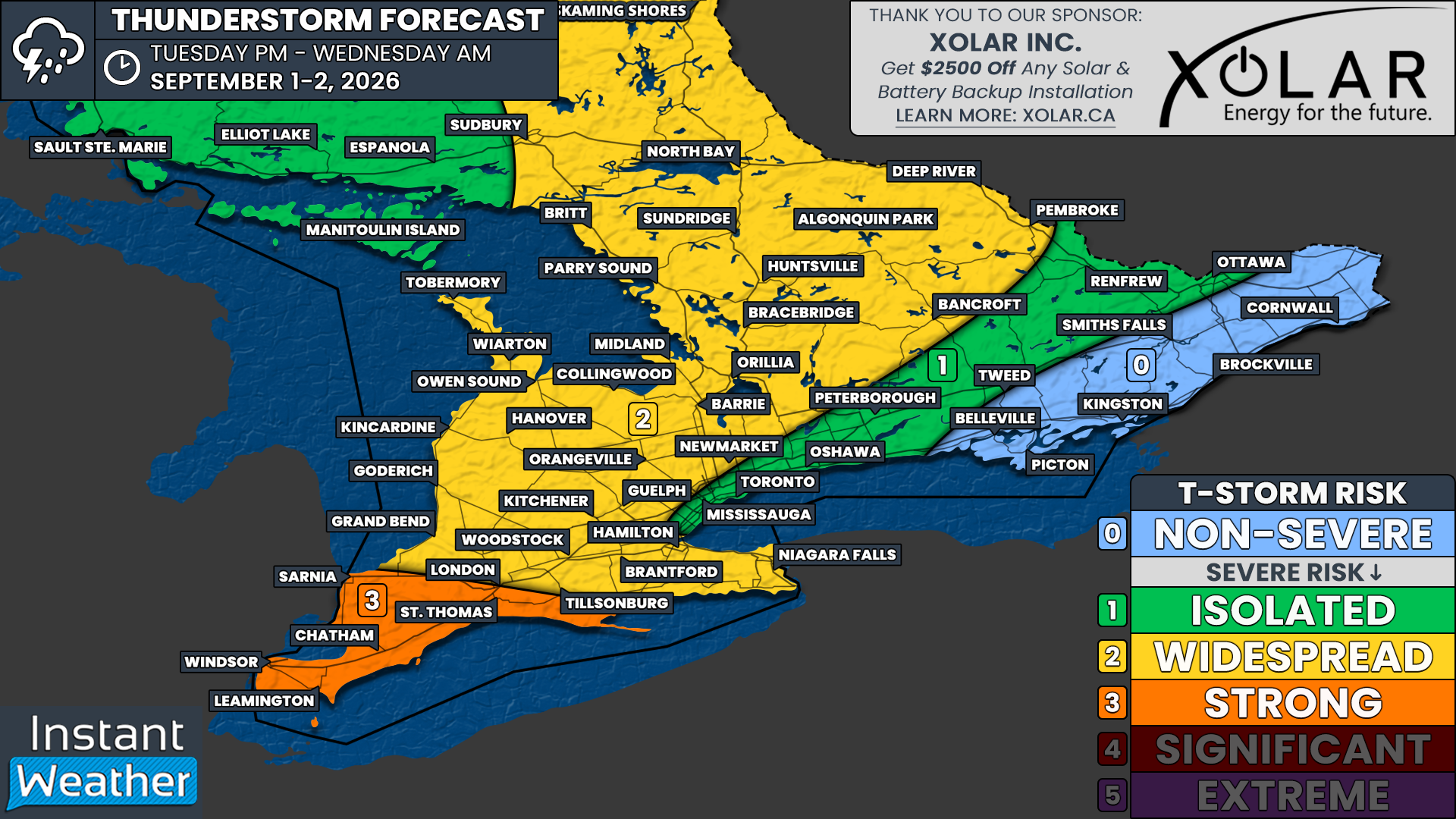
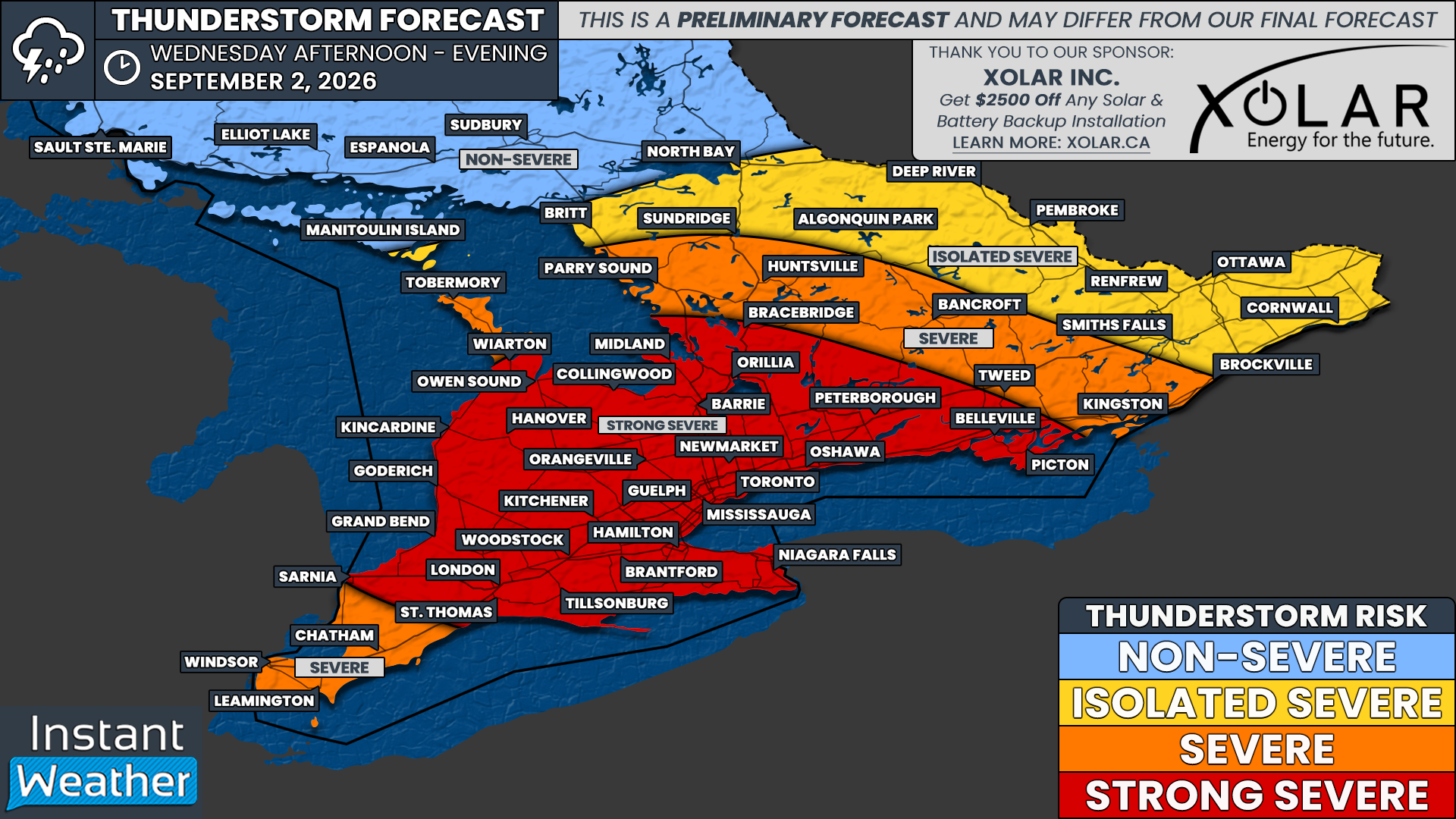
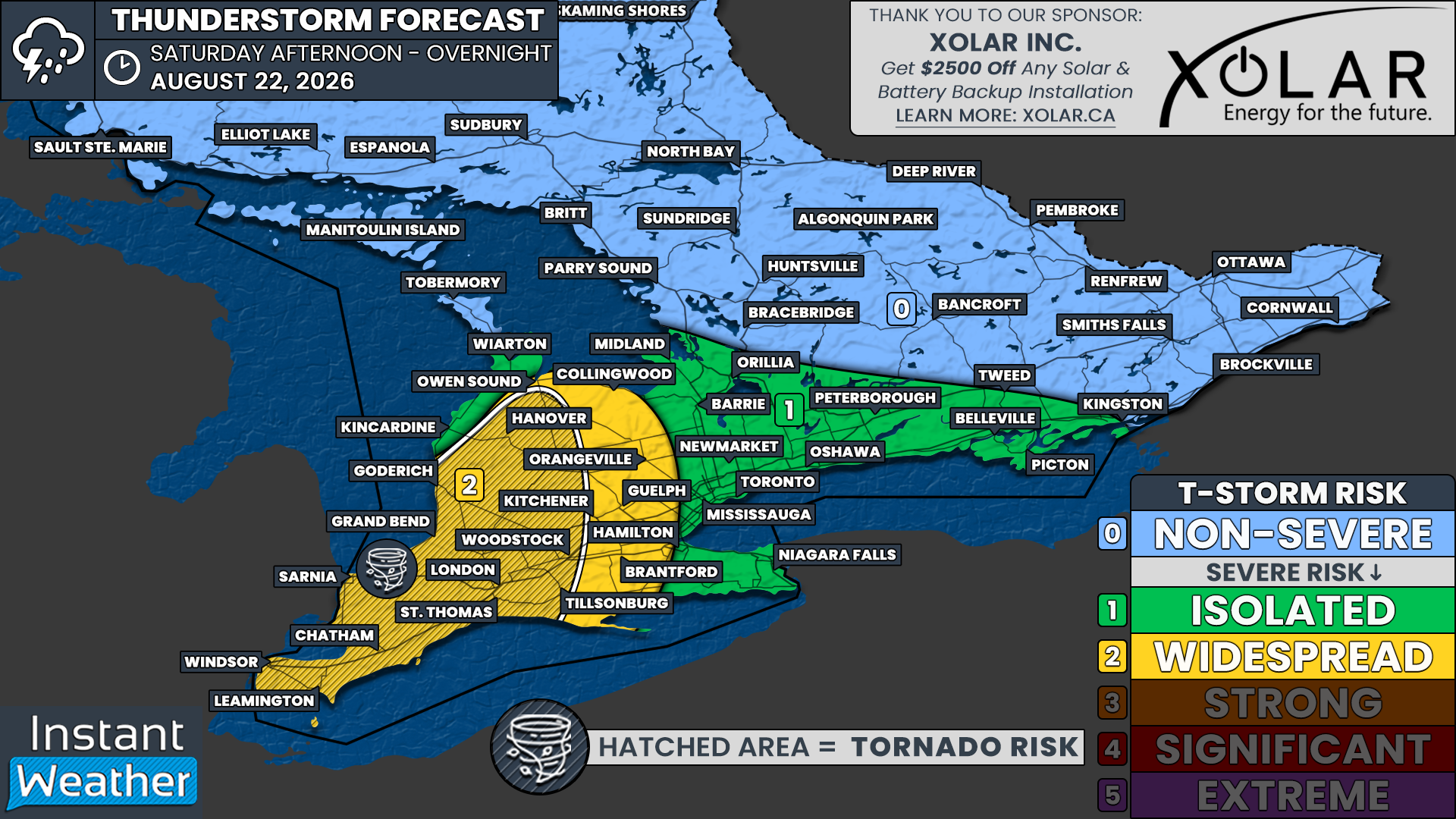
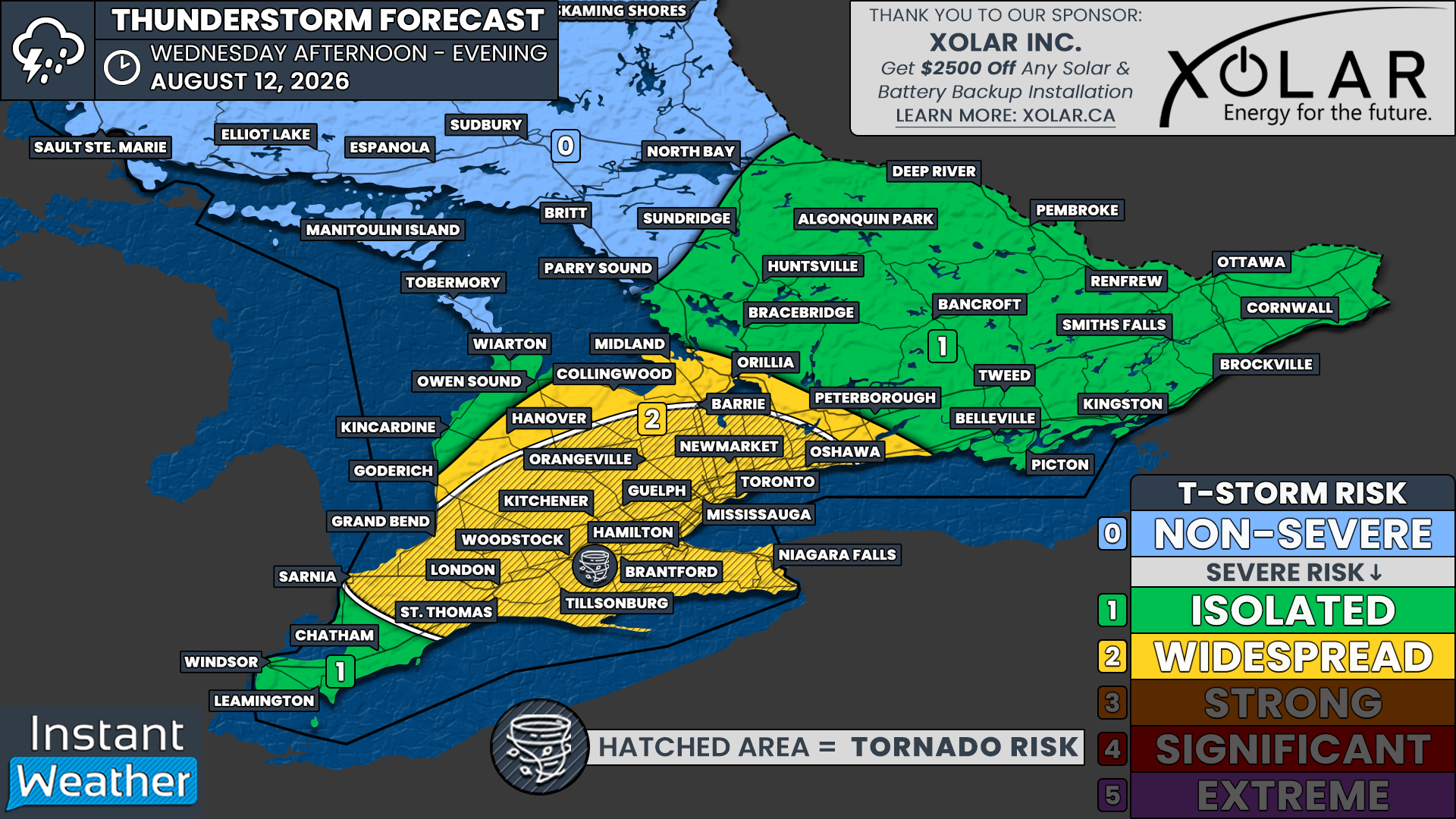
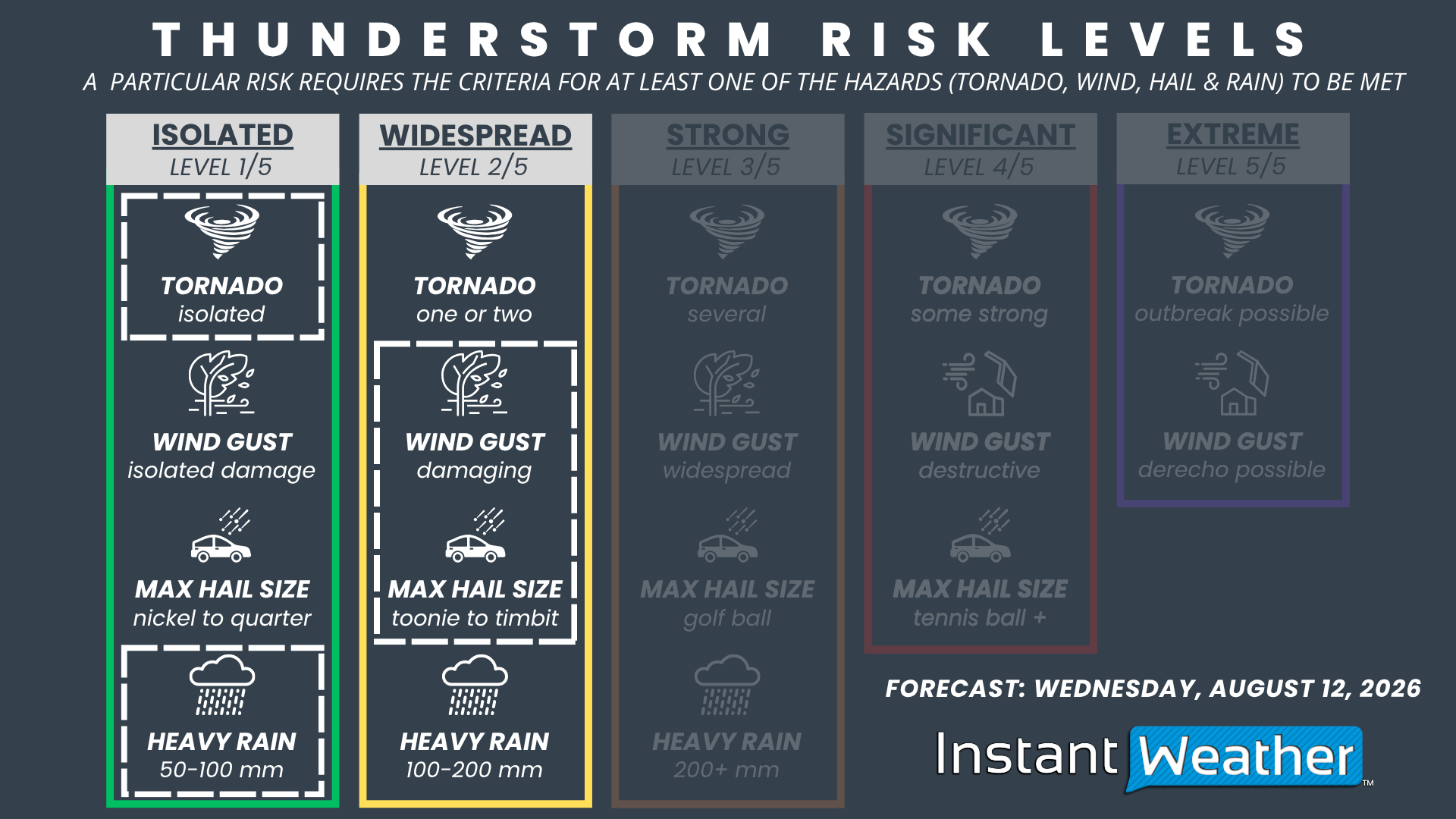
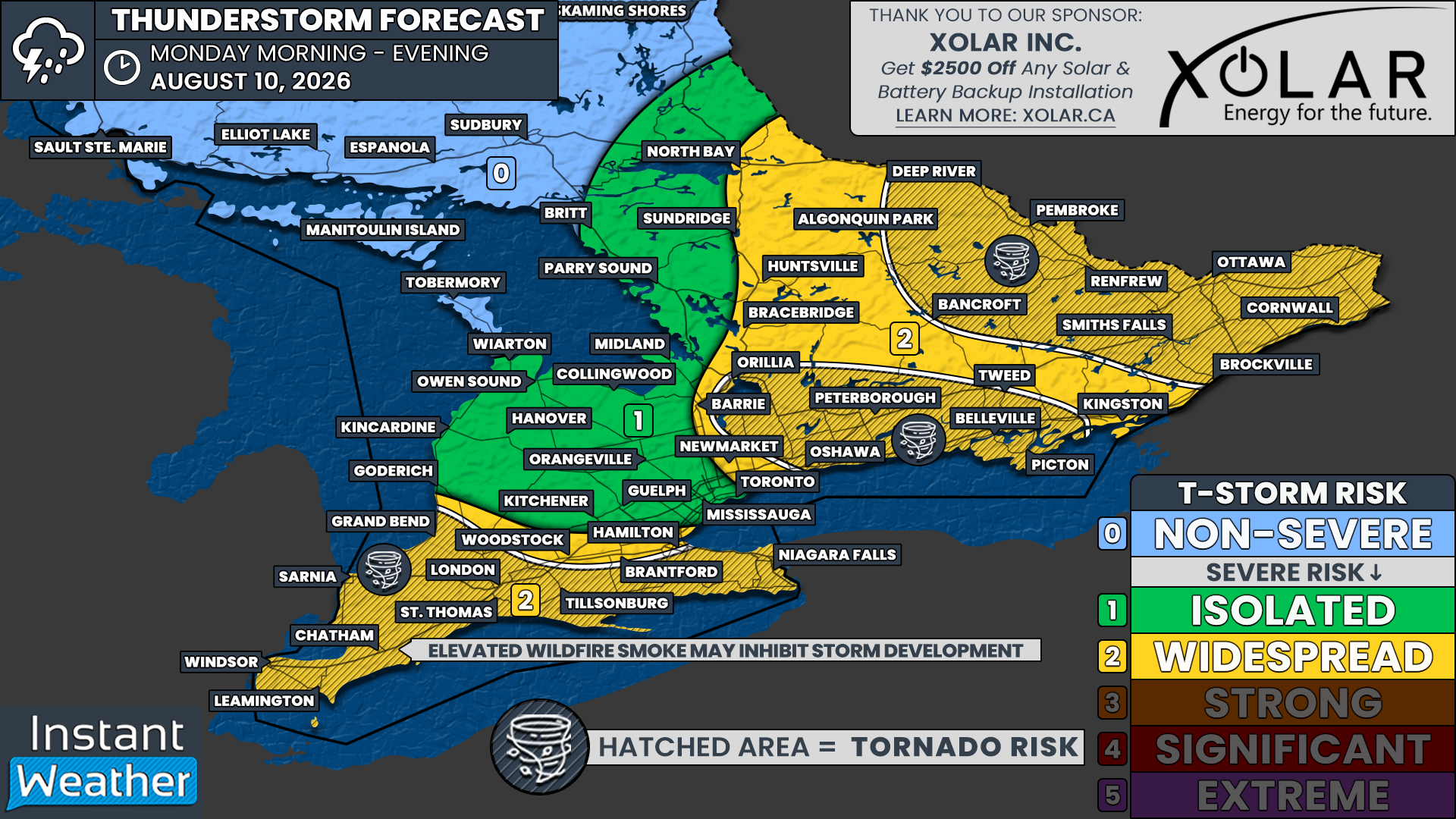
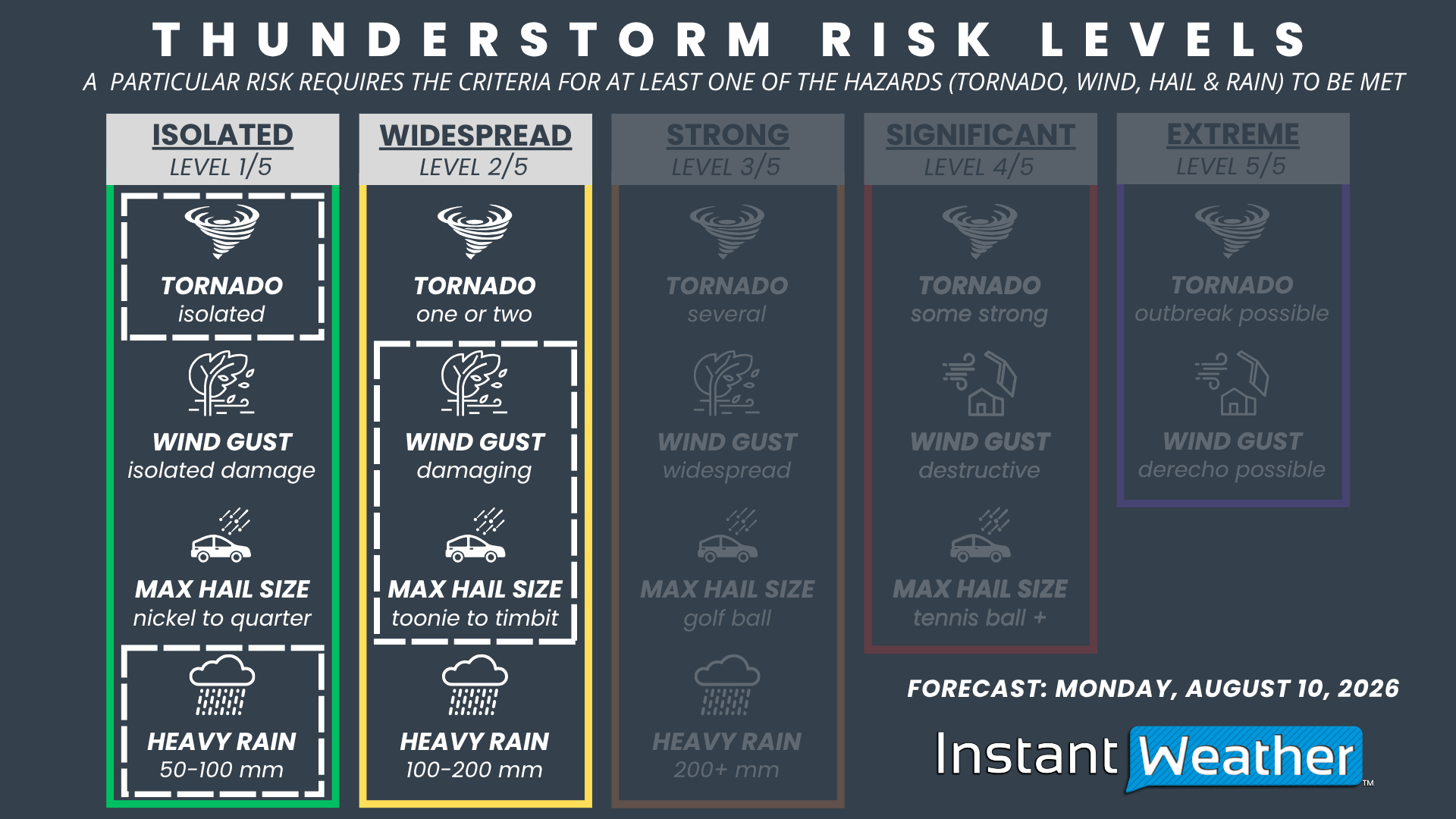
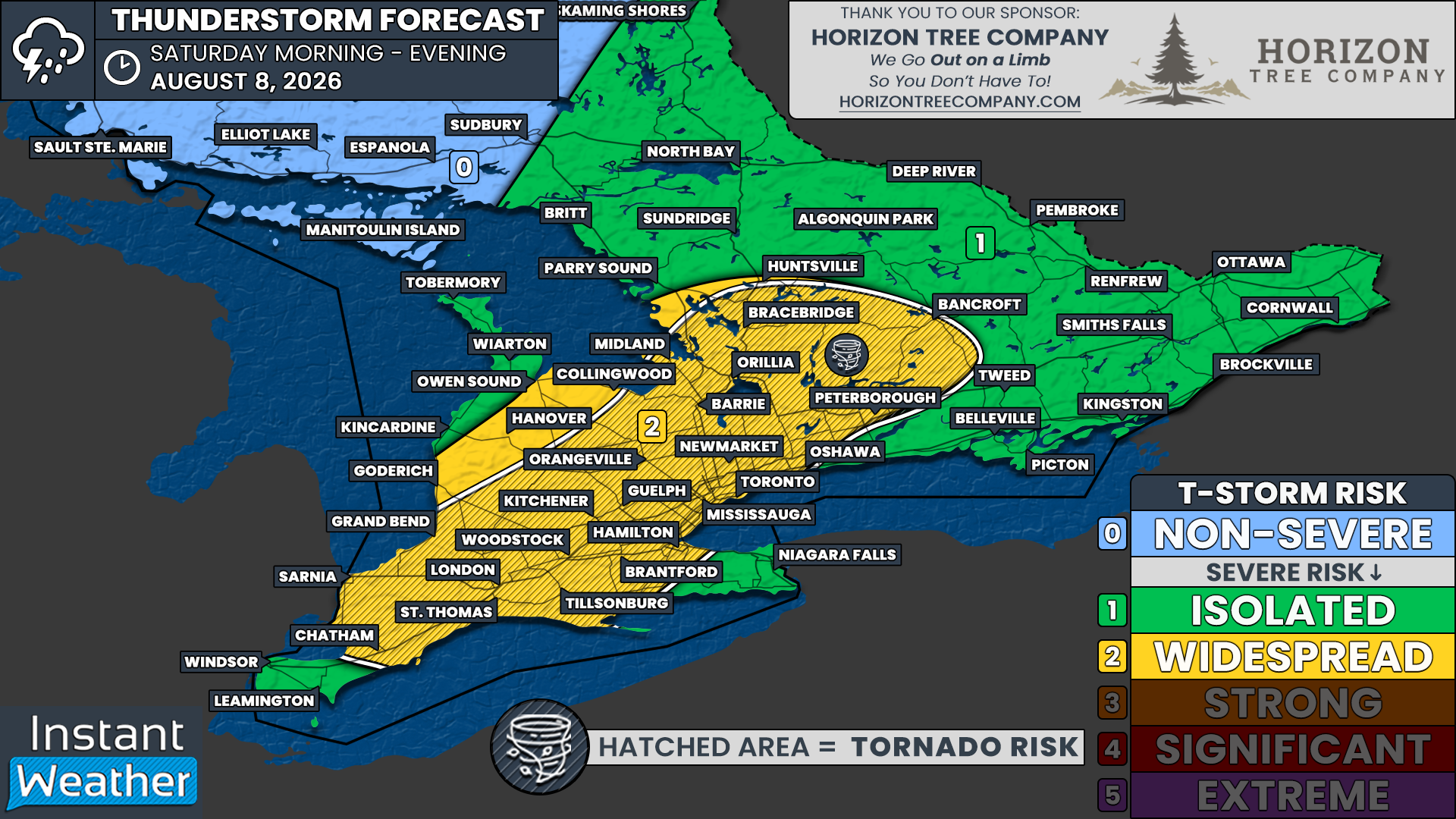
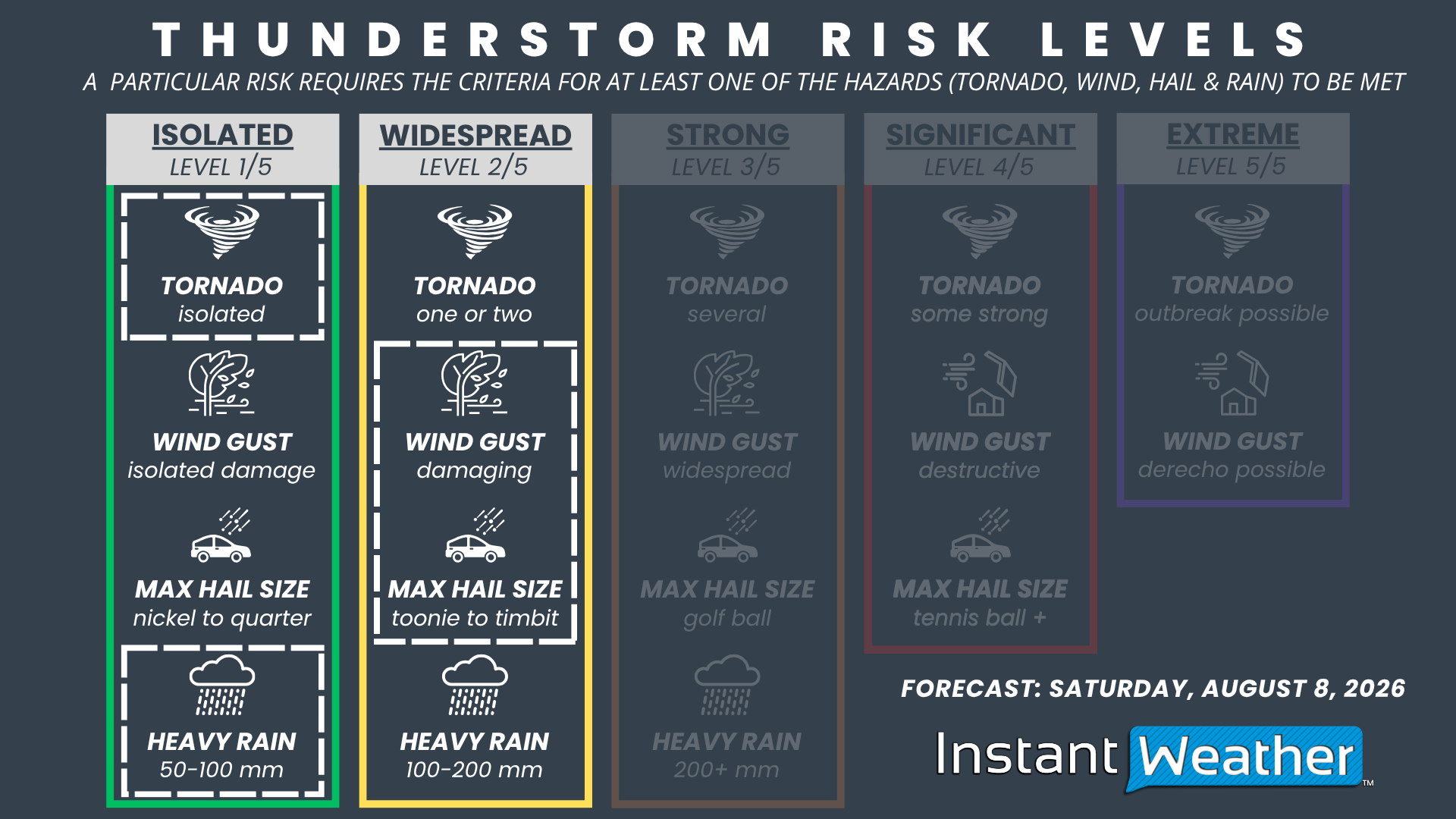
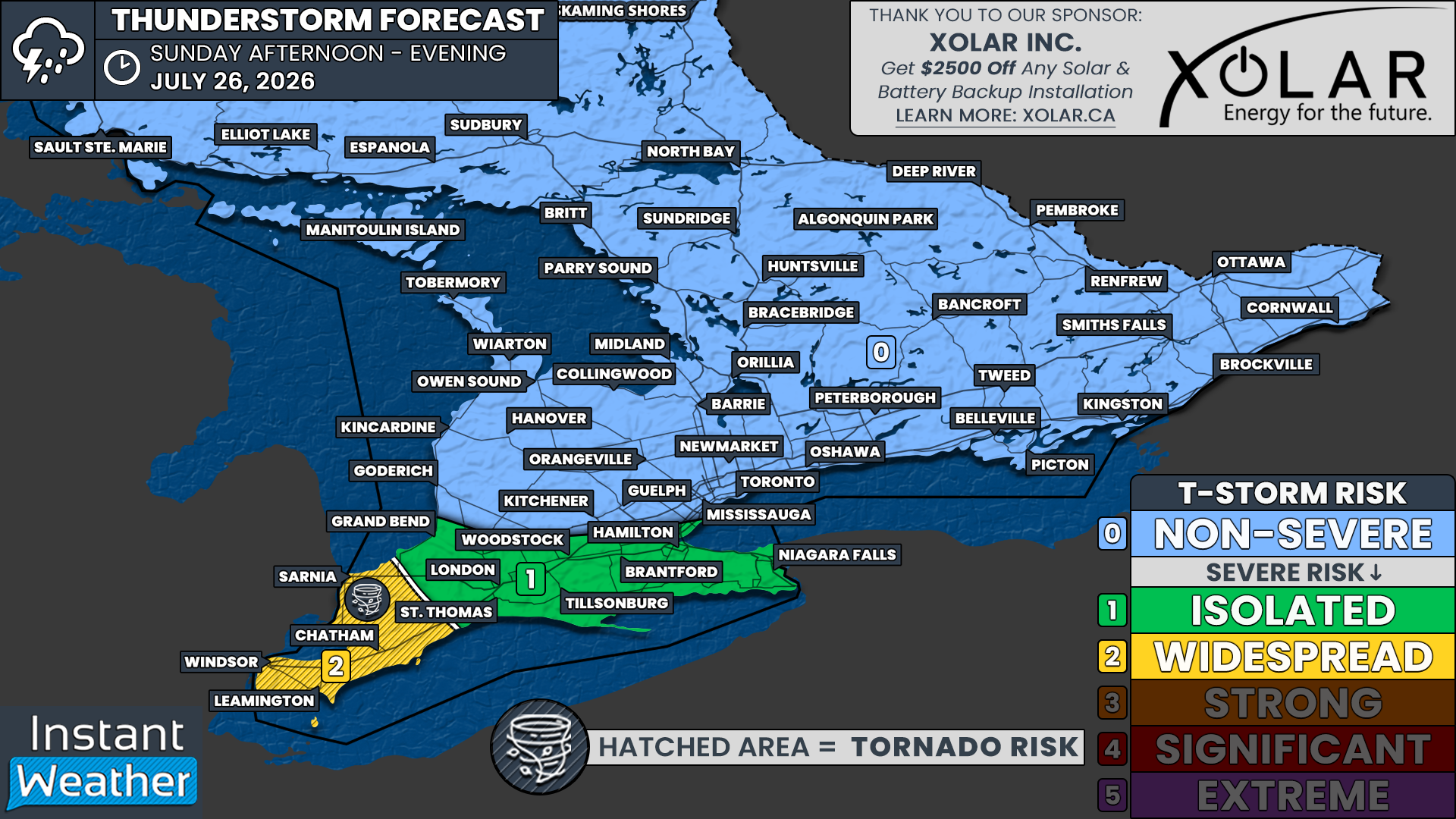
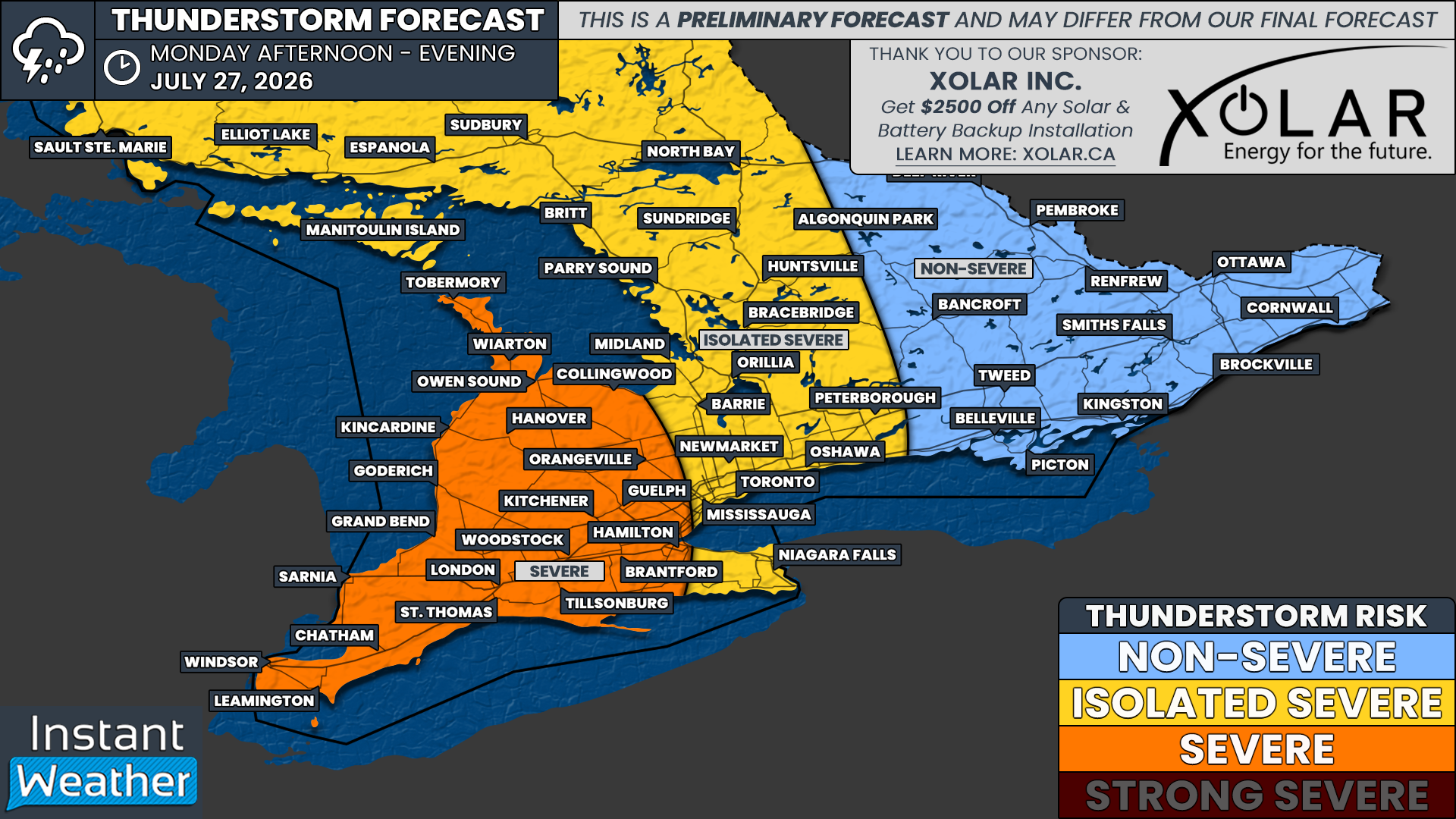
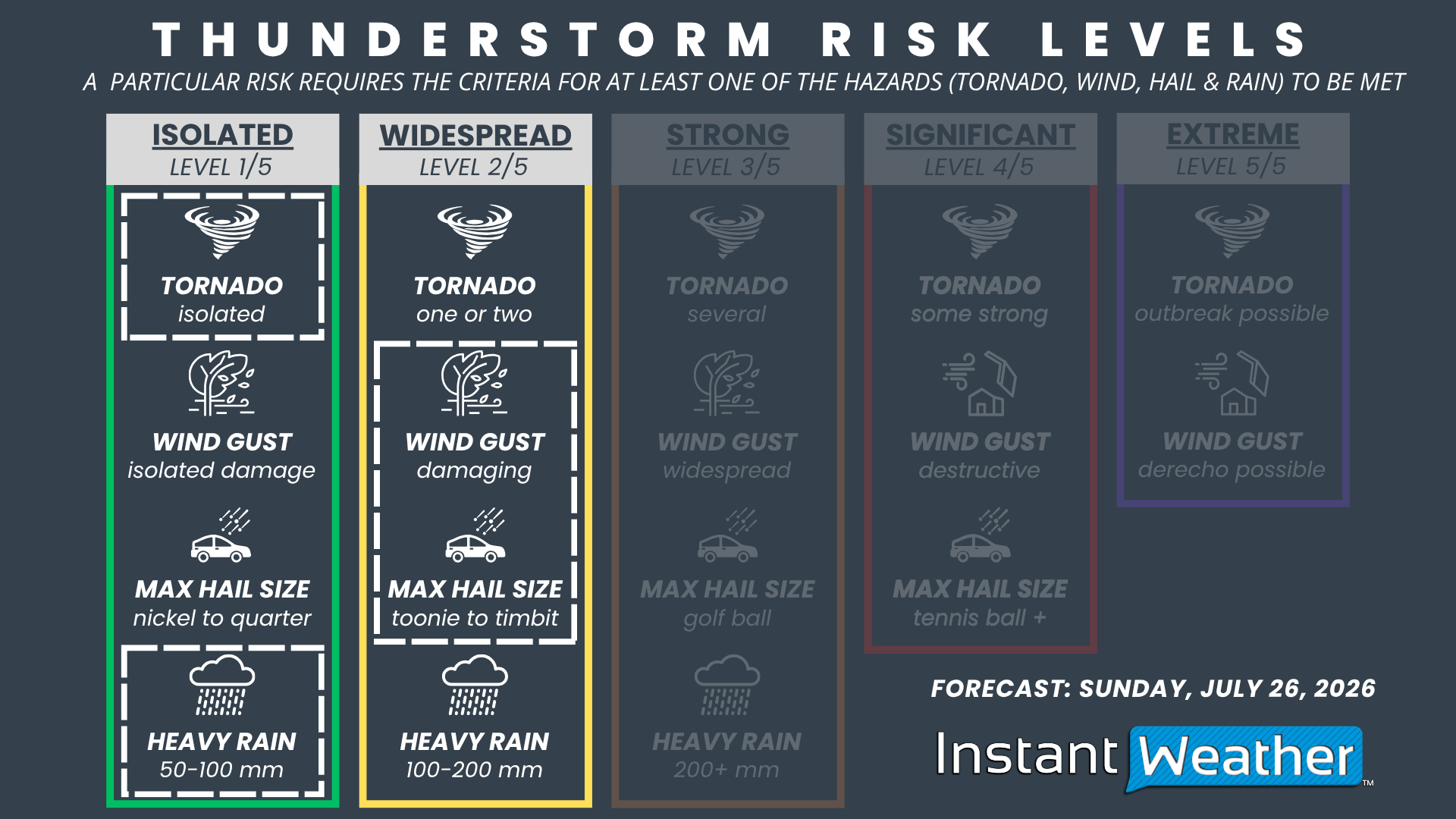
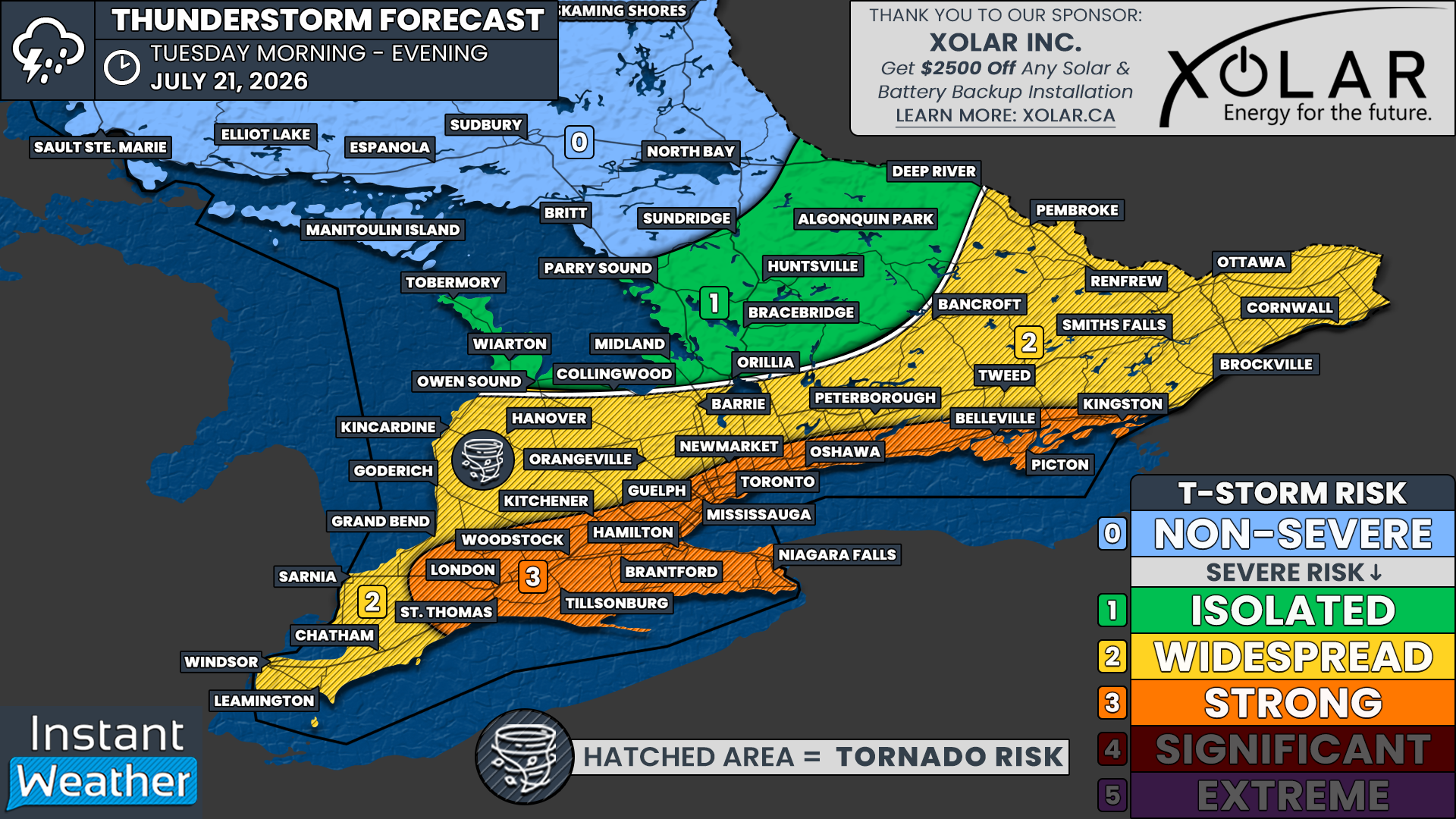
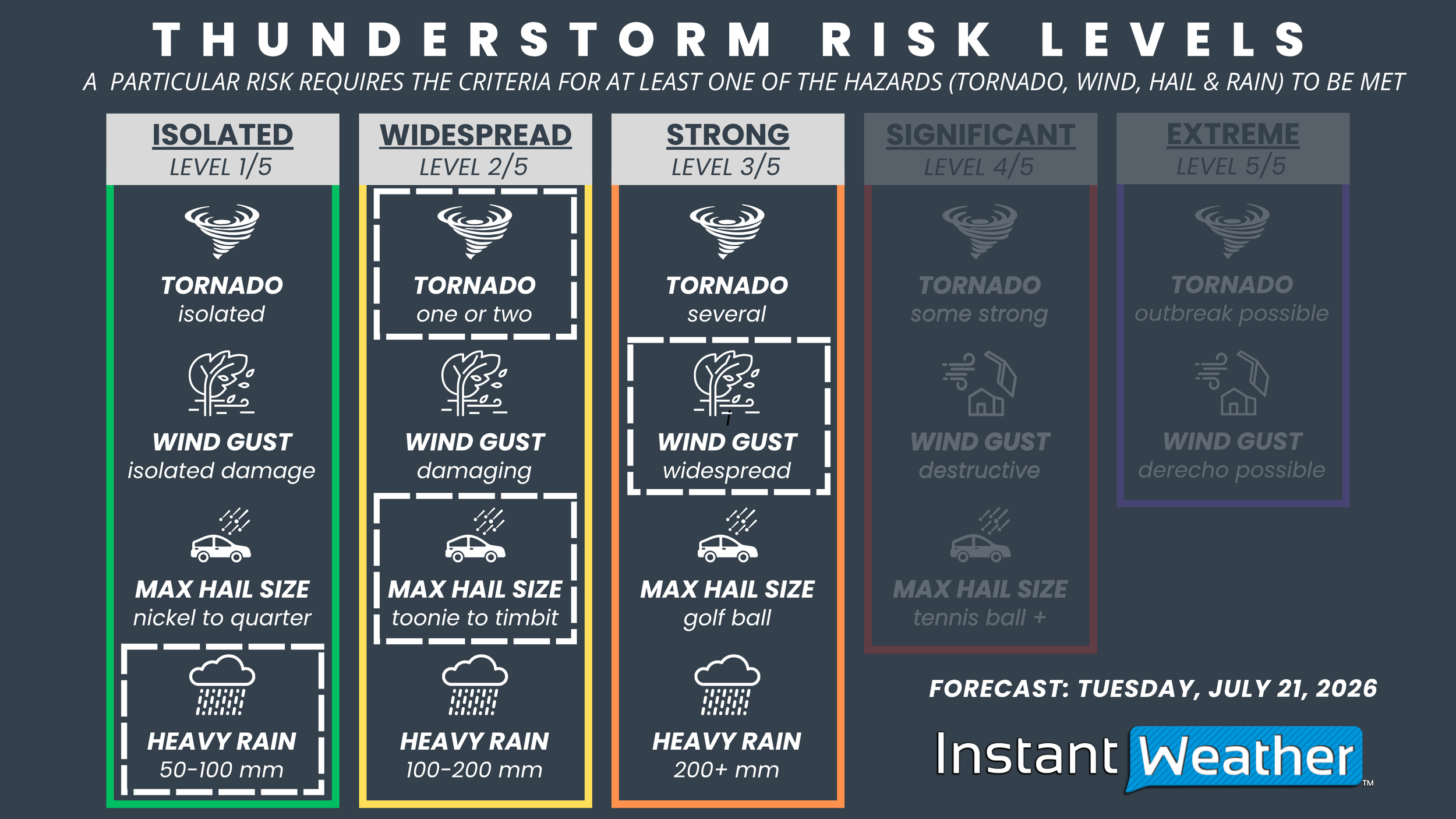
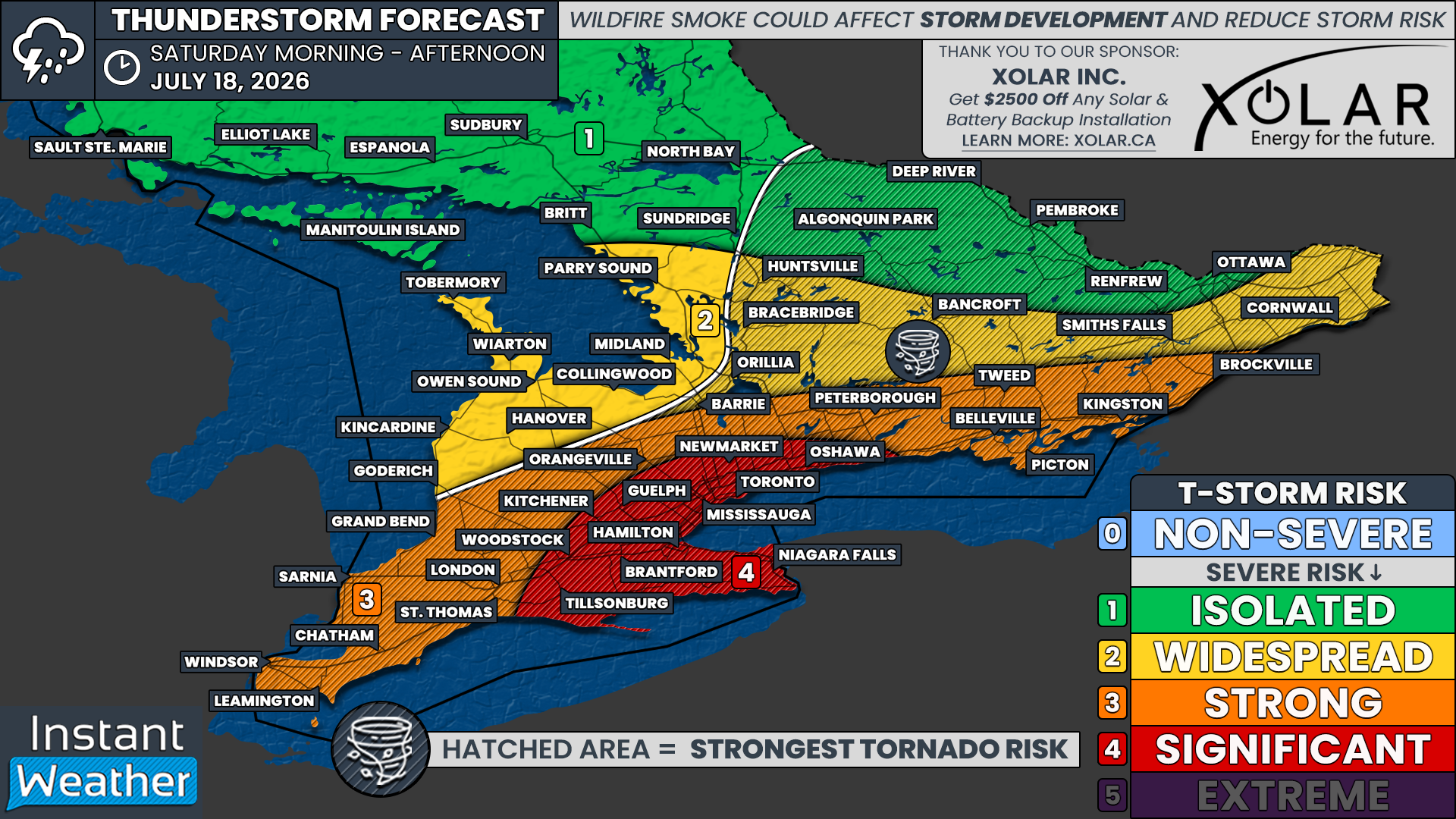
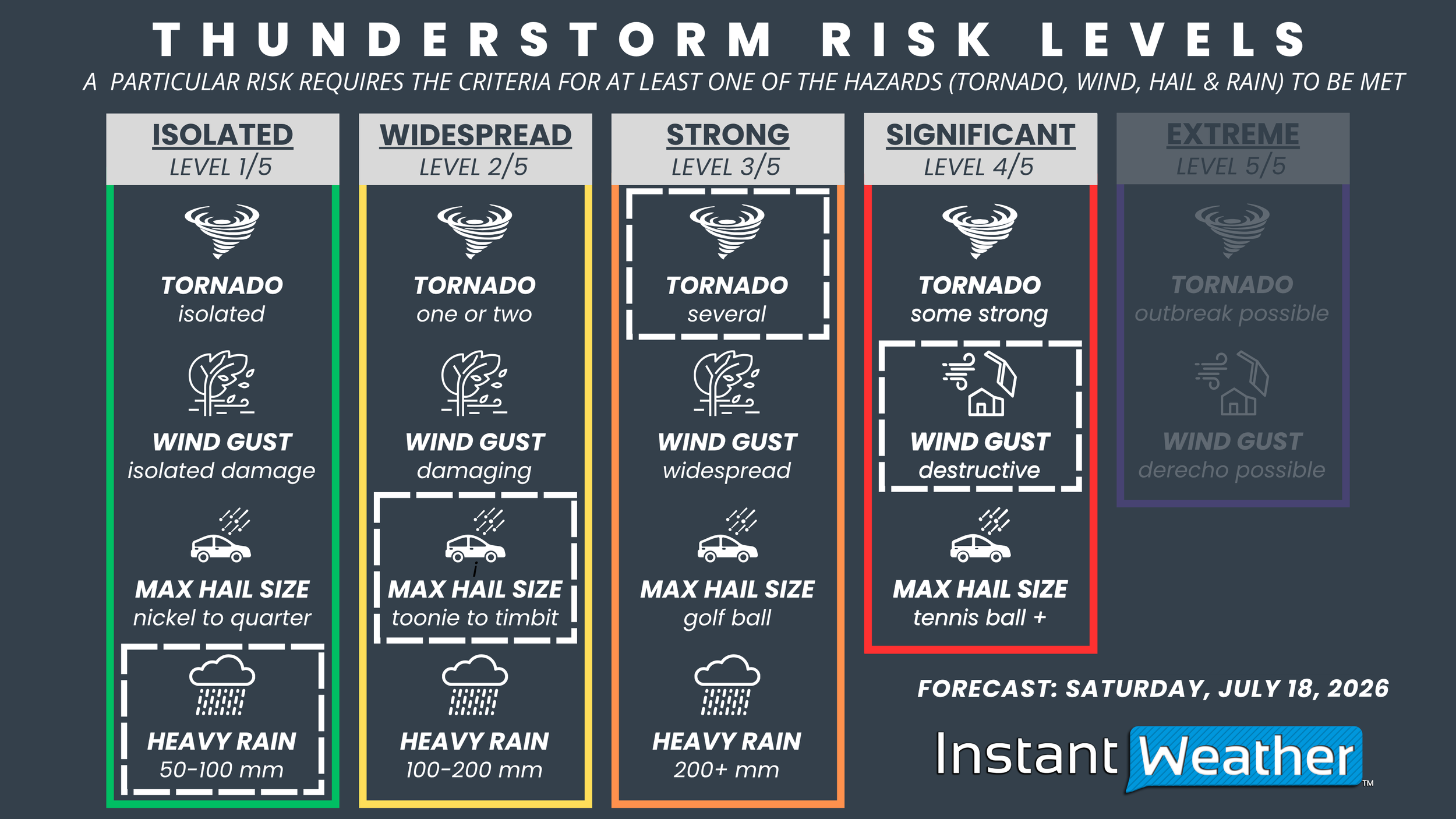
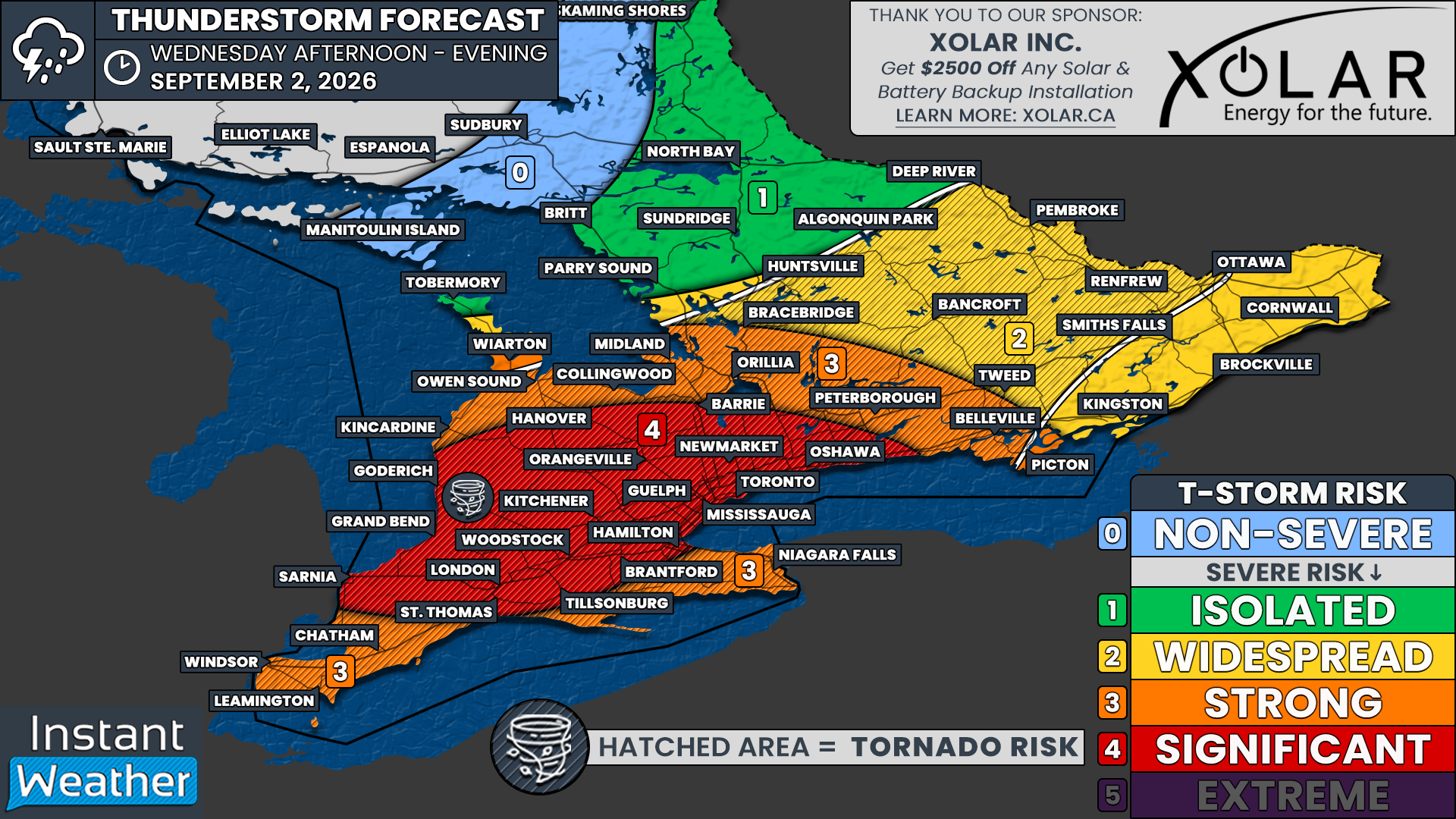
Overall, the forecast for Thursday looks quite similar to Wednesday. We have a “Strong” (Level 3/5) severe risk across a large area, but this time it also includes portions of Deep Southwestern Ontario, including the Sarnia and London areas, along with the Golden Horseshoe.

Other locations included in this risk zone are Goderich, Owen Sound, Kitchener, Hamilton, Guelph, Toronto, Newmarket, Barrie, Orillia, Peterborough, Belleville and Kingston.

This risk is being driven by the potential for strong wind gusts within this corridor, with multiple linear storms possible. If these storms can organize, they could lead to widespread wind damage. There is also the risk for up to Timbit-sized hail and one or two tornadoes.

We have a “Widespread” (Level 2/5) severe risk for Windsor, Chatham and the Lake Erie shoreline, extending into the Niagara region. There is also another “Widespread “ risk zone through Muskoka, Algonquin Park, Bancroft and the Ottawa Valley.

These areas are outside the zone most likely to see the most widespread damaging wind gusts, so the primary threat here will be driven by up to Timbit-sized hail and the risk for one or two tornadoes.

Another major concern is flooding, especially in the Ottawa Valley. This region saw significant flooding on Wednesday after more than 100 mm of rain fell in some areas. Flooding could once again become a serious issue if storms linger over the same communities or repeatedly track over the Ottawa area.

For northern sections of Central Ontario into Northeastern Ontario, including North Bay, Sudbury and Elliot Lake, we have an “Isolated” (Level 1/5) severe risk. We are not expecting widespread severe weather in this area, but with so much energy in the atmosphere, we cannot rule out an isolated pop-up storm capable of becoming severe.

Strong Severe Storm Risk Threatens Canada Day Across Southern Ontario, Damaging Winds and Isolated Tornadoes Possible

NOTE: YOU CAN CLICK ON THE MAP TO OPEN A ZOOMABLE IMAGE

Hot and humid weather has arrived across Southern Ontario just in time for Canada Day, with temperatures soaring into the mid-to-upper 30s, with the humidex making it feel into the 40s. While many will be heading outside to celebrate, this intense heat is also creating an atmosphere that is primed for severe thunderstorms later today.

Unfortunately, this stormy weather could put a damper on Canada Day celebrations, particularly across portions of Southwestern, Central and Eastern Ontario.

We are tracking a conditional severe weather threat for Wednesday afternoon and evening, with the risk potentially continuing into the overnight hours. The hot, humid air will provide plenty of fuel for thunderstorm development. Wherever storms are able to form, they could rapidly become severe thanks to the extremely unstable atmosphere.

In addition to isolated storm development, there is also the potential for one or more organized linear complexes of thunderstorms to move through Southern Ontario. If these systems develop and hold together, they could produce widespread damaging wind gusts across a large portion of the province.

We continue to describe today's threat as conditional because forecast models are doing a poor job of determining exactly where storms will develop. We know the environment is more than capable of supporting severe thunderstorms, but storms first need to form in order to take advantage of the available instability.

Development may be triggered by lake breeze boundaries, leftover outflow boundaries from earlier storms, or other small-scale features that are notoriously difficult to predict ahead of time. As a result, not everyone will see a thunderstorm today, but those that do could experience very intense conditions.


Join Us on YouTube for Storm Coverage:

We'll be providing comprehensive live coverage of any storms that develop today on our YouTube channel. Our team will be tracking storms in real time with live radar analysis, warnings, storm reports and chaser coverage, so if severe weather threatens your area, be sure to join us live to help stay informed.


As of 1 PM, we're already watching a strong complex of thunderstorms developing over Northern Michigan that is tracking toward Lake Huron and eventually Southwestern Ontario by the mid to late afternoon. If this complex is able to maintain its strength as it crosses into Ontario, it could produce widespread damaging wind gusts from areas east of Lake Huron through the Lake Simcoe region and eventually into Eastern Ontario.

Additional thunderstorms may also develop later today across Quebec before sweeping into portions of Eastern Ontario and the Ottawa Valley during the evening and early overnight hours.

Outside of these organized storm complexes, isolated thunderstorms may develop almost anywhere across Southern Ontario this afternoon and evening. If they are able to establish themselves before merging into larger clusters, a few discrete supercells could develop.

These storms would be capable of producing damaging wind gusts, hail up to the size of Timbits and an isolated tornado. While the tornado threat appears highest across Eastern Ontario, an isolated tornado cannot be ruled out anywhere in Southern Ontario today.

NOTE: YOU CAN CLICK ON THE GRAPHIC TO OPEN A ZOOMABLE IMAGE

We have a 'Strong' (Level 3/5) severe weather risk for locations including Goderich, Kincardine, Owen Sound, Hanover, Collingwood, Midland, Barrie, Orillia, Bracebridge, Peterborough, Tweed, Bancroft, Smiths Falls, Renfrew, Ottawa, Brockville and Cornwall. This higher risk is primarily driven by the potential for widespread damaging wind gusts this afternoon and evening, although large hail and an isolated tornado are also possible.

Surrounding areas, including Grand Bend, Woodstock, Kitchener, Guelph, Hamilton, Toronto, Newmarket, Oshawa and Kingston, are under a 'Widespread' (Level 2/5) severe weather risk. These locations could also experience damaging wind gusts if storm complexes hold together, although the tornado risk is somewhat lower compared to Central and Eastern Ontario.

We also have an 'Isolated' (Level 1/5) severe weather risk across the rest of Deep Southwestern Ontario, along with the Niagara region. While storm coverage is expected to remain limited here, any storm that does develop could quickly become severe given the highly unstable environment.

Farther north, we have gone with an 'Widespread' (Level 2/5) to 'Isolated' (Level 1/5) severe weather risk across northern portions of Central Ontario, including North Bay and Sudbury. Storms that develop in this region could strengthen before tracking south and eastward into Quebec and Eastern Ontario.

The severe weather threat should gradually diminish around midnight. However, thunderstorms may continue overnight as the atmosphere will remain exceptionally unstable despite the loss of daytime heating. If a mature storm complex is able to move through overnight, isolated severe weather will remain possible, with damaging wind gusts posing the primary threat.

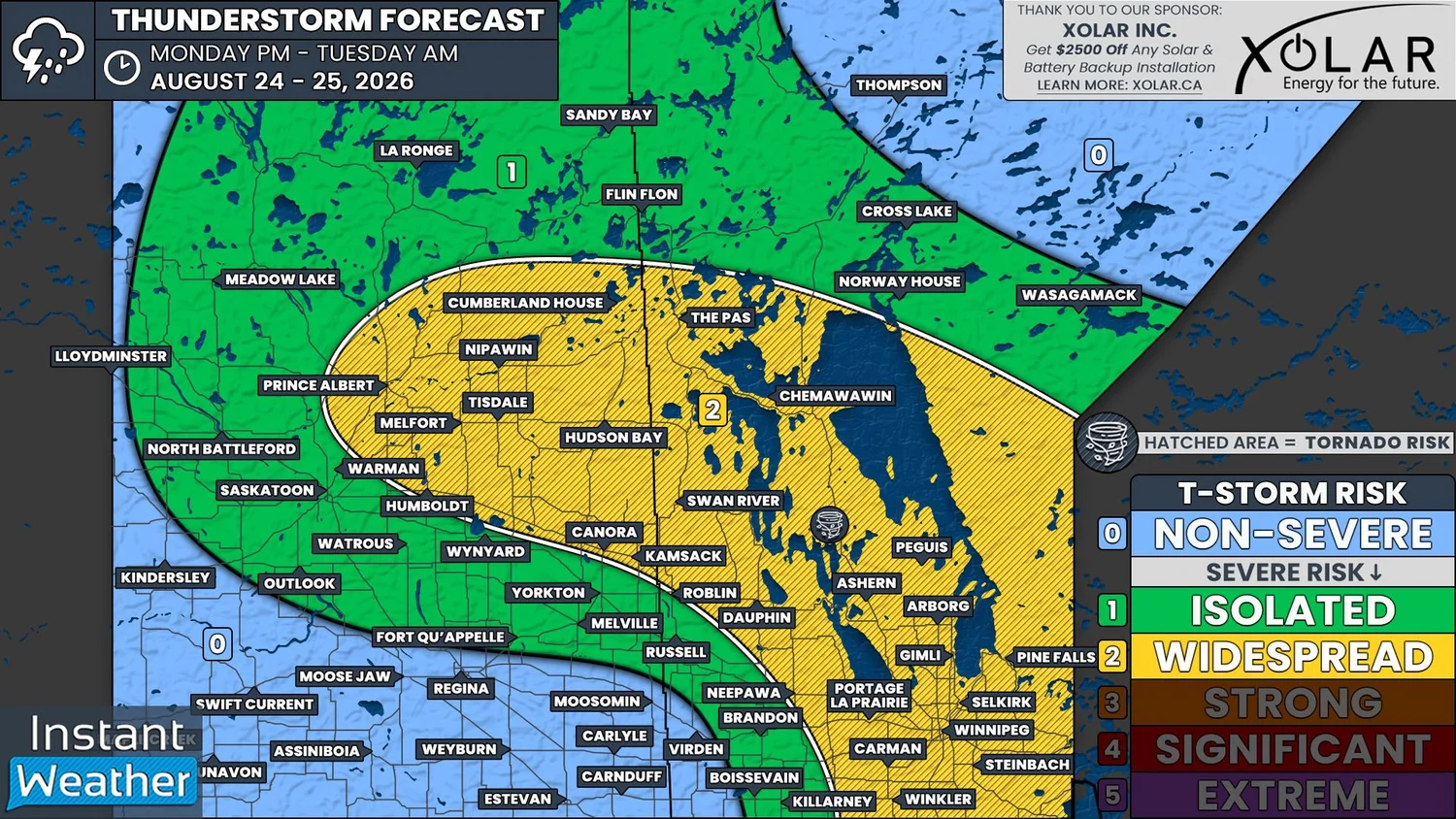
Multiple Tornadoes and Tennis Ball Sized Hail Possible Monday Across Manitoba and Northwestern Ontario

NOTE: YOU CAN CLICK ON THE MAP TO OPEN A ZOOMABLE IMAGE

After a destructive severe weather outbreak that brought violent tornadoes to Western Manitoba on Sunday, the risk shifts eastward into Winnipeg, Eastern Manitoba and Northwestern Ontario on Monday.

Based on the latest forecast data, today's storms could bring a similarly dangerous setup with the potential for significant severe weather, including multiple tornadoes, huge hail up to the size of tennis balls, destructive wind gusts in excess of 100 km/h, and areas of flash flooding.

The greatest concern is across areas just southeast of Winnipeg where we have issued a 'significant' severe weather risk. This includes Winkler, Steinbach, Kenora, Dryden, Atikokan and Fort Frances.

Storms that develop in this corridor will have the potential to rapidly become powerful supercells capable of producing all severe weather hazards. The tornado threat is expected to be highest in this zone where atmospheric conditions appear most favourable for rotating thunderstorms.

A 'strong' severe weather risk extends across the rest of South-central and Eastern Manitoba, including Winnipeg, Portage la Prairie, Carman, Killarney, Selkirk, Gimli, Ashern, Arborg, Peguis, Pine Falls, Red Lake, Sioux Lookout and Thunder Bay.

While damaging wind gusts and large hail will likely be the primary hazards across much of this area, an isolated tornado cannot be ruled out, especially across South-central Manitoba and the Interlake region where conditions may still support discrete rotating storms before they begin to organize into larger clusters.

Farther west, there is a widespread to isolated severe weather risk across Western Manitoba, including Brandon, Virden, Dauphin, Roblin and Swan River. Flooding is expected to be the biggest concern in this region as slow-moving thunderstorms could repeatedly track over the same communities.

Rainfall totals could exceed 100 mm in localized areas, leading to flash flooding. An isolated tornado also cannot be ruled out around the Brandon area during the afternoon should any storms remain isolated long enough to become organized.

SIMULATED RADAR - MAP FROM WEATHERBELL

Today's severe weather threat is expected to begin during the afternoon with slow-moving thunderstorms developing across Western Manitoba, particularly near the Brandon area.

These storms will move very little, increasing the risk of training thunderstorms where multiple storms repeatedly pass over the same locations.

This could quickly lead to localized flooding, but these storms may also be capable of producing large hail, damaging wind gusts and even an isolated tornado.

SIMULATED RADAR - MAP FROM WEATHERBELL

The primary severe weather outbreak is expected to unfold later in the afternoon and into the early evening as isolated thunderstorms develop along the international border from Winkler eastward through Southeastern Manitoba and into Fort Frances in Northwestern Ontario.

The atmosphere during this period is expected to be highly supportive of supercell development. Any storm that can remain isolated will have the potential to produce tornadoes, very large hail and destructive wind gusts.

Hail could reach the size of tennis balls in the strongest storms, which would be capable of causing significant damage to vehicles, roofs and crops.

Winnipeg sits near the northwestern edge of the greatest severe weather threat. While current guidance keeps the most dangerous storms just southeast of the city, even a small shift farther west could bring a much higher tornado risk into the Winnipeg area.

SIMULATED RADAR - MAP FROM WEATHERBELL

The tornado threat should gradually decrease after sunset as daytime heating fades and the atmosphere becomes less favourable for discrete supercells. However, that will not mark the end of the severe weather threat.

As the evening progresses, many of the isolated storms are expected to merge into one or more organized lines of thunderstorms. While the tornado risk will lessen, these storm lines could produce widespread destructive wind gusts capable of causing tree damage, power outages and structural damage across parts of Manitoba and Northwestern Ontario.

These storms could reach the Winnipeg and Thunder Bay regions around midnight with another round of severe weather. Although the primary concern overnight will shift toward damaging straight-line winds, an isolated nocturnal tornado cannot be completely ruled out.

The severe weather threat should come to an end across Manitoba after midnight as the storm complex moves eastward. However, portions of Northwestern Ontario may continue to see strong to severe thunderstorms into Tuesday morning before the system gradually weakens and exits the region.


Tornado Risk for Regina Area as Significant Severe Storm Risk Target Saskatchewan & Manitoba Saturday

NOTE: YOU CAN CLICK ON THE MAP TO OPEN A ZOOMABLE IMAGE

After a brief reprieve from active weather across Saskatchewan and Western Manitoba, the threat of severe thunderstorms returns on Saturday. This round of storms could bring a potentially significant severe weather risk to portions of Southeastern Saskatchewan, especially around Weyburn and Estevan.

Isolated thunderstorms are expected to develop near the International Border around the dinner hour. Any storms that form could quickly become supercells capable of producing all severe weather hazards, including tornadoes, golf ball-sized hail and destructive wind gusts up to 120 km/h.

There is also a strong severe weather risk extending northward toward Assiniboia, Moose Jaw and Regina. An isolated tornado cannot be ruled out in these areas as well, although confidence in storm development is lower compared to locations closer to the border.

Further south, additional thunderstorms are expected to develop across Montana and North Dakota. As the evening progresses, these storms are forecast to merge into a large complex that will race northeast toward Saskatchewan and Southwestern Manitoba.

The earlier isolated supercells over Southeastern Saskatchewan are expected to be absorbed into this larger storm complex as it crosses the border. As this happens, the primary threat will shift from large hail and tornadoes to widespread damaging wind gusts as the storms organize into a fast-moving line during the mid and late evening hours.

This line is expected to sweep northeast from Regina toward the Manitoba border. There is still some uncertainty regarding how well it will maintain its strength after sunset, as the loss of daytime heating will reduce available instability. However, we expect at least an isolated to widespread severe weather risk to continue past midnight as the storms approach the Yorkton and Brandon corridor.

SIMULATED RADAR - MAP FROM WEATHERBELL

Based on the latest data, isolated thunderstorms are most likely to develop between 5 and 7 PM CST near the International Border. These storms could impact the Weyburn and Estevan areas as they rapidly intensify into supercells capable of producing large hail, damaging wind gusts and tornadoes.

The environment will be particularly favourable for tornadic development during the first few hours of these storms' lifespan. The greatest tornado risk appears to be closest to the border, although this threat could extend northwest toward Moose Jaw and Regina if storms are able to develop there during the late afternoon and early evening.

SIMULATED RADAR - MAP FROM WEATHERBELL

As the mature line of storms over Montana and North Dakota advances into Saskatchewan, the earlier isolated storms are expected to merge into the line, forming a bowing segment stretching from Regina to the Manitoba border.

Although the tornado threat will decrease once the storms become linear, a brief QLCS spin-up tornado cannot be ruled out, particularly near any bookend vortices that develop within the line. The primary hazard, however, will become widespread damaging wind gusts, with localized gusts over 100 km/h possible. The hail threat will also diminish by this stage, although quarter to toonie-sized hail may still accompany the strongest storms.

The line will continue sweeping across Southeastern Saskatchewan and into Southwestern Manitoba during the overnight hours. While isolated damaging wind gusts will remain possible within the strongest portions of the line, there is still uncertainty regarding how well the storms will maintain their intensity after midnight.


Southern Ontario Faces Severe Storm and Tornado Risk Thursday Ahead of Possible Canada Day Heatwave

THIS FORECAST IS SPONSORED BY:

NOTE: YOU CAN CLICK ON THE MAP TO OPEN A ZOOMABLE IMAGE

While the latter half of June has been relatively quiet across Southern Ontario when it comes to severe weather, thanks to cooler temperatures dominating the region, that pattern is about to change in a big way. As we head into the final days of June, much warmer and increasingly humid air will begin pushing into the province, bringing with it a rapidly increasing risk for thunderstorms.

The first significant opportunity arrives on Thursday, when portions of Southwestern Ontario could see a widespread severe thunderstorm risk. An isolated severe threat may also extend farther east into parts of the Golden Horseshoe and Central Ontario.

If thunderstorms are able to develop during the afternoon and early evening, they will move into a very favourable environment capable of supporting supercell thunderstorms. These storms could produce all modes of severe weather, including toonie-sized hail or larger, damaging wind gusts in excess of 100 km/h, torrential rainfall and even a few isolated tornadoes.

The most favourable environment currently appears to be across areas including Sarnia, Chatham, Grand Bend, Goderich and London. However, isolated thunderstorms could also develop as far north as the Bruce Peninsula, east toward Lake Simcoe, and south into portions of the Greater Toronto Area. While the tornado threat decreases farther away from Lake Huron, it cannot be completely ruled out as far east as Kitchener, Hamilton and portions of the southern Georgian Bay shoreline.


Join Us on YouTube for Storm Coverage:

We'll be providing comprehensive live coverage of any storms that develop on Thursday afternoon on our YouTube channel. Our team will be tracking storms in real time with live radar analysis, warnings, storm reports and chaser coverage, so if severe weather threatens your area, be sure to join us live to help stay informed.


SIMULATED RADAR - MAP FROM WEATHERBELL

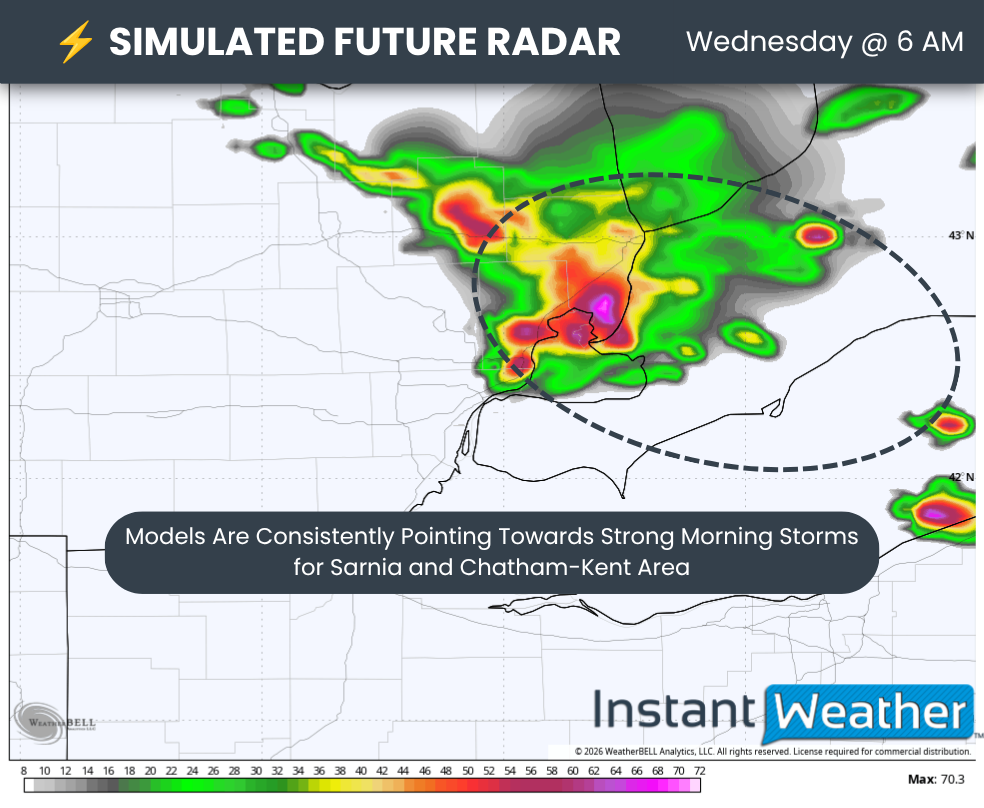
Thursday's forecast does come with one important complication. Morning showers and non-severe thunderstorms are expected to move through Southwestern Ontario before spreading into Central and Eastern Ontario during the day.

As we've seen many times before, morning convection can make or break an afternoon severe weather event. If clouds and showers linger too long, they can prevent the atmosphere from recovering enough to support stronger storms later in the day.

On the other hand, if skies clear by around the noon hour, as many of the latest models suggest, there should be several hours available for temperatures and instability to quickly rebound.

Significant Tornado Parameter - MAP FROM WEATHERBELL

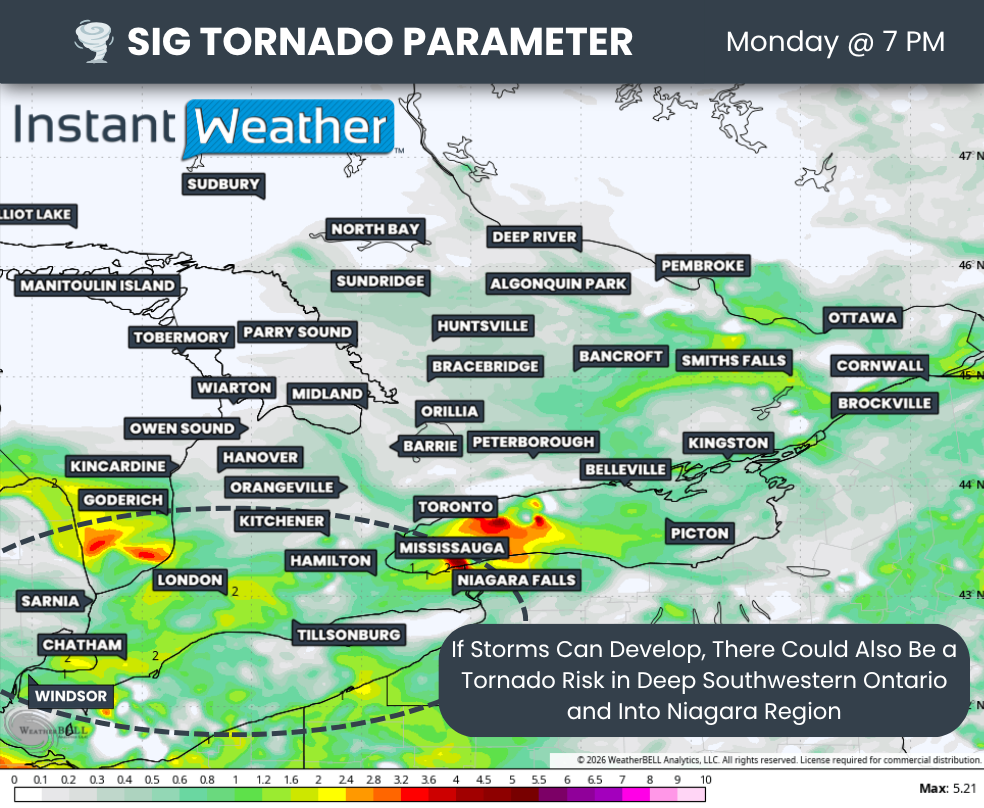
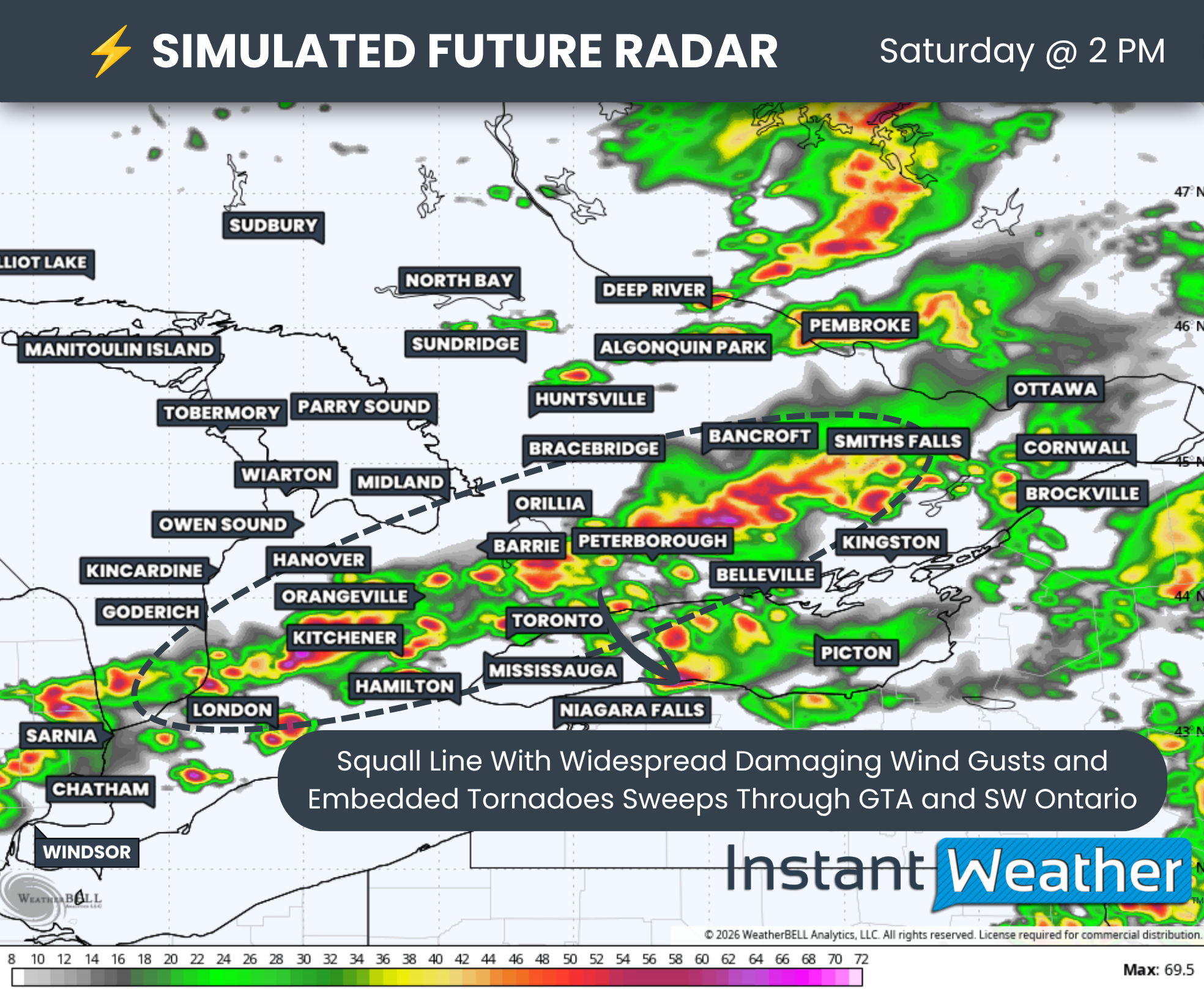
By the mid-afternoon, the atmosphere is expected to become increasingly supportive of severe thunderstorms, with the highest risk developing between roughly 2 PM and 6 PM. The strongest combination of instability and wind shear currently appears to be centred near the Lake Huron shoreline, extending into Sarnia and Chatham.

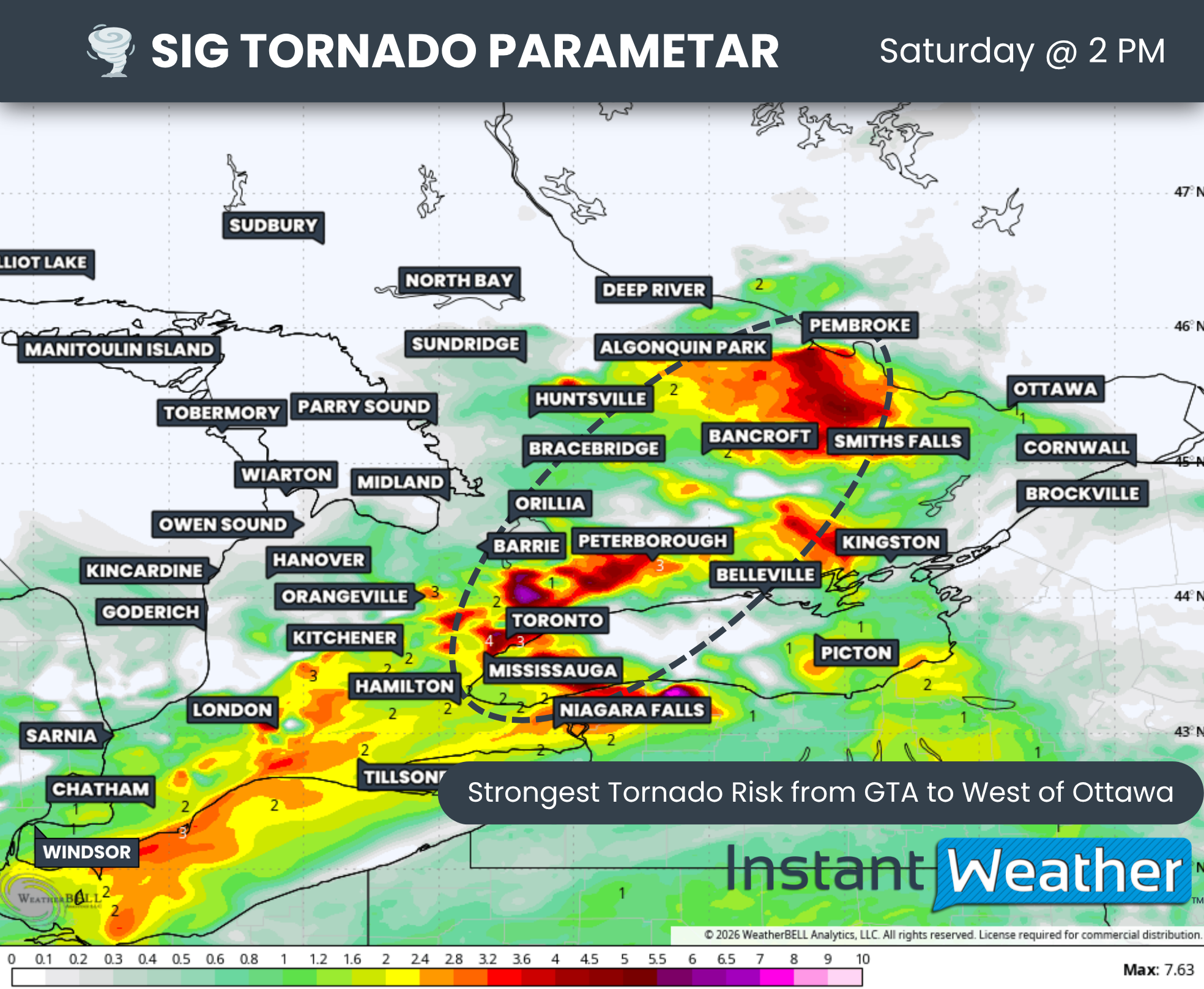
The latest Significant Tornado Parameter (STP) data also highlights an enhanced corridor stretching from the Michigan border across Lake Huron into Southwestern Ontario. Should storms form within this corridor, they could rapidly intensify into rotating supercells capable of producing very large hail, damaging winds and isolated tornadoes.

SIMULATED RADAR - MAP FROM WEATHERBELL

THIS FORECAST IS SPONSORED BY:

There remains some disagreement among the forecast models regarding exactly where storms will first develop.

Some models initiates storms as early as 3 PM across Michigan before they quickly cross into Deep Southwestern Ontario. This scenario would place communities such as Sarnia, Grand Bend, Goderich and London at the greatest risk.

Other models delay development until later in the afternoon or early evening, with storms forming closer to the Hanover to Grand Bend corridor before tracking southeast toward London, Kitchener and possibly Hamilton. Regardless of which solution verifies, the greatest tornado potential continues to favour areas along and just inland from the southeastern Lake Huron shoreline.

Additional isolated thunderstorms may also develop around Lake Simcoe and into the Greater Toronto Area during the late afternoon and early evening. While the environment in these areas appears less favourable for widespread severe weather, a few stronger storms cannot be ruled out. The primary threats would be hail up to quarter size along with isolated damaging wind gusts.

As the sun sets Thursday evening, the severe weather threat should gradually diminish as daytime heating is lost. However, scattered non-severe showers and thunderstorms may continue well into the overnight hours, particularly across Central and Eastern Ontario.

TEMP ANOMALY - MAP FROM WEATHERBELL

Looking beyond Thursday, the severe weather threat briefly settles down. Friday may bring a very isolated thunderstorm risk across Eastern Ontario, particularly near the Ottawa Valley, while much of the weekend currently appears relatively quiet from a severe weather perspective.

The bigger story heading into next week will likely be the return of significant heat.

Temperatures are expected to steadily climb through the weekend, with many areas approaching or exceeding 30°C by Monday. Current medium-range guidance suggests the heat could continue to intensify into the middle of next week, potentially peaking around Canada Day.

Some forecast models are indicating temperatures running between 5 and 10°C above seasonal averages, with localized anomalies approaching 15°C in parts of Ontario on Canada Day. If those projections verify, daytime highs could reach the low to mid 30s across portions of both Southern and Northern Ontario.

When combined with increasing humidity, it may feel close to 40°C in many communities.

This surge of heat and humidity will also provide plenty of fuel for additional thunderstorm development. While it is still too early to determine exactly which days will carry the greatest severe weather risk, there are increasing signs that we could be entering a much more active pattern over the next one to two weeks. Exactly when storms develop will depend on the arrival of cold fronts and other triggering mechanisms, something that will become much clearer once higher resolution models come into range.

We'll continue monitoring both Thursday's severe weather potential and the possible prolonged heat event expected next week. Stay tuned for forecast updates throughout the coming days as confidence continues to increase.

Widespread Severe Thunderstorms Possible Across Southern Alberta and into Southwestern Saskatchewan Today with Slight Risk of a Tornado

NOTE: YOU CAN CLICK ON THE MAP TO OPEN A ZOOMABLE IMAGE

Severe thunderstorms are going to be likely across Southern Alberta and into parts of Central Alberta and Southwestern Saskatchewan today. A cold front associated with the low pressure system that’s responsible for the heavy rainfall in Central Alberta will be the trigger for thunderstorm development this afternoon and evening.

Temperatures are expected to climb into the low to mid-20s, but dewpoints are expected to be fairly low, barely reaching mid-teens for most of Southern Alberta and Southwestern Saskatchewan. This lack of moisture could hamper thunderstorm development, however some moisture from the north could make its way into the region later today, which would make up for the lower dewpoints.

Simulated reflectivity at 3pm MDT, courtesy of weatherbell.

Thunderstorms are expected to develop early this afternoon in the Foothills as individual cells. These storms will likely be severe for most of the region, but there is a more isolated severe risk closer to the low pressure center, in the Edmonton area and westward.

As the storms progress eastward through the afternoon and evening, they are expected to eventually merge into a line. This transition to a linear storm mode will bring a more widespread severe risk across Southeastern Alberta and eventually into Southwestern Saskatchewan later in the evening (around 8-10pm).

The severe risk does not extend too far eastward into Saskatchewan because the storms will weaken later in the evening. This will lead to a more isolated threat into the Swift Current area by around midnight before it’s expected that the storms become non-severe for the rest of the overnight period.

Simulated reflectivity at 9pm MDT, courtesy of weatherbell.

Across most of Southern Alberta and stretching into parts of Central Alberta, including Red Deer, and Southwestern Saskatchewan is where there is the greatest risk for widespread severe thunderstorms today. In this region, the main severe weather threats will be strong wind gusts above 100km/h and large hail that could be as big as ping pong balls. There is also a small risk of a tornado today, but that will be very conditional on there being enough moisture moving into this area from the north ahead of the thunderstorm development.


Powerful June Storm System Could Bring Damaging Winds and Isolated Tornadoes to Southern Ontario Overnight

NOTE: YOU CAN CLICK ON THE MAP TO OPEN A ZOOMABLE IMAGE

An unusually strong and deepening low pressure system for mid-June is set to track through the Great Lakes region overnight Wednesday and into Thursday. This powerful system will bring the potential for severe weather to a large portion of Southern Ontario, with the greatest threat occurring late tonight and into Thursday morning.

The same system is expected to produce a significant severe weather outbreak across portions of Illinois, Indiana and Michigan this afternoon and evening. In those areas, forecasters are highlighting the risk of violent tornadoes, destructive wind gusts and large hail as a potent combination of instability and wind shear develops ahead of the approaching low pressure system.

As this line of storms pushes eastward into Michigan tonight, it is expected to gradually weaken before reaching Ontario. However, weakening does not necessarily mean the severe threat will disappear.

Even in a decaying state, this line of storms could still bring impactful weather to portions of Southwestern Ontario, especially areas closest to the international border and along the Lake Huron shoreline.

Based on the latest forecast data, the primary threat appears to be damaging wind gusts in excess of 100 km/h. In localized areas, stronger wind gusts could occur if isolated downbursts develop within the line of storms. These stronger pockets of wind have the potential to cause tree damage, power outages and scattered property damage.

While the tornado threat will be considerably lower than what is expected across parts of the United States, it cannot be completely ruled out.

The atmosphere over Deep Southwestern Ontario will remain supportive of some rotation early in the night, particularly while the line of storms is still relatively organized. Any tornado risk would likely be brief and localized in nature, but the strong dynamics associated with this system mean it is something we will be watching closely.
Another factor adding complexity to this forecast is the strength of the low pressure system itself.

In addition to thunderstorm-related winds, very strong winds will be present just above the surface overnight. Normally, a temperature inversion would act as a lid and prevent those stronger winds from mixing down to ground level. Current indications suggest that inversion should remain in place for much of the night.

However, if portions of that stronger wind are able to reach the surface, isolated non-thunderstorm wind gusts in excess of 90 km/h would be possible. This risk appears highest near the shorelines of Lake Huron and Lake Erie where local effects can help enhance wind gusts.


We’ll be closely monitoring this severe weather threat throughout the evening and overnight hours.

If conditions warrant, we’ll be going live on our YouTube channel with real-time storm tracking, radar analysis, warning updates and coverage of any severe weather that develops across Southern Ontario.

Be sure to subscribe to our YouTube channel HERE and turn on notifications so you don’t miss any live coverage. Whether it’s damaging winds, tornado warnings or rapidly changing conditions, we’ll be there to keep you informed every step of the way.


Heavy rainfall will also accompany this system. Many areas will receive beneficial rainfall, but localized torrential downpours could lead to rainfall amounts exceeding 50 mm in a relatively short period of time. If storms repeatedly move over the same area, flash flooding could develop, especially in urban locations and areas with poor drainage.

The highest severe weather risk tonight stretches across Deep Southwestern Ontario and portions of the Lake Huron shoreline. This includes Windsor, Leamington, Chatham, Sarnia, Grand Bend, Goderich and Kincardine.

In these areas, storms could begin arriving as early as 8 to 9 PM and continue through the overnight hours. Damaging wind gusts remain the primary concern, although heavy rain and an isolated tornado cannot be ruled out.

As the line progresses eastward, it is expected to reach the London, Woodstock, Kitchener, Guelph, Orangeville and Hanover areas around or shortly after midnight. There remains some uncertainty regarding exactly how much strength the storms will retain by this point. However, the potential still exists for several pockets of damaging winds to survive farther inland.

The tornado threat should be lower compared to areas farther west, but strong winds and localized flooding will continue to be concerns as the line moves through.

By the time the storms reach Central Ontario and the Golden Horseshoe during the overnight hours, the severe threat should be decreasing further. That said, this remains a powerful weather system and some stronger portions of the line could still produce isolated wind gusts approaching 90 km/h.

As a result, we continue to highlight an isolated severe weather risk for Toronto, Hamilton, Niagara, Newmarket, Barrie, Orillia, Bracebridge, Peterborough and Bancroft.

Attention will then shift to Eastern Ontario during the early morning hours on Thursday. Unlike areas farther west, there are indications that the atmosphere may begin to recover somewhat as the main line approaches. There is also the potential for additional isolated thunderstorms to develop behind or ahead of the main line shortly after sunrise.

This could allow for a secondary severe weather threat across portions of Eastern Ontario, particularly near the international border and into the Ottawa Valley. This broader morning severe weather risk includes Kingston, Brockville, Smiths Falls, Cornwall, Ottawa and Picton.

Should additional storms develop within this environment, all severe weather hazards would be possible including damaging wind gusts, heavy rainfall, hail and even an isolated tornado.

Forecast confidence in the tornado threat remains lower due to the early morning timing and questions surrounding how much instability can develop. However, the environment bears watching closely given the strength of the overall weather system.

The severe weather threat is expected to gradually come to an end from west to east through Thursday morning, with most areas seeing the risk diminish by early afternoon.

Even after thunderstorms exit the region, conditions will remain quite blustery throughout the day. Strong non-thunderstorm wind gusts may continue across much of Southern Ontario as the powerful low pressure system pulls away from the Great Lakes.

Strong Winds and Timbit Sized Hail Possible with Widespread Risk of Severe Thunderstorms in Southern Alberta & Saskatchewan Tuesday

NOTE: YOU CAN CLICK ON THE MAP TO OPEN A ZOOMABLE IMAGE

It’s looking like it’ll be an active day for some parts of Alberta and Saskatchewan today. A low pressure system from Southern British Columbia will track southeastward through Southern Alberta and Saskatchewan today, which will trigger the development of thunderstorms across the region.

Temperatures are expected to climb into the low to mid-20s, with dewpoints possibly into the mid-teens, across Southern Alberta and Saskatchewan, which should help fuel thunderstorm development. There will be a modest amount of CAPE in the region, with weather models showing upwards of 1000J/kg for some areas. While this is not a great deal of instability, the combination of shear and a mechanism for lift will be enough for scattered thunderstorms to develop across the region.

Simulated reflectivity at 2pm, courtesy of weatherbell.

Non-severe thunderstorms have already developed this morning in Central Alberta. As the low continues tracking southeast into Southern Alberta, so too will the thunderstorms and starting in the early afternoon, it’s likely that the storms that develop will become severe.

The bulk of the thunderstorm activity is expected to make its way into Southern Saskatchewan later in the afternoon, around 3-5pm. Behind the initial cluster of storms in this area, additional storms are expected to develop to the west, in Southern Alberta. Most of these storms will likely be severe, but there is a more isolated severe risk that will extend eastward across much of the rest of Southern Saskatchewan.

The thunderstorms will gradually weaken through the evening as they continue tracking into Montana and most of the storms should cross the international border by midnight. However, there is a chance that some storms could linger in Southern Saskatchewan into the early morning hours.

Simulated reflectivity at 6pm, courtesy of weatherbell.

An area that stretches from northwest of Calgary southeastward into Southwestern Saskatchewan, shown in yellow on our forecast map, is where there is the greatest risk for widespread severe thunderstorms today. Across this region, the main threat from thunderstorms today will be strong wind gusts in excess of 100km/h, however there is also the threat that these storms could produce large hail that could be as large as Timbits and maybe even as large as golf balls. Given that at least one tornado is confirmed to have touched down in Northern Alberta from this system last night, the possibility of additional tornadoes today can not be ruled out.


Wickedly Windy Weekend in Store Across Alberta, Widespread Gusts up to 100km/h

NOTE: if you click or tap on this image you can zoom in

It’s going to be a blustery weekend across Alberta, with strong wind gusts in excess of 70km/h expected at some point over the next two days for most of the province. These strong winds will strike in two rounds as two separate systems are slated to track through the Prairies this weekend.

The first system will begin to make its way into Northern Alberta Friday evening. it will bring a mixture of snow, rain, and freezing rain to the region overnight and through Saturday morning.

This system won’t bring too much snow to the area; a maximum of 5-10cm is expected and this will be isolated more to the Northeast. As far as freezing rain is concerned, it will be patchy and occur south of where the snow will fall. Total accretion will be limited to 1-2mm, but this will still be enough for untreated surfaces to become slippery.

The rdps model showing total snowfall as of 2pm mt on Saturday. courtesy of WeatherBell.

To the south of the passage of this system, it’s a completely different story. High temperatures on Saturday are expected to be well above seasonal throughout Central and Southern Alberta, climbing into the double digits and maybe approaching the 20°C mark closer to the US border.

The first round of strong winds will also be found south of the system that will be tracking through Northern Alberta. The winds will start to pick up overnight Friday and peak Saturday morning. Wind gusts of 70-90km/h are expected through the Foothills and stretching across the width of the province to the north of Edmonton. Meanwhile, slightly weaker gusts, in the 50-70km/h range, will impact much of the rest of Central and Southern Alberta.

The rdps model showing showing wind gusts on Saturday at 11am mt. courtesy of WeatherBell.

This first round of strong winds will start to die down in the afternoon and evening for most of the province. However, the gusts will remain strong throughout the Rockies and communities closer to the International border. Beyond these areas, things will become calm for a few hours before the second system begins to make its way into the province later Saturday evening.

This second system is also expected to move through Northern Alberta, but it will track slightly to the south. Once again, snow is expected to fall across a swath of Northern Alberta crosses through the region from Saturday evening to Sunday evening, with models suggesting that up to 20cm could fall.

The winds are expected to be even stronger on Sunday as the cold front associated with the second system pushes southward and also leads to much cooler temperatures across most of the province. The winds will ramp back up Saturday evening and continue into Sunday afternoon before things start to quieten down in the evening. Widespread gusts up to 100km/h are likely during this time and gusts exceeding 100km/h can be also expected in Southwest Alberta.

The rdps model showing 24 hour snowfall amounts as of 9am mt on Monday. courtesy of WeatherBell.

The end of the strong winds won’t be the end of active weather for the weekend. Snow is expected to develop Sunday evening across the Southern Foothills, which will spread eastward into the early morning hours of Monday before dissipating. Around 5-15cm of snow can be expected by lunchtime on Monday from Olds to the Montana border.

Blowing Snow and Near-Blizzard Conditions Could Threaten Friday Evening Commute Across Southern Ontario

NOTE: YOU CAN CLICK ON THE MAP TO OPEN A ZOOMABLE IMAGE

This week has mostly offered a much-needed reprieve from what felt like an endless onslaught of snow that dominated much of January. For many across Southern Ontario, it finally felt like winter eased up a little. Aside from an Alberta Clipper earlier this week, snowfall became lighter and more scattered, and we even managed to climb out of the deep freeze over the past few days, with temperatures returning closer to seasonal norms for early February.

That quieter stretch is now coming to an end as we head into the weekend. A fast-moving but potent weather system is set to cross the region on Friday, bringing a quick blast of heavy snow, strong winds, and sharply falling temperatures. While this will not be a long-duration storm, its timing and intensity could still cause significant disruption.

The main feature to watch will be a cold front sweeping across Ontario on Friday afternoon and evening. Along the leading edge of this front, a frontal squall is expected to develop. This type of setup is known for producing intense snowfall over a very short period of time, often accompanied by rapidly worsening visibility.

As this squall moves through, whiteout conditions are likely to develop with little warning. Snowfall rates could become very heavy for one to two hours in many areas, which is more than enough time for roads to become snow-covered and slippery before plows are able to respond.

Wind will be another major factor with this system. In the wake of the cold front, wind gusts are expected to ramp up quickly. Many areas could see gusts exceeding 70 km/h, with even stronger gusts possible in some locations. This combination of fresh snow and strong winds will lead to widespread blowing snow and significantly reduced visibility.
Unfortunately, the worst of these conditions is expected to line up with the afternoon and early evening commute across much of Southwestern and Central Ontario. Travel conditions could deteriorate rapidly during this window, especially on highways and open rural roads where blowing snow tends to be more severe.
Snowfall totals from this system are not expected to be extreme by winter standards. Most areas are generally looking at around 5 to 10 cm of snow, with locally higher amounts possible. Areas near Lake Huron could see totals exceed 10 cm due to minor lake enhancement adding to the frontal snow.

The bigger concern is not how much snow falls, but how quickly it falls. With most of the accumulation occurring in a narrow one to two-hour window, roads can become snow-covered very quickly. This rapid accumulation often leads to poor driving conditions even when overall totals are modest.

Hourly snowfall rates (cm) - MAP FROM WEATHERBELL

Snow is expected to begin spreading into Southwestern and Central Ontario during the mid-morning hours on Friday. At this point, winds should still be relatively light. Snowfall rates during the morning should generally remain below 1 cm per hour, which means conditions should stay manageable for the early part of the day.

This initial area of light snow will gradually expand eastward through the late morning and early afternoon, reaching Eastern Ontario as the day goes on. Travel impacts during this phase are expected to be limited, though roads may start to become slick in spots.

PRECIP TYPE - MAP FROM WEATHERBELL

By mid to late afternoon, attention turns to the arrival of the sharp cold front. This front will have three main impacts on the region, with the first being the intense frontal squall along its leading edge.

The squall is expected to begin moving into parts of Northern Ontario and the Lake Huron region sometime between 2 and 4 PM. From there, it will push steadily southeastward through the afternoon.

The Muskoka to London corridor is likely to see the squall move through between roughly 4 and 6 PM. During this time, snowfall rates could become very heavy, and visibility may drop to near zero for brief periods.

As the squall continues southeast, it is expected to reach the Greater Toronto Area around the dinner hour. While it may weaken somewhat by this point, a burst of heavy snow and gusty winds is still possible.

By the early evening, the squall should be pushing into Eastern Ontario, reaching areas such as Kingston and Ottawa sometime around 9 to 10 PM. Even though it will be later in the day, conditions could still become hazardous for a time as it moves through.

Whiteout conditions may occur with little warning wherever the squall passes. These conditions could last for an hour or two in any given location, making travel very difficult during that brief window.

WIND GUST - MAP FROM WEATHERBELL

The second major concern with this system will be the strong winds developing behind the cold front. Wind gusts are expected to be strongest near Lake Huron, where some models are indicating gusts approaching 80 km/h from Goderich through Grand Bend and into London.

In this area, localized blizzard conditions are possible from the late afternoon into the evening hours. Environment Canada has mentioned that a blizzard warning may be required for parts of this region, though there remains some uncertainty regarding how long the strongest winds will last.

Even outside of the Lake Huron shoreline, many areas could see wind gusts between 50 and 70 km/h. These winds will be more than enough to cause blowing snow, especially with freshly fallen snow being easily lofted off the ground.

Blowing snow is likely to continue into the evening even after snowfall tapers off, prolonging travel impacts and keeping visibility reduced for several hours.

WIND GUST - MAP FROM WEATHERBELL

Another aspect being closely monitored is the potential for very strong wind gusts along higher elevations north of the Greater Toronto Area. Some models suggest a corridor of stronger winds following the Oak Ridges Moraine, extending from Durham Region through York Region and into parts of Peel Region.

In these areas, wind gusts could approach or even exceed 90 km/h. If this scenario materializes, there could be an increased risk of power outages and localized damage, especially in exposed areas.

Hourly snowfall rates (cm) - MAP FROM WEATHERBELL

Behind the cold front, lake effect snow is expected to develop along the Lake Huron shoreline Friday evening and continue overnight. The exact intensity of this lake effect snow remains somewhat uncertain.

A significant portion of Lake Huron is currently covered in ice, which can limit how much moisture the lake can supply. This may prevent the lake effect from becoming as intense as it otherwise could be.

However, the very strong winds will play a major role in impacts regardless of snowfall intensity. Wind gusts exceeding 70 km/h will likely lead to near blizzard conditions along the shoreline, with blowing snow continuing through the evening and into the overnight hours.

WIND CHILL - MAP FROM WEATHERBELL

The third and perhaps most noticeable impact of this cold front will be the sudden return to bitterly cold temperatures. This drop in temperature will be sharp and abrupt, not gradual.

By Saturday morning, widespread wind chills are expected to make it feel well into the -30s across much of Southern Ontario. Some areas could even approach wind chills near -40°C.

Actual air temperatures are expected to range from -25°C to -30°C across most regions. Deep Southwestern Ontario, including areas closer to Lake Erie, may stay a bit milder, closer to -20°C.

NOTE: YOU CAN CLICK ON THE MAP TO OPEN A ZOOMABLE IMAGE

As mentioned, snowfall totals from this event are not expected to be overly impressive on their own and would be considered fairly typical for this time of year. The real story will be the wind, the rapid snowfall rates, and the extreme cold that follows.

The highest snowfall totals are expected along the Lake Huron shoreline from Kincardine down through Grand Bend. In these areas, 5 to 10 cm from the frontal squall combined with locally 10 to 15 cm from lake effect snow could result in overall totals between 10 and 20 cm.

Elsewhere across Southwestern Ontario, excluding Deep Southwestern Ontario, as well as Central and Eastern Ontario, a general 5 to 10 cm of snow is expected. Localized pockets could approach 15 cm if the squall slows down or briefly stalls over an area.

For Deep Southwestern Ontario, including Sarnia and Windsor, along with the western portions of the GTA and the Niagara region, snowfall totals are expected to be lower. Around 2 to 5 cm is likely in these areas as the frontal squall weakens and becomes less organized.

Even in areas with lower snowfall totals, conditions could still become hazardous for a time due to strong winds, blowing snow, and rapidly falling temperatures as winter reminds us it is far from finished.

Yet Another Round of Intense Winds and Whiteouts Will Batter Alberta & Saskatchewan Tonight Ahead of Bitter Cold

NOTE: if you click or tap on this image you can zoom in

In a seemingly never ending trend of strong winds, it comes as no surprise that we’re in for another bout of intense wind gusts beginning this evening and continuing into Wednesday morning. These strong northerly winds will be courtesy of a cold front that will blast southward from the Northwest Territories, having already crossed into Northern Alberta earlier this afternoon.

As the cold front makes its way across Northern Alberta through the remainder of the afternoon and into the early evening, 70-80km/h gusts are likely. The winds will become stronger as the cold front moves into Central Alberta a bit later in the evening, with gusts expected to exceed 80km/h over most of Eastern Alberta and into Southwest Saskatchewan. This also includes the possibility of gusts up to, and even exceeding, 100km/h, particularly from Kindersley and southeastward to the US border. The strongest winds will exit the region before sunrise, but gusts upwards of 60km/h are expected to linger into Wednesday evening.

The rdps model showing wind gusts at 10pm MT/11pm CT on Tuesday. courtesy of WeatherBell.

These winds will also once again be accompanied by snow. Bands of flurries are expected to organize into snow squalls, which will reduce visibility in impacted areas. Given how narrow the bands are anticipated to be, there will likely be periods of rapid reductions in visibility followed by sudden clearing. It is also unlikely that there will be any blizzard warnings issued this time around because of how short-lived the whiteouts should be.

Overall, we could see a few centimetres of snow falling, but with the wind, it’ll be impossible to measure anyways. The exception to this will be in deep Southwestern Saskatchewan, in the Cypress Hills area, where 5-10cm of snow could accumulate.

The arrival of this cold front will be the precursor of frigid Arctic air that is slated to start to flood south later in the day Wednesday, and will persist until the beginning of next week. By Friday morning, we’re looking at widespread temperatures in the range of -25°C to -45°C across the Prairies, with windchills below -50°C!

We will have more details regarding how cold it will get and where in the coming days, but you’re definitely going to want to bundle up for the rest of the week!

The rdps model showing air temperatures at 8am MT/9am CT on Friday. courtesy of WeatherBell.

Powerful Wind Storm on Monday to Fuel Blizzard Conditions in Southern Ontario With Up to 25-50 cm of Snow Possible by Tuesday

NOTE: YOU CAN CLICK ON THE MAP TO OPEN A ZOOMABLE IMAGE

The major winter storm we have been focused on over the past few days has now arrived, bringing hazardous ice storm conditions to parts of Southern Ontario while Northern Ontario continues to deal with heavy snowfall. This system is already creating widespread travel issues and power concerns, and the worst impacts are still unfolding as we head into Monday.

Freezing rain will gradually come to an end by late morning or early afternoon on Monday for most areas as temperatures briefly climb above the freezing mark. While that may offer a short-lived improvement in conditions, it will be followed quickly by another round of dangerous weather as colder Arctic air surges back into the region from the west.

As this colder air pushes in, precipitation will rapidly transition from rain or freezing rain over to snow. This snow will become increasingly enhanced by Lake Huron and Georgian Bay, setting the stage for a prolonged and high-impact snow squall event across much of Southwestern and Central Ontario.

At the same time, a rapidly strengthening low-pressure system will track directly along the lower Great Lakes through early Monday. This setup will drive very strong winds across Southern and Northeastern Ontario, especially near the lakes, with widespread gusts exceeding 90 km/h and locally approaching or exceeding 100 km/h along exposed shorelines.

These powerful winds, when combined with heavy snowfall, will lead to blizzard conditions developing east of Lake Huron and southeast of Georgian Bay. Snow squalls will also intensify as the system pulls away, resulting in widespread snowfall totals of 25 to 50 cm across Grey-Bruce, Huron, Perth and Simcoe counties by the end of Tuesday.

The threat of blowing snow and sharply reduced visibility will not be limited to the traditional snowbelt regions. Localized blizzard conditions may extend across much of Southwestern and Central Ontario, including portions of the GTA. Even areas that do not receive significant snowfall could see near-zero visibility at times due to wind gusts in the 70 to 90 km/h range.

Given these conditions, road and highway closures are very likely in the hardest hit areas, especially across the snowbelt. Travel will be extremely hazardous and potentially impossible at times. Non-essential travel should be avoided through Monday and into Tuesday where possible.

Although winds are expected to gradually ease by early Tuesday, snow will continue to pile up east of Lake Huron and southeast of Georgian Bay. With very cold temperatures lingering through the remainder of the week, the snow squall risk could persist in some form for several additional days, depending on wind direction.

PRECIP TYPE - MAP FROM WEATHERBELL

In the Ottawa Valley, freezing rain should come to an end by late morning on Monday as temperatures briefly rise above freezing. Meanwhile, colder air will already be invading areas closer to Lake Huron, with rain changing over to snow as early as mid-morning.

This transition will allow bands of heavy snow to develop through Southern and Central Ontario. There is also the potential for a frontal snow squall to form along the advancing cold front, producing a narrow but intense burst of snow that could rapidly deteriorate travel conditions.

MAX WIND GUST (KM/H) - MAP FROM WEATHERBELL

Adding to the severity of this setup will be the strong winds developing by mid-morning on Monday and continuing through the afternoon. Wind gusts of 90 to 100 km/h are possible near the shores of Lake Huron, Georgian Bay, Lake Ontario and Lake Erie, while areas farther inland could still see gusts reaching 70 to 90 km/h.

When these winds combine with intense snow squalls moving through late Monday morning, blizzard criteria will likely be met in several regions. This is especially true east of Lake Huron, including Huron, Perth, Grey and Bruce counties, as well as areas southeast of Georgian Bay near Lake Simcoe, where winds are expected to be strongest.

Hourly snowfall rates (cm) - MAP FROM WEATHERBELL

As the main system exits by Monday afternoon, snowfall will become increasingly driven by moisture from the lakes. This will concentrate the heaviest and most persistent snowfall within the snowbelt, particularly east of Lake Huron and around Lake Simcoe, where steady light to moderate lake effect snow will continue.

While snowfall rates during this phase may not be extreme, the combination of ongoing snow and strong winds will continue to produce near-zero visibility at times. Blizzard conditions may persist into the evening hours in the hardest hit regions despite somewhat lighter snowfall rates.

Winds will slowly begin to ease overnight into Tuesday morning, but blowing snow will remain a major issue. Gusts of 70 to 80 km/h may still occur east of Lake Huron early Tuesday, keeping travel conditions hazardous even as the most intense blizzard conditions begin to fade.

NOTE: YOU CAN CLICK ON THE MAP TO OPEN A ZOOMABLE IMAGE

The peak period for blizzard conditions is expected from Monday morning through Monday afternoon. During this time, gusts near or above 90 km/h will combine with steady lake effect snow.

Blizzard criteria is most likely to be met around Lake Huron, including areas such as Tobermory, Wiarton, Owen Sound, Kincardine, Hanover, Goderich and Grand Bend, as well as across Simcoe County and parts of northern York and Durham regions.


What is a blizzard?

In Canada, blizzard conditions are officially defined as a combination of strong winds and blowing snow that severely reduces visibility.

Environment Canada considers blizzard criteria to be met when sustained winds or frequent gusts of at least 40 km/h combine with falling or blowing snow to reduce visibility to 400 metres or less. These conditions must persist for at least four consecutive hours to be classified as a blizzard.

It is important to note that blizzard conditions are based on visibility and wind, not snowfall amounts, meaning they can occur even with relatively light snowfall if winds are strong enough to cause widespread blowing and drifting snow.


Surrounding areas may also see periods of blizzard conditions, including London, Tillsonburg, Woodstock, Kitchener, Newmarket, Oshawa and Orillia. Confidence is slightly lower in these locations due to their distance from the core lake effect bands, but brief or localized blizzard conditions remain fairly likely.

Across Southwestern Ontario, including Windsor, Chatham and Sarnia, localized blizzard conditions are possible for a few hours Monday morning as heavier system snow moves through. Similar brief conditions could develop in the Niagara region and the outer Golden Horseshoe, where strong winds overlap with bursts of snow.

Hourly snowfall rates (cm) - MAP FROM WEATHERBELL

Overnight Monday into Tuesday morning, persistent snow squalls are expected to become established. One squall off Lake Huron may stretch through parts of Huron and Perth counties and at times reach into Woodstock and Brantford.

The Georgian Bay snow squall is expected to focus on the Collingwood to Barrie corridor and may occasionally extend into portions of York and Durham Region. These squalls may remain relatively locked in place through the night and morning hours, allowing snow to accumulate quickly as temperatures fall and accumulation efficiency increases.

Hourly snowfall rates (cm) - MAP FROM WEATHERBELL

By Tuesday afternoon, a shift in wind direction is expected to weaken the Georgian Bay squall. The Lake Huron squall will likely become dominant and gradually drift northward, stretching from Hanover through Kitchener and into the western GTA.

This northward drift is expected to continue into Tuesday evening, while a new squall may redevelop farther south, again focusing on Huron and Perth counties and extending toward Kitchener and Hamilton Tuesday night.

Although this forecast period ends Tuesday evening, snow squalls are expected to persist into Wednesday, with activity becoming more focused on Grey-Bruce. A separate forecast will be issued to cover conditions beyond Tuesday.

NOTE: YOU CAN CLICK ON THE MAP TO OPEN A ZOOMABLE IMAGE

Given the meandering nature of the snow squalls east of Lake Huron, no single location is expected to dramatically outpace others in snowfall. Instead, widespread totals will be spread across communities such as Port Elgin, Chatsworth, Hanover, Flesherton, Kincardine, Mildmay, Minto, Point Clark, Wingham, Goderich, Listowel, Mitchell, Clinton, Exeter and Woodstock.

Snowfall totals in these areas are generally expected to range from 25 to 50 cm by the end of Tuesday. Similar totals of 25 to 50 cm are also likely for locations southeast of Georgian Bay, including Collingwood, Wasaga Beach, Barrie, Angus, Innisfil and Keswick.

Areas just outside the core lake effect zones, such as Grand Bend, London, Fergus, Arthur, Meaford, Owen Sound, Wiarton, Lion’s Head, Tobermory, Bradford and Orillia, are expected to see lower totals. These areas are generally looking at 15 to 25 cm of snow, though small shifts in wind direction could easily bring heavier snowfall into these communities.

For the remainder of Southwestern and Central Ontario, snowfall totals are expected to range from 5 to 15 cm. Most of this snow will fall early Monday with the system itself, followed by occasional lake effect snow through Tuesday.

Deep Southwestern Ontario, much of the GTA, the Niagara region and Eastern Ontario are expected to see less than 5 cm of snow overall. Despite lower accumulations, strong winds and brief bursts of snow could still lead to poor travel conditions at times.

Blizzard Conditions Expected as High Impact Winter Storm Targets the Prairies Wednesday With Up to 30cm of Snow

NOTE: if you click or tap on this image you can zoom in

The next Clipper to cross the Prairies, the latest in the seemingly never-ending train of such systems, is setting up to be the most impactful of the season so far. This system will bring 15+cm of snow to all three provincial capitals, along with blizzard conditions to parts of Southern Saskatchewan and Manitoba Wednesday and into Thursday. There has been little change in the projected track of the Clipper since we shared our preliminary forecast Monday evening so many of the details remain the same and total snowfall accumulations have become clearer.

Alberta

Snow has fallen throughout the day Tuesday in the Rockies and this will continue into the evening and overnight. Late Tuesday evening, the snow will begin to expand southeastward from Northwestern Alberta as the low pressure center associated with the system starts to make its way into the province. The leading edge of the snow will cross Alberta through the early morning hours, reaching the Saskatchewan border shortly before sunrise.

The rdps model showing precipitation type and intensity at 5Am MT on Wednesday, courtesy of WeatherBell.

The snow will be fairly light to moderate for most of the impacted areas of Alberta. A majority of Southern Alberta can expect less than 5cm since the precipitation will start off as a mixture of rain and freezing rain, possibly for several hours, due to the temperatures hovering around the freezing mark. However, there will be a switch over to snow as the temperatures drop, leading to the freezing of wet surfaces and minimal snow accumulation.

To the north, the lack of warm air and more consistent snowfall will result in greater accumulations. A large swath of Central Alberta and into Northern Alberta can expect 5-15cm of fresh snow, falling at rates of 1-2cm/hr during the late morning and early afternoon. In the Edmonton area and southeastward through Wainwright to the Saskatchewan border, heavier snow is expected to fall, possibly exceeding 3cm/hr, leading to rapid accumulation above 15cm.

In the early afternoon, the snow will begin to taper off from northwest to southeast across Alberta and it will gradually exit the province during the evening.

NOTE: if you click or tap on this image you can zoom in

The rdps model showing precipitation type and intensity at 12Pm CST on Wednesday, courtesy of WeatherBell.

Saskatchewan

As the system makes its way through Saskatchewan, the situation becomes quite a bit messier. The leading edge of the precipitation will start to push through the province during the morning mostly as snow, but with rain, freezing rain, and ice pellets in the mix through the warmer air that will be present in Southern Saskatchewan. The freezing rain could last for several hours, resulting in a few millimetres of ice buildup on untreated surfaces. However, as the low tracks eastward during the afternoon, cold air will wrap around and result in a freezing of wet surfaces and a period of snow that follows.

Meanwhile, across Central Saskatchewan, as the snow moves through the province, it will intensify. Heavy snowfall rates up to 4cm/h during the afternoon and evening will result in the widespread quick accumulation of 15-30cm over an area that includes both Saskatoon and Regina.

The rdps model showing precipitation type and intensity at 7Pm CT on Wednesday, courtesy of WeatherBell.

Manitoba

The snow will finally start to cross into Manitoba in the late morning. There will be a much smaller pocket of warm air that will be isolated to the southwest corner of the province, so while there will be a chance for a brief period of freezing rain in Manitoba, the risk won’t be as prolonged or as widespread as in Saskatchewan.

The area of heavier snowfall will spread from Central Saskatchewan into Central Manitoba through the afternoon and evening, where it will also result in a widespread 15-30cm of fresh snow, including in Winnipeg.

During the evening, the system will begin to shift and start to track more southward as it also loses some intensity. This will bring the main band of snow into Southeastern Saskatchewan and Southern Manitoba overnight and through Thursday morning.

In Saskatchewan, the snow will taper off starting shortly after midnight and exit the province by around sunrise. The snow will continue for a few extra hours in Manitoba, starting to dissipate during the early morning hours and eventually finishing in the southeast corner of the province in the afternoon.

NOTE: if you click or tap on this image you can zoom in

This only covers the snowfall aspect of this storm, but there is one major factor left to consider: the wind. Strong winds are expected to develop Wednesday morning and continue through the afternoon and evening before dying down overnight across the Prairies. We’re looking at widespread wind gusts over 60km/h and likely exceeding 100km/h, particularly in Southern Alberta and Saskatchewan. There is even the possibility of damaging wind gusts that approach 130km/h in parts of Southern Alberta!

While the most intense gusts will not coincide with the area where the heaviest snow is expected to fall, gusts above 60km/h will be more than enough for blizzard conditions to develop across Central Saskatchewan and into Central Manitoba starting in the afternoon and lasting into the overnight hours. This will likely result in large stretches of multiple highways being closed due to very poor visibility along with rapid accumulation of snow on the road surfaces.

For the rest of the region, where the wind gusts could be stronger, even a little bit of snowfall could severely impact visibility throughout the day.

Travelling in these conditions can extremely dangerous so please plan ahead, try to limit any travel, and stay safe!

NOTE: if you click or tap on this image you can zoom in

First Look at the Major Snowstorm Set to Impact the Prairies This Week

NOTE: if you click or tap on this image you can zoom it

After a seemingly constant stretch of back-to-back clippers bringing brief blasts of snow, we’re finally looking at a proper snowstorm across the Prairies this week. While this will be another clipper, it will be much more impactful, bringing periods of heavy snow to Edmonton, Saskatoon, Regina, and Winnipeg. Here’s a preliminary look at roughly what can be expected, but keep in mind that exact timing and snowfall amounts will likely change between now and the start of the event.

The snow is set to begin late Tuesday or very early Wednesday morning in the Rockies and Northern Alberta before gradually spreading eastward with the trajectory of the associated low. The leading edge of the snow will cross into Saskatchewan before sunrise Wednesday and then into Manitoba by the late morning or early afternoon.

NOTE: if you click or tap on this image you can zoom it

The snowfall should be fairly moderate as it tracks across Alberta before it starts to taper off in the evening. To the east, on the other hand, the snow is expected to intensify Wednesday afternoon in Saskatchewan and in the evening in Manitoba, leading to a significant swath of up to 30cm of heavy snowfall by the noon hour on Thursday.

To complicate matters further, strong winds with gusts exceeding 100km/h are expected across the Southern Prairies beginning Wednesday afternoon and continuing overnight. This will very likely lead to white-out conditions, possibly even reaching the threshold to be considered a blizzard, in Southern Saskatchewan and Manitoba that will probably result in highway closures.

It’s also worth noting that in the warm sector, along the southern edge of the snow, there will be the possibility of a mixture of rain, freezing rain, and ice pellets which would be followed by snow as the temperatures fall. We will have more information on this risk, along with further details regarding the entire storm in our full forecast that will be posted Tuesday evening.

NOTE: if you click or tap on this image you can zoom it

Nasty Winter Storm Will Bring Mixed Bag of Precipitation, Flash Freeze Risk, and Strong Winds to Alberta Monday & Tuesday

NOTE: if you click or tap on this image you can zoom it

The forecast across Alberta for Monday and Tuesday is certainly complex. We are looking at all precipitation types; rain, snow, freezing rain and ice pellets; to be falling somewhere in the province and some places could see a combination of different kinds of precipitation. There is also a widespread risk of a flash freeze and to top it all off, wind gusts exceeding 100km/h are likely.

Before we get too ahead of ourselves, let’s start with the least complicated aspect of the forecast: the snow in Northern Alberta and through the Rockies.

Northern Alberta & The Rockies

Light snow has been falling in parts of Northern Alberta Monday morning and into the afternoon, trailing the previous round of widespread snowfall across the region. A narrow band of snow will persist through the afternoon and drop 5+cm of accumulating snow by the evening.

The Hrdps model showing precipitation type and intensity at 5Pm MT on Monday, courtesy of WeatherBell.

In the evening, widespread snow will move into Northern Alberta, including the Northern Rockies, from British Columbia. The snow will spread southeastward across Northern Alberta and into parts of Central Alberta during the evening and overnight hours.

The snowfall will last for up to 8 hours and it will start to taper off along the BC border shortly after midnight. This large band of snow will exit into Saskatchewan before sunrise, but scattered areas of light snow will linger through the morning across Northern Alberta.

The area that is expected to see snow throughout Monday afternoon will end up with the greatest accumulation by Tuesday afternoon. More than 15cm of fresh snow is anticipated over this area, especially in Peace River, on top of what has already fallen from the weekend. Beyond this, the rest of Northern Alberta and into parts of Central Alberta will be in the 5-15cm range and accumulations decrease moving southward. There is a slight caveat to this, which we will touch upon a bit further down.

NOTE: if you click or tap on this image you can zoom it

For the Rockies, the snowfall will spread southward during the evening and overnight. Overall, 5-15cm can be expected throughout this region. The higher elevations will approach 15cm while the valleys will be closer, or possibly even below, 5cm.

Central Alberta

Things start to get messy in parts of Central Alberta as the band of snow travels southeastward into the region.

The arrival of a warm front that crossed through Central and Southern Alberta overnight Sunday has resulted in temperatures climbing to a few degrees above the freezing mark across the region. As the snow from Northern Alberta tracks southeast through the evening and overnight Monday, and encounters this warmer air above the surface, there will be a transition over to ice pellets (sleet) and freezing rain.

This is expected to start to occur to the north of Edmonton, from Whitecourt to St. Paul. Despite the surface temperatures remaining subzero in this area, there will be enough warm air aloft for the transition to ice pellets to happen and this area could see a few centimetres of ice pellets accumulating. The caveat mentioned above is that the map of snowfall totals also includes accumulation of ice pellets in this area.

precipitation types and their corresponding temperature profiles

Moving southward, the amount of warm air aloft increases and the precipitation will change to freezing rain. The area at risk of freezing rain stretches roughly from west of Drayton Valley and Rocky Mountain House to Wainwright and Provost. The northern part of this area will likely see a combination of ice pellets and freezing rain as the thickness of the warm air aloft decreases.

The freezing rain is expected to be light and only last for an hour or two, resulting in up to 1mm of ice accretion. However, this is still enough to cause some issues when travelling on untreated roads.

Timing-wise, the ice pellets and freezing rain will start to fall as early as 7pm Monday evening and continue into the overnight hours as the band of precipitation tracks towards Saskatchewan.

The rdps model showing precipitation type and intensity at 3am MT on Tuesday, courtesy of WeatherBell.

Southern Alberta

In Southern Alberta, as well as in portions of Central Alberta, surface temperatures hovering around zero, and slightly above, will lead to precipitation falling as rain with a bit of wet snow mixed in. The rain will be light and scattered, broken off from the main band of precipitation, throughout the region overnight and into Tuesday morning. Unfortunately, this poses a unique problem for this region.

In the early morning hours of Tuesday, a sharp cold front will start to blast southward through Central and Southern Alberta. Temperatures could plunge by up to 20°C in the span of only a few hours, resulting in a flash freeze of any rain that has fallen, as well as the snow melt from the previous day.

This flash freeze is expected to happen just in time for the morning commute for Calgary and communities to the north, so road conditions could be very poor if they aren’t treated ahead of time and maintained. The cold front will then stall around Calgary through the morning and afternoon before it continues tracking southward during the evening, bringing below freezing temperatures to the rest of Southern Alberta.

If that wasn’t enough, strong winds gusts up to, and possibly exceeding, 100km/h are possible in Southwestern Alberta overnight Monday. Luckily, these strong winds should die down by Tuesday morning.

The hrdps model showing surface temperature at 1am MT on Tuesday, courtesy of WeatherBell.

The hrdps model showing surface temperature at 0am MT on Tuesday, courtesy of WeatherBell.

All in all, this incoming system will impact most of Alberta, with each region expecting to be impacted in different ways. Road conditions will deteriorate across the province at some point over the next 24 hours so make sure to plan accordingly when travelling and stay safe.

Severe Storms Target Southwestern Ontario Wednesday with Tornado and Damaging Wind Risk

NOTE: YOU CAN CLICK ON THE MAP TO OPEN A ZOOMABLE IMAGE

Storm season has certainly gotten off to a slow start in Southern Ontario, to say the least. Aside from a few scattered events earlier in the spring, it’s been a fairly quiet lead-up to summer across the region.

However, that’s about to change in a big way. As we approach the summer solstice on Friday, which marks the official start of summer, the pattern is shifting. Warmer temperatures and a more active storm pattern are setting the stage for what looks like a much stormier stretch of weather.

Wednesday’s setup will feature an environment that becomes increasingly favourable for storm development through the day. The main focus will be across Southwestern Ontario and into parts of the Golden Horseshoe during the afternoon and evening hours.

While the storms will likely start off isolated and scattered, they are likely to move quite slowly. This raises the potential for localized flooding, especially in areas that see multiple rounds of heavy rainfall from training storms.

A few storms could also produce near-severe wind gusts and small hail, particularly during the late afternoon and early evening. While not every area will be affected, those that are could see some very heavy rainfall over a short period of time.

The greater concern comes later in the day for Deep Southwestern Ontario, where a more potent setup could take shape.

Storms are expected to develop over Michigan during the afternoon and early evening. As these storms intensify, they may track eastward and cross into Ontario during the evening. Areas such as Windsor, Chatham, and Sarnia could be in the path of these stronger cells.

These storms will be moving into a more unstable environment that could support damaging wind gusts, quarter-sized hail, and potentially even an isolated tornado.

While confidence in storm development across the border is high, the extent of the severe threat in Ontario will depend heavily on the exact timing of when those storms cross into the province.

ESTIMATED AIR TEMPERATURE - MAP FROM WEATHERBELL

Before the storms arrive, temperatures will be on the rise across much of Southern Ontario. Afternoon highs are expected to reach the mid to upper 20s across Southwestern Ontario and into the Golden Horseshoe by early afternoon.

Central and Eastern Ontario will be a bit cooler, with highs ranging from the low to mid-20s. The Ottawa Valley could end up a touch warmer than the surrounding areas.

SIMULATED RADAR - MAP FROM WEATHERBELL

This heat and humidity will act as fuel for thunderstorm development, especially around Lake Huron and into areas near Lake Simcoe by the afternoon. Models vary on how widespread storm activity will be, with some showing scattered pop-up storms and others hinting at a more organized cluster.

Either way, any storms that do develop will be slow-moving, and locations underneath these cells could see multiple rounds of rainfall. That’s where the flood threat becomes more concerning, especially in urban areas that are more prone to flash flooding.

For much of the region, flooding will remain the primary concern. However, a few stronger storms could bring near-severe wind gusts and hail up to nickel size.

SIMULATED RADAR - MAP FROM WEATHERBELL

By the evening, our attention will turn stateside, where strong to severe storms are expected to organize over Michigan.

These storms are forecast to cross into Deep Southwestern Ontario sometime during the evening. The atmospheric setup in that region will support damaging wind gusts, hail up to the size of quarters, and the potential for a tornado.

Again, the timing will be critical. If these storms arrive before sunset, they’ll have access to better instability and surface heating, making them more capable of becoming severe. However, if they hold off until later in the night, the lack of daylight heating could limit their intensity.

ESTIMATED ENVIRONMENT FOR TORNADOES - MAP FROM WEATHERBELL

Models are currently showing a narrow window between 6 and 9 PM where the tornado potential could materialize, particularly around Windsor, Leamington, and Chatham. This will depend on how quickly storms move eastward from Michigan and whether they interact with the more favourable environment before it begins to weaken.

Once the sun sets, the tornado threat should diminish quickly, though some thunderstorm activity may continue through the night into early Thursday morning.

While a few non-severe thunderstorms may linger overnight, the severe threat will likely taper off before midnight.

As it stands, the highest risk for severe weather on Wednesday will be focused on Deep Southwestern Ontario, including Windsor, Leamington, Chatham, and Sarnia, with the window for impactful storms likely between 3 PM and midnight.

We’ve placed this region under a Level 2 (Widespread) risk due to the potential for damaging wind gusts and one or two tornadoes. Up to quarter-sized hail and locally up ot 50-100mm of rain is also possible.

Elsewhere across Southwestern Ontario and into the Golden Horseshoe, we’ve gone with a Level 1 (Isolated) risk.

This lower tier is mainly for flooding concerns, as slow-moving storms could drop significant rainfall over the same areas during the afternoon and early evening.

Some locations could also see isolated severe wind gusts, nickel-sized hail, and a very low tornado risk (confined mainly to parts of Southwestern Ontario).

The Never-Ending Winter Continues for Southern Ontario; Snowy System Could Dump Up to 25cm by Tuesday

NOTE: YOU CAN CLICK ON THE MAP TO OPEN A ZOOMABLE IMAGE

Residents across Southern Ontario, especially in the snowbelt regions, have certainly had their fair share of winter weather this season. From intense snow squalls back in December to the crippling ice storm that hit parts of Central Ontario just last month, it's no wonder that many are ready to say goodbye to winter.

Unfortunately, it seems that Mother Nature didn’t get the memo. Spring-like weather remains out of sight for at least the next week. Instead, the region is facing below-seasonal temperatures, with many areas struggling to reach the freezing mark during the day. On top of that, a fast-moving weather disturbance is currently affecting Northeastern Ontario with heavy snow. This system is expected to push into Southern Ontario late Monday as a cold front makes its way through the region.

Snowfall will intensify overnight and continue into Tuesday morning. The heaviest bands are expected across northern portions of Central Ontario and through the Ottawa Valley. Snowfall totals in these areas could easily exceed 15 cm, with some locations possibly seeing as much as 25 cm.

Elsewhere in Southern Ontario, lake enhancement and lake effect snow behind the system could lead to locally higher amounts—anywhere from 5 to 15 cm is possible around Lake Huron and along the southern shores of Georgian Bay.

Strong wind gusts of up to 80 km/h are also expected Monday evening into the early overnight hours around Georgian Bay, Lake Huron, and parts of Central Ontario. These gusts may create blowing snow and significantly reduce visibility at times.

More concerning, though, is the impact these winds could have on restoration efforts in areas still reeling from last month’s devastating ice storm. With nearly 50,000 Hydro One customers still without power after 10 days, additional outages are possible as the already fragile infrastructure struggles under the pressure of these gusty conditions.

HOURLY SNOWFALL RATE/intensity - MAP FROM WEATHERBELL

As of Monday evening, heavy snow continues to fall across the Sudbury and North Bay regions, both of which have seen a significant dumping of snow throughout the day. By the time conditions begin to improve later this evening, localized snowfall totals will likely surpass 20 cm.

Further south, a sharp cold front is pushing a line of heavy snow across Southern Ontario over the next few hours. Along with the sudden drop in temperatures, this front could bring a quick burst of intense snowfall, leading to brief whiteout conditions and rapid accumulation.

Temperatures are still hovering just above freezing ahead of the front, which should help limit how much of the snow sticks at first, as the wet snow may melt upon contact with the relatively warm ground.

ESTIMATED WIND GUSTS- MAP FROM WEATHERBELL

Another concern this evening will be the development of strong wind gusts near Lake Simcoe and extending into parts of the Golden Horseshoe. Wind speeds could reach 60 to 80 km/h in localized areas.

While those wind speeds wouldn’t normally cause widespread issues, the combination of gusty winds and heavy snow could lead to pockets of blowing snow and reduced visibility, especially on the roads.

This area is also still recovering from the recent ice storm, with ongoing power restoration efforts in regions like Simcoe County, Peterborough, and the Kawartha Lakes. The added strain from tonight’s strong winds could cause further damage to the already weakened power grid in those communities.

HOURLY SNOWFALL RATE/intensity - MAP FROM WEATHERBELL

After midnight, the focus of the heaviest snow will shift eastward into the Ottawa Valley. Persistent, moderate to heavy snow is expected across the region, especially in and around the City of Ottawa. One key area we’ll be closely monitoring is just west of Ottawa, where forecast models are showing the potential for a pocket of very heavy snowfall.

Communities including Algonquin Park, Barry’s Bay, Pembroke, and Petawawa could be directly impacted by this locally intense band of snow. If it shifts slightly east, it may sneak into Ottawa itself—something that could have a major effect on the Tuesday morning commute. Snowfall rates in this band may exceed 5 cm per hour, leading to near-whiteout conditions.

Additionally, more localized lake-effect snow bands could develop off Lake Huron and Georgian Bay early Tuesday. Based on current guidance, one of these bands may impact parts of Huron and Perth counties, with a small chance of reaching the London area, though whether or not London sees any snow will depend on exactly where the band sets up. Some weaker snow activity is also expected near the southern shores of Georgian Bay, including places like Owen Sound, Meaford, and Collingwood.

HOURLY SNOWFALL RATE/intensity - MAP FROM WEATHERBELL

By Tuesday morning, snowfall will begin to taper off from west to east across the region. The Ottawa Valley will continue to see steady snow past sunrise, although it should begin to lighten up by early afternoon.

Lingering lake effect snow flurries may continue near Lake Huron and Georgian Bay, but are also expected to wind down by late morning as the system finally pulls away.

ESTIMATED WIND CHILL - MAP FROM WEATHERBELL

In addition to the snow, Tuesday will bring a blast of bitterly cold Arctic air to much of Southern Ontario. This late-season cold snap will make it feel especially harsh for those heading out in the morning. Once the wind chill is factored in, it could feel like the -20s across parts of Central Ontario.

Make sure to dress warmly, especially if you've already switched to a spring wardrobe. It might be time to dig out that heavy winter coat once again.

The frigid temperatures also pose an added risk for anyone still without power following the ice storm. Be sure to check in on friends, family, and neighbours who may be vulnerable to the cold, and if needed, make use of warming centres set up in the hardest-hit communities.

NOTE: YOU CAN CLICK ON THE MAP TO OPEN A ZOOMABLE IMAGE

The highest snowfall totals from this system are expected in the northern sections of Central and Eastern Ontario, including places like Sudbury, North Bay, northern Muskoka, Algonquin Park, Pembroke, Renfrew, and Ottawa. These areas are likely to receive 15 to 25 cm of snow in total, including the accumulation that began earlier on Monday.

Elsewhere in Central Ontario and extreme Eastern Ontario, along with areas east of Lake Huron, snowfall totals are expected to fall in the 5 to 15 cm range. The wide range is due to uncertainty about how much snow will stick, as the heaviest snowfall is forecast while temperatures hover near or just above freezing. Affected areas include Grand Bend, Goderich, Kincardine, Grey-Bruce, Collingwood, Simcoe County, Muskoka, Bancroft, Brockville, and Cornwall.

For much of Southern Ontario, less than 5 cm is expected, with the Golden Horseshoe likely seeing no more than a dusting. In Deep Southwestern Ontario, including Windsor, Chatham, and Sarnia, little to no accumulation is expected from this system.

Mid-Week Freezing Rain Risk Threatens Southern Ontario After Last Weekend’s Devastating Ice Storm

NOTE: YOU CAN CLICK ON THE MAP TO OPEN A ZOOMABLE IMAGE

With recovery efforts well underway across Central Ontario following the devastating ice storm last weekend—which left hundreds of thousands without power—a new weather threat is now on the horizon, potentially hindering progress.

A dynamic and complex system is expected to move into Southern Ontario starting Wednesday morning and continuing into Thursday, bringing with it a mix of impactful weather, including heavy snow, freezing rain, and even the risk of severe thunderstorms.

Unlike the recent ice storm, which brought over 30 hours of relentless freezing rain, this upcoming round will be more typical in nature. Most regions affected can expect four to eight hours of freezing rain, followed by a gradual transition to regular rain as temperatures rise.

While the severity won't match the last event, this system is still expected to bring 5 to 10mm of ice accretion in some of the hardest-hit zones, especially across higher elevations northwest of the Greater Toronto Area, including parts of the Dundalk Highlands and the Kitchener-Waterloo region.

That amount of ice is enough to snap tree branches and potentially cause power outages, especially with infrastructure already weakened. Thankfully, we don’t expect widespread or prolonged outages this time, and restoration efforts should be more manageable. However, with hydro crews still stretched thin from the last storm, even minor outages could take longer than usual to resolve.

Further north, across Central and Eastern Ontario, freezing rain is also expected—though it will be mixed at times with ice pellets and snow. These regions should see a faster changeover to rain, which will help limit overall ice build-up. Still, light icing and slick roads are possible through the afternoon and evening hours, particularly on untreated surfaces.

Adding to the concern are strong wind gusts, which are expected to develop Wednesday afternoon and could return overnight. Gusts may reach 70 to 90 km/h, especially in exposed areas of Central Ontario and regions east of Lake Huron. With already-compromised infrastructure, even moderate gusts could bring additional tree and power line damage.

PRECIPITATION TYPE - MAP FROM WEATHERBELL

Precipitation will begin spreading into Southwestern Ontario late Wednesday morning into the early afternoon. For areas in Deep Southwestern Ontario and along the Lake Erie shoreline, including Windsor, Chatham, and Sarnia, the precipitation will fall as rain from the start, limiting any freezing rain risk.

However, higher elevation zones—particularly those east of Lake Huron and extending through Kitchener, Guelph, and Orangeville—will be dealing with below-freezing surface temperatures trapped under a layer of warm air aloft. This setup is classic for freezing rain, as the rain freezes on contact with cold ground surfaces.

The Greater Toronto Area could see some brief periods of freezing rain as well, particularly in areas away from the immediate lakeshore where it tends to stay cooler. However, any icing here is expected to be minor and short-lived, quickly melting as temperatures rise above freezing.

By mid-afternoon, Central Ontario, especially areas surrounding Lake Simcoe, will likely start off with a wintry mix of wet snow and ice pellets as the first bands of precipitation arrive. These areas could then transition to a few hours of freezing rain before warming into plain rain overnight.

ESTIMATED WIND GUSTS- MAP FROM WEATHERBELL

As the afternoon progresses, wind gusts will begin to increase, particularly in regions east of Lake Huron and into parts of Central Ontario. While model guidance varies, most are pointing to a window of potentially damaging gusts between 70 to 90 km/h.

The NAM model continues to show gusts near 100 km/h, though this may be on the higher end of the spectrum. Overnight, another round of strong gusts is possible as a line of thunderstorms develops. If these storms materialize, localized wind gusts could reach similar or even stronger levels. The severe weather threat should remain confined to Deep Southwestern Ontario.

PRECIPITATION TYPE - MAP FROM WEATHERBELL

As we head into Wednesday evening, freezing rain will come to an end for much of the GTA as temperatures rise above the freezing mark. However, it is expected to persist longer across areas to the northwest, where colder air hangs on longer. This is where the most prolonged and severe icing is likely.

The freezing rain will also spread into parts of Central Ontario and the Bruce Peninsula, both of which were hit hard by the weekend storm and remain vulnerable to additional impacts.

Eastern Ontario will begin to see precipitation late in the day, starting with a burst of heavy snow, followed by a changeover to ice pellets and then freezing rain. How quickly this transition happens will determine how much snow is able to accumulate.

Some model scenarios suggest snowfall totals of 5 to 10 cm are possible, particularly in regions along the Quebec border including Ottawa.

PRECIPITATION TYPE - MAP FROM WEATHERBELL

By around midnight, temperatures will begin to climb across regions southwest of Lake Simcoe, triggering a changeover to rain. Overnight, heavy rainfall will continue to spread across Southwestern Ontario and into the Golden Horseshoe. This rain may come down heavily at times, especially in areas that see embedded thunderstorms.

There is also a risk of severe thunderstorms through the evening and overnight hours in Deep Southwestern Ontario, including Windsor, Chatham, and Sarnia. These storms could produce wind gusts up to 100 km/h, and while the overall tornado risk is low, it can’t be ruled out. A more detailed thunderstorm forecast will be issued on Wednesday if conditions continue to trend toward severe potential.

The freezing rain will gradually lift northward into the Sudbury–North Bay–Ottawa corridor overnight. While these areas may deal with a few hours of freezing rain early on, a transition to rain is expected before daybreak on Thursday.

NOTE: YOU CAN CLICK ON THE MAP TO OPEN A ZOOMABLE IMAGE

The worst freezing rain impacts are expected across higher elevations of Southwestern Ontario and areas northwest of the GTA, where the freezing rain will last longest.

Some of these zones could see 5 to 10mm of ice accretion, and locally higher amounts over 10mm aren’t out of the question depending on exact temperatures and dynamics.

This kind of ice build-up can cause significant surface glazing and may lead to tree and power line damage. Areas most at risk include Listowel, Kitchener, Fergus, Guelph, Orangeville, Shelburne, and parts of York Region.

Northern parts of the GTA could see 2 to 5mm of ice, while areas closer to the lake should remain below 2mm, with ice melting quickly once temperatures rise.

Across Central Ontario and into the Ottawa region, a general 2 to 5mm of icing is expected, though this could trend higher if ice pellets are less dominant or the switch to rain is delayed.

RAINFALL ACCUMULATION - MAP FROM WEATHERBELL

Beyond the freezing rain, this system is also expected to deliver significant rainfall totals. Much of Southern Ontario could see 30 to 50mm of rain, with localized amounts up to 75mm possible in areas affected by thunderstorms.

With local waterways already running high due to spring runoff, this amount of rain could lead to flooding in low-lying areas, particularly where ice and debris continue to block drainage routes. This is of particular concern for communities still without power from the ice storm, as their ability to respond to flooding may be limited.

Blowing Snow Could Be a Concern Overnight and Into Tuesday Morning as Strong Winds Move Through the Maritimes

Model Image showing the location of snow at 3AM Tuesday, January 28th, 2025

We are continuing to track the intense squall line that is making its way across parts of Ontario and Quebec. Luckily, the strongest winds and blasts of heavy snow will pass through New England, but the Maritimes won’t be completely spared.

We’re already beginning to see the winds ramp up in New Brunswick and PEI, ahead of the squall line. Wind gusts are expected in the 60-80km/h range across the two provinces for the remainder of the evening and into the early morning. The strong winds will make their way into the Western half of Nova Scotia at around 9pm and will spread across the province overnight and continue through the morning.

These strong winds are expected to whip up the snow that is already on the ground, leading to localized white-out conditions and drifting snow. This will make travel in some areas difficult so make sure to take extra caution out on the roads during these conditions.

The snow associated with the squall line will follow the strong winds, moving into Northern New Brunswick after midnight. It will spread southeastward across the region throughout the morning, reaching Prince County, PEI just after sunrise and the Annapolis Valley and Cumberland County, Nova Scotia shortly after. This snowfall will be moderate and only last for a couple of hours, leading to isolated pockets of 5-10cm across the region, but it won’t be too impactful.

Damaging Wind Storm Sweeps Into Ontario With Gusts Over 90 km/h and Blizzard Conditions on Monday

NOTE: YOU CAN CLICK ON THE MAP TO OPEN A ZOOMABLE IMAGE

The final week of January is shaping up to start with turbulent weather across Southern Ontario, as a damaging windstorm is set to impact the region on Monday.

Wind gusts are forecasted to reach 80 to 90 km/h across much of Southern Ontario during the day on Monday, with some localized pockets potentially seeing gusts exceeding 100 km/h.

Power outages are a significant concern for the hardest-hit regions, along with other types of wind-related damage, such as fallen tree branches and unsecured objects being blown around. In addition, the strong winds may create another hazard along the Great Lakes shoreline, where ice could be pushed ashore, causing damage to property along the lakes.

Adding to the danger, a sharp cold front is expected to sweep through Ontario over the next 24 hours, bringing a blast of wintry weather, including an intense frontal snow squall. Combined with the strong winds, some areas could experience blizzard-like conditions starting late Monday afternoon and lasting into the evening.

While this event isn’t expected to bring significant snowfall totals to Southern Ontario, accumulations could range from 5 to 15 cm, depending on the location.

However, areas east of Lake Superior in Northern Ontario may see higher amounts, with localized totals reaching 20 to 30 cm, while a broader area of Northeastern Ontario is expected to receive 10 to 20 cm.

NOTE: YOU CAN CLICK ON THE MAP TO OPEN A ZOOMABLE IMAGE

The windstorm is expected to begin early Monday morning across Southern Ontario, with wind speeds gradually increasing through mid-morning.

Southwestern Ontario, particularly areas along the Lake Huron shoreline, will experience the strongest winds first, around sunrise. These conditions will then spread east and north by early afternoon.

The strongest winds are anticipated during the early to mid-afternoon hours, with widespread gusts ranging from 70 to 90 km/h across the region.

Areas such as the Dundalk Highlands, Niagara region, Northern Lake Erie shoreline, and Prince Edward County could see slightly higher wind gusts due to their exposure to the lakes and elevated terrain. Gusts in these areas may exceed 100 km/h, possibly reaching 105 to 110 km/h near Collingwood along the Georgian Bay shoreline.

Other locations, including Goderich, Kincardine, Owen Sound, Wiarton, Tobermory, Guelph, Kitchener, Hamilton, Brantford, Britt, Parry Sound, Belleville, Kingston, and Brockville, could experience wind gusts between 90 and 100 km/h. This range represents the greatest potential for wind damage, including localized power outages.

The remainder of Southern Ontario—excluding Deep Southwestern Ontario and the Ottawa Valley—can expect gusts between 80 and 90 km/h, with occasional stronger gusts. Deep Southwestern Ontario and the Ottawa Valley are likely to see slightly weaker winds, with maximum gusts of 70 to 80 km/h.

For those with properties along the Great Lakes, particularly Lake Erie, the risk of ‘ice shoves’—where winds push broken ice onto shore—is a concern. This phenomenon can cause significant damage and flooding along the shoreline. Residents in affected areas should prepare for this potential over the next 24 hours.

PRECIPITATION TYPE - MAP FROM WEATHERBELL

Wind speeds are expected to diminish somewhat later in the afternoon and into Monday evening, though they will remain strong, ranging from 60 to 90 km/h. This coincides with the arrival of a pocket of moderate to heavy snow in Central Ontario during the late afternoon.

The snowfall is expected to begin affecting the Parry Sound and Muskoka regions between 2:00 and 4:00 PM, leading to blowing snow and possible blizzard conditions lasting several hours into the evening.

Travel during this time will likely be hazardous, with significantly reduced visibility and potentially closed roads. While snowfall rates won’t be overwhelming, at a few centimetres per hour, the strong winds will make conditions dangerous.

Travel should be avoided unless absolutely necessary. Fortunately, conditions are expected to improve within a few hours.

PRECIPITATION TYPE - MAP FROM WEATHERBELL

By dinnertime, widespread snowfall is likely across most of Central Ontario, portions of Eastern Ontario, and areas east of the Lake Huron shoreline.

The worst conditions are expected early in the event, as the snow begins and winds are strongest, with gradual improvement into the later evening hours.

The greatest risk of blizzard conditions will be across Grey-Bruce, the Georgian Bay shoreline, Muskoka, and Parry Sound, where the heaviest snow and strongest winds are forecasted to overlap.

PRECIPITATION TYPE - MAP FROM WEATHERBELL

An intense, narrow band of snow is also expected to develop along the cold front as it moves through Southern Ontario in the evening.

This frontal snow squall could bring a sudden burst of heavy snow almost everywhere in Southern Ontario, lasting less than an hour.

The squall is expected to reach Central and Eastern Ontario by mid to late evening, while the Greater Toronto Area and Niagara region may not experience it until closer to midnight.

This squall is not expected to produce significant snowfall totals, as it will pass through quickly. However, it could bring 2 to 5 cm of snow within 15 to 30 minutes, along with brief but intense blowing snow.

Although conditions may feel like a blizzard during this time, they likely won’t meet the official criteria, which require blizzard conditions to last at least four hours. That criteria is more likely to be met around the Lake Huron and Georgian Bay shoreline as the snow starts earlier in the day.

NOTE: YOU CAN CLICK ON THE MAP TO OPEN A ZOOMABLE IMAGE

By the end of Monday, the highest snowfall totals are expected in the higher elevations of Central Ontario, including Huntsville, Sundridge, Algonquin Park, and North Bay, where accumulations of 10 to 20 cm are likely, though closer to the lower end of that range.

For the rest of Central Ontario and areas east of Lake Huron, including Hanover, Orangeville, and Collingwood, this event is expected to bring 5 to 10 cm of fresh snowfall.

Eastern Ontario and the Lake Huron shoreline should see 2 to 5 cm, primarily from the passing snow squall.

The Golden Horseshoe and Deep Southwestern Ontario are likely to receive less than 2 cm of snow.

NOTE: YOU CAN CLICK ON THE MAP TO OPEN A ZOOMABLE IMAGE

In Northern Ontario, snow will begin late Sunday night and continue through much of Monday.

The heaviest accumulations will occur east of Lake Superior, where lake enhancement and embedded snow squalls could push totals to 20 to 30 cm in areas like Wawa and Sault Ste. Marie.

Blizzard conditions are possible during the morning and afternoon in these regions, with wind gusts reaching 70 to 90 km/h near the shoreline.

The rest of Northeastern Ontario, stretching from North Bay to Cochrane along the Quebec border, is expected to receive 10 to 20 cm of snow by the end of Monday.

Sudbury, which may find itself in a dry pocket, is forecasted to see 5 to 10 cm, closer to the lower end of that range, while Elliot Lake should receive less than 5 cm.