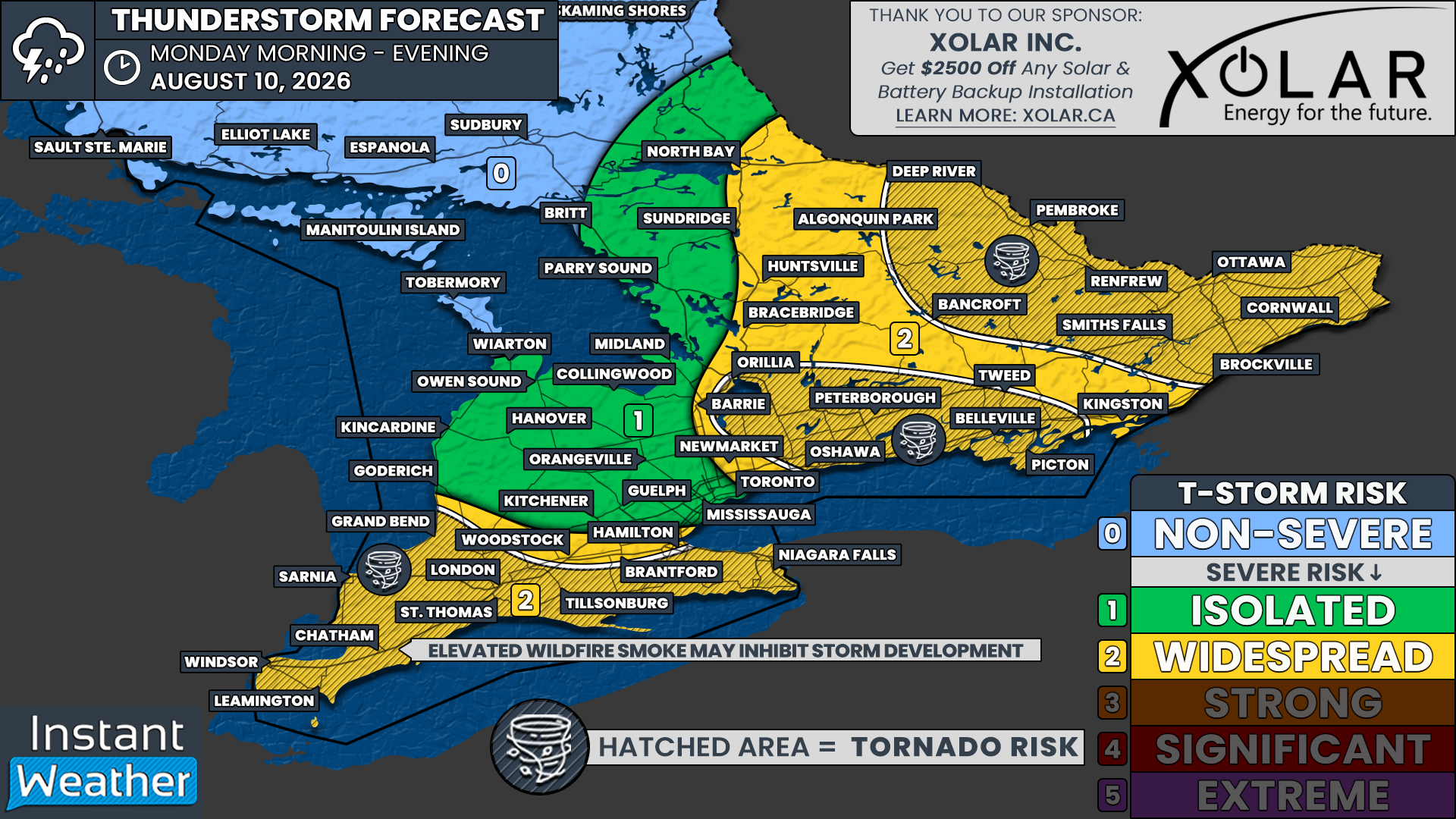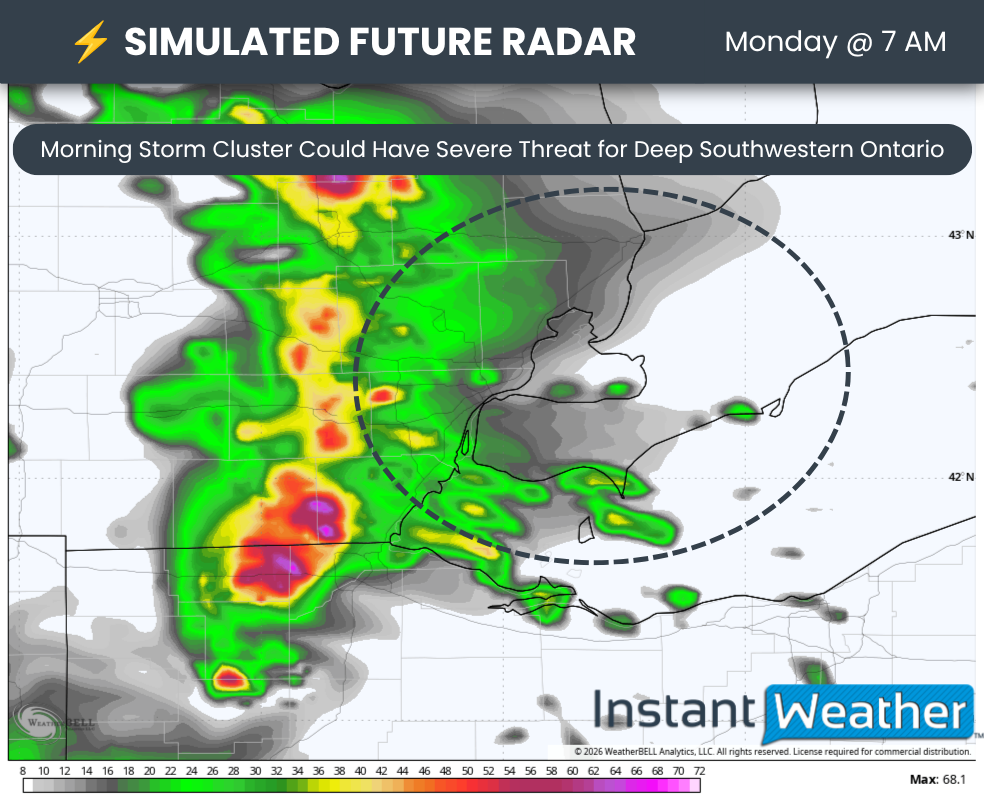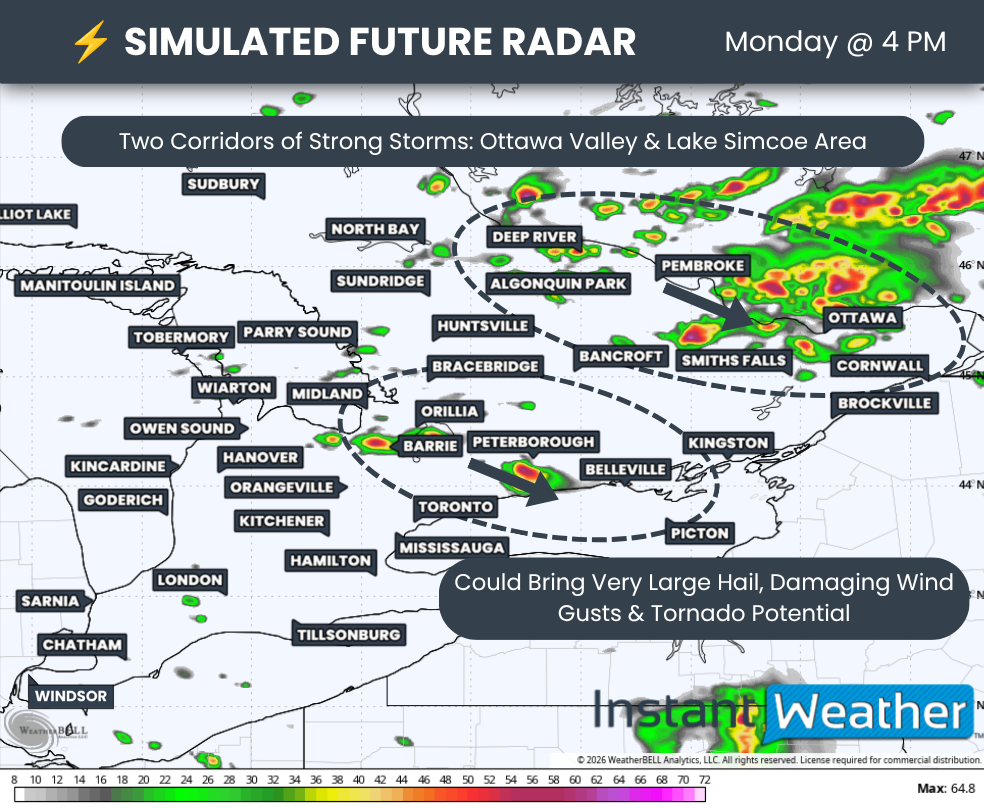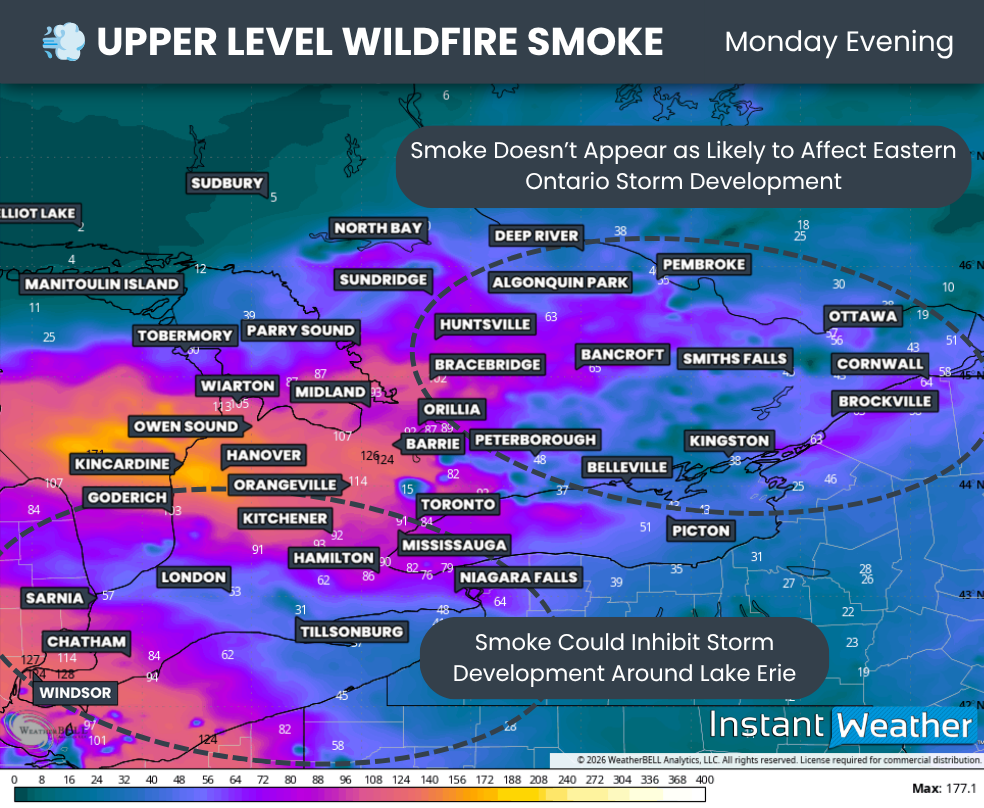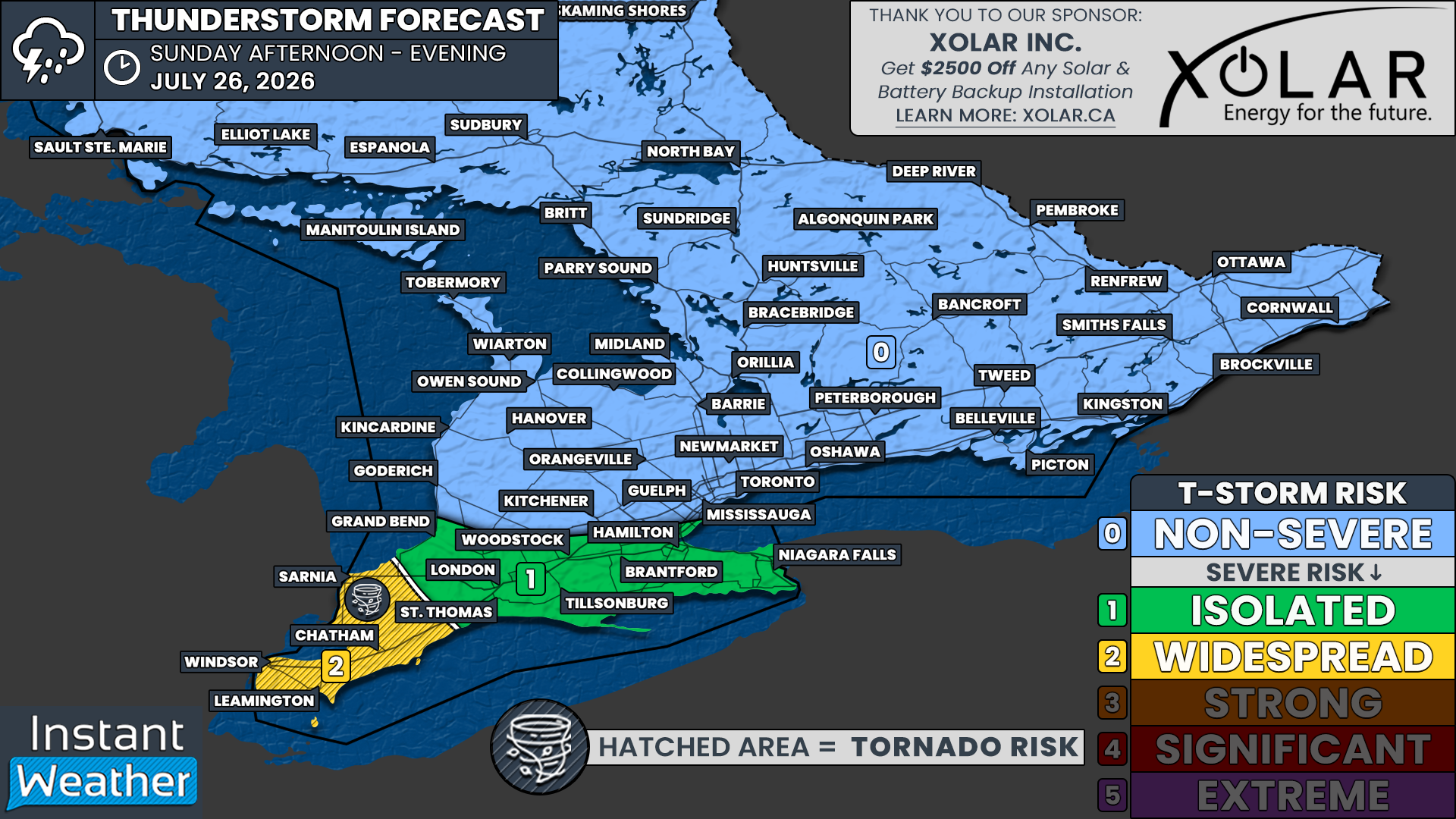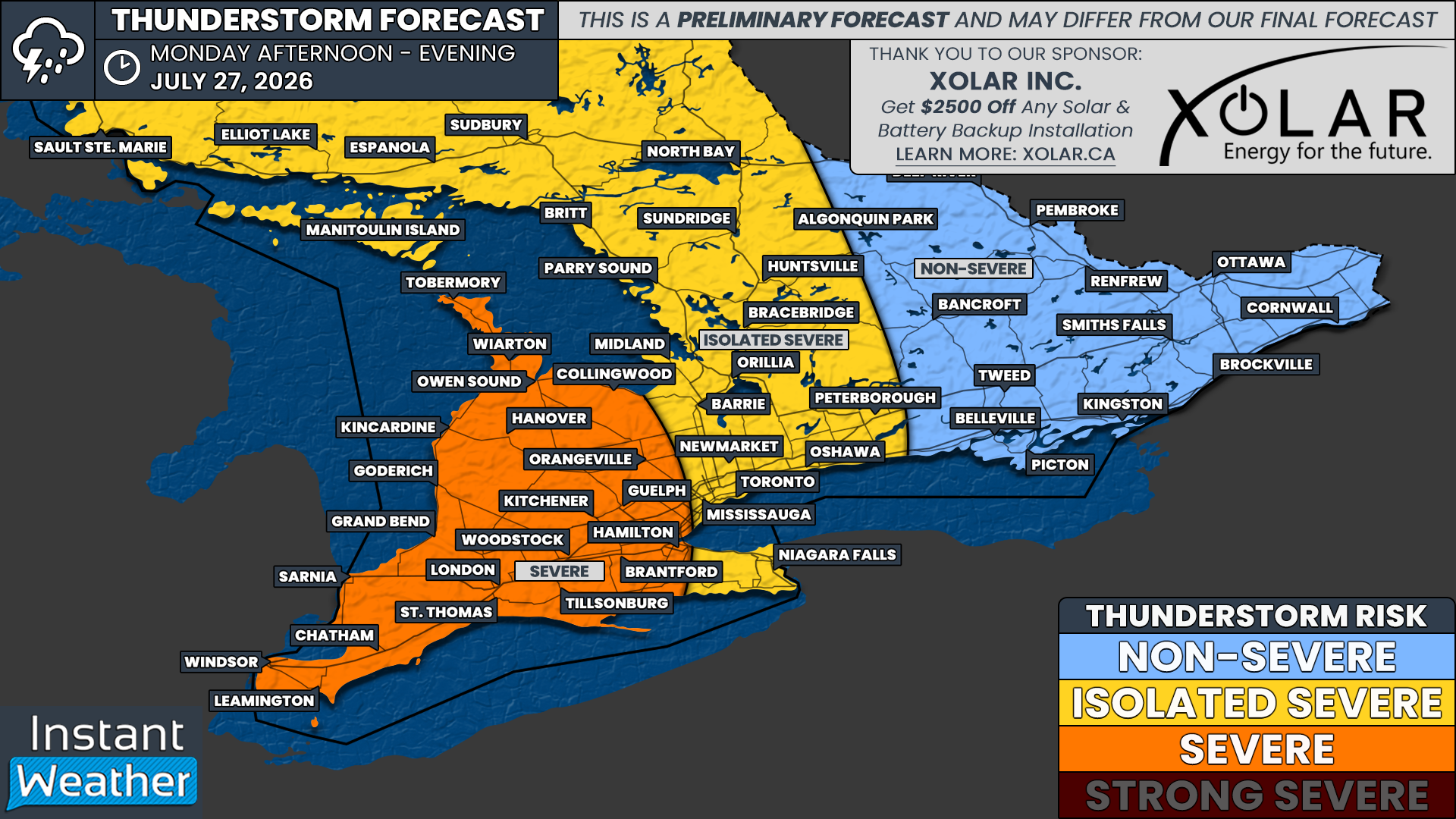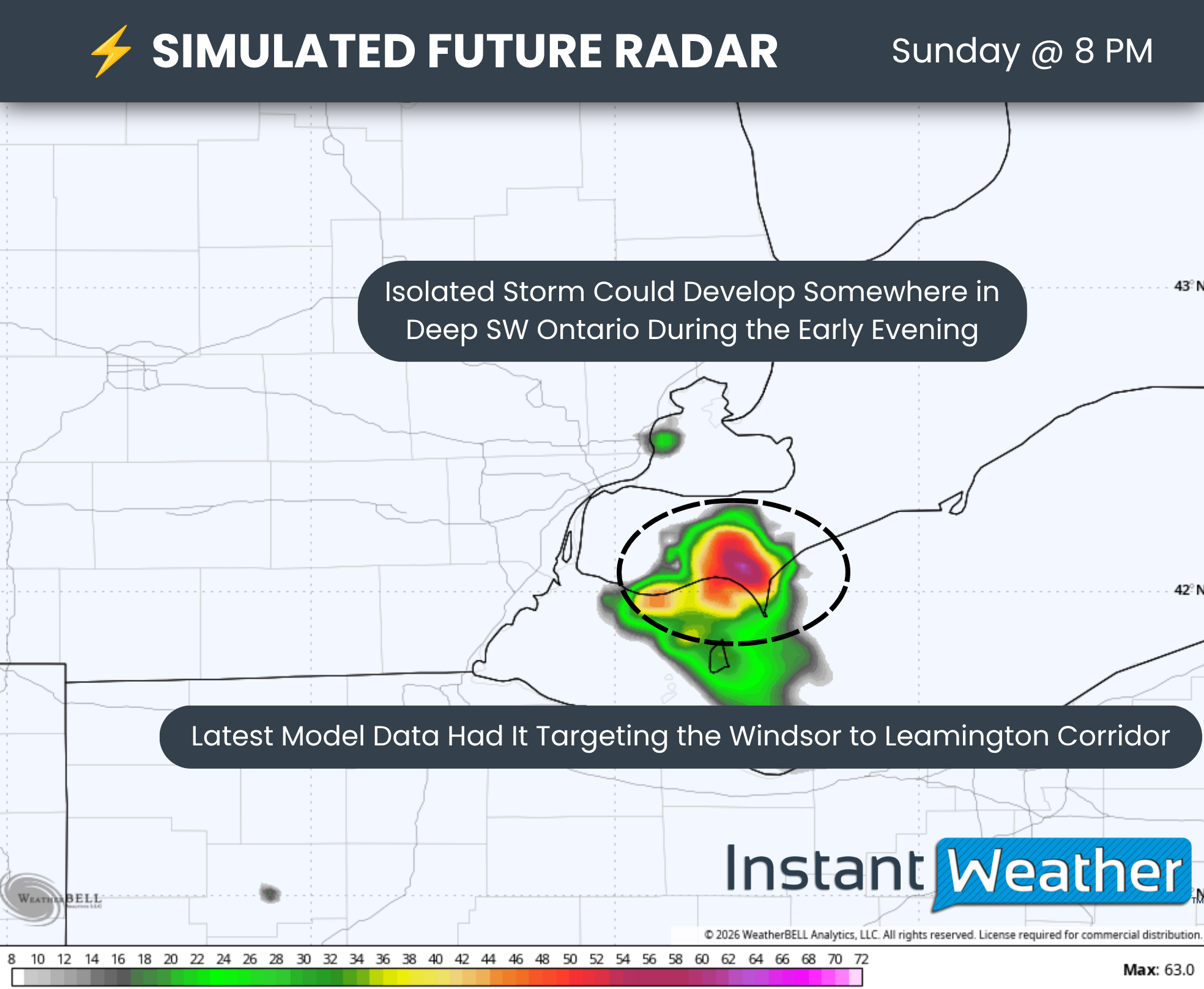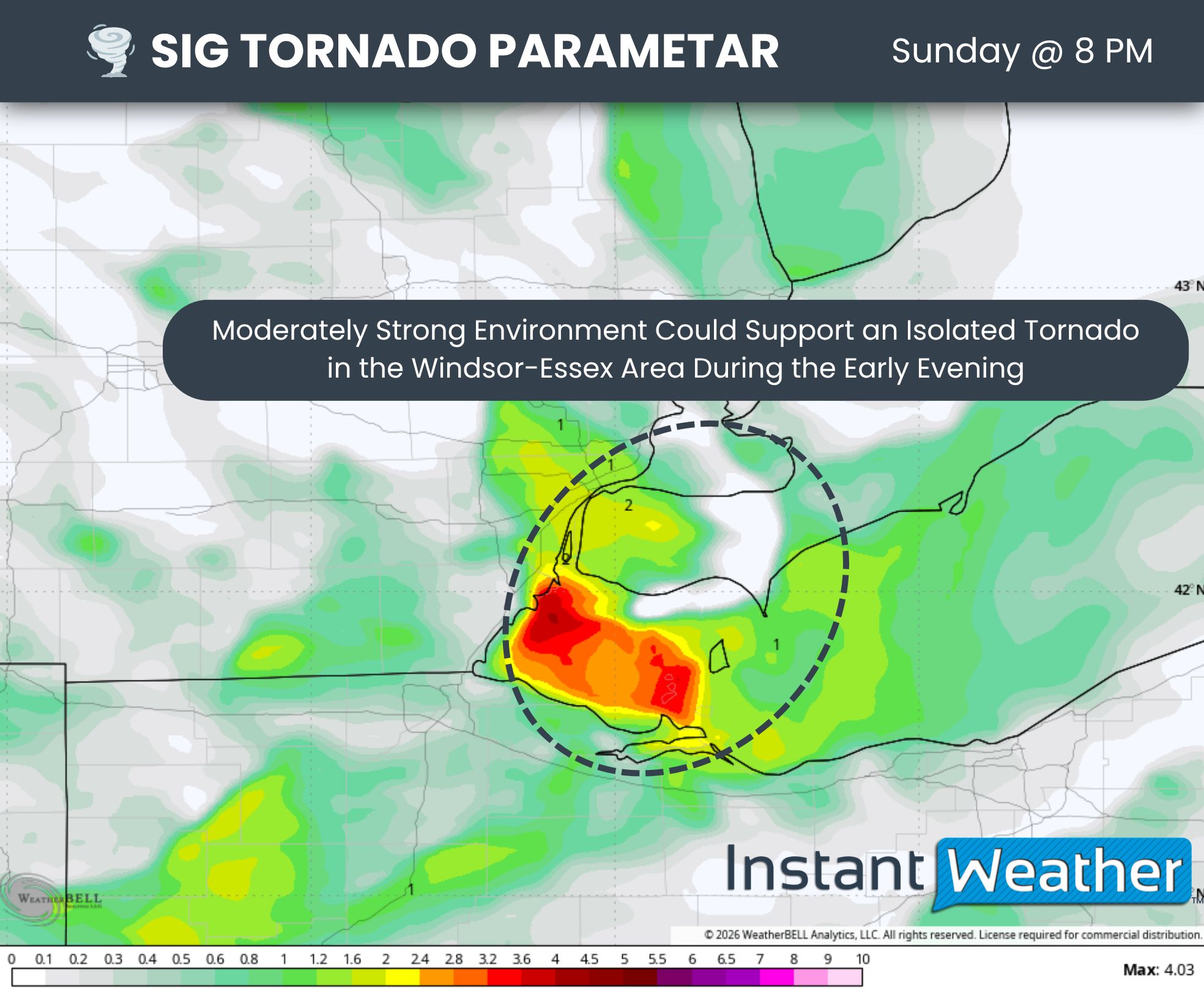
Another Round of Damaging Storms Could Hit Southern Ontario Thursday With Tornado Risk Increasing

THIS FORECAST IS SPONSORED BY:

NOTE: YOU CAN CLICK ON THE MAP TO OPEN A ZOOMABLE IMAGE

After an active Canada Day that saw storms sweep through Southern Ontario, causing damage and power outages from widespread damaging wind gusts, Thursday may feel like déjà vu for some areas. For parts of the province, this could be the third severe weather risk of the week.

Fueling all of this active weather is the ongoing heat event, which has led to temperatures soaring into the mid to upper 30s across many locations. Thursday is expected to be similarly hot, creating more than enough instability for another round of severe weather.

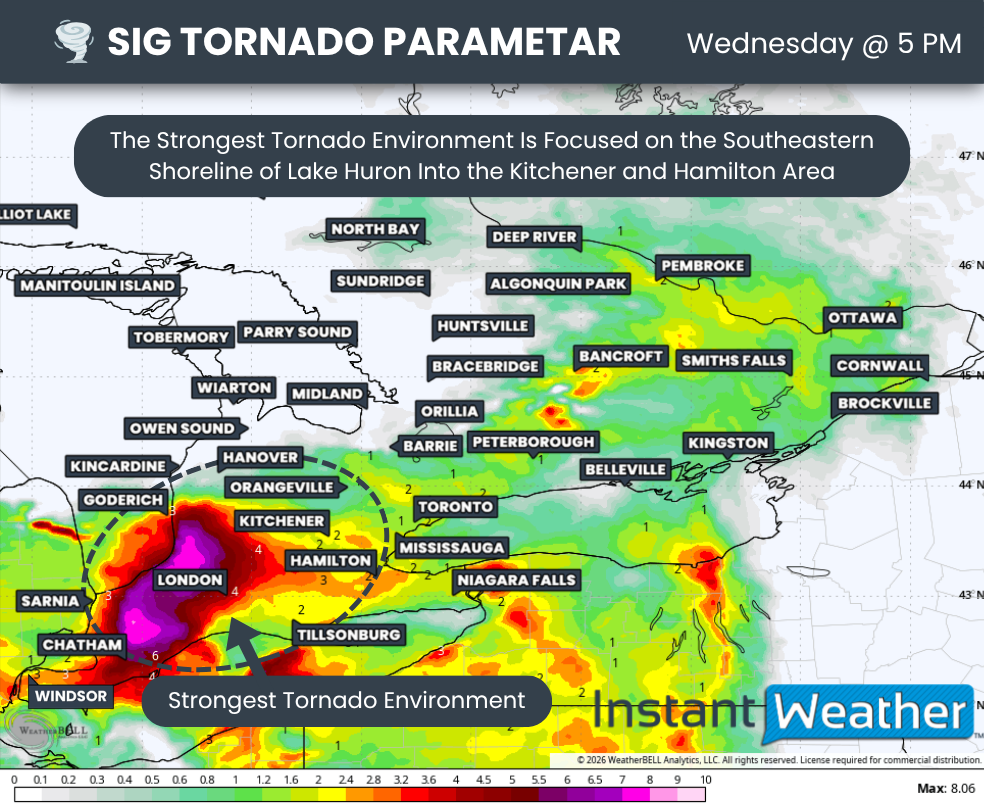
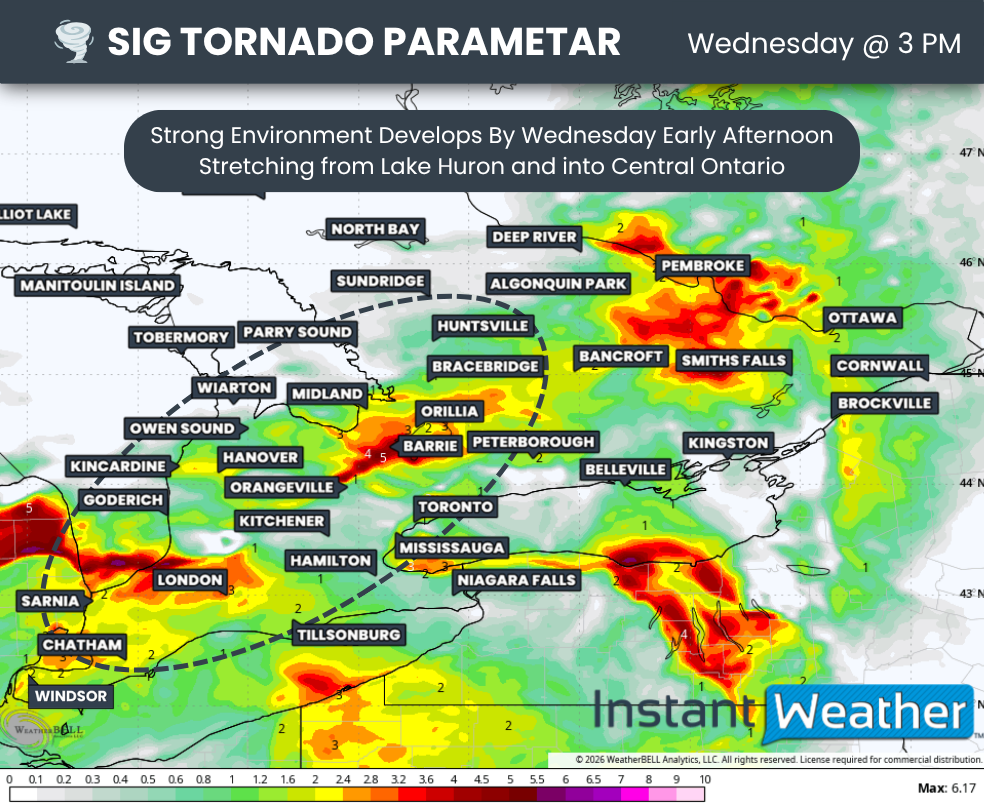
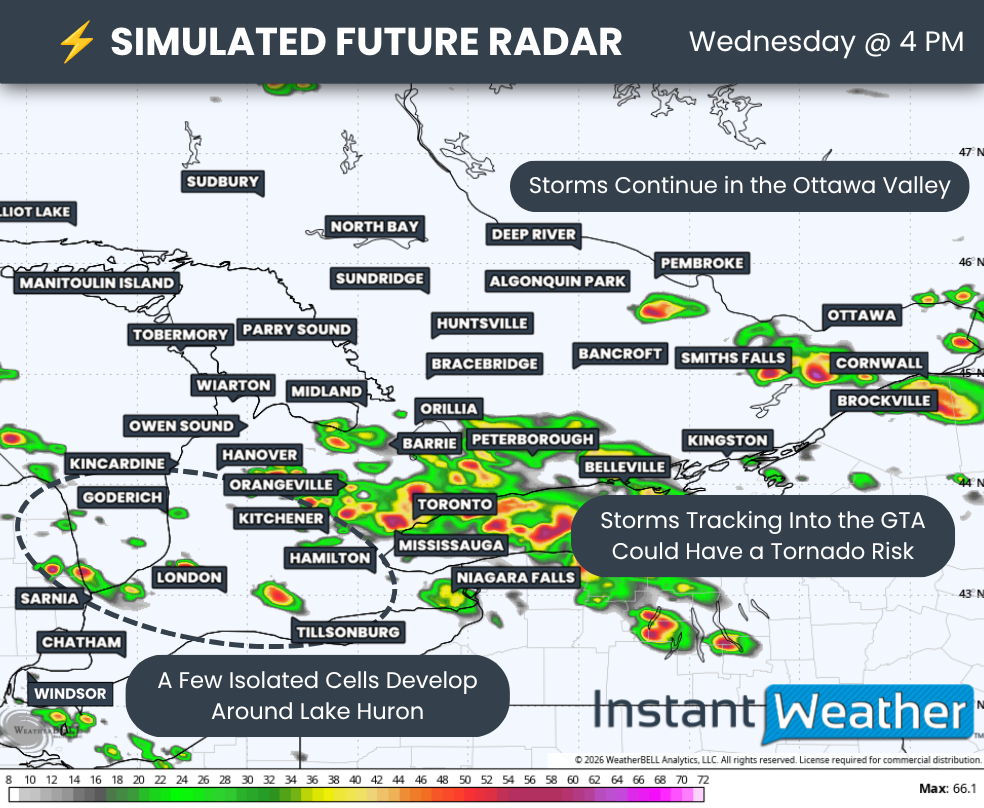
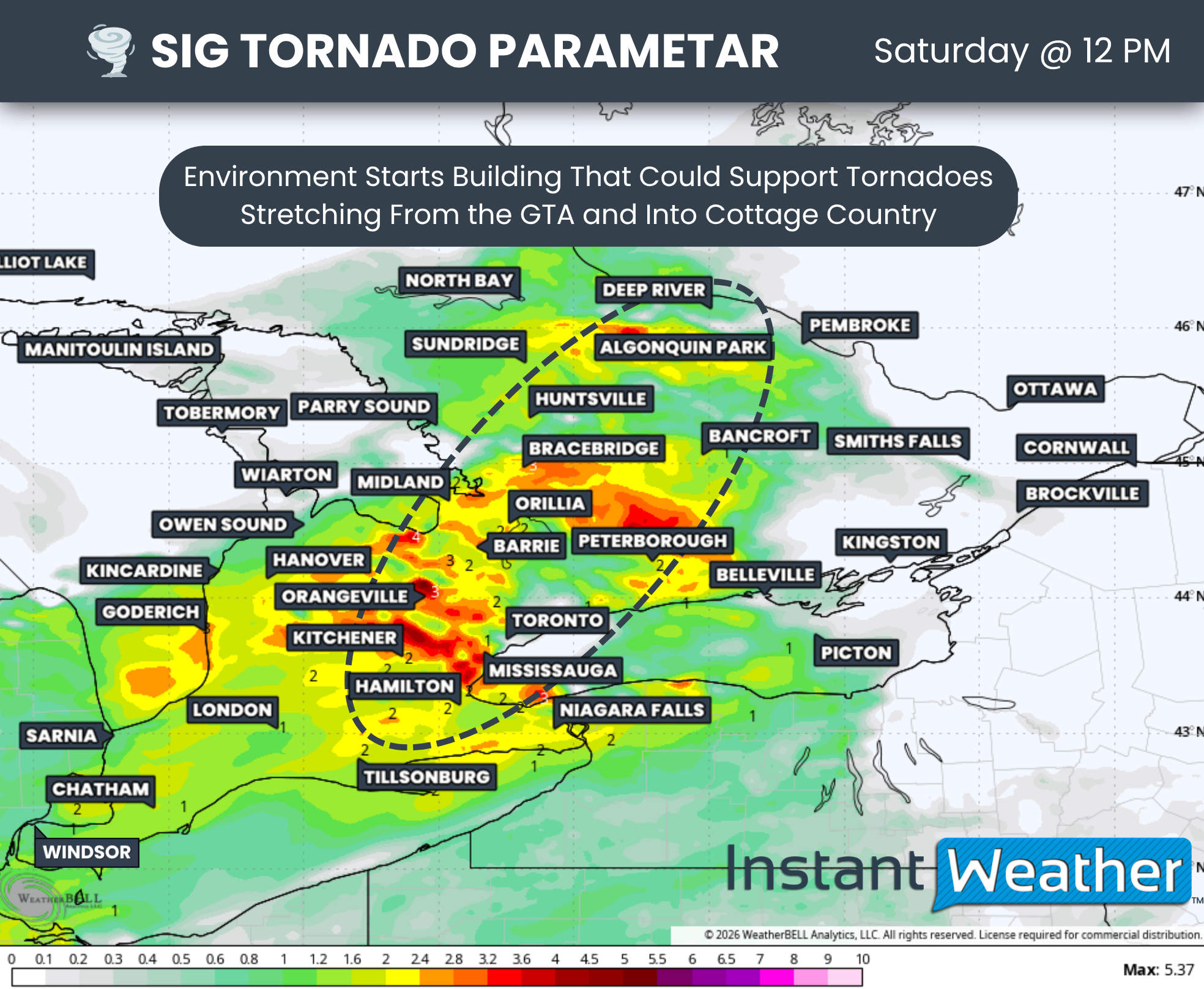
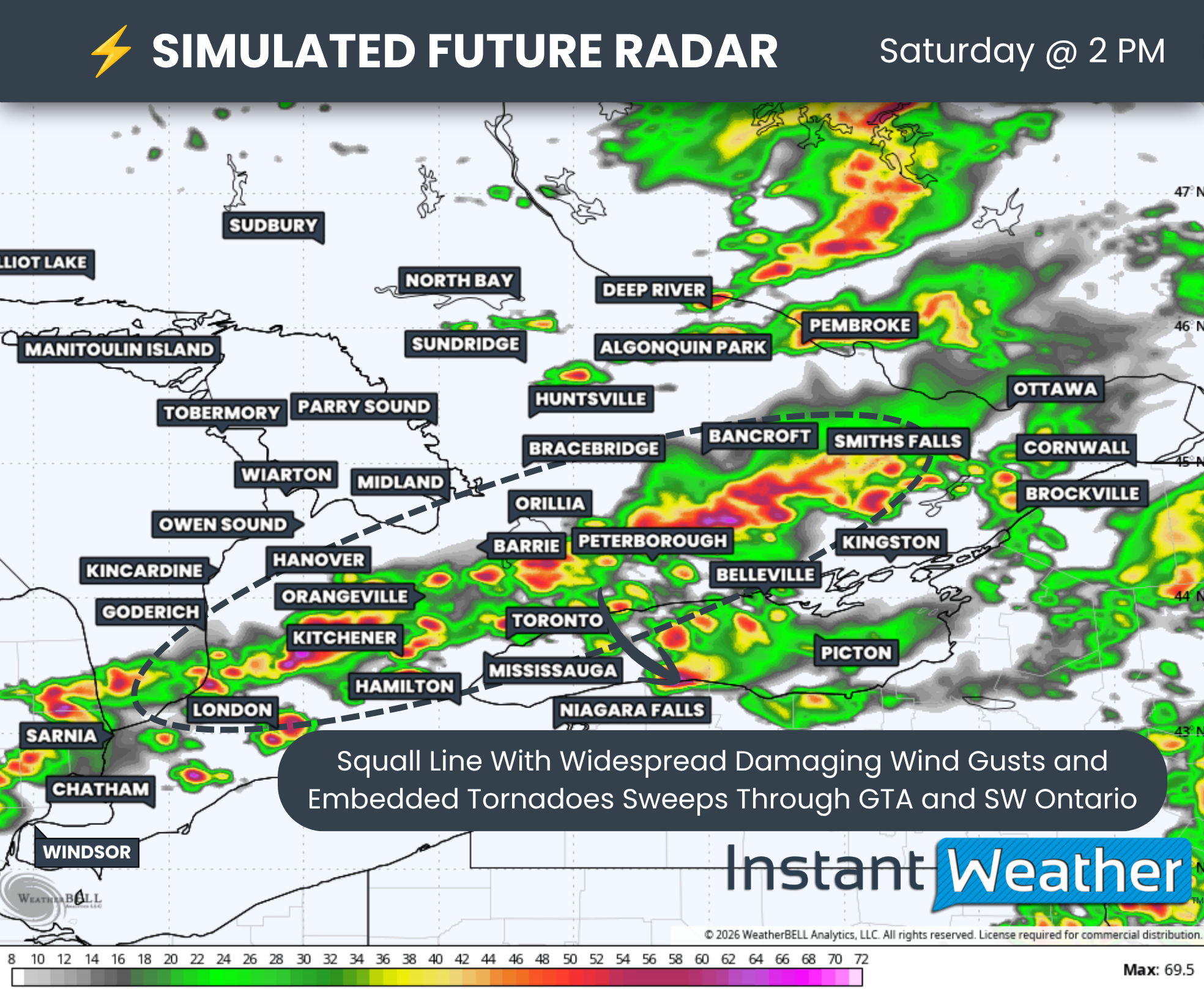
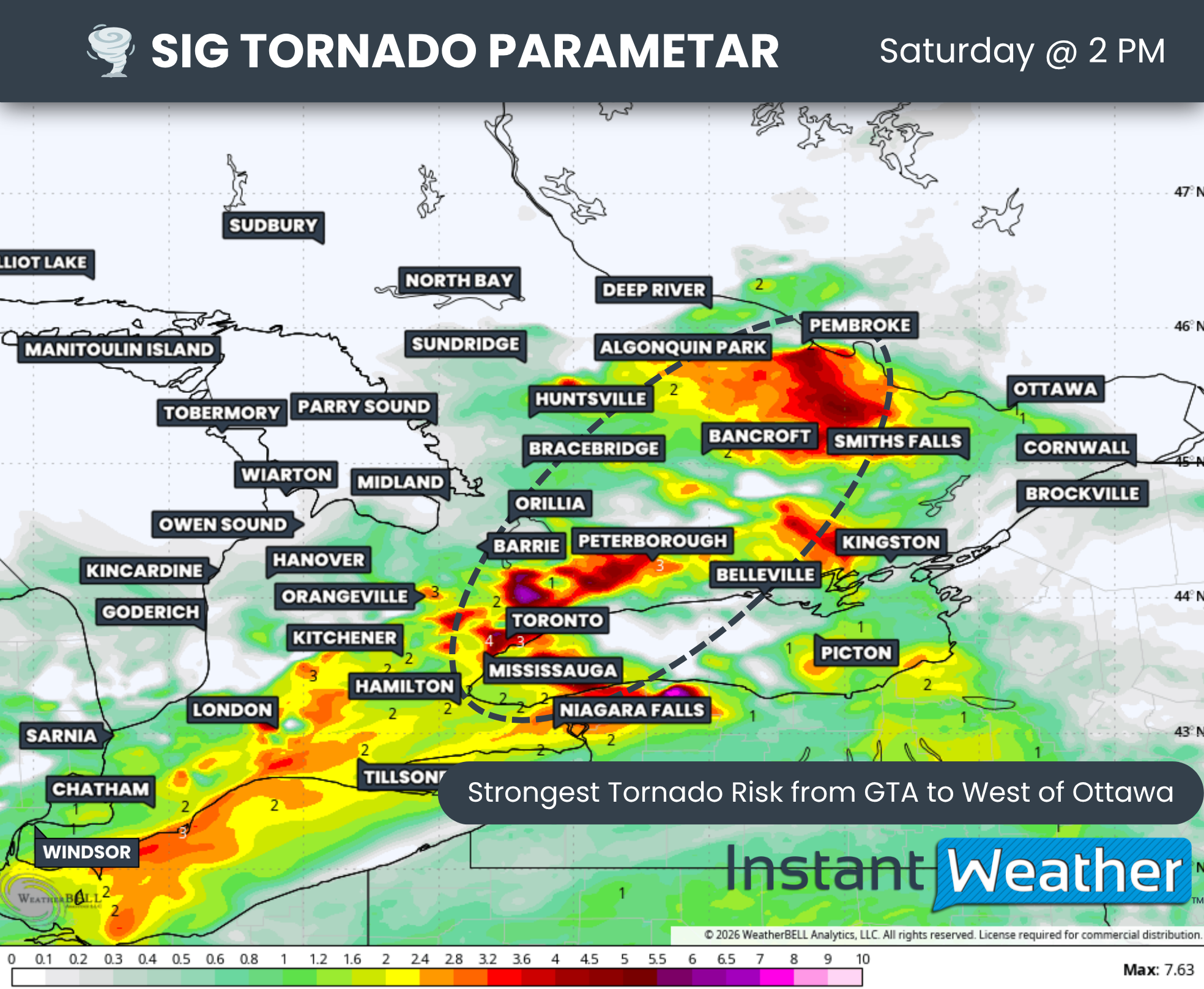
While Wednesday’s risk was mainly focused on damaging wind gusts, Thursday could feature a more defined tornado risk, with one or two tornadoes possible. The focus of this tornado risk appears to be in Southwestern Ontario near the Lake Huron shoreline, along with parts of Eastern Ontario, including the Ottawa Valley.

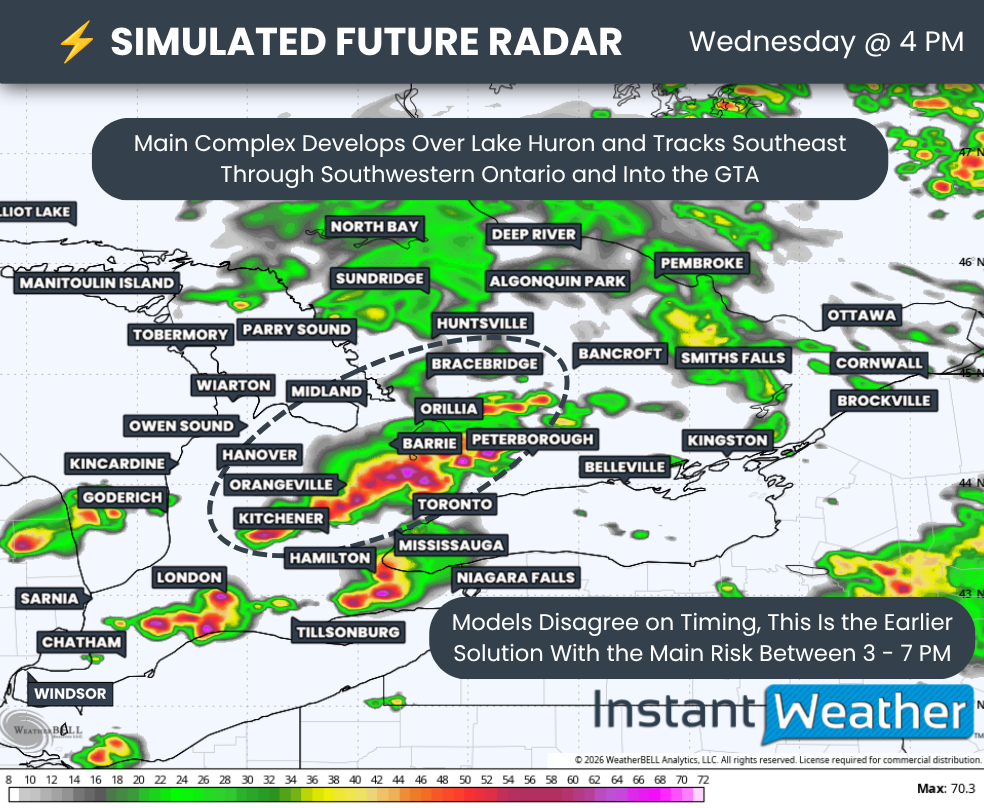
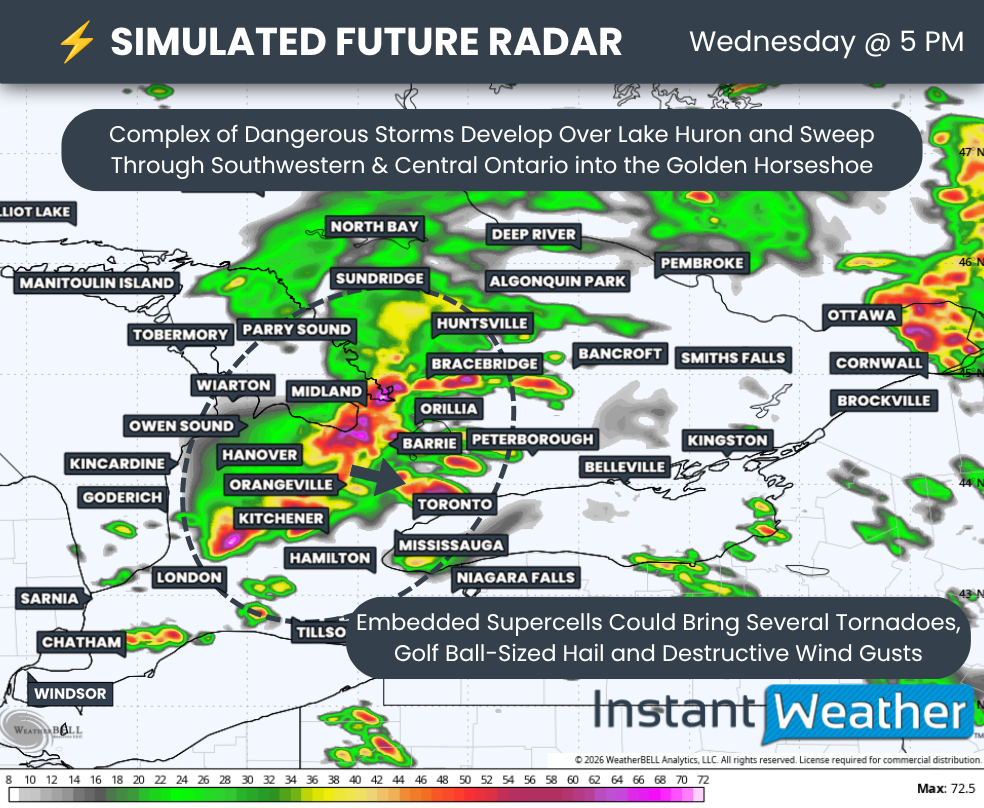
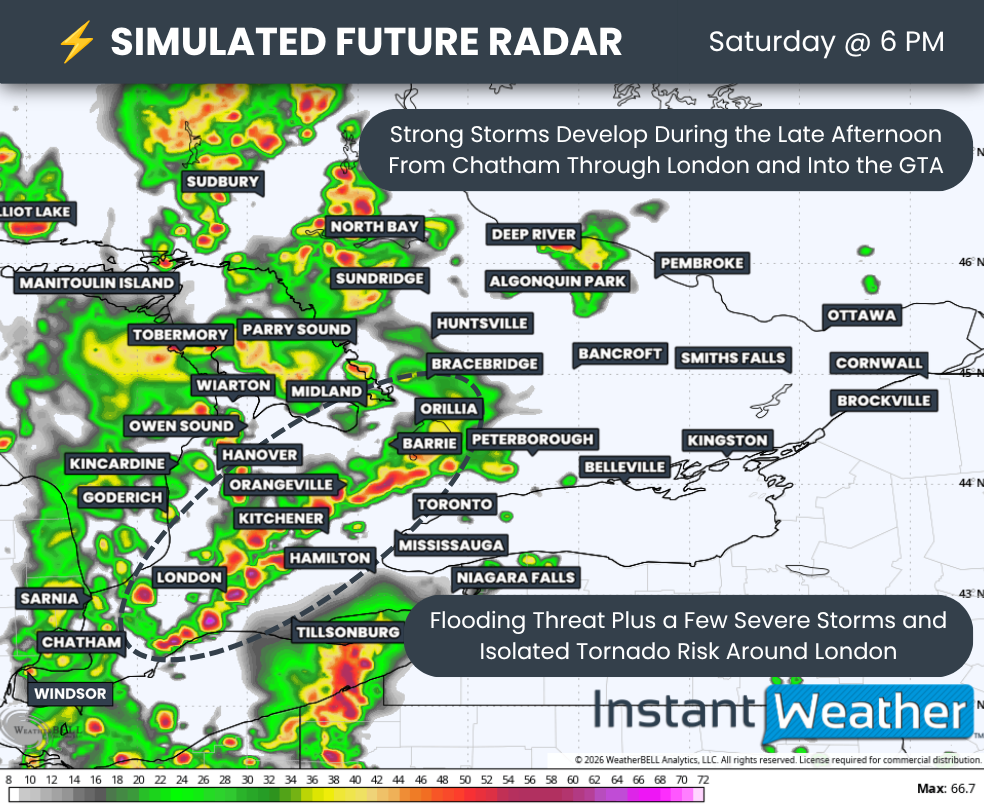
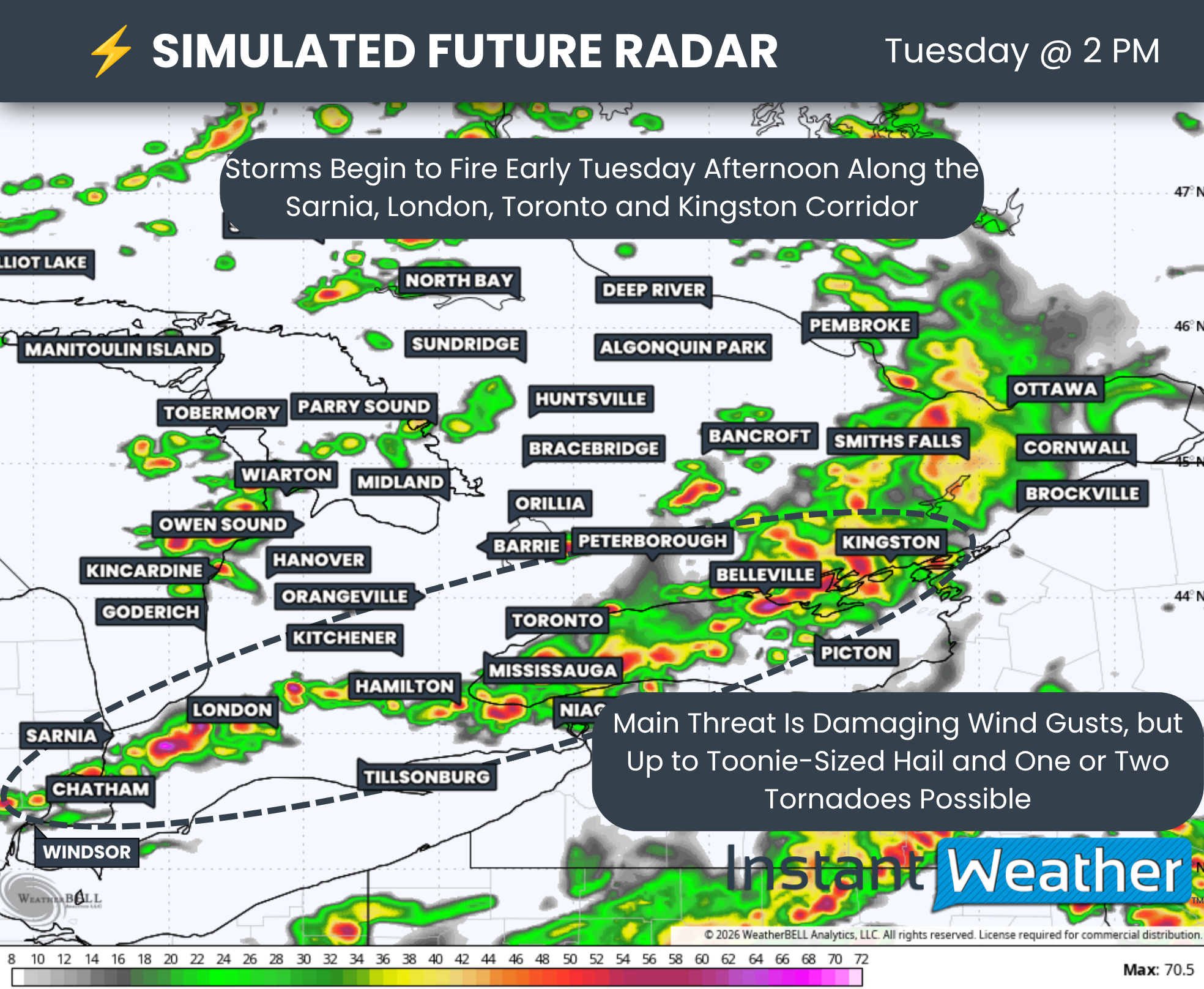
The damaging wind gust threat also remains very present. Similar linear-like storms could sweep through a corridor from Lake Huron into the GTA, and then toward the Lake Simcoe, Peterborough and Kingston areas.

Up to Timbit-sized hail is also possible, especially across Eastern Ontario, along the Lake Huron shoreline and around the London area. In these regions, a more isolated storm mode could support a few supercell thunderstorms.

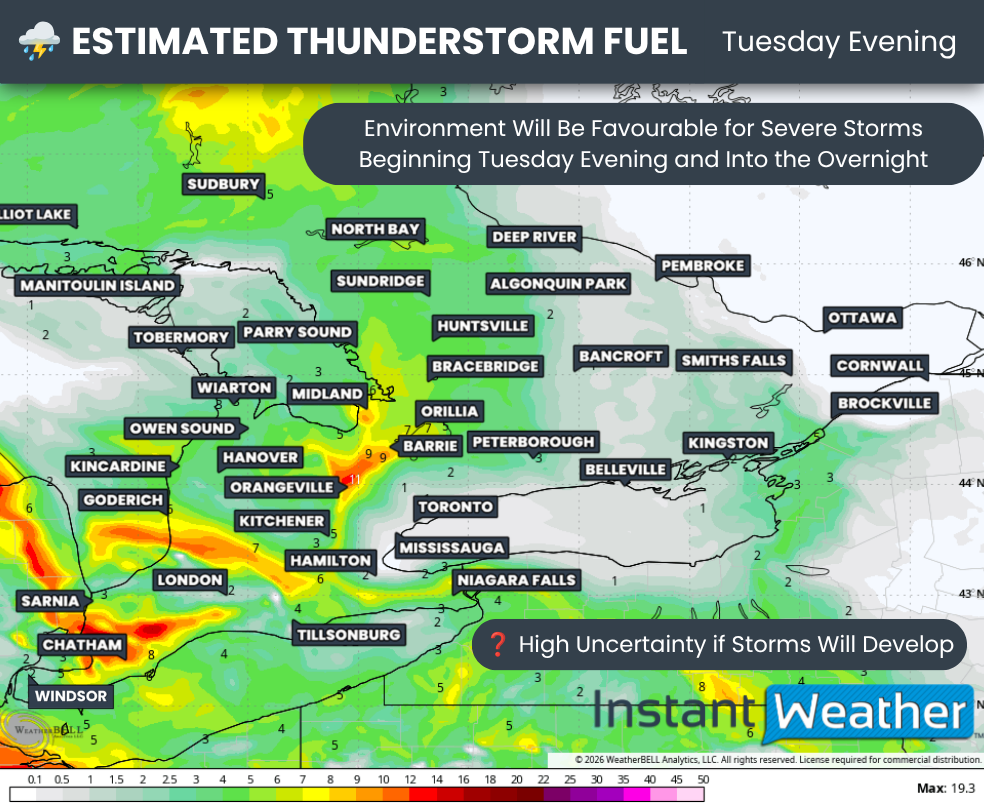
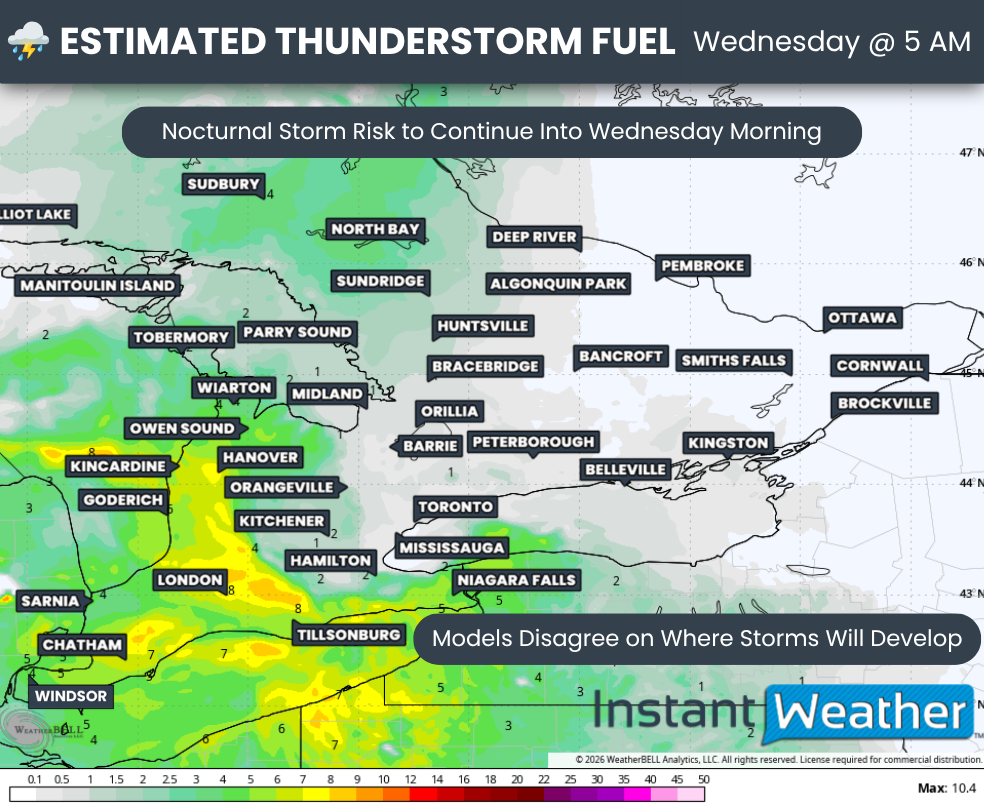
Once again, models are struggling to pinpoint exactly when and where storm development will happen. They tend to perform poorly in these types of dynamic setups, especially when storms are triggered by smaller-scale features such as lake breezes and outflow boundaries from other storms.

What we do know is where the strongest environment is located, along with a rough idea of where models are most likely to develop storms.

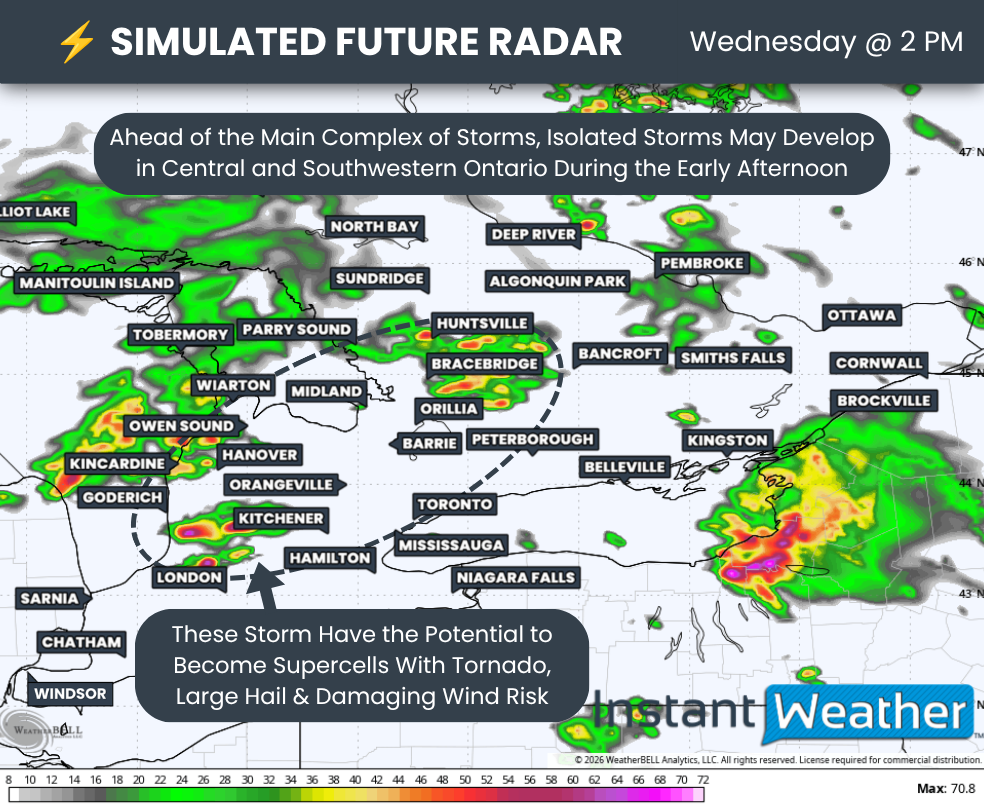
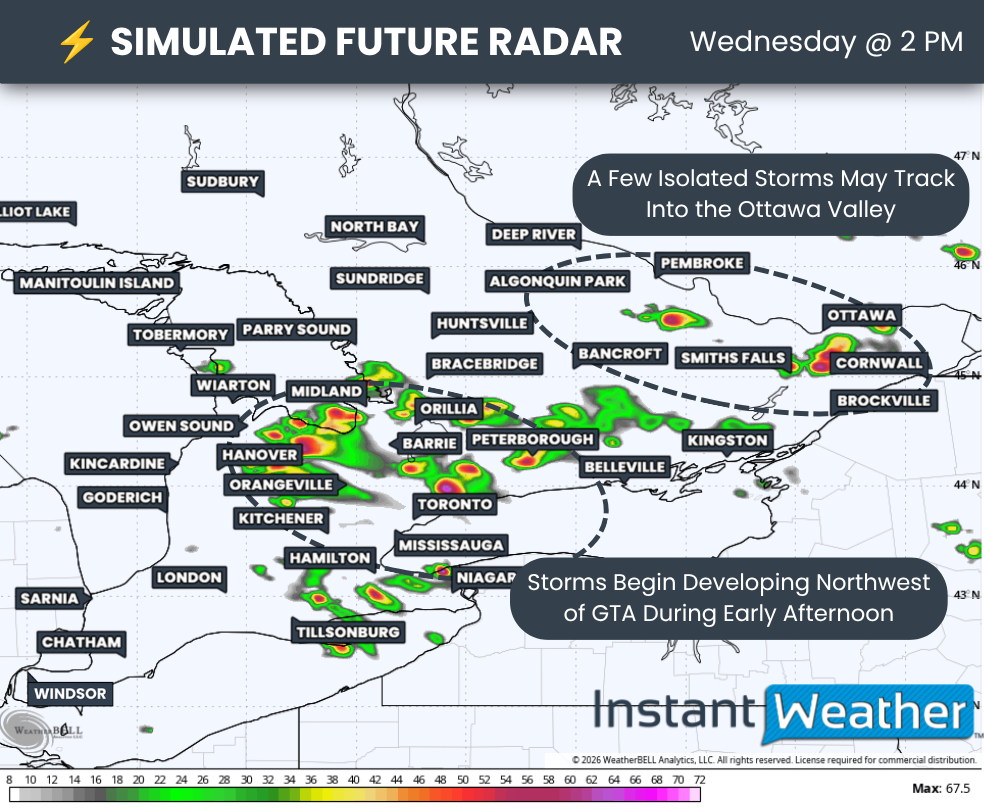
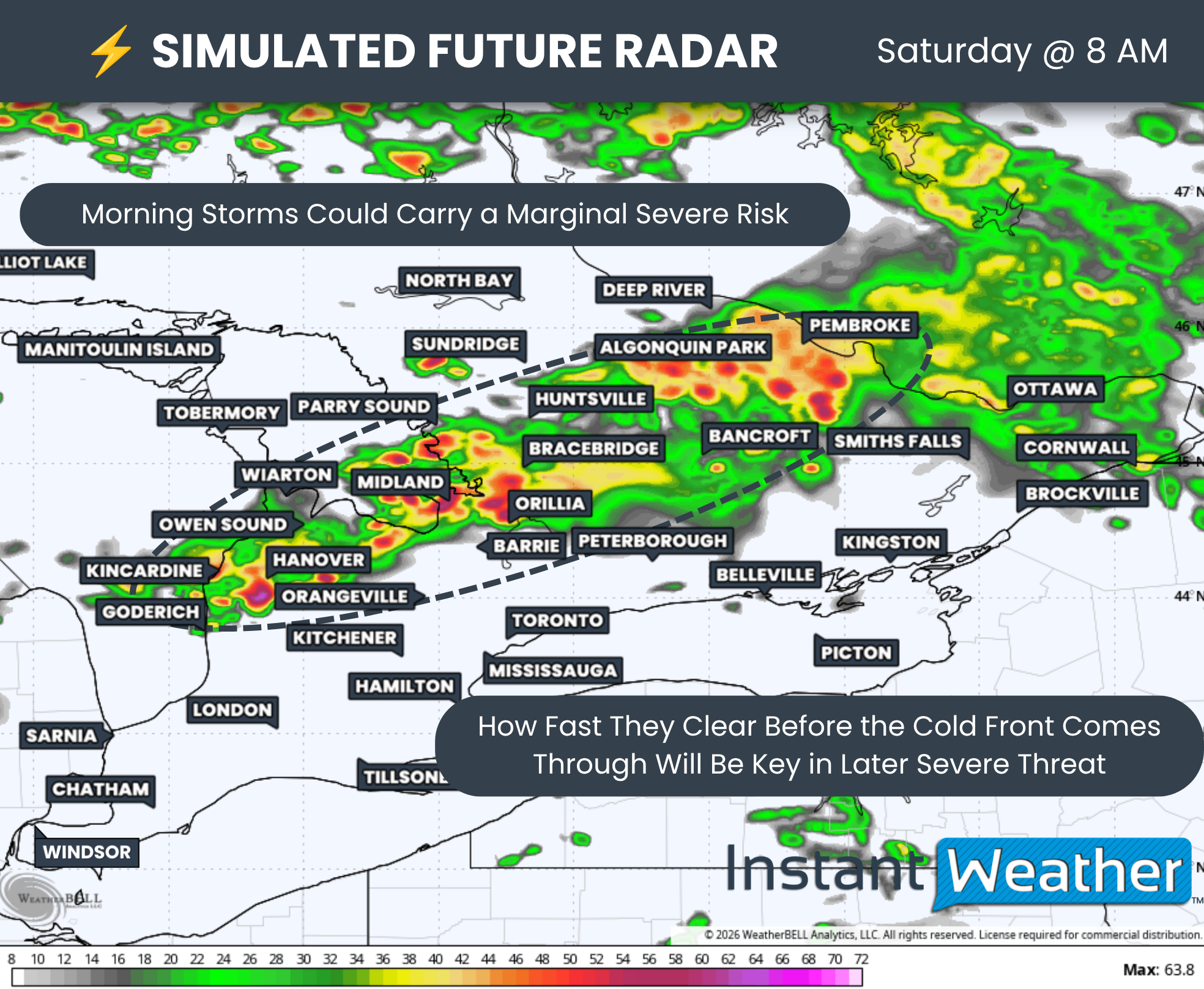
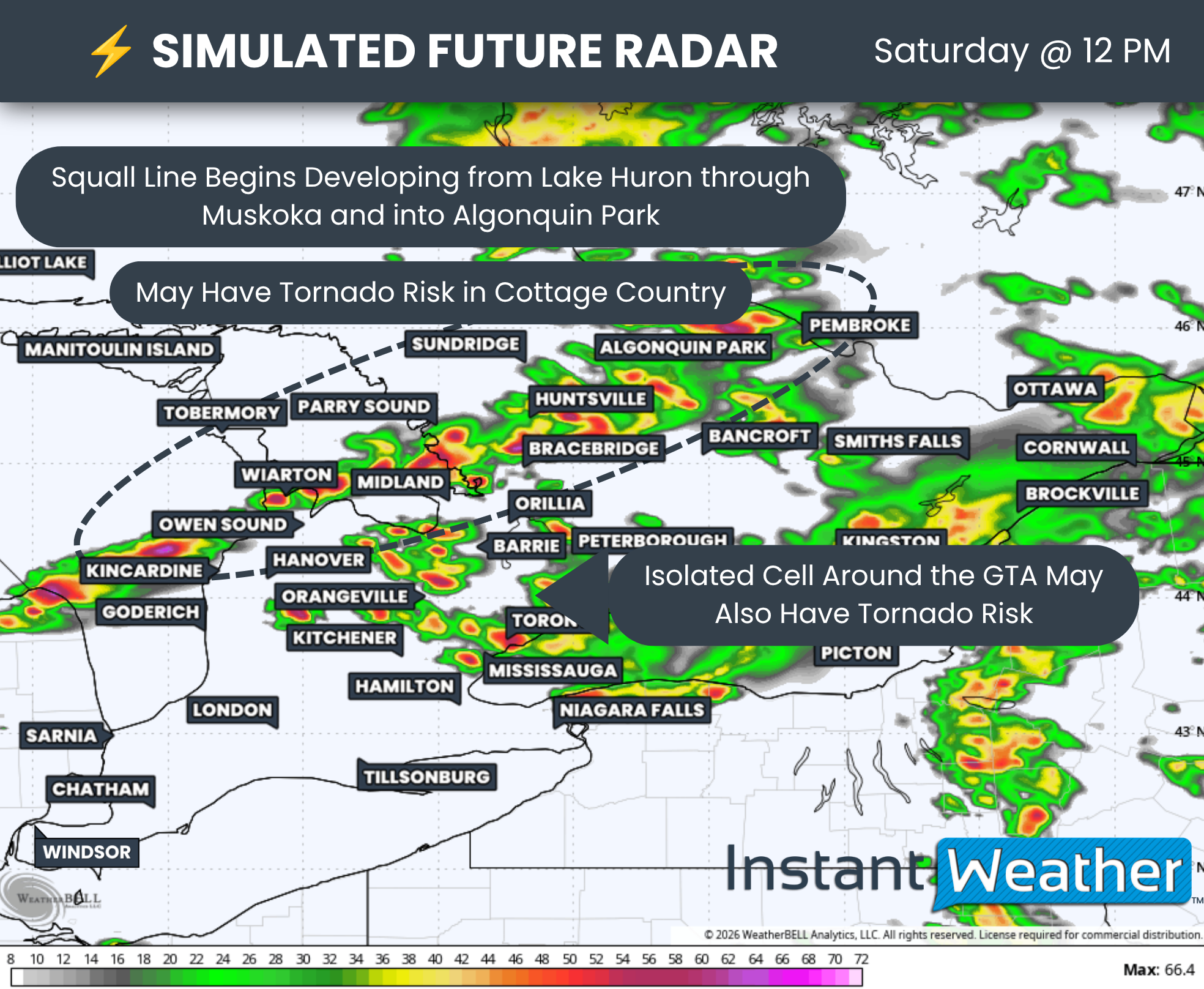
That begins during the afternoon, when we could see isolated cells develop from the Lake Simcoe area down toward Kingston. These storms could support a tornado risk, which is why this corridor is also highlighted on our map for tornado potential.

However, confidence is lower in this area. Not every model shows storm development, so this part of the forecast will depend heavily on whether the right triggers are in place.

Another zone of possible storm development can be found across the Ottawa Valley and Eastern Ontario during the evening. A strong shear environment could support rotation if storms are able to develop.

Similar to the afternoon Lake Simcoe risk, confidence is lower here because not all models show storm development. The threat will depend on whether storms can actually form and take advantage of the environment.

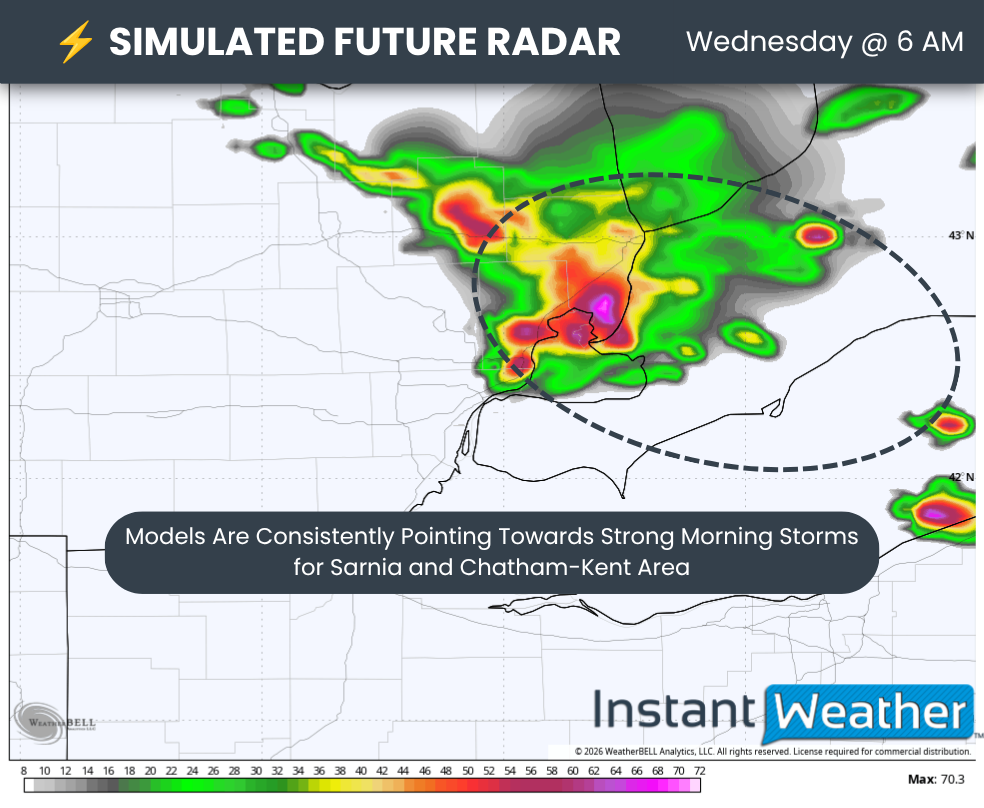
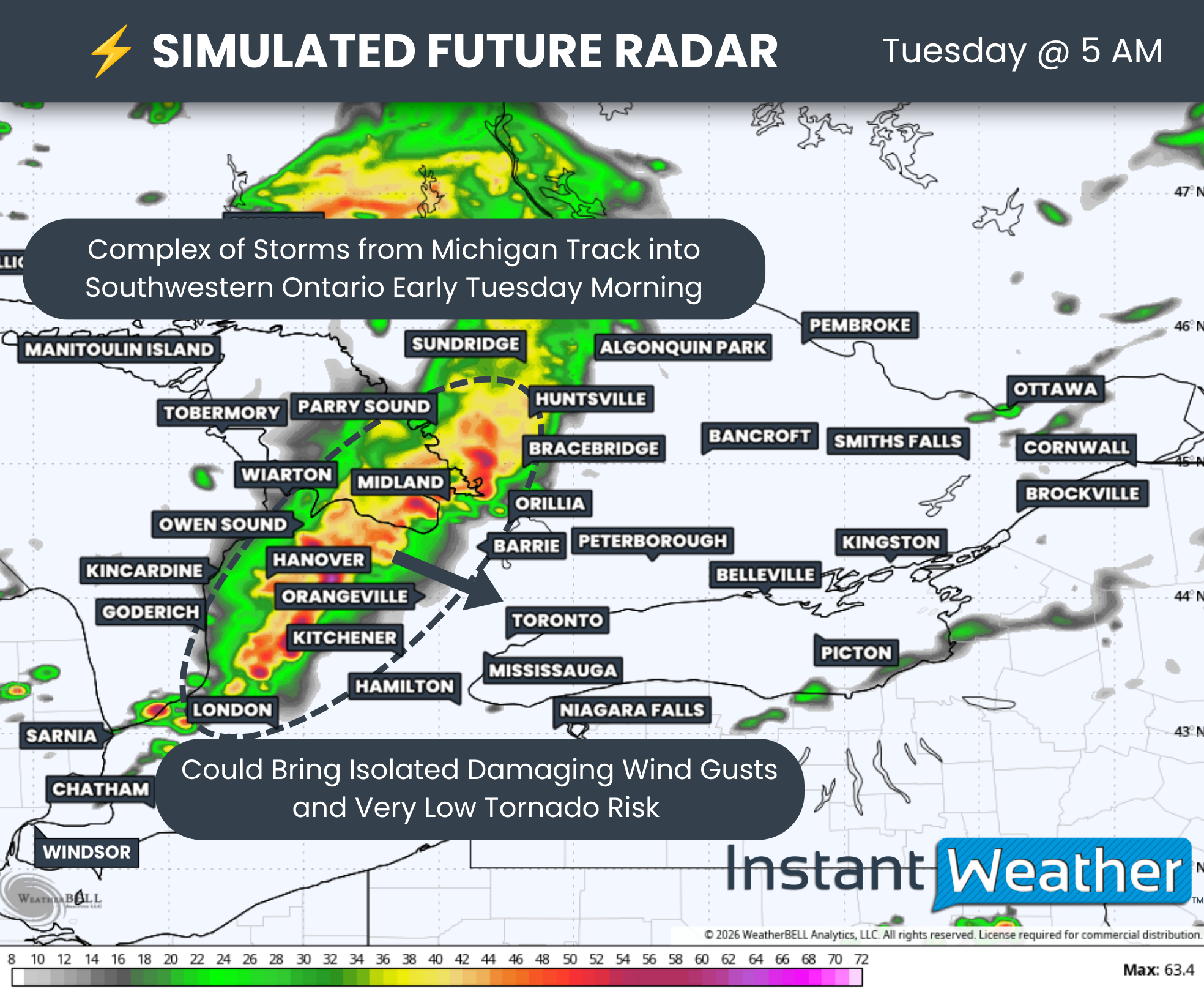
The Lake Huron storms may eventually merge into a larger complex and bring a potential late-night damaging wind gust risk through the GTA and Niagara region.

There is still some question about how long this complex would be able to maintain its strength, especially once we lose daytime heating. However, if it holds together, damaging wind gusts could once again become a concern.

NOTE: YOU CAN CLICK ON THE GRAPHIC TO OPEN A ZOOMABLE IMAGE

THIS FORECAST IS SPONSORED BY:


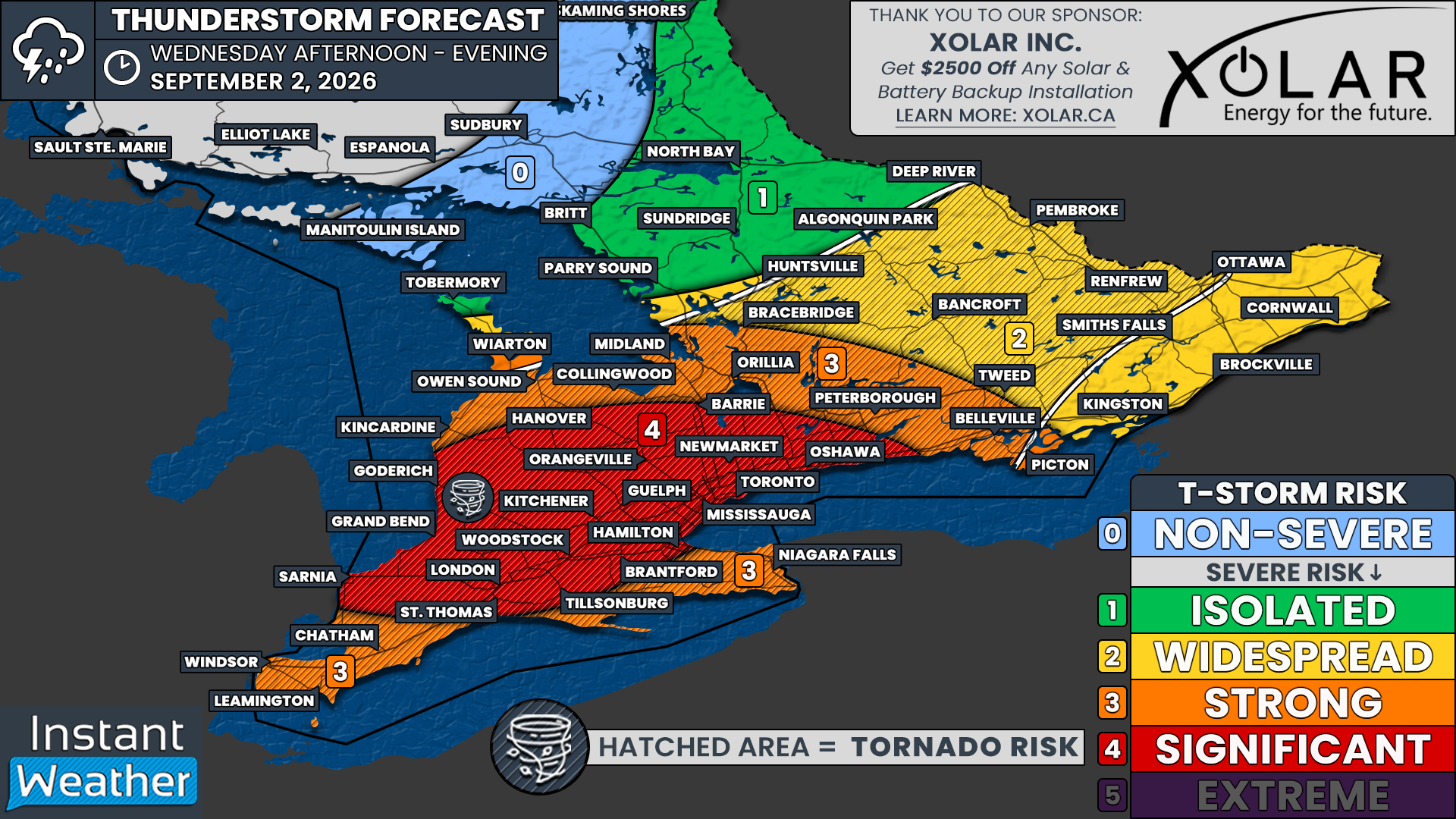
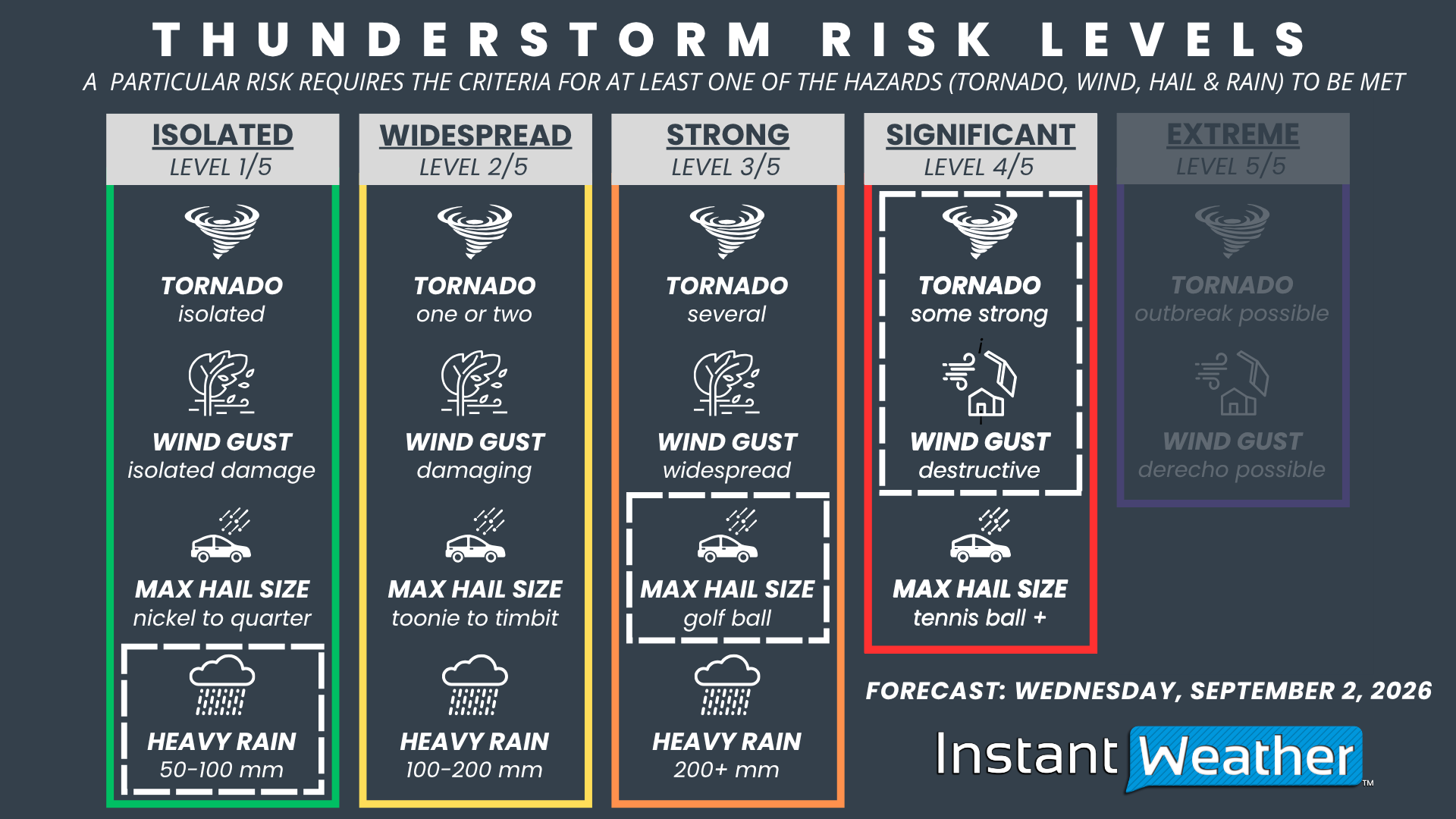
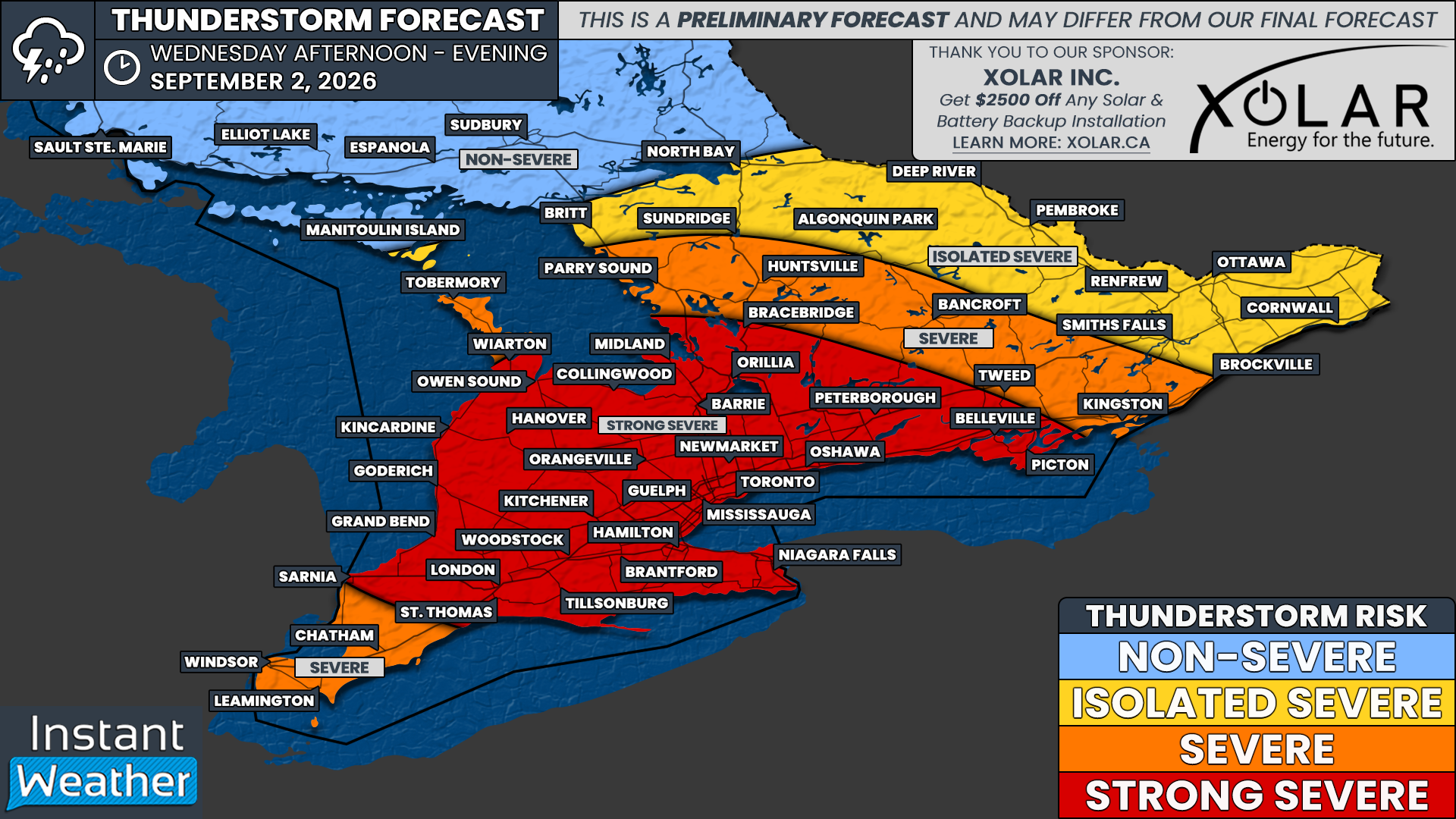
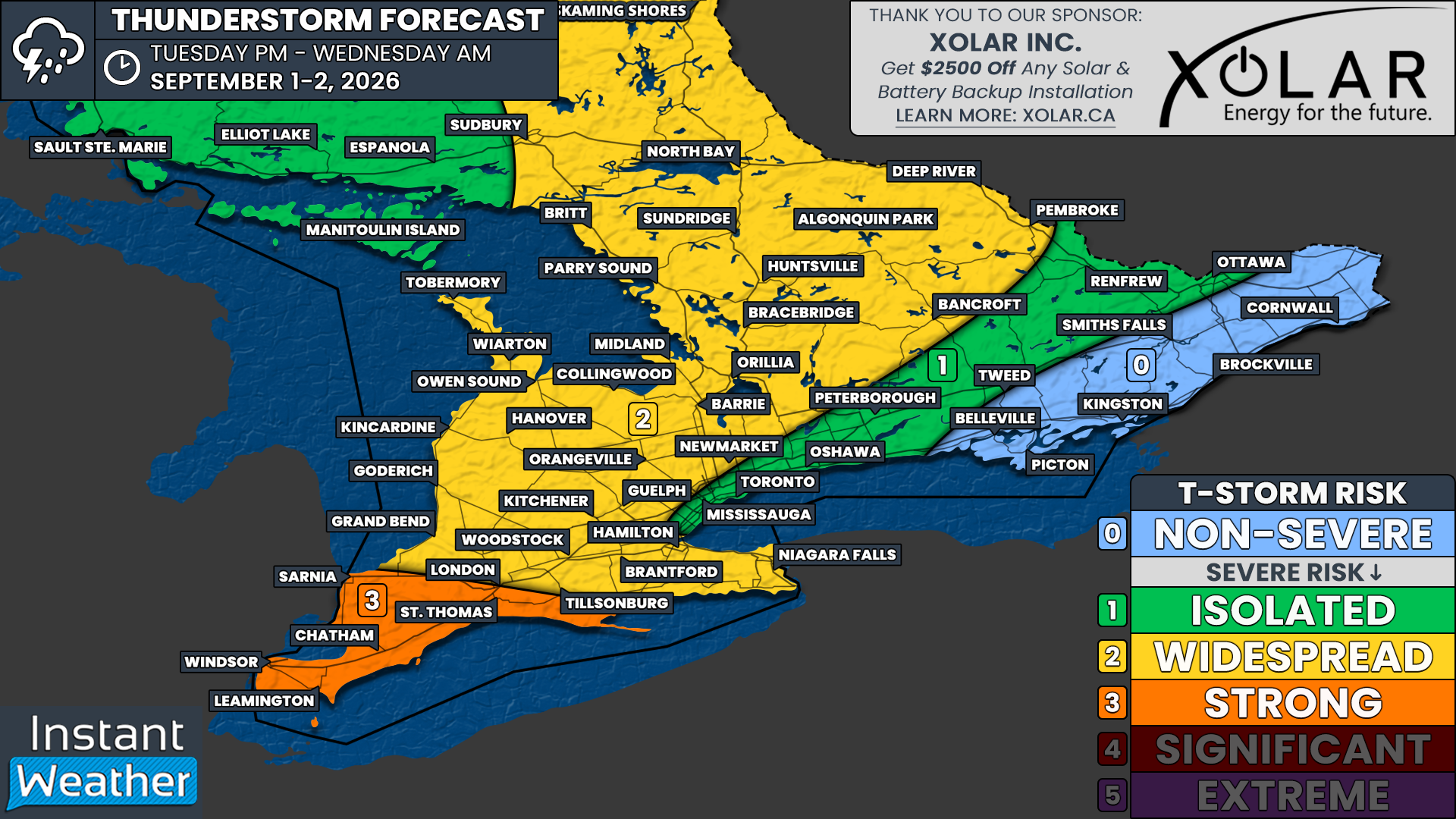
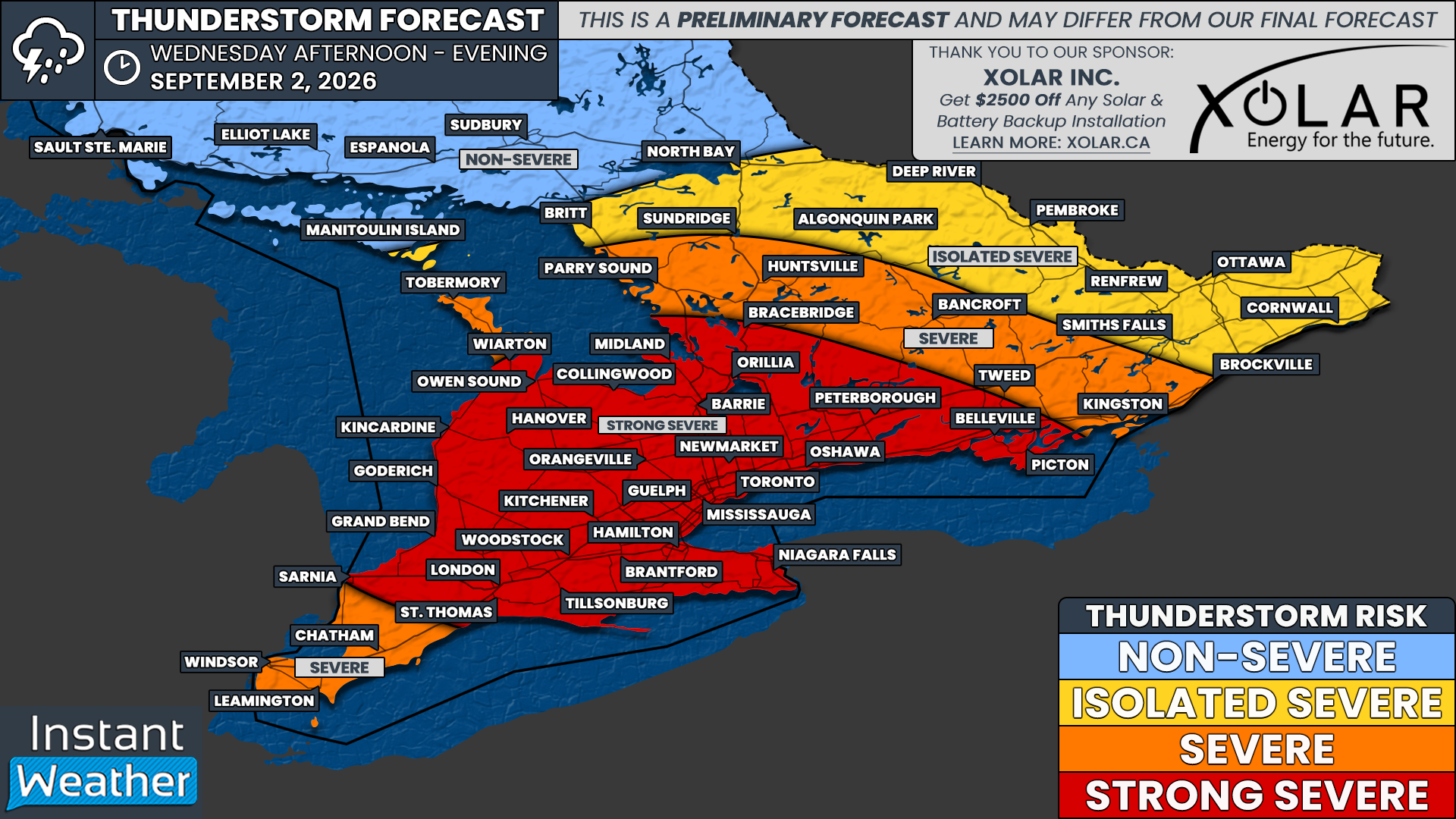
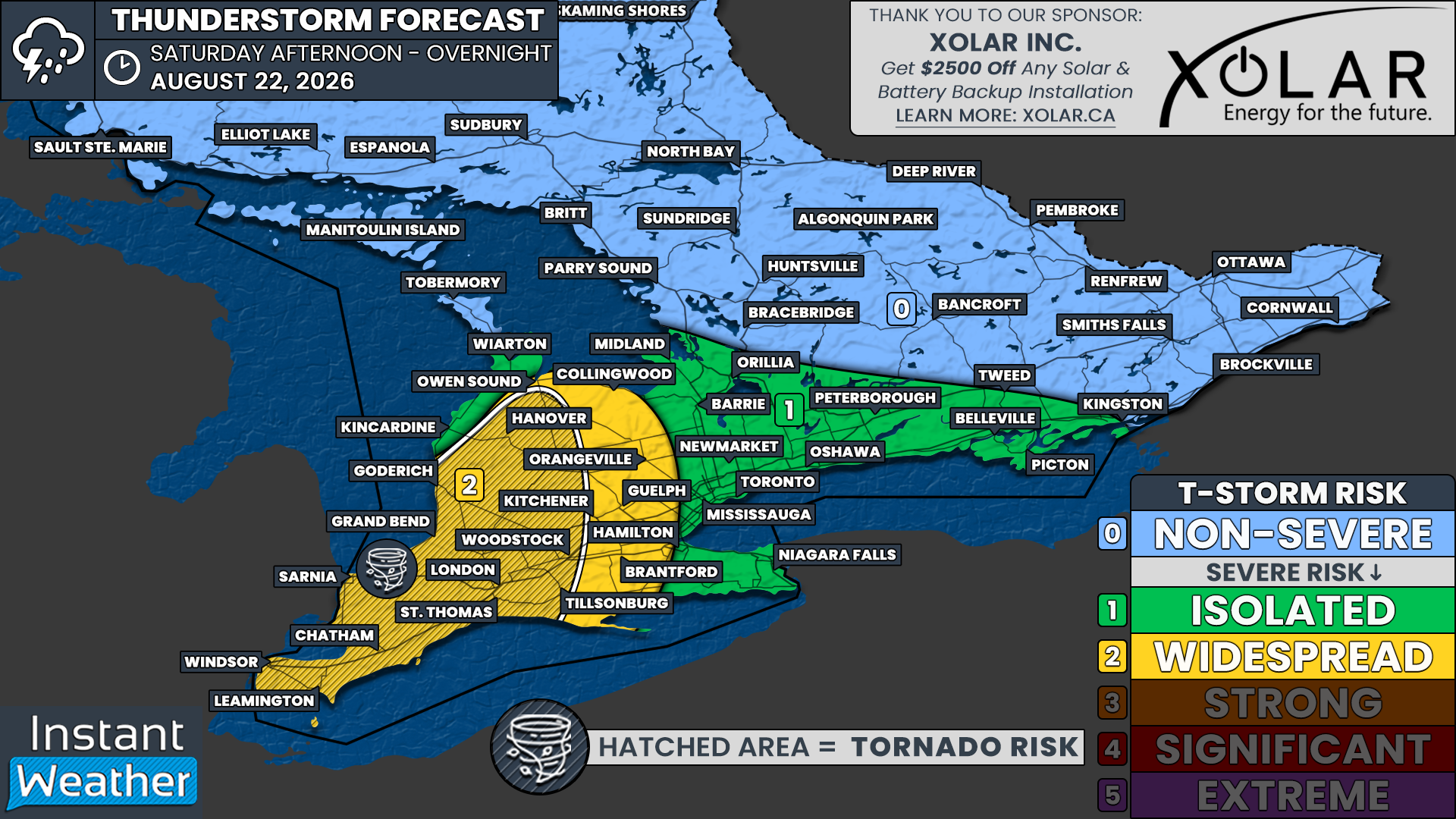
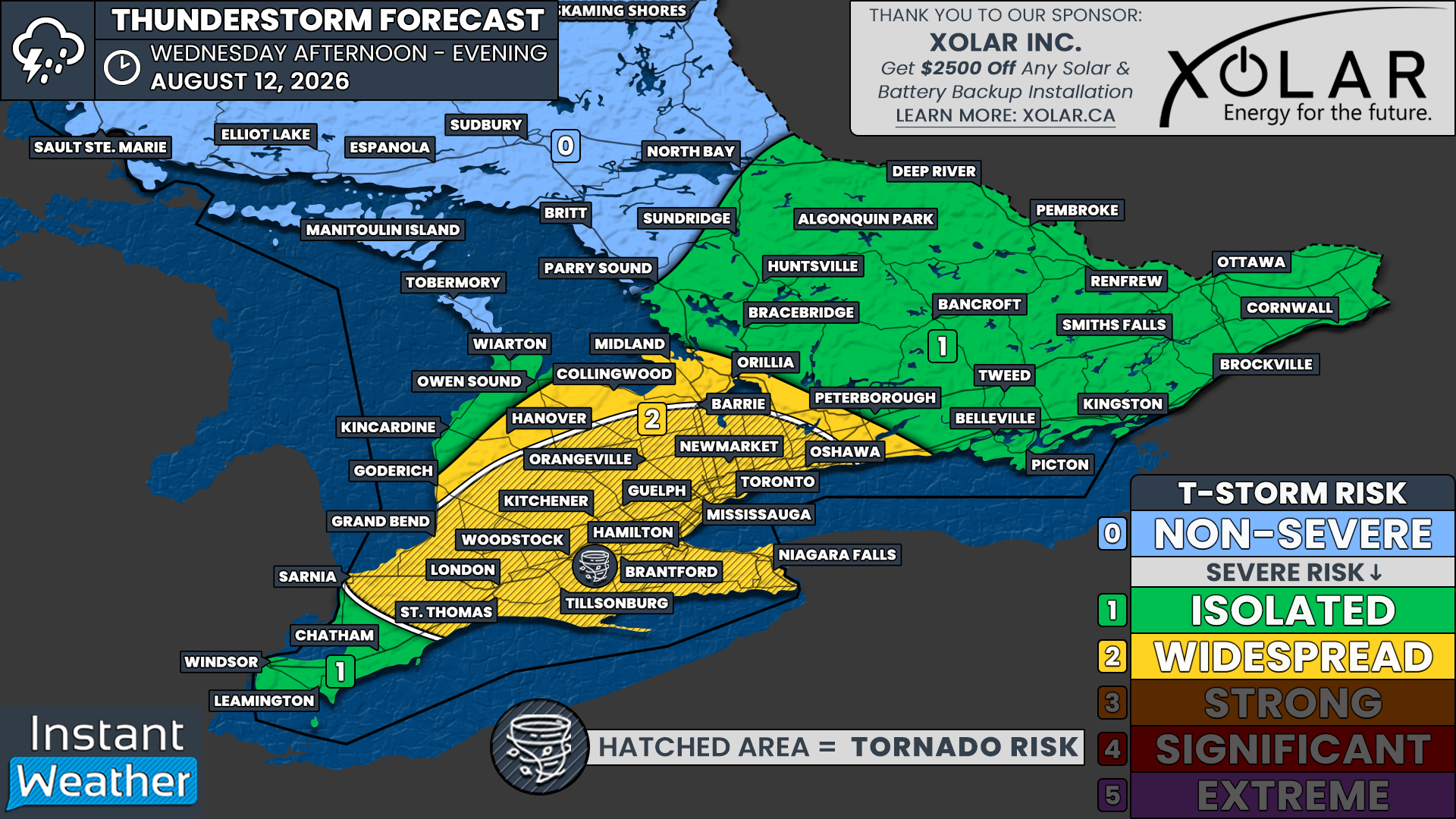
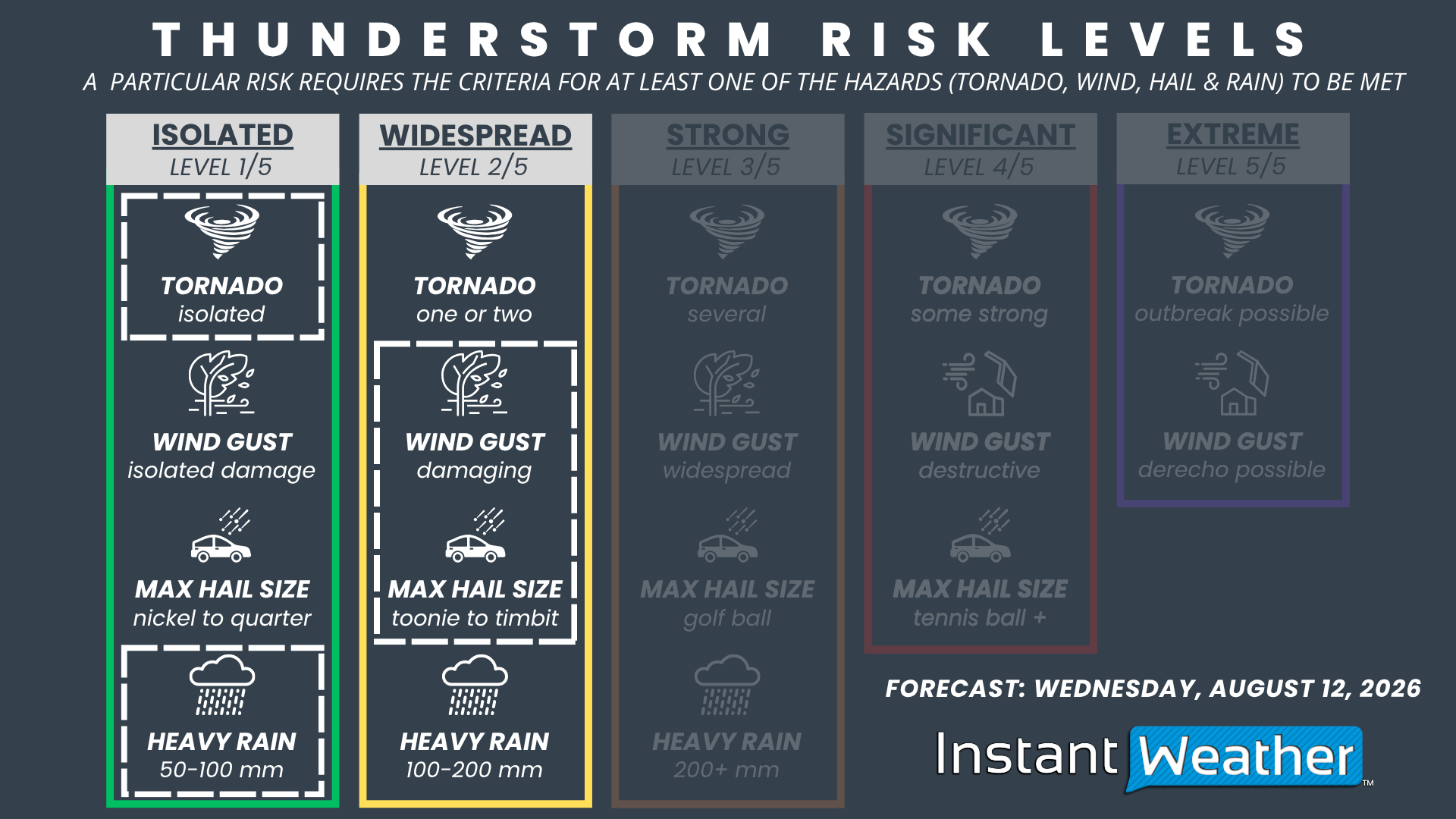
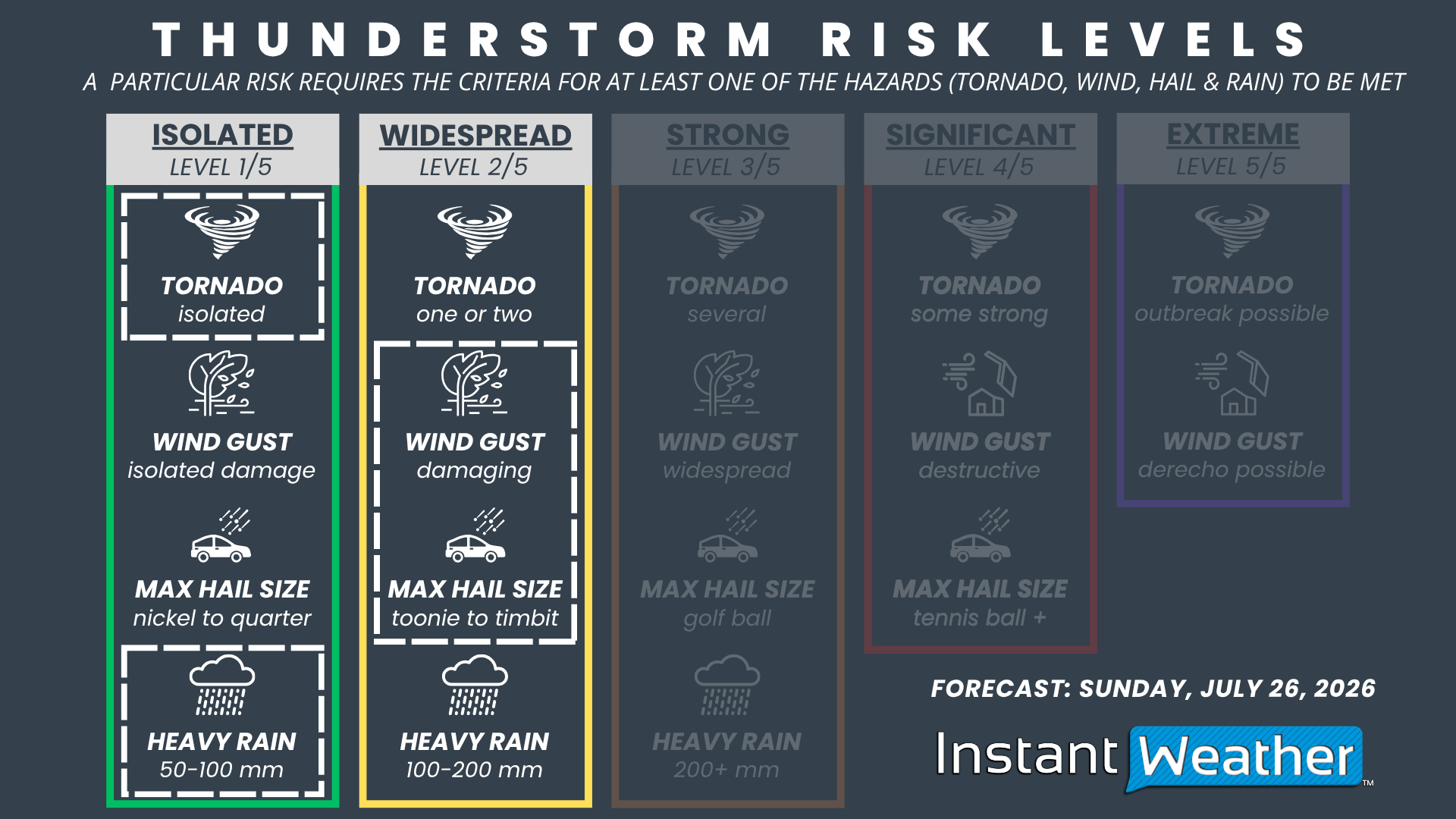
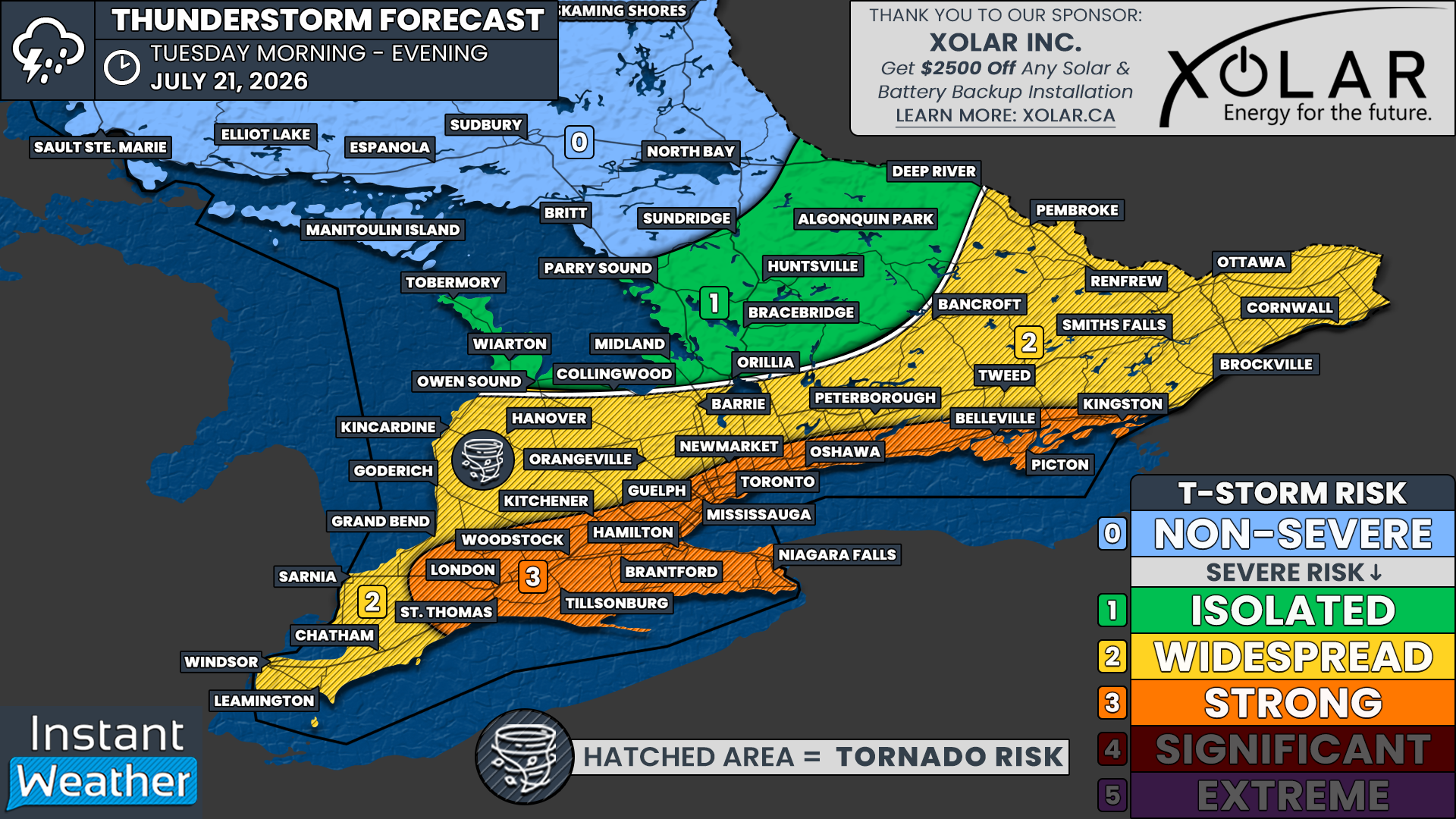
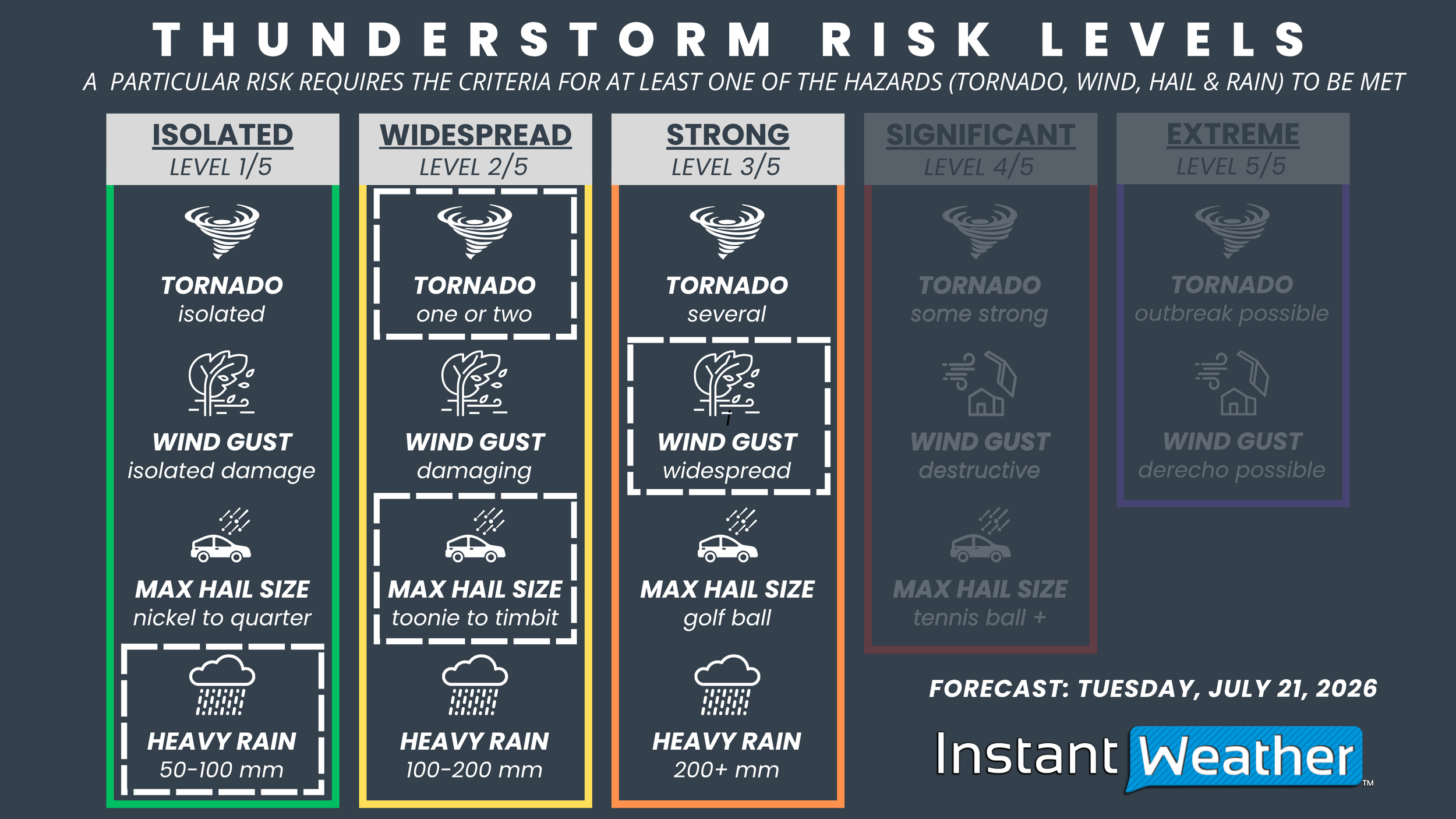
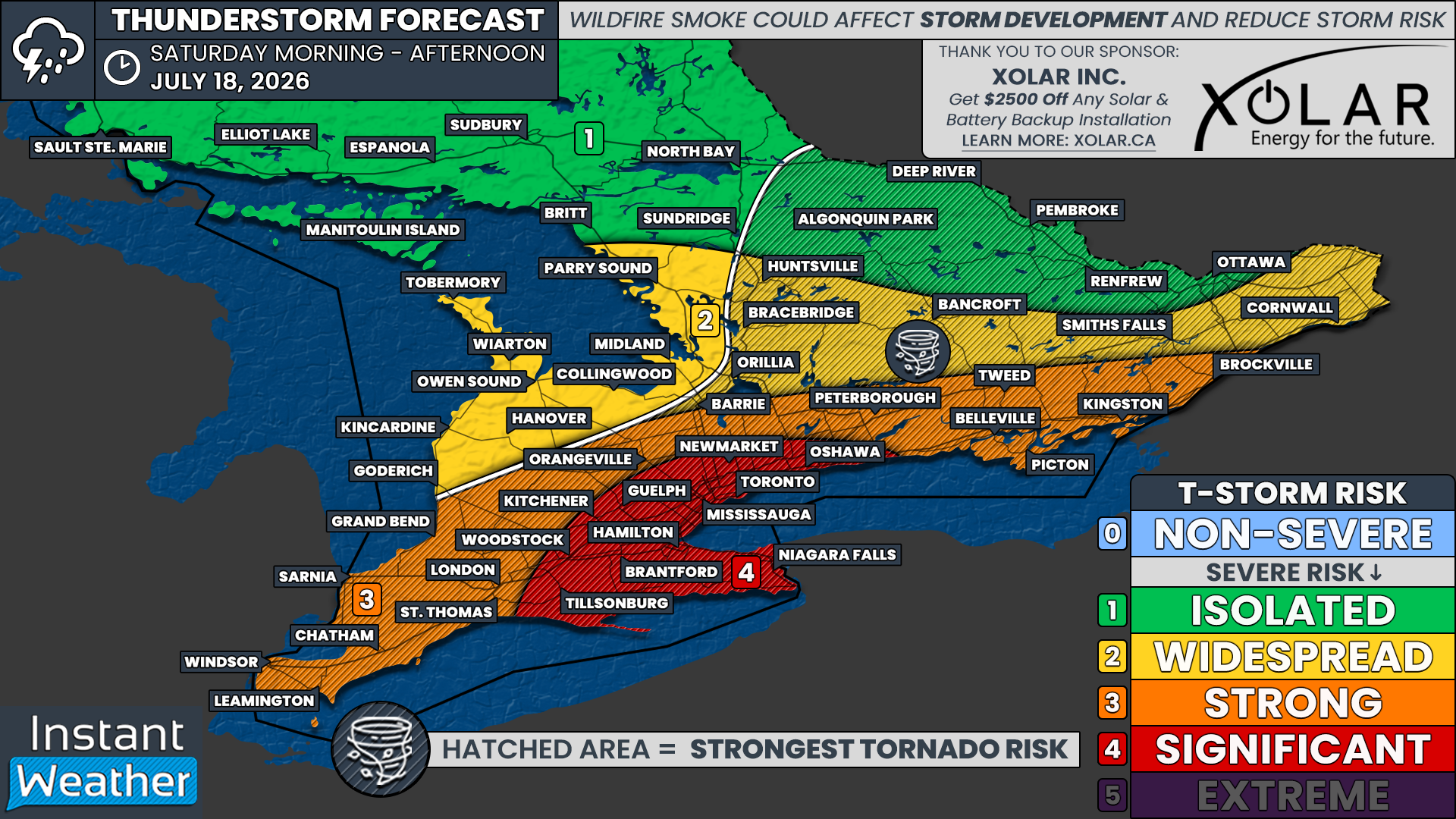
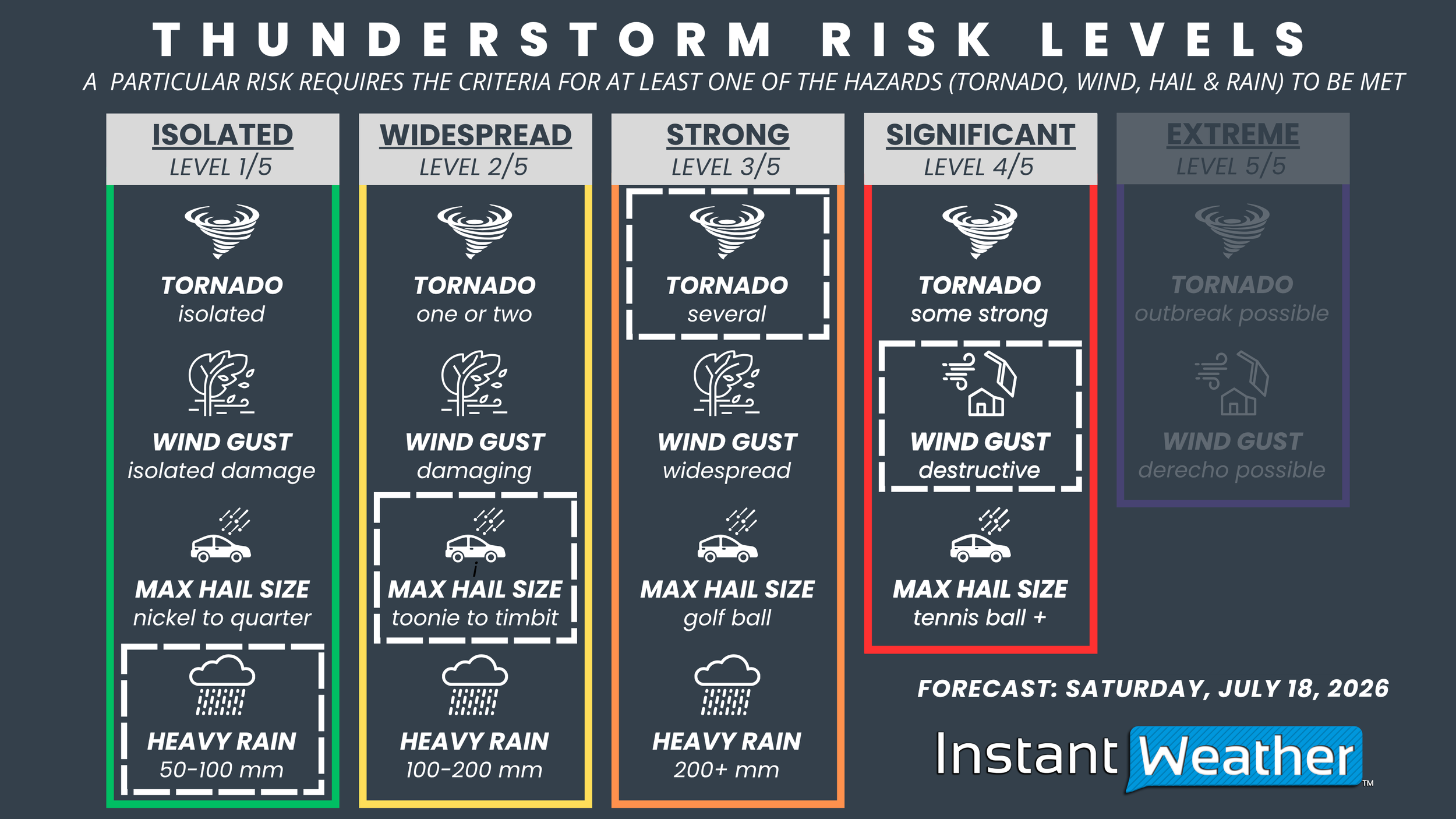
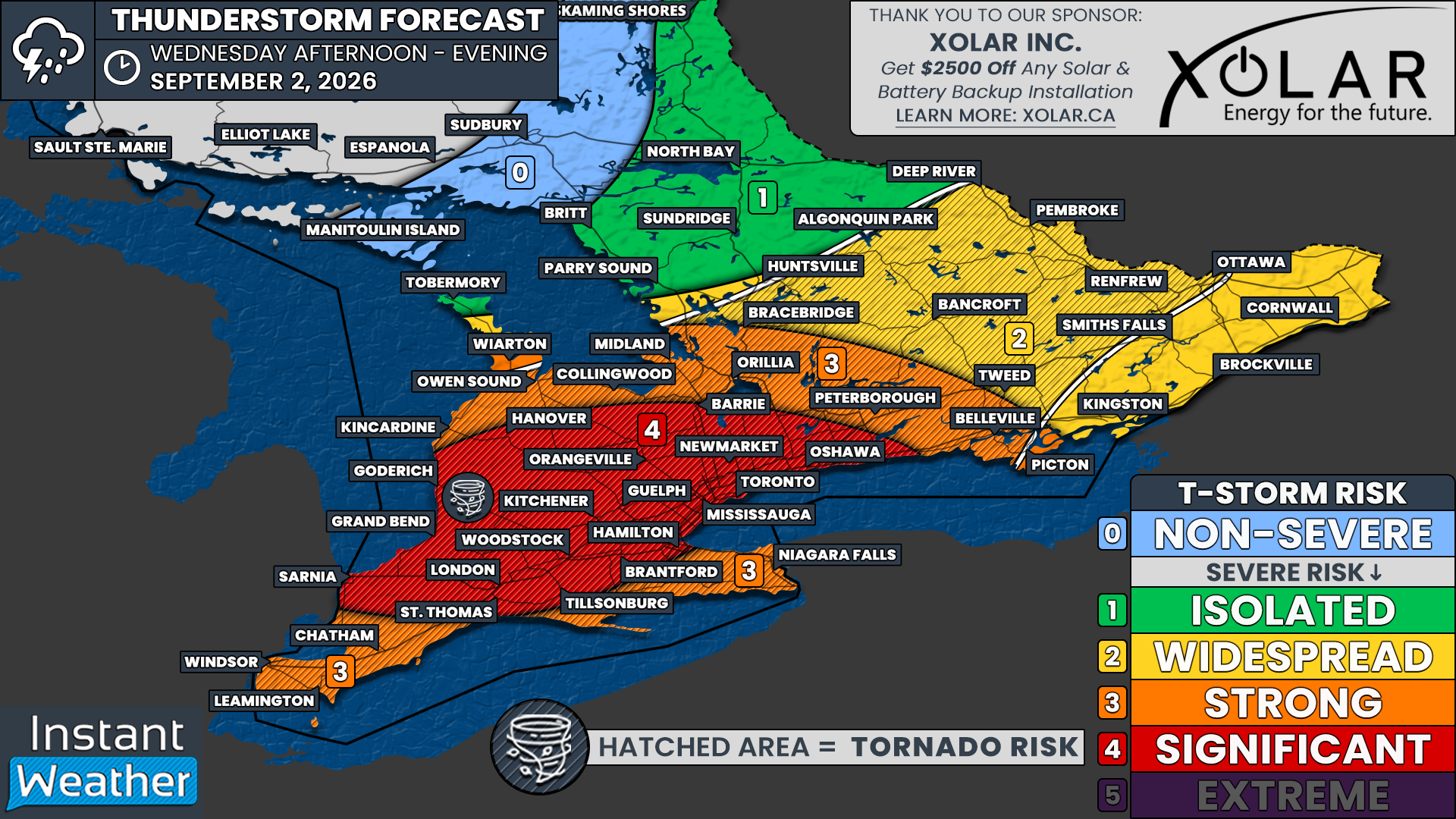
Overall, the forecast for Thursday looks quite similar to Wednesday. We have a “Strong” (Level 3/5) severe risk across a large area, but this time it also includes portions of Deep Southwestern Ontario, including the Sarnia and London areas, along with the Golden Horseshoe.

Other locations included in this risk zone are Goderich, Owen Sound, Kitchener, Hamilton, Guelph, Toronto, Newmarket, Barrie, Orillia, Peterborough, Belleville and Kingston.

This risk is being driven by the potential for strong wind gusts within this corridor, with multiple linear storms possible. If these storms can organize, they could lead to widespread wind damage. There is also the risk for up to Timbit-sized hail and one or two tornadoes.

We have a “Widespread” (Level 2/5) severe risk for Windsor, Chatham and the Lake Erie shoreline, extending into the Niagara region. There is also another “Widespread “ risk zone through Muskoka, Algonquin Park, Bancroft and the Ottawa Valley.

These areas are outside the zone most likely to see the most widespread damaging wind gusts, so the primary threat here will be driven by up to Timbit-sized hail and the risk for one or two tornadoes.

Another major concern is flooding, especially in the Ottawa Valley. This region saw significant flooding on Wednesday after more than 100 mm of rain fell in some areas. Flooding could once again become a serious issue if storms linger over the same communities or repeatedly track over the Ottawa area.

For northern sections of Central Ontario into Northeastern Ontario, including North Bay, Sudbury and Elliot Lake, we have an “Isolated” (Level 1/5) severe risk. We are not expecting widespread severe weather in this area, but with so much energy in the atmosphere, we cannot rule out an isolated pop-up storm capable of becoming severe.

Strong Severe Storm Risk Threatens Canada Day Across Southern Ontario, Damaging Winds and Isolated Tornadoes Possible

NOTE: YOU CAN CLICK ON THE MAP TO OPEN A ZOOMABLE IMAGE

Hot and humid weather has arrived across Southern Ontario just in time for Canada Day, with temperatures soaring into the mid-to-upper 30s, with the humidex making it feel into the 40s. While many will be heading outside to celebrate, this intense heat is also creating an atmosphere that is primed for severe thunderstorms later today.

Unfortunately, this stormy weather could put a damper on Canada Day celebrations, particularly across portions of Southwestern, Central and Eastern Ontario.

We are tracking a conditional severe weather threat for Wednesday afternoon and evening, with the risk potentially continuing into the overnight hours. The hot, humid air will provide plenty of fuel for thunderstorm development. Wherever storms are able to form, they could rapidly become severe thanks to the extremely unstable atmosphere.

In addition to isolated storm development, there is also the potential for one or more organized linear complexes of thunderstorms to move through Southern Ontario. If these systems develop and hold together, they could produce widespread damaging wind gusts across a large portion of the province.

We continue to describe today's threat as conditional because forecast models are doing a poor job of determining exactly where storms will develop. We know the environment is more than capable of supporting severe thunderstorms, but storms first need to form in order to take advantage of the available instability.

Development may be triggered by lake breeze boundaries, leftover outflow boundaries from earlier storms, or other small-scale features that are notoriously difficult to predict ahead of time. As a result, not everyone will see a thunderstorm today, but those that do could experience very intense conditions.


Join Us on YouTube for Storm Coverage:

We'll be providing comprehensive live coverage of any storms that develop today on our YouTube channel. Our team will be tracking storms in real time with live radar analysis, warnings, storm reports and chaser coverage, so if severe weather threatens your area, be sure to join us live to help stay informed.


As of 1 PM, we're already watching a strong complex of thunderstorms developing over Northern Michigan that is tracking toward Lake Huron and eventually Southwestern Ontario by the mid to late afternoon. If this complex is able to maintain its strength as it crosses into Ontario, it could produce widespread damaging wind gusts from areas east of Lake Huron through the Lake Simcoe region and eventually into Eastern Ontario.

Additional thunderstorms may also develop later today across Quebec before sweeping into portions of Eastern Ontario and the Ottawa Valley during the evening and early overnight hours.

Outside of these organized storm complexes, isolated thunderstorms may develop almost anywhere across Southern Ontario this afternoon and evening. If they are able to establish themselves before merging into larger clusters, a few discrete supercells could develop.

These storms would be capable of producing damaging wind gusts, hail up to the size of Timbits and an isolated tornado. While the tornado threat appears highest across Eastern Ontario, an isolated tornado cannot be ruled out anywhere in Southern Ontario today.

NOTE: YOU CAN CLICK ON THE GRAPHIC TO OPEN A ZOOMABLE IMAGE

We have a 'Strong' (Level 3/5) severe weather risk for locations including Goderich, Kincardine, Owen Sound, Hanover, Collingwood, Midland, Barrie, Orillia, Bracebridge, Peterborough, Tweed, Bancroft, Smiths Falls, Renfrew, Ottawa, Brockville and Cornwall. This higher risk is primarily driven by the potential for widespread damaging wind gusts this afternoon and evening, although large hail and an isolated tornado are also possible.

Surrounding areas, including Grand Bend, Woodstock, Kitchener, Guelph, Hamilton, Toronto, Newmarket, Oshawa and Kingston, are under a 'Widespread' (Level 2/5) severe weather risk. These locations could also experience damaging wind gusts if storm complexes hold together, although the tornado risk is somewhat lower compared to Central and Eastern Ontario.

We also have an 'Isolated' (Level 1/5) severe weather risk across the rest of Deep Southwestern Ontario, along with the Niagara region. While storm coverage is expected to remain limited here, any storm that does develop could quickly become severe given the highly unstable environment.

Farther north, we have gone with an 'Widespread' (Level 2/5) to 'Isolated' (Level 1/5) severe weather risk across northern portions of Central Ontario, including North Bay and Sudbury. Storms that develop in this region could strengthen before tracking south and eastward into Quebec and Eastern Ontario.

The severe weather threat should gradually diminish around midnight. However, thunderstorms may continue overnight as the atmosphere will remain exceptionally unstable despite the loss of daytime heating. If a mature storm complex is able to move through overnight, isolated severe weather will remain possible, with damaging wind gusts posing the primary threat.

Multiple Tornadoes and Tennis Ball Sized Hail Possible Monday Across Manitoba and Northwestern Ontario

NOTE: YOU CAN CLICK ON THE MAP TO OPEN A ZOOMABLE IMAGE

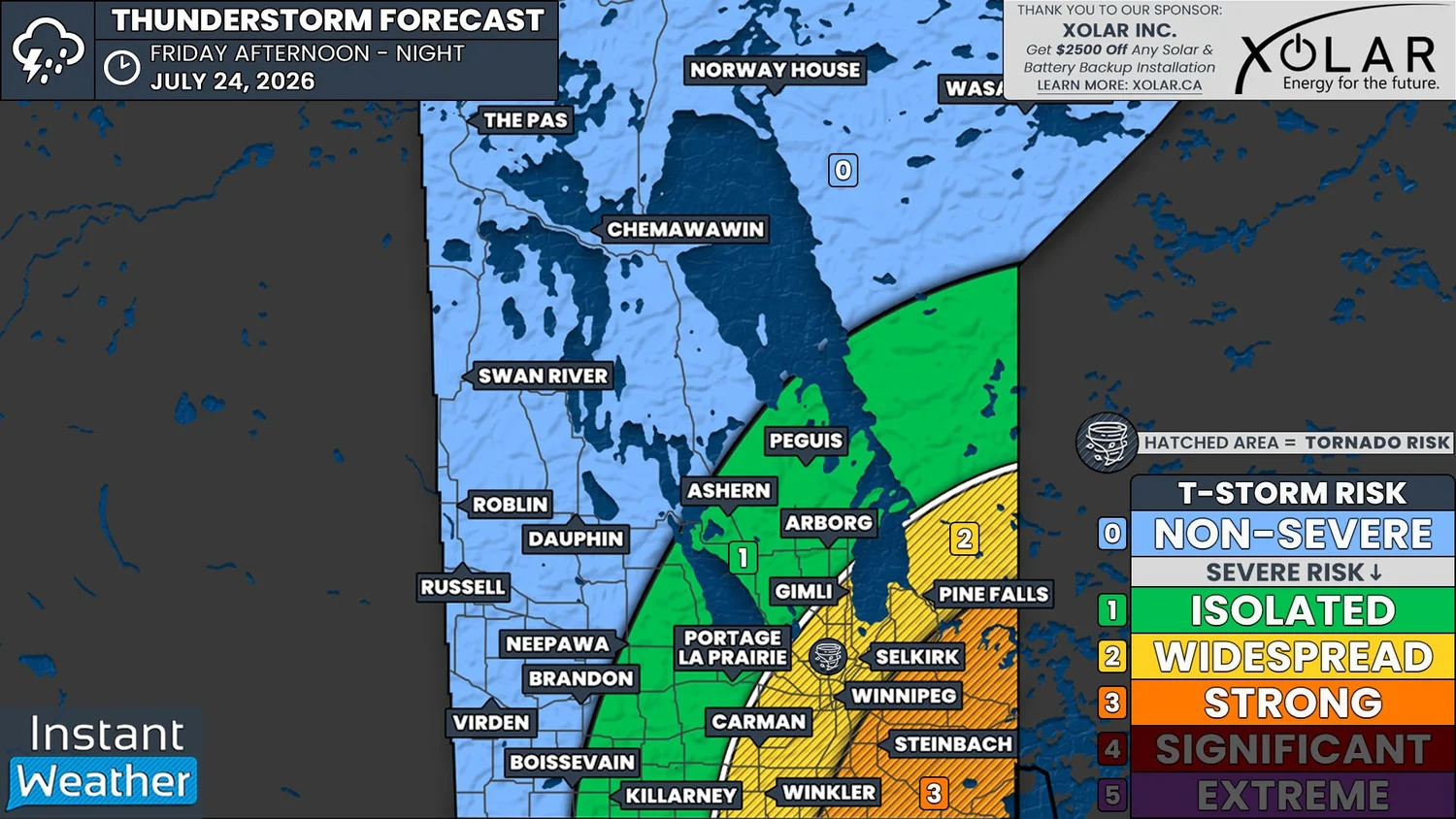
After a destructive severe weather outbreak that brought violent tornadoes to Western Manitoba on Sunday, the risk shifts eastward into Winnipeg, Eastern Manitoba and Northwestern Ontario on Monday.

Based on the latest forecast data, today's storms could bring a similarly dangerous setup with the potential for significant severe weather, including multiple tornadoes, huge hail up to the size of tennis balls, destructive wind gusts in excess of 100 km/h, and areas of flash flooding.

The greatest concern is across areas just southeast of Winnipeg where we have issued a 'significant' severe weather risk. This includes Winkler, Steinbach, Kenora, Dryden, Atikokan and Fort Frances.

Storms that develop in this corridor will have the potential to rapidly become powerful supercells capable of producing all severe weather hazards. The tornado threat is expected to be highest in this zone where atmospheric conditions appear most favourable for rotating thunderstorms.

A 'strong' severe weather risk extends across the rest of South-central and Eastern Manitoba, including Winnipeg, Portage la Prairie, Carman, Killarney, Selkirk, Gimli, Ashern, Arborg, Peguis, Pine Falls, Red Lake, Sioux Lookout and Thunder Bay.

While damaging wind gusts and large hail will likely be the primary hazards across much of this area, an isolated tornado cannot be ruled out, especially across South-central Manitoba and the Interlake region where conditions may still support discrete rotating storms before they begin to organize into larger clusters.

Farther west, there is a widespread to isolated severe weather risk across Western Manitoba, including Brandon, Virden, Dauphin, Roblin and Swan River. Flooding is expected to be the biggest concern in this region as slow-moving thunderstorms could repeatedly track over the same communities.

Rainfall totals could exceed 100 mm in localized areas, leading to flash flooding. An isolated tornado also cannot be ruled out around the Brandon area during the afternoon should any storms remain isolated long enough to become organized.

SIMULATED RADAR - MAP FROM WEATHERBELL

Today's severe weather threat is expected to begin during the afternoon with slow-moving thunderstorms developing across Western Manitoba, particularly near the Brandon area.

These storms will move very little, increasing the risk of training thunderstorms where multiple storms repeatedly pass over the same locations.

This could quickly lead to localized flooding, but these storms may also be capable of producing large hail, damaging wind gusts and even an isolated tornado.

SIMULATED RADAR - MAP FROM WEATHERBELL

The primary severe weather outbreak is expected to unfold later in the afternoon and into the early evening as isolated thunderstorms develop along the international border from Winkler eastward through Southeastern Manitoba and into Fort Frances in Northwestern Ontario.

The atmosphere during this period is expected to be highly supportive of supercell development. Any storm that can remain isolated will have the potential to produce tornadoes, very large hail and destructive wind gusts.

Hail could reach the size of tennis balls in the strongest storms, which would be capable of causing significant damage to vehicles, roofs and crops.

Winnipeg sits near the northwestern edge of the greatest severe weather threat. While current guidance keeps the most dangerous storms just southeast of the city, even a small shift farther west could bring a much higher tornado risk into the Winnipeg area.

SIMULATED RADAR - MAP FROM WEATHERBELL

The tornado threat should gradually decrease after sunset as daytime heating fades and the atmosphere becomes less favourable for discrete supercells. However, that will not mark the end of the severe weather threat.

As the evening progresses, many of the isolated storms are expected to merge into one or more organized lines of thunderstorms. While the tornado risk will lessen, these storm lines could produce widespread destructive wind gusts capable of causing tree damage, power outages and structural damage across parts of Manitoba and Northwestern Ontario.

These storms could reach the Winnipeg and Thunder Bay regions around midnight with another round of severe weather. Although the primary concern overnight will shift toward damaging straight-line winds, an isolated nocturnal tornado cannot be completely ruled out.

The severe weather threat should come to an end across Manitoba after midnight as the storm complex moves eastward. However, portions of Northwestern Ontario may continue to see strong to severe thunderstorms into Tuesday morning before the system gradually weakens and exits the region.


Canada Day Heatwave Set to Grip Southern Ontario With Near 40°C Heat and Severe Storm Risk

THIS FORECAST IS SPONSORED BY:

NOTE: YOU CAN CLICK ON THE MAP TO OPEN A ZOOMABLE IMAGE

As we approach the end of June, the weather is set to heat up in a big way across Southern Ontario with the arrival of a prolonged heatwave that is expected to bring dangerously hot temperatures by Canada Day. Based on the latest forecast data, there appears to be very little relief from the heat in the short term, with above seasonal temperatures potentially lasting through much of the week before easing closer to normal by next weekend.

The heat begins to build on Monday and Tuesday with daytime highs approaching the 30°C mark for the first time during this event. Ironically, these may end up being the “coolest” days of the week as temperatures continue to climb, with some areas potentially reaching the mid 30s by Canada Day, even before humidity is taken into account.

To make matters worse, there will be very little relief overnight. Starting Tuesday night, temperatures are expected to remain in the low to mid 20s across much of Southern Ontario. These unusually warm nights prevent homes and buildings from cooling down and give people little opportunity to recover from the daytime heat, increasing the risk of heat-related illnesses, especially after several consecutive days of extreme temperatures.

In addition to the heat, this warming trend is also expected to create an increasingly unstable atmosphere that will provide plenty of fuel for thunderstorms throughout the week. That doesn't necessarily mean storms will develop every day. Thunderstorms also require a trigger to get started, even when the atmosphere is primed.

However, the ingredients are expected to be in place for multiple rounds of thunderstorms over the coming week, including the potential for severe weather beginning as early as Tuesday.

ESTIMATED TEMPERATURE (°C) - MAP FROM WEATHERBELL

This heat event officially begins on Monday with daytime temperatures generally ranging from 27 to 30°C across Southern Ontario.

Keep in mind that communities located along the shorelines of the Great Lakes may remain a few degrees cooler where lake breezes develop. These breezes act like a natural air conditioner by pulling cooler air off the water and pushing it inland, offering some temporary relief for locations directly downwind.

NOTE: YOU CAN CLICK ON THE MAP TO OPEN A ZOOMABLE IMAGE

Tuesday brings another step upward with daytime highs expected to exceed 30°C across nearly all of Southern Ontario.

The hottest temperatures are expected across Southwestern Ontario, along with the Golden Horseshoe, where the urban environment creates what is known as the ‘urban heat island’ effect. Cities contain large amounts of concrete, asphalt and buildings that absorb heat from the sun throughout the day. Unlike forests or grassy areas, these surfaces release that stored heat slowly overnight, causing cities to remain noticeably warmer than surrounding rural areas, especially during prolonged heat events.

Temperatures in these areas are currently forecast to reach between 33 and 36°C. Once humidity is factored in, it could feel more like the upper 30s or even low 40s.

ESTIMATED CAPE - MAP FROM WEATHERBELL

Along with the increasing temperatures on Tuesday will come a significant surge in thunderstorm energy. Forecast models are showing CAPE (Convective Available Potential Energy) values ranging from 2,000 to more than 4,000 J/kg across much of Southern Ontario. For perspective, CAPE values between 1,000 and 2,000 J/kg are already considered more than sufficient to support strong to severe thunderstorms.

While CAPE is only one ingredient needed for severe weather, it gives us an indication of how much energy is available for developing thunderstorms. The higher the CAPE, the greater the potential for storms to grow rapidly and become intense if they are able to form.

What CAPE cannot do on its own is actually produce thunderstorms. A triggering mechanism is still needed to force warm, humid air upward. Common triggers include an approaching cold front, a warm front, lake breeze boundaries, outflow boundaries from earlier storms or even the heating of the ground during the afternoon. Without one of these lifting mechanisms, the atmosphere can remain loaded with energy while little or no storm development occurs.

Since this energy is expected to remain in place for much of the week, there is a high likelihood that at least a few rounds of thunderstorms will develop. Some of these storms could certainly become severe. At this point, Wednesday and Thursday appear to offer the greatest chance for thunderstorm development, although we're still several days away and the exact timing, location and severity will become clearer as we get closer. This will need to be closely watched as it could put a damper on Canada Day celebrations.

ESTIMATED TEMPERATURE (°C) - MAP FROM WEATHERBELL

While temperatures will cool somewhat overnight, the overnight relief will be minimal, particularly across Southwestern Ontario and the Greater Toronto Area.

Current projections suggest temperatures on Wednesday morning may struggle to fall below 25°C in these areas before sunrise, with most other parts of Southern Ontario remaining above 20°C.

These warm overnight temperatures are particularly concerning because they greatly increase the health risks associated with prolonged heat. Normally, cooler nights allow the body to recover from daytime heat stress and help homes naturally cool down.

When temperatures stay elevated all night, that recovery becomes much more difficult, especially for seniors, young children, those with chronic health conditions and anyone without access to air conditioning, such as the unhoused. Several consecutive nights of poor overnight cooling can significantly increase the risk of heat exhaustion and heat stroke.

Extreme heat can affect anyone, not just vulnerable groups, so it's important to take precautions throughout this event.

Stay well hydrated by drinking plenty of water, even if you don't feel thirsty, and try to avoid alcohol or excessive caffeine, which can contribute to dehydration.

Limit strenuous outdoor activities during the hottest part of the day, typically from late morning through the early evening, and wear lightweight, loose-fitting, light-coloured clothing whenever possible.

If you have access to air conditioning, spend time indoors where it's cool. If not, consider visiting a shopping mall, library or community cooling centre for a few hours. Also remember to check in on family members, friends and neighbours, especially older adults, young children and those with underlying health conditions.

Never leave children or pets inside a parked vehicle, even for a few minutes. Temperatures inside a vehicle can climb to dangerous levels extremely quickly!

Finally, learn to recognize the warning signs of heat-related illness. Symptoms such as dizziness, nausea, headache, heavy sweating or confusion should never be ignored. Heat stroke is a medical emergency and requires immediate medical attention!

NOTE: YOU CAN CLICK ON THE MAP TO OPEN A ZOOMABLE IMAGE

THIS FORECAST IS SPONSORED BY:

As we head into Canada Day, it is shaping up to be an exceptionally hot day with temperatures potentially reaching between 36 and 38°C across Deep Southwestern Ontario and portions of the Greater Toronto Area.

Once again, temperatures could be noticeably cooler near the Great Lakes, where lake breezes develop. With southwesterly winds currently expected, the greatest cooling influence will likely be found along the northeastern shorelines of the lakes.

Elsewhere across Southern Ontario, temperatures are expected to range from 33 to 36°C across much of Southwestern Ontario, around Lake Simcoe and into Eastern Ontario. Central Ontario, along with the higher elevations of the Dundalk Highlands, should remain slightly cooler with highs between 30 and 33°C.

ESTIMATED FEELS LIKE (°C) - MAP FROM WEATHERBELL

Humidity is also expected to continue increasing through Wednesday and Thursday, making it feel even hotter. Factoring in the humidex, it could feel well into the low to mid-40s across much of Southern Ontario. The highest humidex values are expected across Deep Southwestern Ontario and the Golden Horseshoe, although Eastern Ontario could also see "feels like" temperatures approaching 40°C.

A similar setup is expected on Thursday with many areas once again climbing into the mid-30s. Temperatures may ease slightly on Friday before a more noticeable cooldown arrives next weekend, bringing conditions back closer to seasonal values.

While the exact timing of that relief may still shift over the coming days, confidence is increasing that Southern Ontario is about to experience its most significant and prolonged heat event of the year so far. Residents should be prepared for several consecutive days of dangerous heat and stay up to date with the latest forecasts as the week progresses.

Tornado Risk for Regina Area as Significant Severe Storm Risk Target Saskatchewan & Manitoba Saturday

NOTE: YOU CAN CLICK ON THE MAP TO OPEN A ZOOMABLE IMAGE

After a brief reprieve from active weather across Saskatchewan and Western Manitoba, the threat of severe thunderstorms returns on Saturday. This round of storms could bring a potentially significant severe weather risk to portions of Southeastern Saskatchewan, especially around Weyburn and Estevan.

Isolated thunderstorms are expected to develop near the International Border around the dinner hour. Any storms that form could quickly become supercells capable of producing all severe weather hazards, including tornadoes, golf ball-sized hail and destructive wind gusts up to 120 km/h.

There is also a strong severe weather risk extending northward toward Assiniboia, Moose Jaw and Regina. An isolated tornado cannot be ruled out in these areas as well, although confidence in storm development is lower compared to locations closer to the border.

Further south, additional thunderstorms are expected to develop across Montana and North Dakota. As the evening progresses, these storms are forecast to merge into a large complex that will race northeast toward Saskatchewan and Southwestern Manitoba.

The earlier isolated supercells over Southeastern Saskatchewan are expected to be absorbed into this larger storm complex as it crosses the border. As this happens, the primary threat will shift from large hail and tornadoes to widespread damaging wind gusts as the storms organize into a fast-moving line during the mid and late evening hours.

This line is expected to sweep northeast from Regina toward the Manitoba border. There is still some uncertainty regarding how well it will maintain its strength after sunset, as the loss of daytime heating will reduce available instability. However, we expect at least an isolated to widespread severe weather risk to continue past midnight as the storms approach the Yorkton and Brandon corridor.

SIMULATED RADAR - MAP FROM WEATHERBELL

Based on the latest data, isolated thunderstorms are most likely to develop between 5 and 7 PM CST near the International Border. These storms could impact the Weyburn and Estevan areas as they rapidly intensify into supercells capable of producing large hail, damaging wind gusts and tornadoes.

The environment will be particularly favourable for tornadic development during the first few hours of these storms' lifespan. The greatest tornado risk appears to be closest to the border, although this threat could extend northwest toward Moose Jaw and Regina if storms are able to develop there during the late afternoon and early evening.

SIMULATED RADAR - MAP FROM WEATHERBELL

As the mature line of storms over Montana and North Dakota advances into Saskatchewan, the earlier isolated storms are expected to merge into the line, forming a bowing segment stretching from Regina to the Manitoba border.

Although the tornado threat will decrease once the storms become linear, a brief QLCS spin-up tornado cannot be ruled out, particularly near any bookend vortices that develop within the line. The primary hazard, however, will become widespread damaging wind gusts, with localized gusts over 100 km/h possible. The hail threat will also diminish by this stage, although quarter to toonie-sized hail may still accompany the strongest storms.

The line will continue sweeping across Southeastern Saskatchewan and into Southwestern Manitoba during the overnight hours. While isolated damaging wind gusts will remain possible within the strongest portions of the line, there is still uncertainty regarding how well the storms will maintain their intensity after midnight.


Southern Ontario Faces Severe Storm and Tornado Risk Thursday Ahead of Possible Canada Day Heatwave

THIS FORECAST IS SPONSORED BY:

NOTE: YOU CAN CLICK ON THE MAP TO OPEN A ZOOMABLE IMAGE

While the latter half of June has been relatively quiet across Southern Ontario when it comes to severe weather, thanks to cooler temperatures dominating the region, that pattern is about to change in a big way. As we head into the final days of June, much warmer and increasingly humid air will begin pushing into the province, bringing with it a rapidly increasing risk for thunderstorms.

The first significant opportunity arrives on Thursday, when portions of Southwestern Ontario could see a widespread severe thunderstorm risk. An isolated severe threat may also extend farther east into parts of the Golden Horseshoe and Central Ontario.

If thunderstorms are able to develop during the afternoon and early evening, they will move into a very favourable environment capable of supporting supercell thunderstorms. These storms could produce all modes of severe weather, including toonie-sized hail or larger, damaging wind gusts in excess of 100 km/h, torrential rainfall and even a few isolated tornadoes.

The most favourable environment currently appears to be across areas including Sarnia, Chatham, Grand Bend, Goderich and London. However, isolated thunderstorms could also develop as far north as the Bruce Peninsula, east toward Lake Simcoe, and south into portions of the Greater Toronto Area. While the tornado threat decreases farther away from Lake Huron, it cannot be completely ruled out as far east as Kitchener, Hamilton and portions of the southern Georgian Bay shoreline.


Join Us on YouTube for Storm Coverage:

We'll be providing comprehensive live coverage of any storms that develop on Thursday afternoon on our YouTube channel. Our team will be tracking storms in real time with live radar analysis, warnings, storm reports and chaser coverage, so if severe weather threatens your area, be sure to join us live to help stay informed.


SIMULATED RADAR - MAP FROM WEATHERBELL

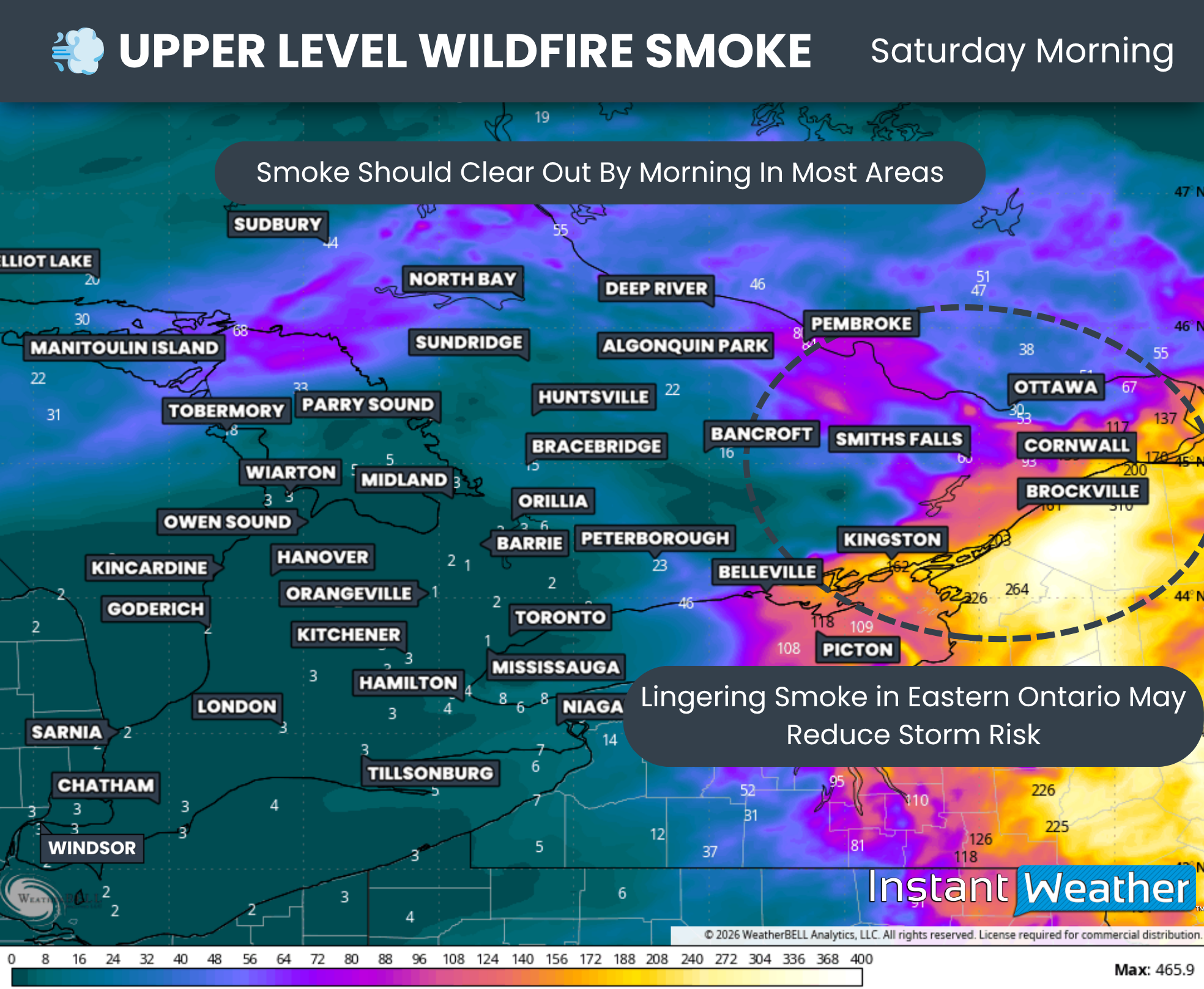
Thursday's forecast does come with one important complication. Morning showers and non-severe thunderstorms are expected to move through Southwestern Ontario before spreading into Central and Eastern Ontario during the day.

As we've seen many times before, morning convection can make or break an afternoon severe weather event. If clouds and showers linger too long, they can prevent the atmosphere from recovering enough to support stronger storms later in the day.

On the other hand, if skies clear by around the noon hour, as many of the latest models suggest, there should be several hours available for temperatures and instability to quickly rebound.

Significant Tornado Parameter - MAP FROM WEATHERBELL

By the mid-afternoon, the atmosphere is expected to become increasingly supportive of severe thunderstorms, with the highest risk developing between roughly 2 PM and 6 PM. The strongest combination of instability and wind shear currently appears to be centred near the Lake Huron shoreline, extending into Sarnia and Chatham.

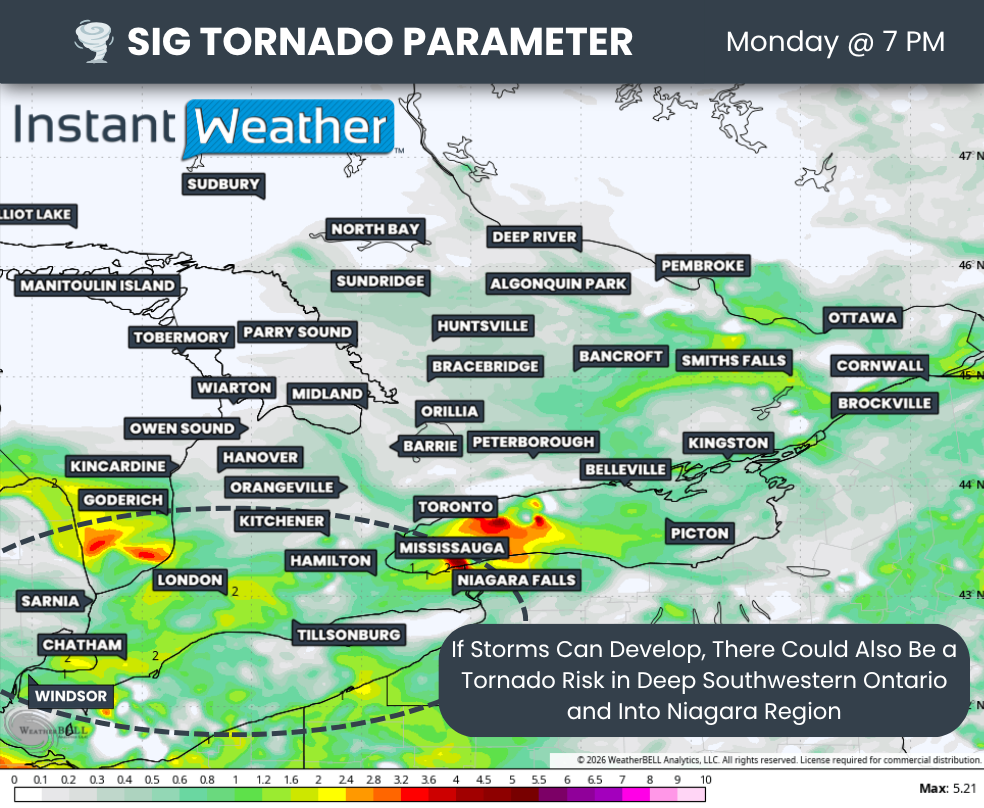
The latest Significant Tornado Parameter (STP) data also highlights an enhanced corridor stretching from the Michigan border across Lake Huron into Southwestern Ontario. Should storms form within this corridor, they could rapidly intensify into rotating supercells capable of producing very large hail, damaging winds and isolated tornadoes.

SIMULATED RADAR - MAP FROM WEATHERBELL

THIS FORECAST IS SPONSORED BY:

There remains some disagreement among the forecast models regarding exactly where storms will first develop.

Some models initiates storms as early as 3 PM across Michigan before they quickly cross into Deep Southwestern Ontario. This scenario would place communities such as Sarnia, Grand Bend, Goderich and London at the greatest risk.

Other models delay development until later in the afternoon or early evening, with storms forming closer to the Hanover to Grand Bend corridor before tracking southeast toward London, Kitchener and possibly Hamilton. Regardless of which solution verifies, the greatest tornado potential continues to favour areas along and just inland from the southeastern Lake Huron shoreline.

Additional isolated thunderstorms may also develop around Lake Simcoe and into the Greater Toronto Area during the late afternoon and early evening. While the environment in these areas appears less favourable for widespread severe weather, a few stronger storms cannot be ruled out. The primary threats would be hail up to quarter size along with isolated damaging wind gusts.

As the sun sets Thursday evening, the severe weather threat should gradually diminish as daytime heating is lost. However, scattered non-severe showers and thunderstorms may continue well into the overnight hours, particularly across Central and Eastern Ontario.

TEMP ANOMALY - MAP FROM WEATHERBELL

Looking beyond Thursday, the severe weather threat briefly settles down. Friday may bring a very isolated thunderstorm risk across Eastern Ontario, particularly near the Ottawa Valley, while much of the weekend currently appears relatively quiet from a severe weather perspective.

The bigger story heading into next week will likely be the return of significant heat.

Temperatures are expected to steadily climb through the weekend, with many areas approaching or exceeding 30°C by Monday. Current medium-range guidance suggests the heat could continue to intensify into the middle of next week, potentially peaking around Canada Day.

Some forecast models are indicating temperatures running between 5 and 10°C above seasonal averages, with localized anomalies approaching 15°C in parts of Ontario on Canada Day. If those projections verify, daytime highs could reach the low to mid 30s across portions of both Southern and Northern Ontario.

When combined with increasing humidity, it may feel close to 40°C in many communities.

This surge of heat and humidity will also provide plenty of fuel for additional thunderstorm development. While it is still too early to determine exactly which days will carry the greatest severe weather risk, there are increasing signs that we could be entering a much more active pattern over the next one to two weeks. Exactly when storms develop will depend on the arrival of cold fronts and other triggering mechanisms, something that will become much clearer once higher resolution models come into range.

We'll continue monitoring both Thursday's severe weather potential and the possible prolonged heat event expected next week. Stay tuned for forecast updates throughout the coming days as confidence continues to increase.

Widespread Severe Thunderstorms Possible Across Southern Alberta and into Southwestern Saskatchewan Today with Slight Risk of a Tornado

NOTE: YOU CAN CLICK ON THE MAP TO OPEN A ZOOMABLE IMAGE

Severe thunderstorms are going to be likely across Southern Alberta and into parts of Central Alberta and Southwestern Saskatchewan today. A cold front associated with the low pressure system that’s responsible for the heavy rainfall in Central Alberta will be the trigger for thunderstorm development this afternoon and evening.

Temperatures are expected to climb into the low to mid-20s, but dewpoints are expected to be fairly low, barely reaching mid-teens for most of Southern Alberta and Southwestern Saskatchewan. This lack of moisture could hamper thunderstorm development, however some moisture from the north could make its way into the region later today, which would make up for the lower dewpoints.

Simulated reflectivity at 3pm MDT, courtesy of weatherbell.

Thunderstorms are expected to develop early this afternoon in the Foothills as individual cells. These storms will likely be severe for most of the region, but there is a more isolated severe risk closer to the low pressure center, in the Edmonton area and westward.

As the storms progress eastward through the afternoon and evening, they are expected to eventually merge into a line. This transition to a linear storm mode will bring a more widespread severe risk across Southeastern Alberta and eventually into Southwestern Saskatchewan later in the evening (around 8-10pm).

The severe risk does not extend too far eastward into Saskatchewan because the storms will weaken later in the evening. This will lead to a more isolated threat into the Swift Current area by around midnight before it’s expected that the storms become non-severe for the rest of the overnight period.

Simulated reflectivity at 9pm MDT, courtesy of weatherbell.

Across most of Southern Alberta and stretching into parts of Central Alberta, including Red Deer, and Southwestern Saskatchewan is where there is the greatest risk for widespread severe thunderstorms today. In this region, the main severe weather threats will be strong wind gusts above 100km/h and large hail that could be as big as ping pong balls. There is also a small risk of a tornado today, but that will be very conditional on there being enough moisture moving into this area from the north ahead of the thunderstorm development.


Powerful June Storm System Could Bring Damaging Winds and Isolated Tornadoes to Southern Ontario Overnight

NOTE: YOU CAN CLICK ON THE MAP TO OPEN A ZOOMABLE IMAGE

An unusually strong and deepening low pressure system for mid-June is set to track through the Great Lakes region overnight Wednesday and into Thursday. This powerful system will bring the potential for severe weather to a large portion of Southern Ontario, with the greatest threat occurring late tonight and into Thursday morning.

The same system is expected to produce a significant severe weather outbreak across portions of Illinois, Indiana and Michigan this afternoon and evening. In those areas, forecasters are highlighting the risk of violent tornadoes, destructive wind gusts and large hail as a potent combination of instability and wind shear develops ahead of the approaching low pressure system.

As this line of storms pushes eastward into Michigan tonight, it is expected to gradually weaken before reaching Ontario. However, weakening does not necessarily mean the severe threat will disappear.

Even in a decaying state, this line of storms could still bring impactful weather to portions of Southwestern Ontario, especially areas closest to the international border and along the Lake Huron shoreline.

Based on the latest forecast data, the primary threat appears to be damaging wind gusts in excess of 100 km/h. In localized areas, stronger wind gusts could occur if isolated downbursts develop within the line of storms. These stronger pockets of wind have the potential to cause tree damage, power outages and scattered property damage.

While the tornado threat will be considerably lower than what is expected across parts of the United States, it cannot be completely ruled out.

The atmosphere over Deep Southwestern Ontario will remain supportive of some rotation early in the night, particularly while the line of storms is still relatively organized. Any tornado risk would likely be brief and localized in nature, but the strong dynamics associated with this system mean it is something we will be watching closely.
Another factor adding complexity to this forecast is the strength of the low pressure system itself.

In addition to thunderstorm-related winds, very strong winds will be present just above the surface overnight. Normally, a temperature inversion would act as a lid and prevent those stronger winds from mixing down to ground level. Current indications suggest that inversion should remain in place for much of the night.

However, if portions of that stronger wind are able to reach the surface, isolated non-thunderstorm wind gusts in excess of 90 km/h would be possible. This risk appears highest near the shorelines of Lake Huron and Lake Erie where local effects can help enhance wind gusts.


We’ll be closely monitoring this severe weather threat throughout the evening and overnight hours.

If conditions warrant, we’ll be going live on our YouTube channel with real-time storm tracking, radar analysis, warning updates and coverage of any severe weather that develops across Southern Ontario.

Be sure to subscribe to our YouTube channel HERE and turn on notifications so you don’t miss any live coverage. Whether it’s damaging winds, tornado warnings or rapidly changing conditions, we’ll be there to keep you informed every step of the way.


Heavy rainfall will also accompany this system. Many areas will receive beneficial rainfall, but localized torrential downpours could lead to rainfall amounts exceeding 50 mm in a relatively short period of time. If storms repeatedly move over the same area, flash flooding could develop, especially in urban locations and areas with poor drainage.

The highest severe weather risk tonight stretches across Deep Southwestern Ontario and portions of the Lake Huron shoreline. This includes Windsor, Leamington, Chatham, Sarnia, Grand Bend, Goderich and Kincardine.

In these areas, storms could begin arriving as early as 8 to 9 PM and continue through the overnight hours. Damaging wind gusts remain the primary concern, although heavy rain and an isolated tornado cannot be ruled out.

As the line progresses eastward, it is expected to reach the London, Woodstock, Kitchener, Guelph, Orangeville and Hanover areas around or shortly after midnight. There remains some uncertainty regarding exactly how much strength the storms will retain by this point. However, the potential still exists for several pockets of damaging winds to survive farther inland.

The tornado threat should be lower compared to areas farther west, but strong winds and localized flooding will continue to be concerns as the line moves through.

By the time the storms reach Central Ontario and the Golden Horseshoe during the overnight hours, the severe threat should be decreasing further. That said, this remains a powerful weather system and some stronger portions of the line could still produce isolated wind gusts approaching 90 km/h.

As a result, we continue to highlight an isolated severe weather risk for Toronto, Hamilton, Niagara, Newmarket, Barrie, Orillia, Bracebridge, Peterborough and Bancroft.

Attention will then shift to Eastern Ontario during the early morning hours on Thursday. Unlike areas farther west, there are indications that the atmosphere may begin to recover somewhat as the main line approaches. There is also the potential for additional isolated thunderstorms to develop behind or ahead of the main line shortly after sunrise.

This could allow for a secondary severe weather threat across portions of Eastern Ontario, particularly near the international border and into the Ottawa Valley. This broader morning severe weather risk includes Kingston, Brockville, Smiths Falls, Cornwall, Ottawa and Picton.

Should additional storms develop within this environment, all severe weather hazards would be possible including damaging wind gusts, heavy rainfall, hail and even an isolated tornado.

Forecast confidence in the tornado threat remains lower due to the early morning timing and questions surrounding how much instability can develop. However, the environment bears watching closely given the strength of the overall weather system.

The severe weather threat is expected to gradually come to an end from west to east through Thursday morning, with most areas seeing the risk diminish by early afternoon.

Even after thunderstorms exit the region, conditions will remain quite blustery throughout the day. Strong non-thunderstorm wind gusts may continue across much of Southern Ontario as the powerful low pressure system pulls away from the Great Lakes.

Strong Winds and Timbit Sized Hail Possible with Widespread Risk of Severe Thunderstorms in Southern Alberta & Saskatchewan Tuesday

NOTE: YOU CAN CLICK ON THE MAP TO OPEN A ZOOMABLE IMAGE

It’s looking like it’ll be an active day for some parts of Alberta and Saskatchewan today. A low pressure system from Southern British Columbia will track southeastward through Southern Alberta and Saskatchewan today, which will trigger the development of thunderstorms across the region.

Temperatures are expected to climb into the low to mid-20s, with dewpoints possibly into the mid-teens, across Southern Alberta and Saskatchewan, which should help fuel thunderstorm development. There will be a modest amount of CAPE in the region, with weather models showing upwards of 1000J/kg for some areas. While this is not a great deal of instability, the combination of shear and a mechanism for lift will be enough for scattered thunderstorms to develop across the region.

Simulated reflectivity at 2pm, courtesy of weatherbell.

Non-severe thunderstorms have already developed this morning in Central Alberta. As the low continues tracking southeast into Southern Alberta, so too will the thunderstorms and starting in the early afternoon, it’s likely that the storms that develop will become severe.

The bulk of the thunderstorm activity is expected to make its way into Southern Saskatchewan later in the afternoon, around 3-5pm. Behind the initial cluster of storms in this area, additional storms are expected to develop to the west, in Southern Alberta. Most of these storms will likely be severe, but there is a more isolated severe risk that will extend eastward across much of the rest of Southern Saskatchewan.

The thunderstorms will gradually weaken through the evening as they continue tracking into Montana and most of the storms should cross the international border by midnight. However, there is a chance that some storms could linger in Southern Saskatchewan into the early morning hours.

Simulated reflectivity at 6pm, courtesy of weatherbell.

An area that stretches from northwest of Calgary southeastward into Southwestern Saskatchewan, shown in yellow on our forecast map, is where there is the greatest risk for widespread severe thunderstorms today. Across this region, the main threat from thunderstorms today will be strong wind gusts in excess of 100km/h, however there is also the threat that these storms could produce large hail that could be as large as Timbits and maybe even as large as golf balls. Given that at least one tornado is confirmed to have touched down in Northern Alberta from this system last night, the possibility of additional tornadoes today can not be ruled out.


Potential Derecho Combined with Threat of Baseball Hail and Tornadoes Marks the Return of Extreme Risk in Saskatchewan and Manitoba Tuesday

NOTE: YOU CAN CLICK ON THE MAP TO OPEN A ZOOMABLE IMAGE

It was a very busy weekend for severe weather in Southeastern Saskatchewan and Southwestern Manitoba. From the two day span, there have been countless reports of massive hail, wind damage, flooding from across the region, as well as a few tornado reports that are awaiting confirmation. Unfortunately, the calmer conditions we saw on Monday will come to an end when strong severe thunderstorms once again impact Southern Saskatchewan and Manitoba today.

Through the day, a low pressure system will strengthen as it moves from Southeastern Montana into Western North Dakota and then into Southeastern Saskatchewan and Southwestern Manitoba by later this afternoon. A warm front will extend eastward from the low pressure center, which will help draw lots of heat and moisture northward into Southern Saskatchewan and Manitoba.

Future Surface weather map with the positions of highs, lows, and fronts displayed for 12pm cst/1pm CDT on Tuesday, courtesy of the national weather service.

Temperatures are slated to climb into upper 20s and low 30s across the region this afternoon and with dewpoints expected to be in the upper teens, there will be plenty of fuel for thunderstorm development. Weather models are showing upwards of 4000J/kg of CAPE in some areas, which will support the development of supercell thunderstorms. Veering winds will also create a significant amount of shear to maintain large supercell thunderstorms and support tornado potential.

Through the morning, there is a chance that some thunderstorms could develop in Southeastern Saskatchewan which would track northeastward into Southwestern Manitoba during the early afternoon. These storms could possibly become severe and produce some small hail and strong winds, but they won’t be as strong as the storms expected later in the day.

Simulated reflectivity at 3pm CST/4pm CDT, courtesy of weatherbell.

Severe thunderstorms could start to fire up in the early afternoon, particularly in Southwestern and West Central Saskatchewan. However, we will gradually see more organized development of stronger thunderstorms occur across Southern Saskatchewan and into Southwestern Manitoba as we get later in the afternoon, around 3-6pm, depending on the time zone.

Similar to what we saw on the weekend, the thunderstorms are expected to grow exponentially into large supercells which will track mostly northeastward through the evening and overnight.

Simulated reflectivity at 7pm CST/8pm CDT, courtesy of weatherbell.

Even more thunderstorms are expected develop during the evening and storms will also move into the region from south of the border. As with the situation on both Saturday and Sunday, there is the likelihood that these additional storms will end up merging into a large line of thunderstorms. These thunderstorms will continue to be quite strong for a few hours after they transition into a linear storm mode.

As the hours tick on and it gets closer to midnight, it’s likely that the storms will begin to gradually weaken. This is also around the time that the severe line will make its way into the Winnipeg area so it’s possible that the city could avoid the greatest severe hazards of the day.

Simulated reflectivity at 11pm CST/12am CDT, courtesy of weatherbell.

The risk of strong severe thunderstorms extends across much of Southern Saskatchewan and Manitoba today. Across much of the region, there will be the possibility for storms to produce ping pong ball hail, damaging wind gusts up to 100km/h, and heavy rains that will likely result in localized flooding.

However, the greatest threat of severe weather will once again be in Southeastern Saskatchewan, into Southwestern Manitoba and extending eastward into the Interlake Region and approaching the Red River Valley. This region, highlighted in red and purple on our forecast map, could see some exceptionally strong thunderstorms this evening that will originate from Montana.

The main threat from the thunderstorms that move through this region is expected be widespread destructive wind gusts upwards of 130km/h and this could very likely end up being considered a derecho. On top of this, the storms will also have torrential downpours that could further exacerbate the flooding issues being faced by some communities and they may produce hail that could be as large as baseballs, which could be extremely dangerous if it’s being driven by winds up to 130km/h. As if this wasn’t enough, there is also a tornado risk across this region.

The major hindrance to tornado development over the weekend was that a lack of moisture ended up keeping the cloud bases high, until they were able to lower later in the evening on Sunday. This could end up being the case today, but this still has the potential to be a life-threatening situation.

Even without the tornado risk, today’s severe weather threat is very serious. If you live in the area that we’ve highlighted in either red or purple on our map, PLEASE be prepared for the likelihood that threatening weather could impact your area today. Make sure you have your phones charged and you have multiple ways to receive weather alerts. It’s also a good idea to have a plan in place in the event that you need to take shelter.


Threat of Large Hail, Damaging Winds and Tornadoes Returns to Saskatchewan and Manitoba on Tuesday

NOTE: YOU CAN CLICK ON THE MAP TO OPEN A ZOOMABLE IMAGE

It was a very busy weekend for severe weather in Southeastern Saskatchewan and Southwestern Manitoba. From the two day span, there have been countless reports of massive hail, wind damage, flooding from across the region, as well as a few tornado reports that are awaiting confirmation. Unfortunately, Monday’s calmer conditions won’t last because strong severe thunderstorms are once again expected to impact Southern Saskatchewan and Manitoba on Tuesday.

Early Tuesday, a low pressure system will move into Southeastern Montana and from there, it will strengthen as it tracks into Western North Dakota through the morning hours and into the afternoon. A warm front will extend eastward from the low pressure center, which will help draw lots of heat and moisture northward into Southern Saskatchewan and Manitoba.

Future Surface weather map with the positions of highs, lows, and fronts displayed for 12pm cst/1pm CDT on Tuesday, courtesy of the national weather service.

Temperatures are slated to climb into upper 20s and low 30s across the region in the afternoon and with dewpoints expected to be in the upper teens, there will be plenty of fuel for thunderstorm development. Some models are showing upwards of 4000J/kg of CAPE in some areas, which will support the development of supercell thunderstorms.

Veering winds will also create a significant amount of shear to maintain large supercell thunderstorms and support tornado potential. Overall, this is looking like a fairly similar environmental setup to Sunday.

During the late morning, there is a chance that some thunderstorms could develop in Southeastern Saskatchewan which would track northeastward into Southwestern Manitoba into the early afternoon hours. These storms will likely become severe and produce some small hail and strong winds, but they won’t be as strong as the storms expected later in the day. However, if these storms manage to persist across the Interlake Region, they could end up re-intensifying through the late afternoon and evening.

Simulated reflectivity at 4pm CST/5pm CDT, courtesy of weatherbell.

The strong severe thunderstorms could start to fire up in the early afternoon, particularly in Southwestern and West Central Saskatchewan. However, we will gradually see more organized development occur across Southern Saskatchewan and into Southwestern Manitoba as we get later in the afternoon, around 3-6pm, depending on the time zone.

Similar to what we saw on the weekend, the thunderstorms are expected to grow exponentially into large supercells which will track mostly northeastward through the evening and overnight.

Simulated reflectivity at 8pm CST/9pm CDT, courtesy of weatherbell.

More thunderstorms are expected develop during the evening and storms will also move into the region from south of the border. As with the situation on both Saturday and Sunday, there is the likelihood that these additional storms will end up merging into a large line of thunderstorms. These thunderstorms will continue to be quite strong for a few hours after they transition into a linear storm mode.

As the hours tick on and it gets closer to midnight, it’s likely that the storms will begin to gradually weaken. This is also around the time that the severe line will make its way into the Winnipeg area so it’s possible that the city could avoid the greatest severe hazards of the day.

Simulated reflectivity at 11pm CST/12am CDT, courtesy of weatherbell.

The risk of strong severe thunderstorms on Tuesday extends across much of Southern Saskatchewan and Manitoba. Throughout this region, the severe thunderstorms could end up producing hail that’s larger than golf balls, widespread damaging wind gusts up to 130km/h, and torrential downpours that could exacerbate the flooding issues some communities are already dealing with.

There is also the potential for tornadoes to form from these thunderstorms. The major hindrance to tornado development over the weekend was that a lack of moisture ended up keeping the cloud bases high until they were able to lower later in the evening on Sunday. This could end up being the case on Tuesday, given the similar environmental setup, but the risk is certainly still in place.

Please keep in mind that this is a preliminary forecast and could differ from our final forecast as more data comes in overnight and tomorrow morning.


Widespread Tornado Threat and Softball-Sized Hail Possible with Extreme Thunderstorm Risk on Sunday as Severe Weather Outbreak Enters its Second Day

NOTE: YOU CAN CLICK ON THE MAP TO OPEN A ZOOMABLE IMAGE

After a busy day yesterday, that saw severe thunderstorms dropping massive baseball-sized hail over parts of Southeastern Saskatchewan and Southern Manitoba, we have the chance to do it all again today. It’s likely that today could be an even greater severe risk day than yesterday, with an extreme risk posed by the possibility of gigantic hail and multiple tornadoes. However, there has been a little bit of uncertainty surrounding how thunderstorms may end up developing this afternoon and evening.

Like yesterday, today’s severe thunderstorm threat will be triggered by a cold front that is currently oriented on a north-south axis and it located just west of the Saskatchewan/Manitoba border. This is a bit further west than originally anticipated when we issued our preliminary forecast on Friday, due in part to the front becoming stationary for a period of time yesterday. As a result, the severe risk today will cover more of Southeastern Saskatchewan and won’t extend as far east across Southern Manitoba.

To the east of the cold front, temperatures will once again climb into the low 30s this afternoon and it’s expected to be much more humid today, with dew points approaching the 20°C mark. The lack of moisture yesterday kept the cloud bases high, which greatly reduced the tornado risk, but it doesn’t look like that will be the case today.

The heat and humidity will lead to high levels of instability and upwards of 3000J/kg of CAPE to fuel thunderstorm development again today. Veering winds will also create a significant amount of shear to maintain large supercell thunderstorms.

Surface weather map with the positions of highs, lows, and fronts displayed as of 6am cst this morning, courtesy of the national weather service.

As we’ve mentioned in this forecast already, and in our forecast from yesterday, there was uncertainty with today’s severe thunderstorm risk. There have been some mostly non-severe thunderstorms that have tracked through Southern Manitoba already this morning and it is possible these could hinder additional development later today.

The storms have weakened over the past couple of hours and the thought was that if they manage to clear early enough, that will allow for there to be ample surface heating needed for the additional explosive development later. However, if the storms stuck around into the afternoon, the severe thunderstorm risk would be greatly reduced. With the clearing of these morning storms already occurring, it seems likely the severe threat will not be diminished.

The significant severe thunderstorms could develop in the late afternoon and into the early evening, around 4-6pm in Southeastern Saskatchewan and extending northeastward into Southern and Central Manitoba. These storms could once again explode into massive and dangerous supercell thunderstorms that would track roughly northeastward through the evening.

Simulated reflectivity at 4pm CST/5pm CDT, courtesy of weatherbell.

The area highlighted on our map in red, that covers a large portion of Southeastern Saskatchewan and Southwestern Manitoba, will be at a very high risk for dangerous severe thunderstorms. The area highlighted in purple, however, is where the strongest environment is expected to be and where there is an extreme risk for incredibly dangerous and life-threatening thunderstorms.

Throughout this region, the severe thunderstorms could end up producing absolutely massive, and maybe record-breaking, softball-sized hail, damaging wind gusts up to 120km/h, and very heavy rainfall that could lead to localized flooding. If we end up seeing the moisture that we were lacking yesterday, and the storm bases are lower, it is entirely possible that we could be looking at a tornado outbreak.

Simulated reflectivity at 8pm CST/9pm CDT, courtesy of weatherbell.

As we progress through the evening, more thunderstorms are expected develop and storms will also move into the region from south of the border. Once again, there is the likelihood that these additional storms will end up merging into a large line of storms which could impact a wide area into the overnight hours.

By the time we see a more linear storm mode, it’s likely that the storms will have weakened from their greatest strength, but they are still expected to be very strong and capable of producing very large hail, damaging wind gusts, and torrential rain.

The tornado threat should also decrease as we get later in the evening and into the overnight hours, but with how strong these thunderstorms could be today, there will still be a slight risk until the storms move into Northern Manitoba during the early morning.

Today’s severe weather threat is very serious. If you live in the area that we’ve highlighted in either red or purple on our map, PLEASE be prepared for the possibility of threatening weather to impact your area today. Make sure you have your phones charged and you have multiple ways to receive weather alerts. It’s also a good idea to have a plan in place in the event that you need to take shelter.

Once again, we will absolutely be live-streaming later so please join us while we monitor and track today’s severe weather. We hope everyone is able to stay safe today!


Tennis Ball-Sized Hail and Multiple Tornadoes Possible as Severe Thunderstorm Outbreak Targets Southeastern Saskatchewan on Saturday

NOTE: YOU CAN CLICK ON THE MAP TO OPEN A ZOOMABLE IMAGE

Over the last several days, we’ve been closely watching the possibility of an intense multi-day setup for this weekend that would impact Southeastern Saskatchewan today and shift into Southwestern Manitoba tomorrow. There has been a lot of chatter online about this severe weather risk and combined with several high-profile storm chasers in the area from the US, it’s easy to say that we’re not looking at your average thunderstorm activity.

Today’s severe thunderstorm threat will be courtesy of a warm and cold front that is poised over Southeastern Saskatchewan and Southwestern Manitoba. The warm sector between the two fronts will see temperatures climb into the upper 20s and low 30s this afternoon, with high humidity.

This will lead to high levels of instability and CAPE (Convective Available Potential Energy) for thunderstorm development. Add in veering winds, changing direction with height, which will create a great amount of shear, and you have the recipe for an outbreak of significantly strong severe thunderstorms.

Surface weather map with the positions of highs, lows, and fronts displayed as of 6am cst this morning, courtesy of the national weather service.

There have already been some scattered thunderstorms this morning which will continue through the afternoon across much of Southern Saskatchewan. These storms are expected to stay non-severe for the most part, but there is an isolated severe risk.

The thunderstorms that will be the focus for today aren’t expected to develop until this evening, starting around 5-6pm, to the east of Regina. Weather models are showing that these storms will likely quickly explode into large and dangerous supercell thunderstorms as they track roughly east-northeastward.

Simulated reflectivity at 6pm CST, courtesy of weatherbell.

The area highlighted on our map in red that covers a large portion of Southwestern Saskatchewan and into parts of the Parkland Region in Manitoba will be at the greatest risk for the strongest of these severe thunderstorms.

In this region, it’s likely that the storms could produce massive hail as large as tennis balls and possibly even larger, damaging wind gusts up to or exceeding 100km/h, and heavy downpours that could result in localized flooding. There is also a considerable threat that multiple tornadoes could touch down in this region; with the stretch from Weyburn to Yorkton appearing to be of particular concern.

As we progress through the evening, we will see additional thunderstorm development occur, which are expected to merge into a line of storms. This will bring a more widespread threat of the significant and strong storms across the rest of Southeastern Saskatchewan and into Manitoba.

Simulated reflectivity at 8pm CST, courtesy of weatherbell.

The severe weather threat will diminish gradually as the hours tick on in the evening and overnight. The tornado risk is also expected to decrease from its highest point by the mid-evening, but the storms could still be strong enough for the risk to remain through the evening. By midnight, there could still be a widespread risk of some severe storms, but this will quickly turn into a more isolated risk and scattered non-severe thunderstorms through the morning.

Looking ahead to tomorrow afternoon, we’re looking at another day of possibly strong severe thunderstorms, with the risk pushing further east across Southern Manitoba. What ends up happening tomorrow will really depend on how things unfold today. There’s the possibility that tomorrow could have even stronger storms than what is expected this afternoon, but this will be heavily contingent on how long any overnight storms manage to persist into tomorrow.

If the storms clear during the morning, that will allow for there to be ample surface heating for the development of another significant severe thunderstorm outbreak. However, if the storms continue into the afternoon, the severe thunderstorm risk will be greatly reduced.

We will have more details later today about how tomorrow could shape up. In the meantime, we will be watching today’s development very closely and we will be streaming later to track the severe thunderstorms live. Be sure to tune in!


June Starts With a Bang as Strong Severe Thunderstorms Threaten Southern Manitoba

NOTE: YOU CAN CLICK ON THE MAP TO OPEN A ZOOMABLE IMAGE

The summer-like heat that has taken hold of the southern half of Manitoba over the last few days is finally going to give way to more seasonal temperatures. A cold front will move through the province today, which will be responsible for the drop in temperatures, however, it will also be the trigger for severe thunderstorms across Southern and Central Manitoba.

Thunderstorms have already developed this morning in Western North Dakota and they have been tracking north-northeastward across Westman. So far, these storms have stayed non-severe, but there is an isolate severe risk associated with them as they will continue making their way into the Parkland Region through the remainder of the morning and into the early afternoon. There is a more widespread severe risk associated with the storms just on the other side of the Saskatchewan border.

While this first wave of storms aren’t too strong, the thunderstorms that will follow this afternoon, on the other hand, could be a different story.

Simulated reflectivity at 3pm CT, courtesy of weatherbell.

The second round of thunderstorms will arrive in the early afternoon in Westman, around 12-1pm, as a combination of discrete cells and small multicellular storms. However, they will gradually organize into an intense line of thunderstorms, that will stretch across Southwestern Manitoba and Western North Dakota by the mid-afternoon.

This line is expected to comprised of strong severe thunderstorms, which could possibly be rotating supercells, that will track northeastward across Southern and Central Manitoba.

The mid-afternoon and into the early evening, from about 3-6pm, will be the time frame when there is the greatest risk for severe weather hazards. Large hail, up to the size of ping pong balls or golf balls, is one of the major threats during this time, along with heavy downpours and damaging wind gusts in excess of 100km/h and possibly as high as 130km/h. There is also the threat of an isolated tornado forming from these supercell storms.

Simulated reflectivity at 7pm CT, courtesy of weatherbell.

By the time the storms reach the Winnipeg area, at around 7-8pm, it’s expected that they will weaken slightly as they shift away from being supercellular and into a more linear storm mode. There will still be a widespread severe risk, with intense winds being of particular concern. Heavy downpours and slightly smaller hail will remain a risk as the bowing line continues towards the Ontario border, however the tornado threat all but disappears.

As we get later in the evening and into the overnight hours, the storms will lose energy and the severe risk will become more isolated. Weak thunderstorms will persist through the early morning hours throughout Eastman and into the Red River Valley, but they will dissipate to light showers by sunrise.

This is the kind of setup that will have a lot of eyes on it. We will definitely be streaming later so make sure to join us for our live coverage of these storms.


Real Taste of Summer for Alberta & Saskatchewan as Temperatures Soar into the 30s with Severe Thunderstorm Risk

NOTE: YOU CAN CLICK ON THE MAP TO OPEN A ZOOMABLE IMAGE

It was only a little over a week ago that we had snow falling across parts of the Prairies. Now, Mother Nature is treating us to some weather whiplash and a true taste of summer, with temperatures climbing into the 30s in a heat wave that begins today and continues through the week.

This extended period heat is courtesy of a strong upper level ridge in the jet stream which will allow much warmer air from the States to surge northward. This ridge is expected to gradually extend eastward over the course of the week, which will then bring the heat into Manitoba and possibly deliver some relief in Eastern Alberta.

Along with the heat today, there will be the risk for severe thunderstorms to develop in Southern Alberta and Southwestern Saskatchewan.

Isolated thunderstorms are possible for Southern Alberta throughout the afternoon, but the greatest risk of severe weather begins with storms that develop later in the afternoon and early evening in both provinces, as well as in Montana. Storms that form during this time will likely be severe as they track northwestward, but as we get later into the evening and overnight hours, they should weaken and become non-severe.

Strong wind gusts in excess of 100km/h are the main threat from today’s severe thunderstorms, but there will also be a possibility of up to nickel-sized hail. There is a chance that there might be enough capping in the atmosphere today that storms could struggle to develop so we will certainly be keeping a close watch on how things shape up over the coming hours.


Tornado Tuesday Could Bring Damaging Storms to Southern Ontario With Strong Severe Threat

NOTE: YOU CAN CLICK ON THE MAP TO OPEN A ZOOMABLE IMAGE

After an active, severe weather day on Monday that left widespread damage across parts of Central Ontario, especially throughout cottage country, another volatile day is shaping up across Southern Ontario.

In fact, Tuesday’s severe weather risk could end up being even stronger than Monday’s in some areas, particularly across Southwestern Ontario extending northeast toward Lake Simcoe and portions of the Golden Horseshoe.

Isolated thunderstorms are expected to develop during the late afternoon and early evening hours, bringing the potential for all modes of severe weather. This includes damaging wind gusts exceeding 100 km/h, hail up to ping pong ball size and the risk for a few tornadoes.

The primary area of concern stretches from Midland southwest toward Sarnia. Conditions in this corridor may support the development of supercells during the early stages of storm development. Supercells are rotating thunderstorms capable of producing tornadoes, very large hail and destructive wind gusts.

This early stage of the event is when the tornado and hail threat is expected to be at its highest, as storms remain isolated and are able to fully tap into the warm, unstable and highly sheared environment in place across the region.

As these storms track north and east through the evening hours, they are expected to gradually transition into a more linear storm mode. In other words, the isolated storms may begin to merge together into a squall line or broken line of embedded thunderstorms as they approach the Golden Horseshoe during the early evening.

At that point, the primary threat would shift away from tornadoes and large hail and toward widespread damaging wind gusts. However, isolated tornadoes can still occur within these types of storm lines through quick spin-ups along the leading edge, even if that is no longer the dominant concern.

The severe weather threat is expected to diminish fairly quickly after sunset, likely between 9 and 10 PM, as the loss of daytime heating weakens the atmosphere’s ability to sustain intense thunderstorms.

Behind the storms, a cold front is expected to sweep through the province overnight, bringing a sharp end to Southern Ontario’s first heat event of the year. By Wednesday morning, some areas could be waking up to temperatures back down in the single digits.

SIMULATED RADAR - MAP FROM WEATHERBELL

Based on the latest simulated radar data, isolated thunderstorms are expected to begin developing along a line extending from Midland southward toward Sarnia around 6 PM. However, that timing could still shift, especially since these setups can sometimes initiate earlier than forecast.

If storms are able to develop earlier in the afternoon, they would have access to an even more favourable environment, potentially increasing the severe weather risk.

Regardless of exactly when storms first form, the expectation is that they will remain fairly isolated for the first few hours of their lifespan as they track east of Lake Huron and northeast toward regions surrounding Lake Simcoe.

There is particular concern for the Midland to Kawartha Lakes corridor, where several model runs continue to indicate the potential for a dominant supercell to develop and track through the region.

Given that the strongest atmospheric conditions are expected to overlap in this area, any storm that develops there could become quite intense quickly, with the potential for tornadoes and very large hail.

Additional severe thunderstorms may also develop farther southwest and track through areas including London, Kitchener, Orangeville and Barrie during the dinner hour.

Farther east, a few isolated storms may also develop near Bancroft and the Ottawa Valley. However, the environment in those areas does not currently appear to be quite as favourable for widespread severe weather, so confidence in storm intensity there remains lower.

SIMULATED RADAR - MAP FROM WEATHERBELL

As the evening progresses and daylight fades, the isolated cells are expected to begin merging together into a more organized line of storms while gradually weakening as they approach the Greater Toronto Area.

These storms could certainly remain severe into the evening hours, but the primary threat would likely transition toward damaging wind gusts, which is common with linear storm events.

That does not mean the tornado threat disappears entirely though. An isolated QLCS tornado cannot be ruled out within the line as it tracks eastward through the evening.

QLCS stands for “quasi-linear convective system,” which is essentially a line of thunderstorms capable of producing brief, fast-forming tornadoes embedded within the line itself. These tornadoes are often difficult to detect and can develop with little warning.

The hail threat, however, is expected to decrease significantly by this stage of the event as storms lose their isolated structure and strong updrafts.

Overall, the severe weather risk should come to a fairly quick end shortly after sunset as the atmosphere stabilizes. While a few overnight thunderstorms may linger behind the main line, they are expected to remain below severe limits.

ESTIMATED TEMPERATURE (°C) - MAP FROM WEATHERBELL


Looking ahead to the rest of the week, Southern Ontario’s brief taste of summer-like weather is set to come to an abrupt end behind Tuesday night’s cold front.

Temperatures are expected to tumble overnight, with some parts of Southwestern and Central Ontario potentially waking up to single-digit temperatures by Wednesday morning. In fact, there may even be some frost risk later this week across portions of Central Ontario as cooler air settles back into the province.

Multi-Day Severe Storm and Tornado Risk Targets Southern Ontario Alongside Summer-Like Heat

NOTE: YOU CAN CLICK ON THE MAP TO OPEN A ZOOMABLE IMAGE

Southern Ontario is about to get its first real taste of summer weather in 2026, and it’s arriving with a potentially stormy side effect.

Temperatures are expected to soar into the upper 20s and even near 30°C in some areas on both Monday and Tuesday as a surge of warm and humid air spreads across the province. While this early-season heatwave will be relatively brief, it’s expected to create a volatile atmosphere capable of producing two consecutive days of severe thunderstorms across parts of Southern Ontario.

From large hail and damaging wind gusts to the possibility of isolated tornadoes, there’s a lot to track over the next 48 hours. Our team will be providing extensive live coverage throughout both severe weather risks on our YouTube channel, with real-time storm tracking, warning updates, radar analysis and live storm chasing coverage as storms develop. If you’re looking for in-depth storm coverage in Ontario, Instant Weather will be the place to be over the next two days.

The first round of potentially severe weather is expected to develop during the mid to late afternoon hours on Monday as strong storms over Michigan begin to track into the Lake Huron and Manitoulin Island area around 3-6 PM. These storms are likely to merge into a single line with embedded cells as they cross the Bruce Peninsula and into regions around the northern and eastern shoreline of Georgian Bay. Early in their lifespan, they could present all storm hazards, including damaging wind gusts and hail up to the size of toonies.

As these storms move into Central Ontario, including much of Ontario’s cottage country such as Muskoka, North Bay and Algonquin Park, the environment could become capable of supporting a brief spin-up tornado. There is still some uncertainty regarding the tornado risk as some models suggest the storms may arrive later in the evening, after the most favourable tornado environment begins to weaken.

A secondary cluster of storms may also approach regions further south and west, including Deep Southwestern Ontario and along the eastern Lake Huron shoreline during the late afternoon and early evening hours. At this point, damaging wind gusts appear to be the primary threat in these areas, while the hail and tornado risk looks lower, although it can never be completely ruled out.

As these clusters of storms track northeast, they are expected to gradually weaken by the late evening as the daytime heating fuelling them begins to fade away. Due to this, there remains some uncertainty regarding how far east the severe risk will extend, as it will largely depend on how quickly the storms move before losing access to the strongest instability.

We have gone with a slight (level 2 out of 5) severe thunderstorm risk for locations including Windsor, Leamington, Chatham, Sarnia, Grand Bend, Goderich, Kincardine, Hanover, Owen Sound, Wiarton, Tobermory, Collingwood, Midland, Bracebridge, Huntsville, Parry Sound, Britt, Manitoulin Island, Sudbury, North Bay, Algonquin Park and Deep River. This is the area most likely to experience the strongest storms today, but it’s important to remember that not everyone within the risk zone will necessarily see severe weather.

A marginal (level 1 out of 5) severe thunderstorm risk includes London, St. Thomas, Woodstock, Tillsonburg, Brantford, Kitchener, Guelph, Orangeville, Barrie, Orillia, Bancroft, Pembroke and Renfrew. If severe weather develops in these areas, it will most likely be isolated damaging wind gusts associated with weakening storms during the evening hours.

Non-severe thunderstorms are also possible for the Greater Toronto Area and parts of Eastern Ontario. While widespread severe weather is not expected there at this time, any storms that do develop could still produce frequent lightning, heavy downpours and locally gusty winds.

NOTE: YOU CAN CLICK ON THE MAP TO OPEN A ZOOMABLE IMAGE

Turning towards Tuesday, the overall severe weather setup may become even more favourable and widespread, but confidence in storm development itself remains lower.

A very warm and unstable atmosphere is expected to build across Southern Ontario throughout the afternoon and evening hours. If storms are able to form, they could rapidly intensify and become severe across Southwestern Ontario, the Golden Horseshoe and areas surrounding Lake Simcoe, along with Central and Eastern Ontario. This setup would support all severe weather hazards, including damaging wind gusts, large hail and isolated tornadoes.

However, forecast models continue to struggle with exactly where storms will initiate and whether they will develop at all. That uncertainty is preventing a more aggressive severe weather outlook at this time.

Current indications suggest isolated thunderstorms may first begin developing around Grey-Bruce during the mid-afternoon hours before slowly tracking southeast toward regions around Lake Simcoe between roughly 2-5 PM. Additional thunderstorm development may also occur farther southwest and along the Lake Erie shoreline later in the day.

Like Monday, these storms will be heavily dependent on daytime heating and atmospheric instability. Once the sun begins to set around 8-9 PM, any storms that have developed are expected to gradually weaken fairly quickly.
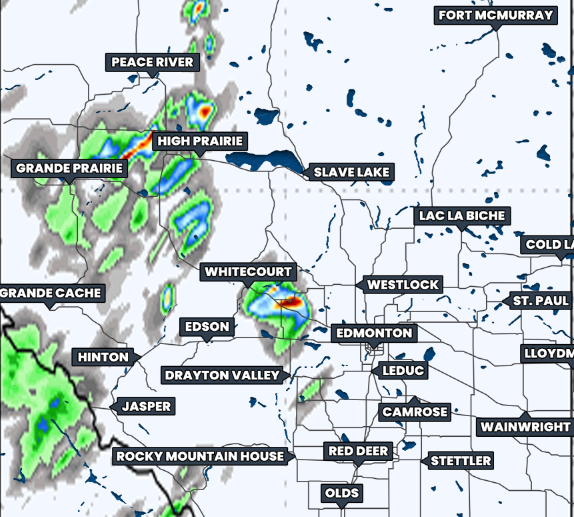
At this time, it appears the Ottawa Valley may remain outside the main severe weather risk on Tuesday. However, that could still change in our final outlook as confidence increases regarding storm development and storm coverage. The atmosphere across Eastern Ontario will still be somewhat supportive of marginally severe thunderstorms, but confidence is currently not high enough to formally include those regions within the isolated severe risk area.
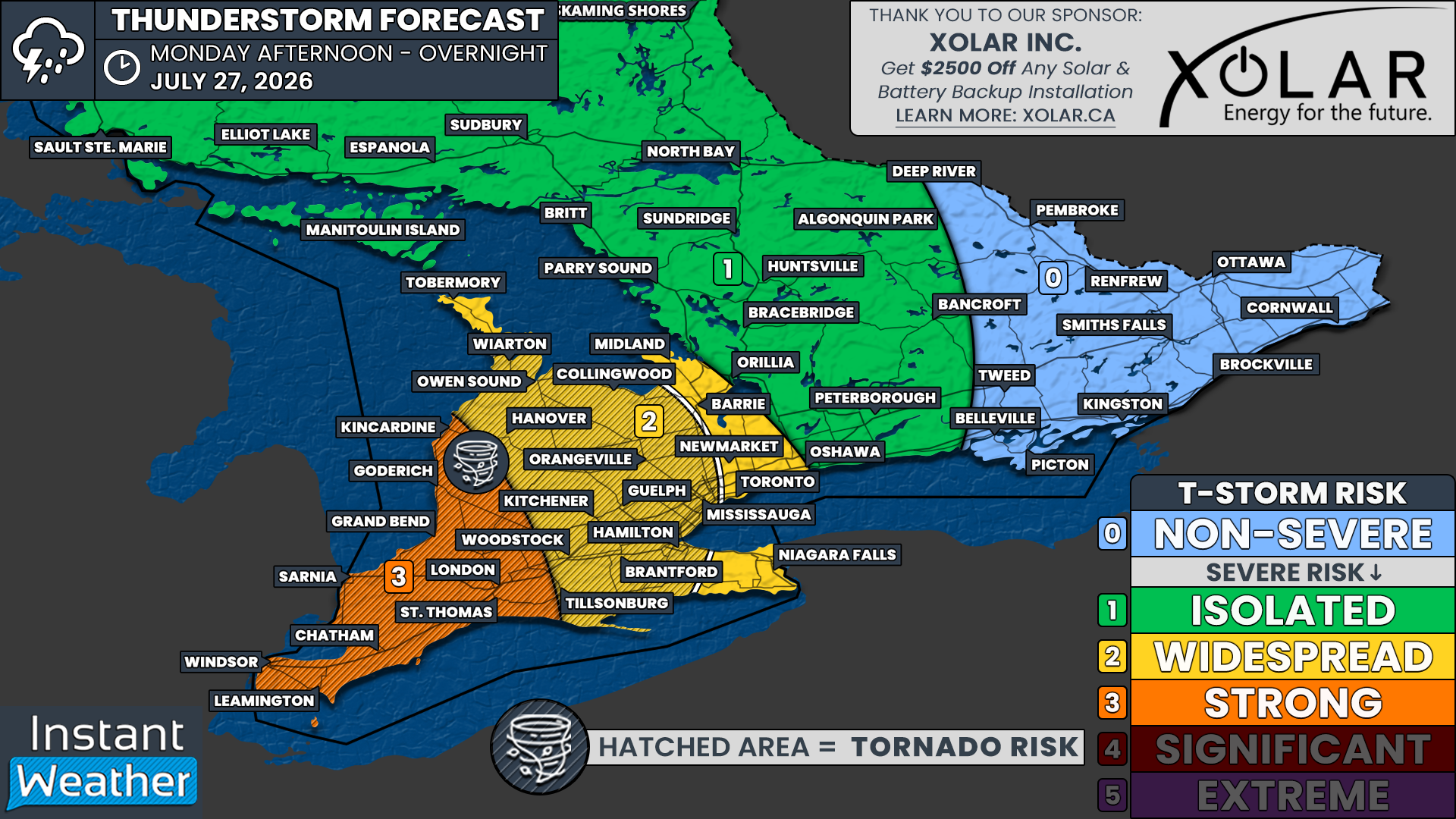
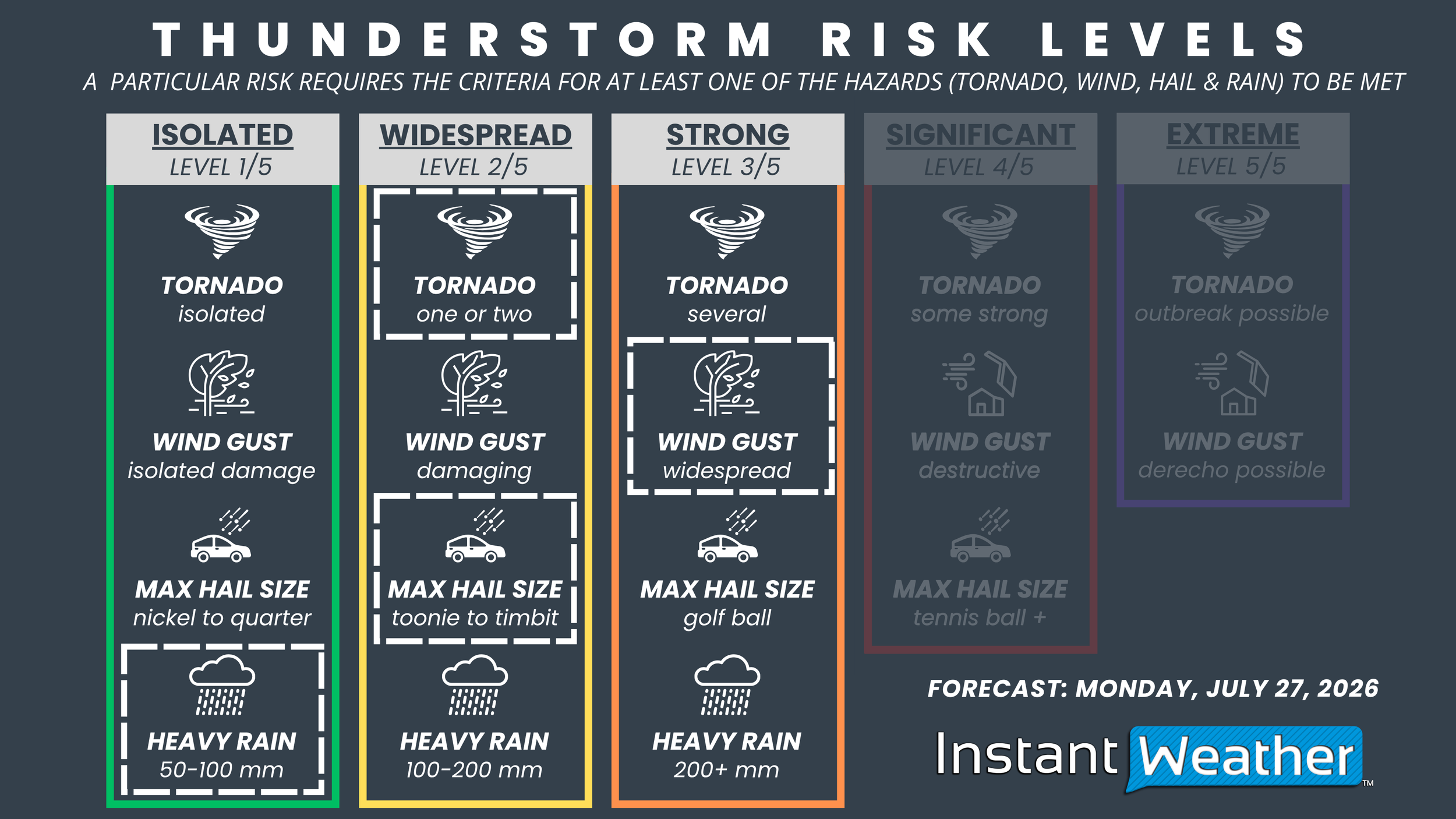
Victoria Day to Bring Early Tease of Summer to Southern Ontario With 30°C Heat and Severe Storm Risk on Monday

NOTE: YOU CAN CLICK ON THE MAP TO OPEN A ZOOMABLE IMAGE

After a chilly and wet start to May across Southern Ontario, it finally looks like summer is ready to make an appearance, just in time for the Victoria Day long weekend.

The first half of the month has certainly felt more like an extension of early spring than the lead-up to summer. We’ve dealt with multiple rounds of widespread frost, temperatures consistently running below seasonal, and even reports of wet flurries in some areas.

While we did get a brief taste of severe weather with Canada’s first confirmed tornado of 2026 on May 9th near Lucan (northwest of London), the summer-like warmth has been hard to come by. That’s about to change!

The Victoria Day long weekend, often considered the “unofficial start of summer” in Ontario, is expected to fully live up to the title this year. A significant warm-up is set to spread across Southern Ontario through the weekend, peaking on Monday with widespread summer-like heat and humidity.

The hottest temperatures on Monday are expected to be found in Deep Southwestern Ontario extending into the western GTA and Niagara region, including Windsor, Chatham, Sarnia, London, Grand Bend, Woodstock, Brantford, Hamilton and Niagara Falls. Daytime highs in these areas are likely to range between 30-33°C with humidex values potentially approaching 35°C at times.

While many will be excited to finally enjoy some summer-like weather, it’s important to remember that the first major heat event of the season can be particularly stressful on the body. Be sure to stay hydrated, limit strenuous outdoor activity during the hottest part of the day, and never leave children or pets unattended in vehicles. Pets can also quickly overheat on hot pavement, so it’s a good idea to check surfaces before heading out for a walk.

For much of the rest of Southern Ontario, daytime highs are expected to range between 27-30°C, with the humidity making it feel into the low 30s. This includes Toronto, Kitchener, Barrie, Muskoka, Peterborough, Kingston and Ottawa.

The higher elevations of the Dundalk Highlands are likely to remain a few degrees cooler, with areas like Orangeville and Shelburne expected to top out closer to 24-27°C.

Meanwhile, temperatures directly along portions of the Lake Erie and Lake Ontario shoreline may stay noticeably cooler thanks to developing lake breezes. Southwest winds coming off the still-cool lake waters will help suppress temperatures near the shoreline through the afternoon hours.

As a result, locations such as Picton, Cobourg, Oshawa, Fort Erie, Port Colborne, Port Dover, Turkey Point and Leamington could struggle to climb much beyond the low 20s despite the intense heat further inland.

A similar cooling effect is expected along the Bruce Peninsula, Manitoulin Island and parts of the northern Georgian Bay shoreline. Locations such as Britt, Manitoulin Island and Tobermory are also expected to remain closer to 20°C.

The heat is expected to continue into Tuesday with similar daytime highs before a cold front sweeps through later in the week, returning temperatures closer to seasonal or even slightly below seasonal levels.

Another concern with the return of summer-like heat will be the increasing fire danger across parts of the province. According to the latest forecast from the Canadian Wildland Fire Information System, portions of Deep Southwestern Ontario could see fire danger levels reach high or even extreme on Monday, thanks to the combination of hot temperatures, dry conditions and gusty winds.

With many people planning campfires and fireworks for the Victoria Day long weekend, it’s especially important to use extra caution with any open flames. Be sure to follow all local burning regulations and fire bans, and check with your local municipality before setting off fireworks or lighting a fire. Under high or extreme fire danger conditions, even a small spark can quickly spread and become difficult to control.

NOTE: YOU CAN CLICK ON THE MAP TO OPEN A ZOOMABLE IMAGE


With the return of summer-like heat also comes the return of increasing atmospheric instability, which can help fuel thunderstorms. The next few days are expected to feature multiple opportunities for thunderstorms across parts of Southern Ontario.

The first round is expected Sunday night into Monday morning as a batch of non-severe nocturnal thunderstorms potentially tracks through areas near Lake Huron extending into Central and Eastern Ontario.

That activity may help set the stage for another round of storms later Monday afternoon and evening. At this point, the greatest risk for isolated severe thunderstorms appears to be focused east of Georgian Bay around Muskoka, Parry Sound and Algonquin Park. A line of storms may also develop over Michigan and track into Deep Southwestern Ontario later Monday night into Tuesday morning, but the exact intensity remains unclear by the time it reaches the border.

Locations that could potentially see isolated severe storms on Monday include Goderich, Kincardine, Hanover, Owen Sound, Wiarton, Tobermory, Collingwood, Midland, Orillia, Bracebridge, Huntsville, Parry Sound, Britt, North Bay, Sudbury, Algonquin Park, Bancroft, Pembroke and Deep River.

It remains too early to determine the exact storm mode and whether any tornado risk will develop. For now, all severe weather hazards remain possible including damaging wind gusts, large hail and torrential rainfall.

A more detailed severe weather outlook, including specific risk categories and hazard breakdowns, will be issued Sunday night or Monday morning once higher resolution forecast models come into range and confidence improves on the exact storm setup.

We’re also monitoring the potential for a more widespread severe thunderstorm risk on Tuesday as a cold front approaches the region later in the day.

However, there is still some uncertainty regarding the exact timing of the cold front. If it arrives later Tuesday afternoon or evening, there would likely be enough daytime heating available to support stronger storms. If the front arrives overnight or earlier in the day, it could significantly reduce instability and limit the severe weather potential.

At this point, isolated thunderstorms remain possible Tuesday afternoon and evening, but the exact location and intensity of the strongest storms remains uncertain.

🔔⛈️ Severe Thunderstorm Risk Today Focused on Southwestern Ontario with Damaging Winds, Large Hail & an Isolated Tornado Cannot be Ruled Out

NOTE: YOU CAN CLICK ON THE MAP TO OPEN A ZOOMABLE IMAGE

Southern Ontario is facing a fairly widespread thunderstorm risk this afternoon and evening, Saturday, May 9, 2026 with the potential for isolated severe thunderstorm activity.

The strongest potential for severe thunderstorms will be in the yellow region, especially between roughly 3 and 7 PM across deep Southwestern Ontario. Storms in this area could bring damaging wind gusts, large hail around 1 to 3 cm in size, frequent lightning, and localized flooding. Isolated tornado activity cannot be ruled out in the yellow region today as well, so we’ll be live streaming on our YouTube channel to monitor for any signs of organized rotation.

In the green region, the main threats will be strong wind gusts, hail, frequent lightning, and torrential rainfall, which could create difficult travel conditions for many. There is a small chance that wind gusts or hail in the green region could briefly reach severe limits, which is why we’ve highlighted it for an isolated severe risk.

We’ll also be sending out Environment Canada’s official watches and warnings through our free InstantWeather app, along with possible custom notifications if we spot anything worth notifying.

And in some exciting news, we’re planning to launch our completely revamped free app on June 1st! It includes dark mode, a widget, and a full rebuild from the ground up for better performance, reduced battery usage, and an improved experience overall. We’ve also built the original app experience into the new version for those who prefer it. :)

More details coming ASAP. Woohoo!

Buckle Up: Parts of Saskatchewan & Manitoba About to Get Hammered By an Intense Spring Storm This Week

NOTE: YOU CAN CLICK ON THE MAP TO OPEN A ZOOMABLE IMAGE

We may be in the latter half of April, but winter is still hanging on across the Prairies. On Wednesday, a massive low pressure system will begin to develop which will bring chaos to Saskatchewan and Manitoba over the next few days.

Unfortunately, we’re looking at all precipitation types in both provinces, with some places possibly expecting full-on blizzard conditions, while others could see temperatures in the 20s and severe thunderstorms. This makes for a very complicated forecast, but we’ll do our best to break it down for you here.

The rdps model showing precipitation type and intensity at 12pm cst/1pm CT on Wednesday, courtesy of WeatherBell.

The rdps model showing precipitation type and intensity at 7pm cst/8pm CT on Wednesday, courtesy of WeatherBell.

An area of light to moderate rainfall began to move into Northern Saskatchewan from Alberta on Wednesday morning, which then started to transition to snow before the lunch hour.

Through the afternoon and into the evening, the area of snowfall will expand and spread eastward as the low strengthens and becomes more organized. Meanwhile, the trailing rainfall will make its way into Central and Southern Saskatchewan.

The snowfall will be fairly light at first, but there is expected to be some pockets of more moderate snowfall during the evening. However, things will really start to ramp up as we get later in the evening and continuing into the overnight hours, just as the leading edge of the storm will start to cross into Northern Manitoba.

The rdps model showing precipitation type and intensity at 12am cst/1am CT on Thursday, courtesy of WeatherBell.

The rdps model showing precipitation type and intensity at 6am cst/7Am CT on Thursday, courtesy of WeatherBell.

This is when the heaviest snow will start to develop, falling at a rate of up to 3cm/hr, and it is expected to persist well into the afternoon across a significant swath of Northern Saskatchewan.

Meanwhile, the heavy rain that is expected to track through West Central and Southwest Saskatchewan overnight Wednesday will start to transition over to snow Thursday morning, as cold air from the Arctic is pulled in around the backside of the system. A quick 5-15cm of snow will be dumped over much of this region by the late afternoon/early evening, at which time this area of snowfall will begin to dissipate.

Also during the early morning hours, freezing rain and ice pellets will be added to the mixture of rain and snow in Northeastern Saskatchewan and into Northern Manitoba. The freezing rain could be quite heavy at times across a fairly narrow path that stretches from approximately Cumberland House and Flin Flon to the Ontario border.

Ice accretions above 5mm, and even as high as 10mm, are possible by the early afternoon Thursday, which has prompted Environment Canada to issue Winter Storm and Freezing Rain Warnings alongside the Snowfall Warnings. This is a significant amount of ice buildup that will likely damage both trees and powerlines and could lead to prolonged power outages for the area, so be prepared.

NOTE: YOU CAN CLICK ON THE MAP TO OPEN A ZOOMABLE IMAGE

Environment Canada Thunderstorm Lookout Map for Thursday morning

The situation across Southern Manitoba and into the Southeast corner of Saskatchewan will be remarkably different. Late Wednesday evening and into the early morning hours of Thursday, there will be the risk of some elevated thunderstorms, particularly to the east of Brandon, that could have the potential to produce up to Toonie-sized hail.

Temperatures will then climb into the upper teens and low 20s in the afternoon in this region before the cold front slides through during the late afternoon and evening. This will trigger development of additional, marginally severe thunderstorms from Winnipeg eastward.

Environment Canada Thunderstorm Lookout Map for Thursday Afternoon and evening

The thunderstorms will likely form in lines, but an individual supercell or two could be possible. These storms may produce strong wind gusts up to 90km/h, Toonie-sized, and the possibility of a tornado can not be ruled out.

As of Wednesday afternoon, this thunderstorm development is conditional on a few factors so if, when, and where they might occur could change. We will definitely be watching the situation closely.

Outside of this area, to the north and west, there is a lesser risk from thunderstorms throughout the day, with strong wind gusts being the main concern. We will go into more detail about the wind later in the forecast.

The rdps model showing precipitation type and intensity at 7pm cst/8pm CT on Thursday, courtesy of WeatherBell.

The rdps model showing precipitation type and intensity at 5Am cst/6Am CT on Friday, courtesy of WeatherBell.

As we get into Thursday evening, the system begins to lose some organization in Saskatchewan, while the heavier snow sets up in Northern Manitoba.

Overnight, the low will start to track northward and it will continue along with path through the day Friday. During this time, there is a possibility of brief freezing drizzle in Central Manitoba, but very little ice would build up.

The heavy snow will continue to fall in Northern Manitoba into the afternoon, while large areas of lighter snow will wrap around the low and settle over Saskatchewan for the majority of the day.

By Friday evening, the entire system will start to fall apart and the snow will taper off overnight. A few flurries will linger through Saturday morning, which may add a centimetre or two to the total accumulations across both Saskatchewan and Manitoba.

By the time the storm has finished, a total of 25-50cm of fresh snow is expected to fall across a large stretch of Northern Saskatchewan and Manitoba. An area of 15-25cm will extend southward into Central Saskatchewan while most of the rest of the province will be in the 5-15cm range.

Heavy rain is also a concern for areas to the south of the heaviest snowfall. Rainfall totals approaching 30mm could lead to some localized flooding, especially in areas where the ground is still partially frozen.

The rdps model showing precipitation type and intensity at 6pm cst/7pm CT on Friday, courtesy of WeatherBell.

Precipitation will not be the only hazard this storm brings; strong wind gusts will also be a concern.

Strong wind gusts up to 90km/h, and possibly up to 100km/h in the Cypress Hills area, will develop this evening in Southeastern Alberta and Southwest Saskatchewan. These strong winds will continue in this region through to the morning before they start to travel eastward. They will cross Southern Saskatchewan through the day and into Southwest Manitoba by the evening, before they die down overnight.

Further north, where the heavy snow is slated to fall, the winds will not be quite as strong, topping out at around 70km/h. This still poses a major issue as it will likely lead to widespread whiteouts, and even crossing the threshold of being a blizzard, across Northern Saskatchewan and Manitoba. These will be treacherous conditions to attempt to travel in this region, so it will be best to postpone any unnecessary travel until the storm is over.

The ECMWF model showing Maximum Wind gust by 12pm CST/1PM CT Friday, courtesy of WeatherBell.