Southern Ontario: ‘Snow Day’ Forecast for Monday, December 1, 2025

For an updated list of school bus cancellations & school closures, please visit our live article: https://instantweatherinc.com/article/2025/12/1/bus-cancellations
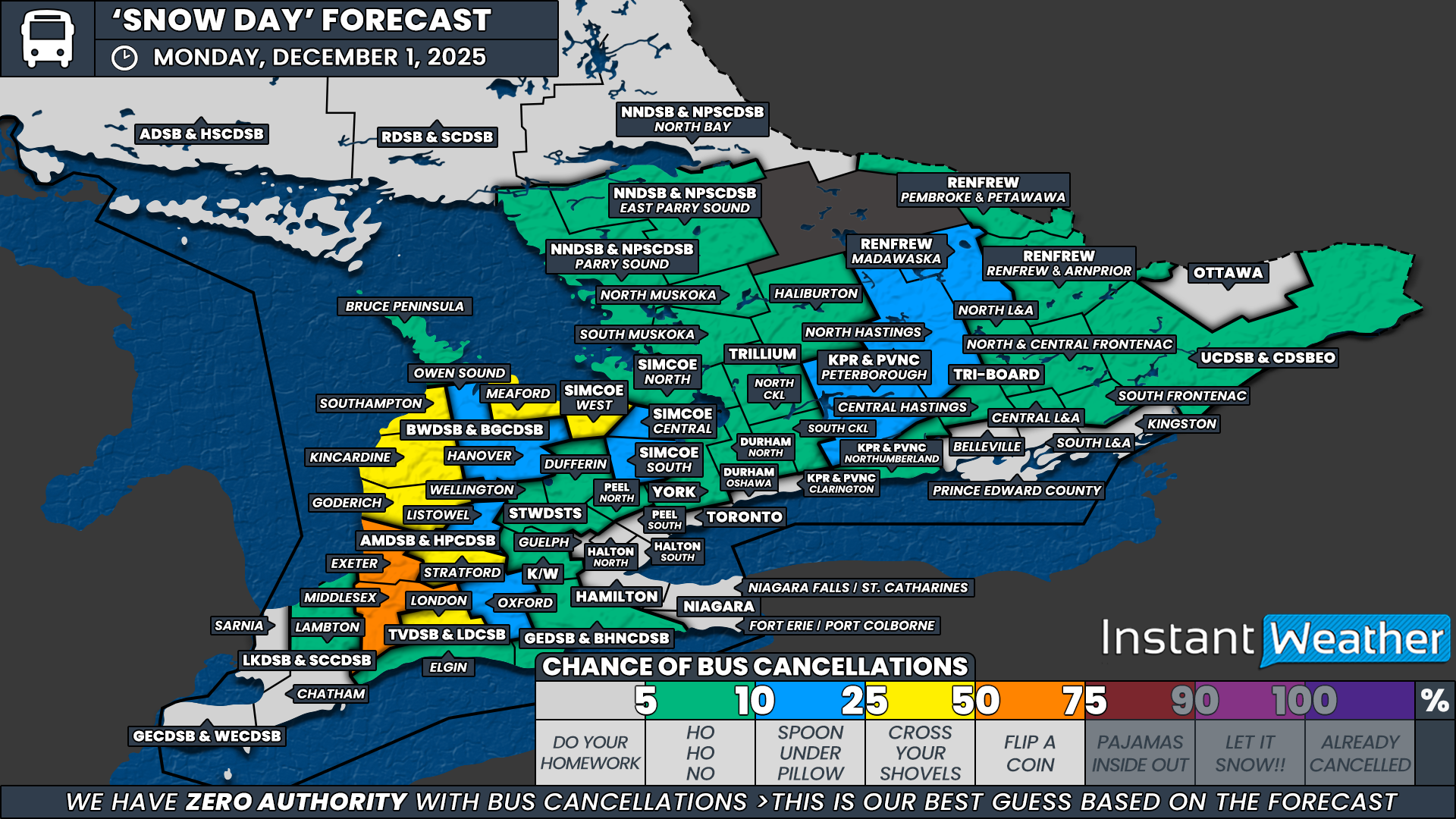
NOTE: YOU CAN CLICK ON THE MAP TO OPEN A ZOOMABLE IMAGE

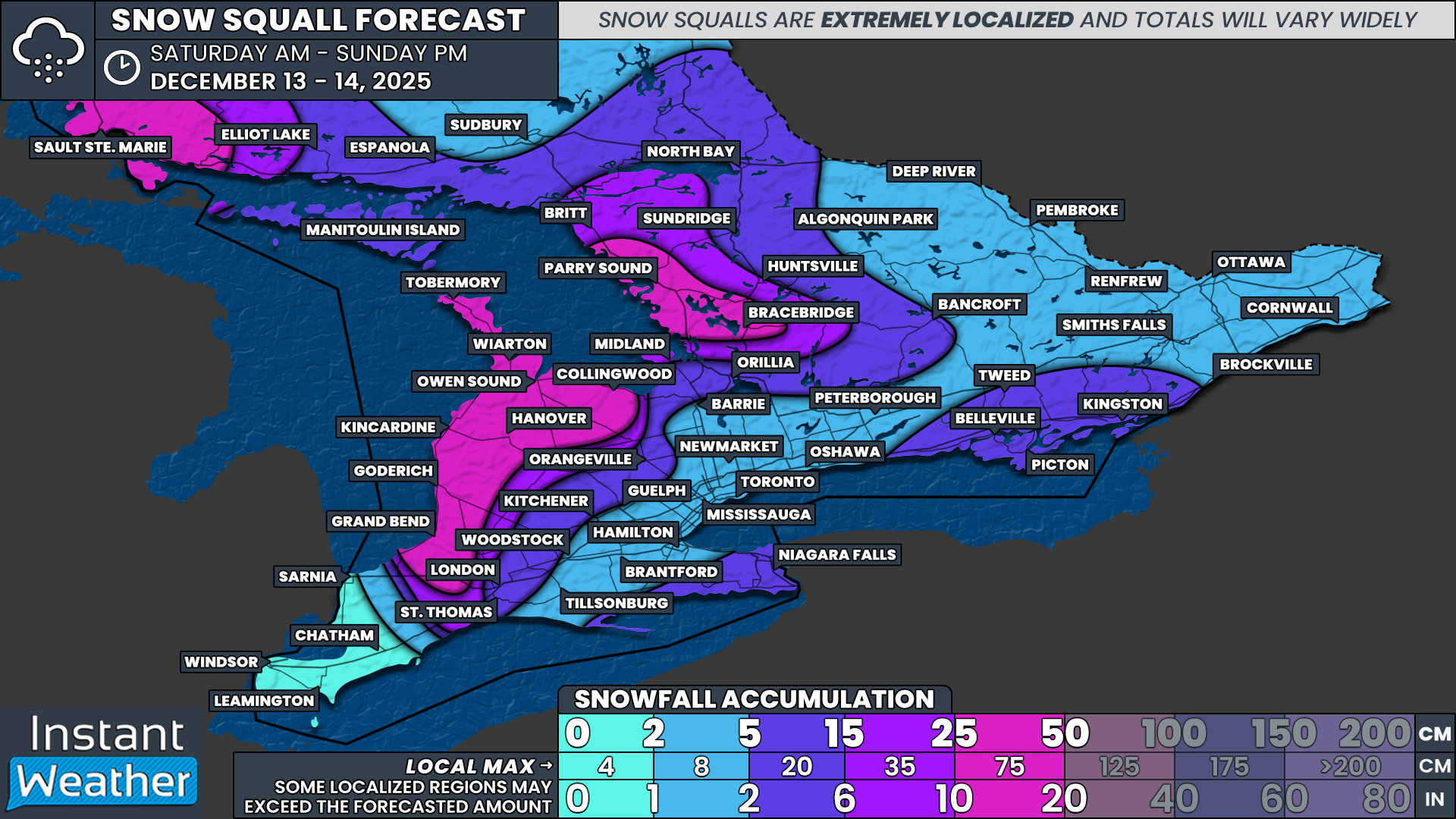
The system that brought widespread snowfall to Southern Ontario on Sunday has now begun to move out of the region. In its place, a sharp drop in temperatures has allowed lake effect snow to develop southeast of Lake Huron and Georgian Bay.

This lake effect activity is expected to continue through the overnight hours and into Monday morning. Local snowfall totals may reach up to 15 cm in the most persistent bands. Environment Canada has issued a mix of snow squall watches and warnings for the areas most likely to be affected.

However, there is still quite a bit of uncertainty surrounding the exact intensity of these squalls and how long they will hold together. Because of this, we are not confident that conditions will reach the threshold needed to prompt widespread school bus cancellations. As a result, the highest probability on the map is capped at 50 percent along the southeastern shoreline of Lake Huron, where warnings are currently in effect and the most organized bands are expected to form.

This 50 percent zone includes southern Huron County within the Avon Maitland District School Board. It also extends into Middlesex County under the Thames Valley District School Board. These regions sit closest to the shoreline hotspot and stand the best chance of seeing stronger, more persistent squalls early Monday morning.

Surrounding this area, we have assigned a 25 percent chance for several boards that remain under a snow squall watch or tend to maintain a higher threshold for cancellations. This includes the London region of the Thames Valley District School Board and the west zone of the Simcoe County District School Board. We have also included northern Huron County and southern Perth County under the Avon Maitland District School Board, as well as the Kincardine, Southampton and Meaford regions within the Bluewater District School Board.

Temperatures are expected to fall quickly overnight, which may lead to icy and slick road conditions by the early morning commute. This is especially true in rural areas where backroads often remain snow-covered or untreated. Because of this, we have assigned a very low to low chance across rural portions of Central and Eastern Ontario. While cancellations are not expected, we cannot fully rule out a few isolated decisions if icy conditions become more impactful in rural areas.

Elsewhere across Southern Ontario, the chance of a snow day remains very low.


Disclaimer: Instant Weather has zero authority when it comes to bus and school closures.

It is completely up to the school boards, bus companies, local authorities, and parents to decide what is best for their children. This is our best guess based on our forecast.
Yet More Snow on the Way for Southern Ontario With a Snowy System on Sunday Bringing Up to 10-20cm

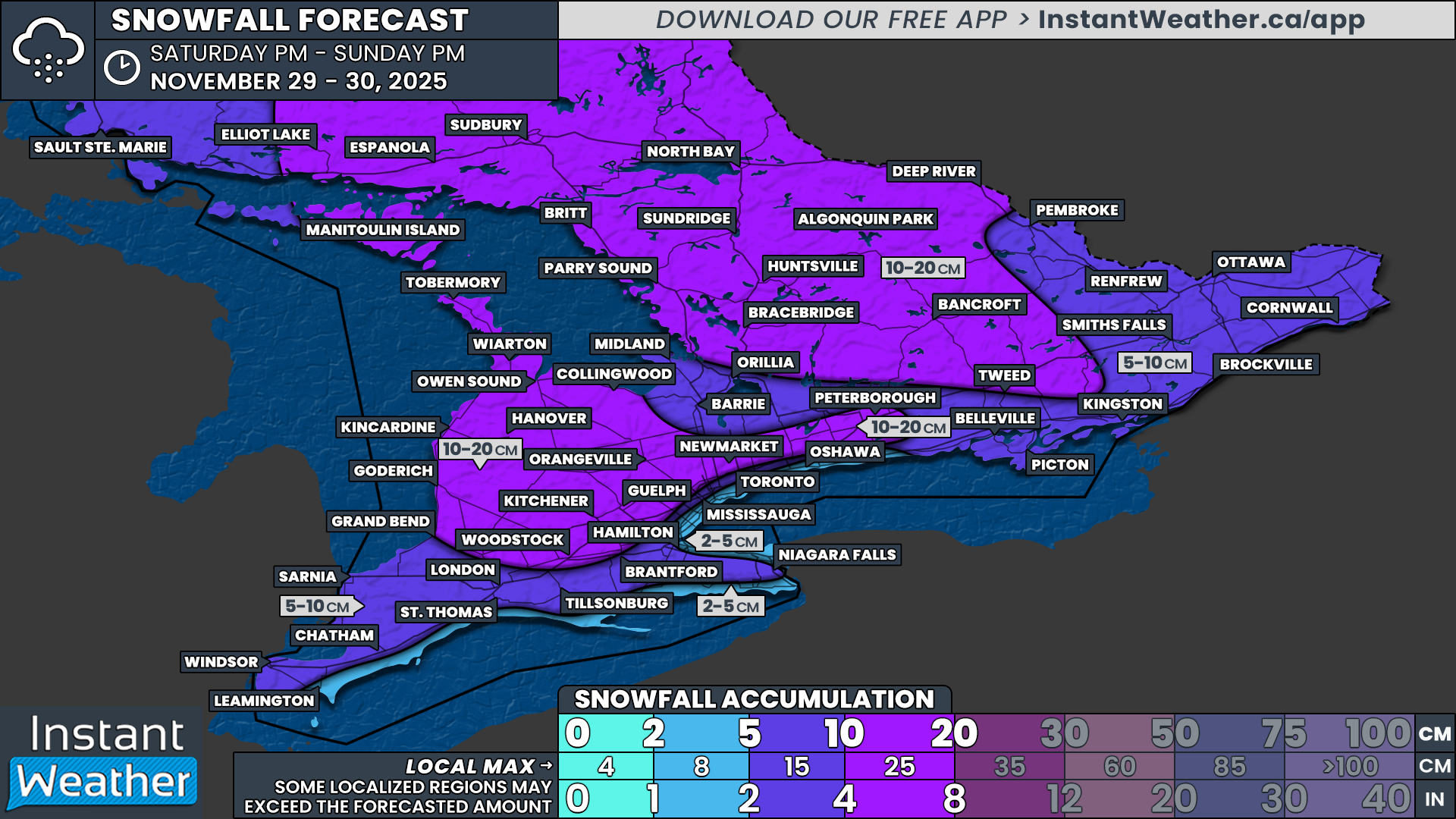
NOTE: YOU CAN CLICK ON THE MAP TO OPEN A ZOOMABLE IMAGE

As many communities in the snowbelt regions around Lake Huron and Georgian Bay are currently digging out from locally over 50cm of snow from squalls over the past two days, another snow maker is already on the way, just in time for the final days of November.

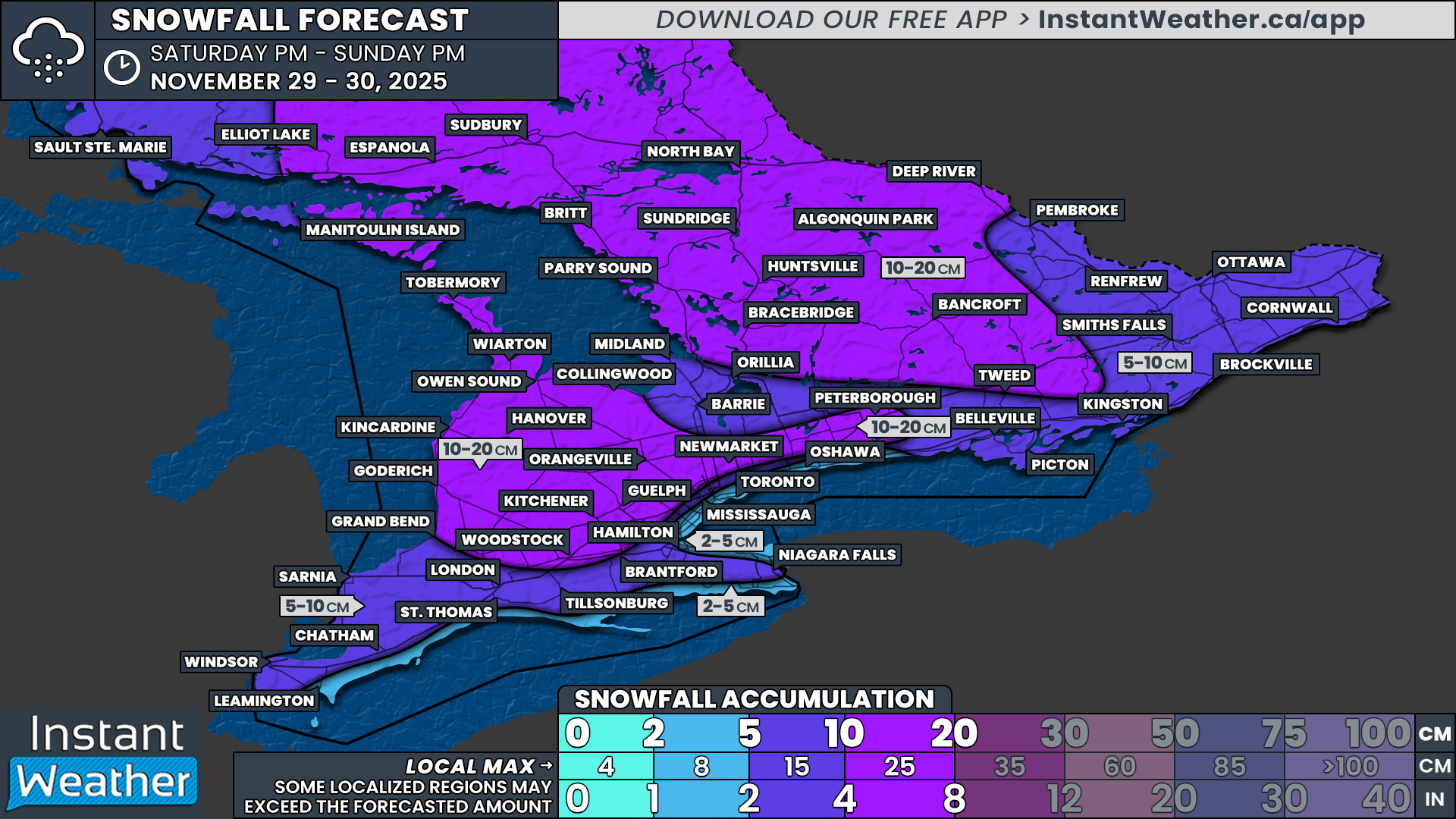
Instead of very isolated pockets seeing intense snowfall totals as we have seen with the lake effect activity, this system will spread accumulating snow across almost all of Southern Ontario. Widespread totals by the end of the weekend are expected to range from 5 to 15cm, with locally as much as 20cm in the areas that remain colder for longer.

Snowfall is expected to begin moving in from the west by late Saturday evening, starting first across Deep Southwestern Ontario. By the middle of the overnight, steady light to moderate snowfall will extend across almost all of Southern Ontario as the system further progresses into our region.

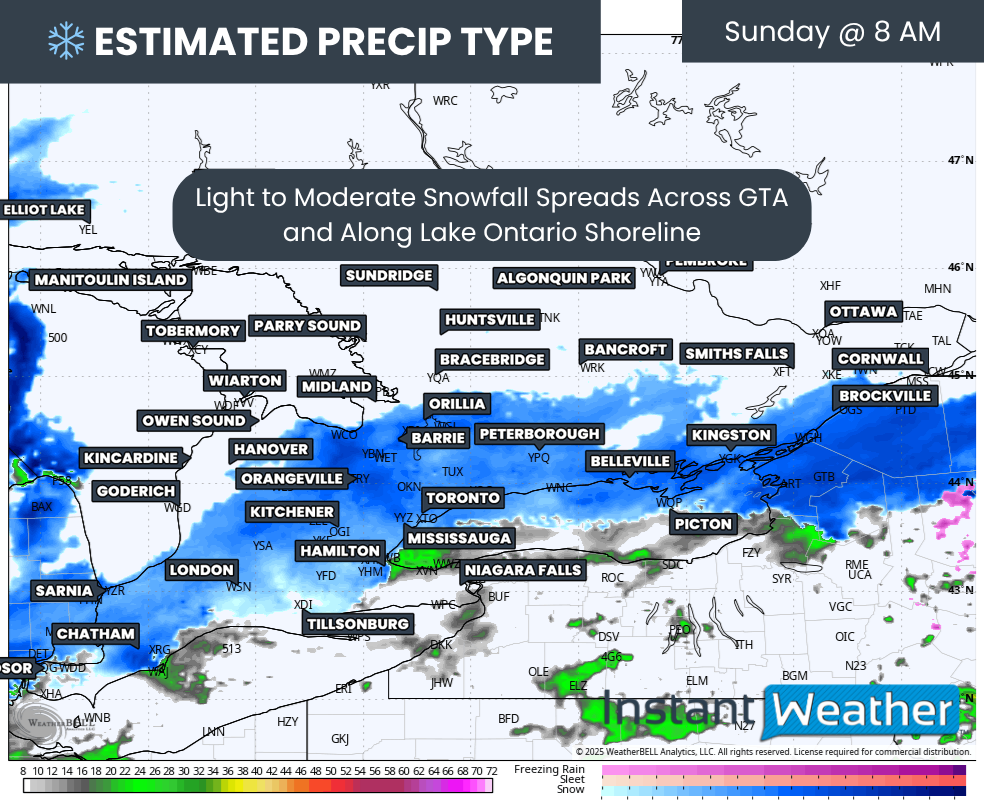
By late Sunday morning, southwesterly winds flowing across the still warm waters of Lake Erie and Lake Ontario are expected to push temperatures several degrees above freezing along the northern shorelines. This may allow the last remaining few hours of precipitation to switch over to rain for some communities right along the lakeshore.

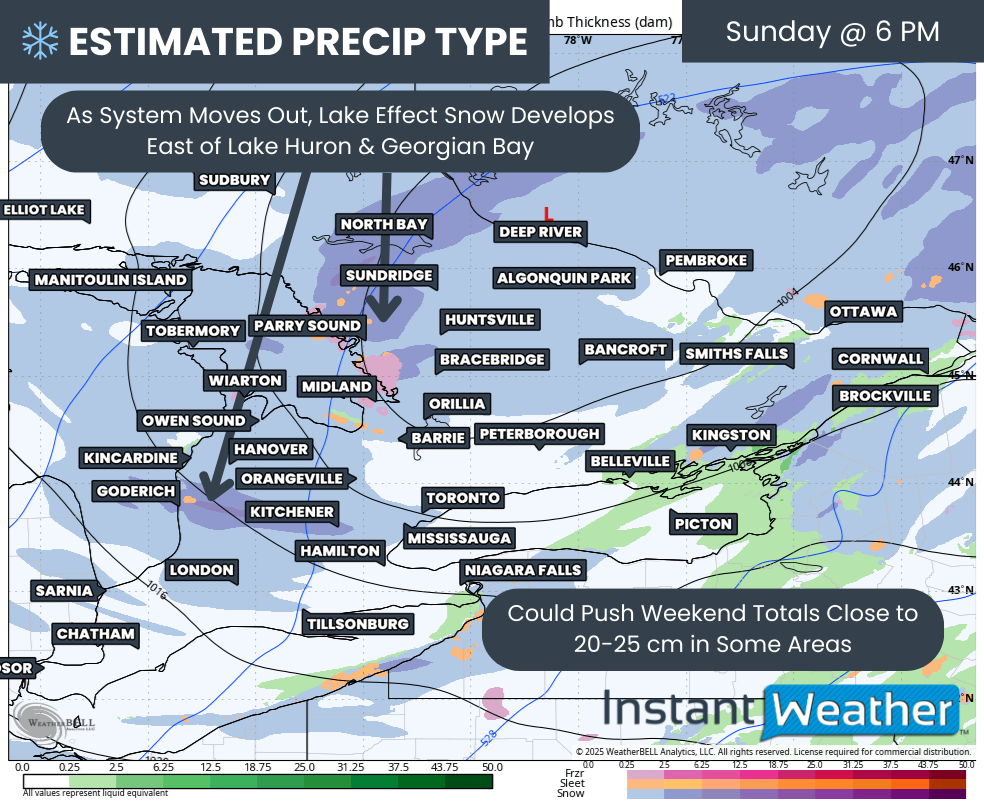
There could also be a lake effect component to this system as it departs our region to the east. As this happens later in the day on Sunday, we may see locally heavier pockets of lake effect snow develop east of Lake Huron and Georgian Bay, which also happens to include some of the same areas hit hard by the squalls over the last few days. This could push weekend totals into the 20 to 25cm range, especially if these bands linger longer into Sunday night.

Looking ahead to the start of the week, Monday should be fairly quiet as the lake effect activity tapers off early in the morning and the remaining flurries from the system fizzle out. It will certainly be colder with everyone seeing temperatures plunge below freezing. However, that calm weather may be short-lived.

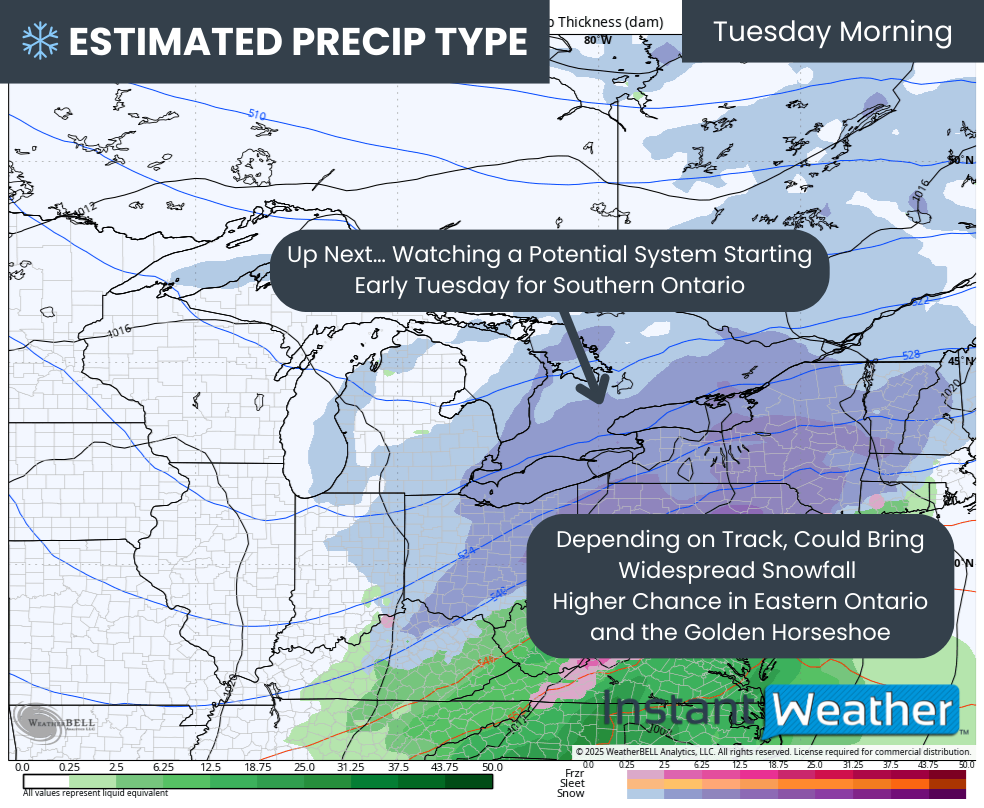
There are early indications of another potential system sliding south of the Great Lakes region. Depending on the track, this could bring another round of heavy snow throughout the early part of Tuesday, especially for areas further southeast.

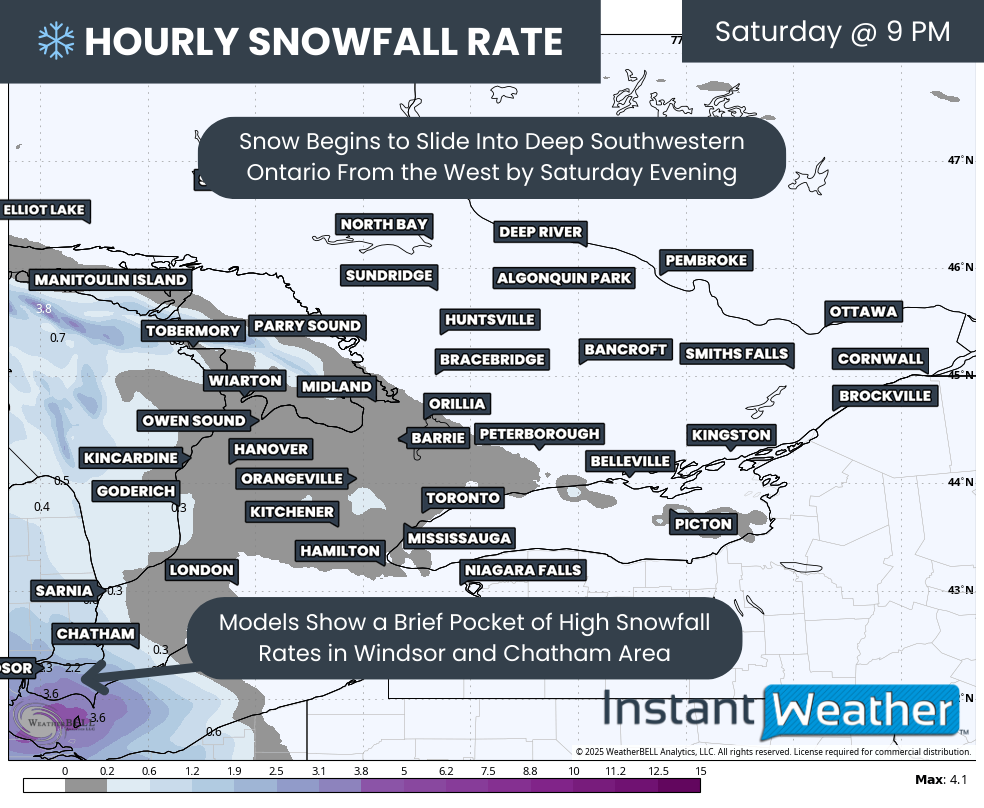
Hourly snowfall rates (cm) - MAP FROM WEATHERBELL

The initial bands of snowfall associated with the weekend system will begin to enter Southwestern Ontario from the west sometime just after the dinner hour on Saturday.

For most areas, the snowfall should be fairly light at first, but some models are showing the potential for several hours of heavier snowfall rates approaching 2 to 4cm per hour for Windsor, Leamington and Chatham. This could lead to a quick 5 to 10cm by the end of the night if the heavier bursts materialize.

Hourly snowfall rates (cm) - MAP FROM WEATHERBELL

As we head into the overnight hours, the system is expected to continue spreading eastward across Southern Ontario, with almost all areas seeing steady snowfall by the middle of the overnight.

Snowfall rates are not expected to be overly extreme, with most regions seeing less than 1cm per hour through Sunday morning. Even still, this snowfall is expected to continue for 6 to 12 hours, which will allow the totals to gradually build up.

Because the snow will be more widespread and less intense than recent squall activity, road crews should be able to keep up with the conditions on most major routes. Travel delays are still likely, so if you do need to drive, be sure to leave plenty of extra time and adjust your speed based on the conditions.

TEMPERATURE - MAP FROM WEATHERBELL

Winds are expected to pick up through the later part of Sunday morning, coming out of the southwest, and flowing across Lake Erie and Lake Ontario. This will push warmer air into the northern shorelines, which may allow the snow to switch over to rain directly along the Lake Erie and Lake Ontario shorelines.

Due to this transition, slightly lower snowfall totals are expected here, and some areas may struggle to reach the 5cm mark. This includes the Greater Toronto Area near the lakeshore, along with Port Colborne, Norfolk County, Tillsonburg, St. Thomas and Rondeau.

PRECIP TYPE - MAP FROM WEATHERBELL

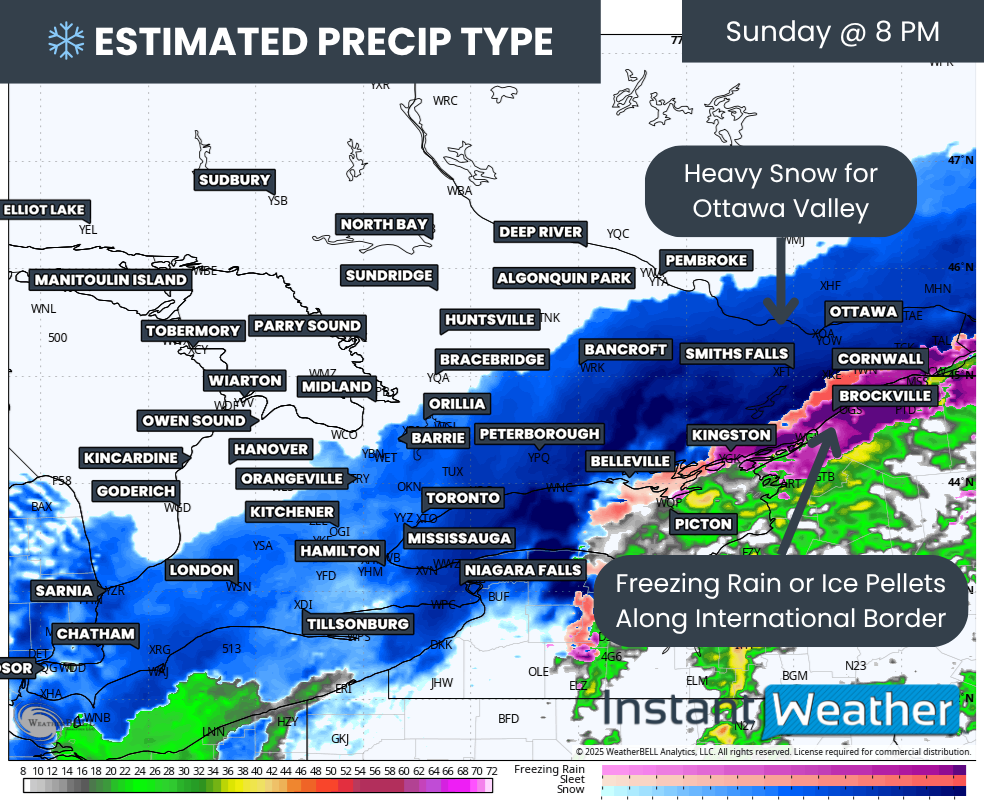
The system is expected to gradually taper off through Sunday afternoon, leaving scattered flurries in its wake into the evening. This leftover precipitation is likely to be enhanced by Lake Huron and Georgian Bay through Sunday evening and into the overnight hours.

Expect an additional 5 to 10cm of snowfall on top of the system totals in the areas that see lake effect enhancement. This could push the end-of-weekend totals to locally as much as 20 to 25cm in the traditional snowbelt regions.

NOTE: YOU CAN CLICK ON THE MAP TO OPEN A ZOOMABLE IMAGE

When it comes to the distribution of precipitation, we expect it to fall fairly evenly across the province. However, snowfall totals will vary based on temperature differences, which will influence how efficiently the snow can accumulate.

The higher snowfall totals from this event are expected in the more northern sections of Central Ontario and extending into the Sudbury and North Bay region. This includes Parry Sound, Muskoka, Algonquin Park and Bancroft.

These regions will see more sustained below freezing temperatures throughout the event, along with lake effect enhancement late Sunday. With this, we are looking at around 10 to 20cm, with locally up to 25cm possible in the heavier lake effect pockets.

A similar situation is expected east of Lake Huron and along the higher elevations of the Dundalk Highlands and Oak Ridges Moraine, where slightly colder temperatures will help accumulations. Expect 10 to 20cm in these areas as well, with localized totals around 25cm, especially east of Lake Huron.

Everyone else, with the exception of the Lake Erie and Lake Ontario shorelines, is looking at a general 5 to 10cm. Some areas could see locally up to 15cm if temperatures end up just a bit cooler than expected. This includes the rest of Southwestern Ontario into Windsor, Chatham and Sarnia, the Lake Simcoe region and parts of the Ottawa Valley.

For communities exposed to the shorelines of Lake Erie and Lake Ontario, which includes Toronto, Oshawa, Oakville, Hamilton, Niagara-on-the-Lake, Port Colborne and Rondeau, snowfall totals will likely be closer to the 2 to 5cm range due to the warmer air intrusion and rain mixing during the latter part of the system.

PRECIP TYPE - MAP FROM WEATHERBELL

As we look into next week, we are closely watching another potential system that could have an impact on Southern Ontario throughout the day on Tuesday. There is still some uncertainty on the exact track, with the latest model runs shifting it slightly further north, which would increase impacts across a wider portion of the region. However, it could easily shift back south.

At this point, we can say there is a decent chance of 5cm or more across a wide stretch of Southern Ontario, with the highest probability being further southeast, including the Niagara region and communities along the St. Lawrence River. Be prepared for possible impacts to the Tuesday morning commute, including the potential for school bus cancellations if the system trends stronger.

Expect possible impacts to the morning commute on Tuesday, including possible school bus cancellations, should we see a stronger system.

Southern Ontario: School Bus Cancellations and Closures for Friday, November 28, 2025

**Please refresh your page every few minutes to receive the latest update**

Cancellation & Closure Map (English Public and Catholic Schools)

Please note: School board boundaries are a rough estimate. Don’t use this map to determine what school board or weather zone you live in as accuracy isn’t guaranteed.

  • Green = No Cancellations

  • Red = Cancellations (Click for More Details)

  • Purple = School Closures (Click for More Details)

List of Cancellations & Closures

English Public and Catholic Schools

  • Avon MaitIand Public & Huron-Perth CathoIic: There are multiple closures/cancellations, please visit this link for more details: https://hpsts.mybusplanner.ca/Alerts

  • BIuewater Public & Bruce-Grey Catholic: All busses are cancelled.

  • Grand Erie Public & Brant HaIdimand Norfolk Catholic: Today, services in all 4 zones are cancelled due to current secondary road conditions and forecasted whiteout conditions during morning run time. As a result, schools are also closed.

  • Simcoe County Public & Simcoe Catholic: Busses are cancelled for the North, Central, and South Zones.

  • Thames Valley Public & London CathoIic: Busses are cancelled for Oxford County.

  • WaterIoo Public & WaterIoo Catholic: All busses are cancelled.

French Schools

  • Conseil scolaire catholique Providence: Busses are cancelled in Oxford and Bruce-Grey.

  • Conseil scolaire Viamonde: Busses are cancelled in Oxford and Bruce-Grey.

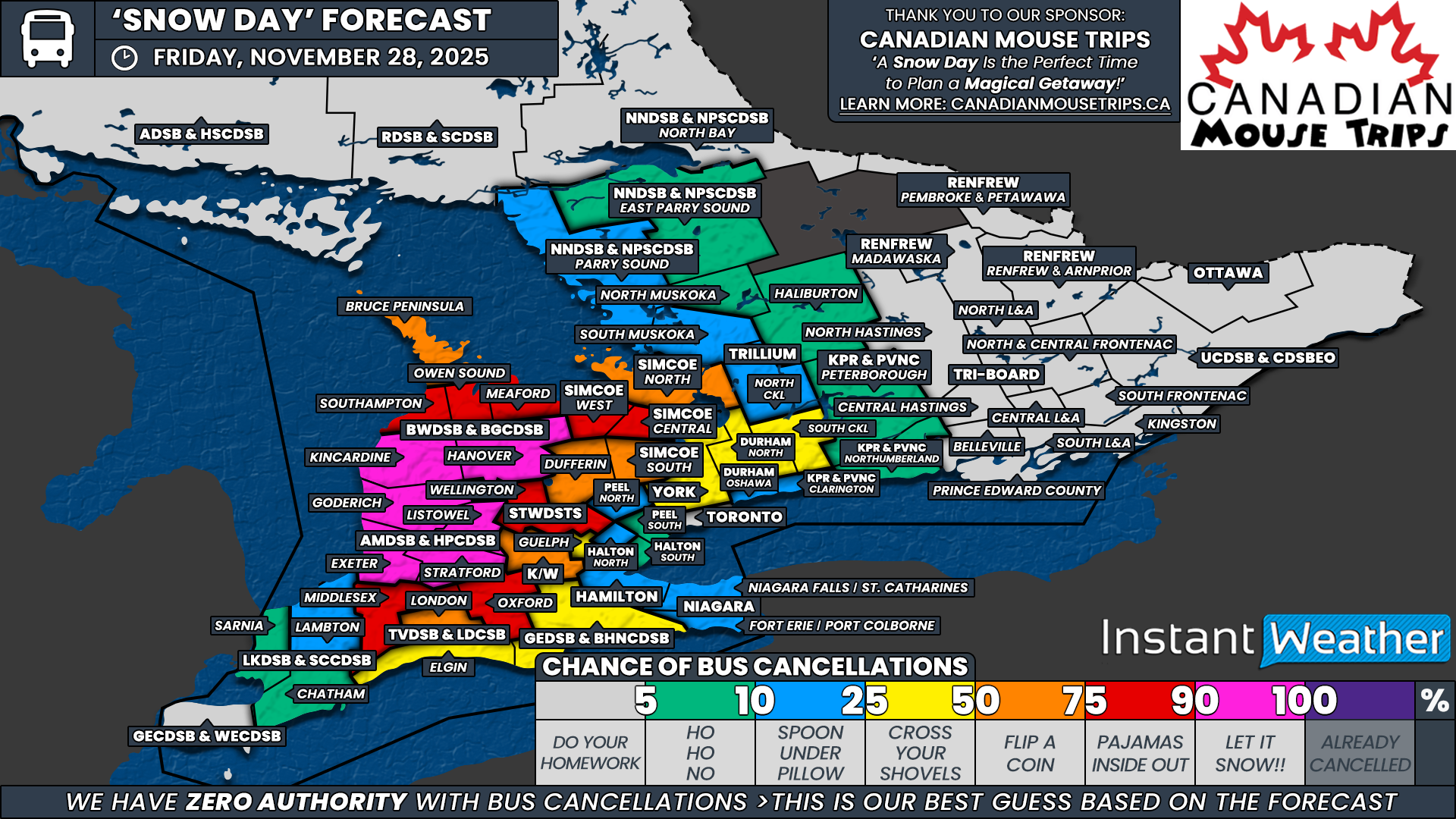
‘Snow Day’ Forecast: Widespread School Bus Cancellations Expected in Southern Ontario’s Snowbelt on Friday

Use Promo Code ‘Instant’ to Receive a Min. $25 Gift Card With Your Vacation!

For an updated list of school bus cancellations & school closures, please visit our live article: https://instantweatherinc.com/article/2025/11/28/bus-cancellations

NOTE: YOU CAN CLICK ON THE MAP TO OPEN A ZOOMABLE IMAGE

Snow squall activity has been developing off Lake Huron and Georgian Bay throughout the day on Thursday and is only expected to intensify as we head into the overnight and early morning hours of Friday.

These snow squalls are forecast to become nearly stationary, affecting much of Grey and Bruce counties, Huron County, Perth County, Wellington County, Simcoe County and parts of the northern Greater Toronto Area.

With snowfall rates reaching 5 to 10 cm per hour in the heaviest bands, along with strong winds causing blowing snow and localized blizzard conditions, it is almost certain that school buses will be cancelled in the hardest hit regions on Friday. School closures are also possible as we are likely to see numerous road closures overnight, with conditions continuing to worsen.

We are most confident in a snow day for the southern portion of the Bluewater District School Board, along with the entire Avon Maitland District School Board. We have assigned these regions a 90 percent chance of school bus cancellations.

These areas are positioned to face the full impact of the long-lasting snow squalls through Friday morning, making it extremely unlikely that buses will be able to operate safely, especially across rural roads.

Outside of these zones, we also have fairly strong confidence in cancellations along the southeastern shoreline of Georgian Bay. This includes the Simcoe County District School Board (west and central areas), the northern section of the Bluewater District School Board, Wellington County under the Upper Grand District School Board, and the Thames Valley District School Board’s Oxford and Middlesex regions.

While confidence is high, there remains a chance that a few of these regions might attempt to run buses either because they sit just outside the core impact zone or because the school board typically has a higher threshold for cancellations. This is especially true for Simcoe County, which has been particularly strict about cancelling buses this season despite strongly worded warnings from Environment Canada. With all of that in mind, we have assigned these regions a 75 percent chance.

The probability drops off quickly outside the primary snow squall corridor. We have a 50 percent chance for the Simcoe County District School Board’s north and south areas, the Bruce Peninsula, Dufferin County, Waterloo Region under the Waterloo Region District School Board, and the London area under the Thames Valley District School Board.

In these regions, it could go either way and will largely depend on the exact positioning of the squalls. For Kitchener and London specifically, both are more urban school boards with a higher threshold for cancellations.

We have assigned a 25 percent chance for Elgin County under the Thames Valley District School Board, the Grand Erie District School Board, York Region under the York Region District School Board, the northern portion of the Durham District School Board, and the southern section of the Trillium Lakelands District School Board, including the southern City of Kawartha Lakes.

While we do not expect widespread cancellations here, if the squalls push far enough inland and produce pockets of whiteout conditions, there is still room for some surprises.

Elsewhere across Southern Ontario, there is less than a 25 percent chance of a snow day.


Disclaimer: Instant Weather has zero authority when it comes to bus and school closures.

It is completely up to the school boards, bus companies, local authorities, and parents to decide what is best for their children. This is our best guess based on our forecast.

BIG CHANGES Coming to Environment Canada’s Alerts Beginning Today

Environment Canada is making big changes to the way it issues weather alerts, in an attempt to make them easier to understand at a glance.

Starting today, Wednesday, November 26th, 2025, the new system will use Yellow, Orange or Red colours for all 'Advisories', 'Watches' and 'Warnings'.

'Statements' will remain unchanged (blue or grey), for now.

Environment Canada is making this change to hopefully help you quickly gauge both the severity of a weather event and the level of confidence forecasters have in their predictions.

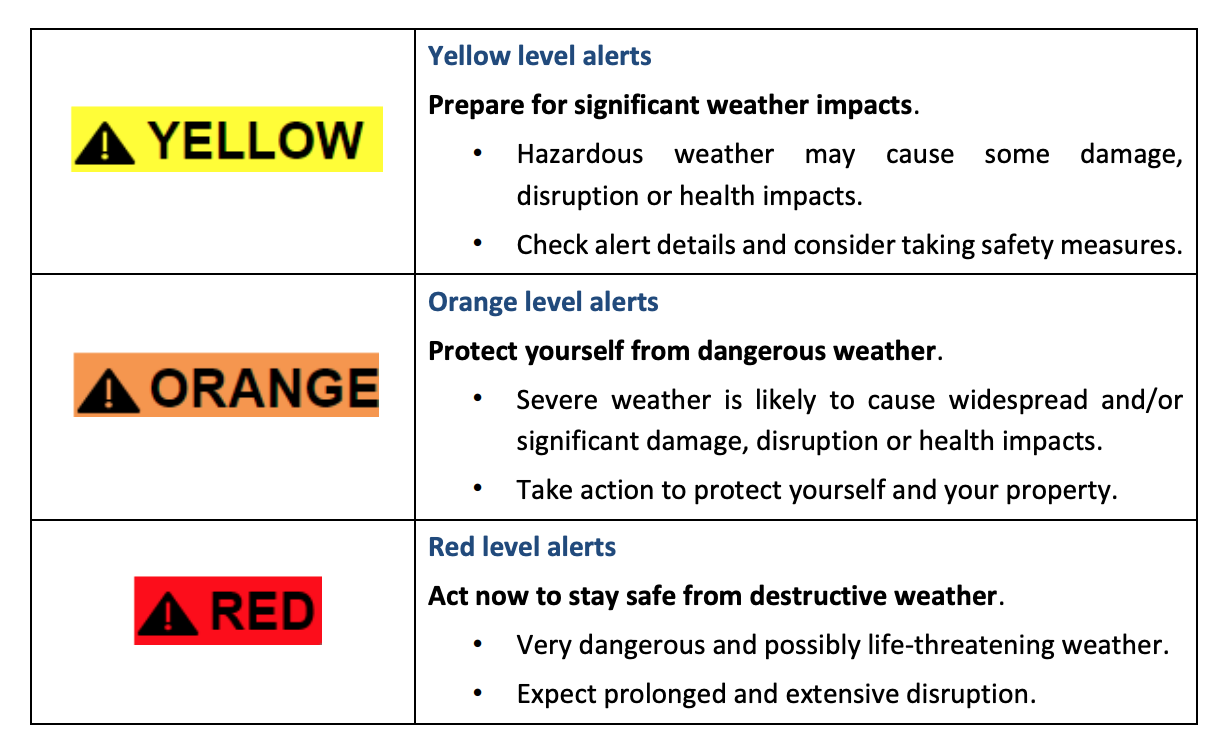
Shown in the chart above, Environment Canada forecasters will choose the colour of alerts based on an "Impact" level and a "Confidence" level.

Here’s a breakdown of the upcoming changes and what they mean for you.


Headline Changes

Currently, weather alert headlines look like this:

Heat Warning

Under the new system, the headline will include a colour code that signals risk. For example:

Yellow Level Warning – Heat

We at Instant Weather feel that something about "Yellow Level Warning – Heat Issued" looks… strange and extra confusing.

Therefore, when we post Environment Canada alerts to social media, send notifications via our free app, and send out text message alerts, we're going to format it like this:

Heat Warning (Yellow Level) Issued

We believe this will make the transition from the old format to the new format easier for our community members. However, we'd love to hear your feedback on this so please let us know what you think about it!


NEW COLOURS

For the first time, advisories, watches and warnings will come in one of three colour options:

- Yellow = low risk (stay alert)

- Orange = moderate risk (take precautions)

- Red = high risk (serious danger)


Impact Level

The new Impact Level will estimate how much damage or disruption a storm is likely to cause.

Possible values:

- Low

- Moderate

- High

- Extreme

For example, a minor snowfall could be flagged as low impact, while a hurricane might carry an extreme impact designation.


Confidence Level

The new Confidence Level should help clarify how confident the Environment Canada forecaster issuing the alert feels.

Possible values:

- Low

- Moderate

- High

- Very High

For example, a “very high confidence” alert means there's near zero question if the storm poses a threat to the alerted area, while a “low confidence” could suggest that path may shift direction or the storm could dissipate.


Why These Changes Matter

Environment Canada believes these updates make weather alerts more actionable and accessible. Instead of vague warnings, you’ll know:

- The severity of the threat (colour level).

- The expected damage (impact level).

- The certainty of the forecast (confidence level).

For further details on these alert changes, visit Environment Canada’s newly launched website regarding colour-coded alerts:

https://www.canada.ca/en/services/environment/weather/severeweather/weather-alerts/colour-coded-alerts.html

Southern Ontario: School Bus Cancellations and Closures for Thursday, November 27, 2025

**Please refresh your page every few minutes to receive the latest update**

Cancellation & Closure Map (English Public and Catholic Schools)

Please note: School board boundaries are a rough estimate. Don’t use this map to determine what school board or weather zone you live in as accuracy isn’t guaranteed.

  • Green = No Cancellations

  • Red = Cancellations (Click for More Details)

  • Purple = School Closures (Click for More Details)

List of Cancellations & Closures

English Public and Catholic Schools

  • Avon MaitIand Public & Huron-Perth CathoIic: There are several cancellations, please visit this link for more details: https://hpsts.mybusplanner.ca/Alerts

  • BIuewater Public & Bruce-Grey Catholic: All busses are cancelled.

  • Dufferin-PeeI Catholic: Buses to St. Andrew, St. Peter, St. Benedict as well as Dufferin County buses to Robert F. Hall CSS are cancelled today due to road conditions

  • Near North Public & Nipissing-Parry Sound CathoIic: All School busses in West Parry Sound ( Britt/Nobel - Mcdougall/Whitestone/Ahmic Harbour - Town of Parry Sound - Mactier/Humphrey/Rosseau) are cancelled for today

  • Upper Grand Public & Wellington CathoIic: All school taxis and buses in Centre Wellington, The Town of Erin and the Town of Rockwood (Division 2), North Wellington (Division 3), and Dufferin County as well as to Robert F. Hall Secondary School (Division 4) will not be operating today. Schools in North Wellington (Division 3) are CLOSED.

French Schools

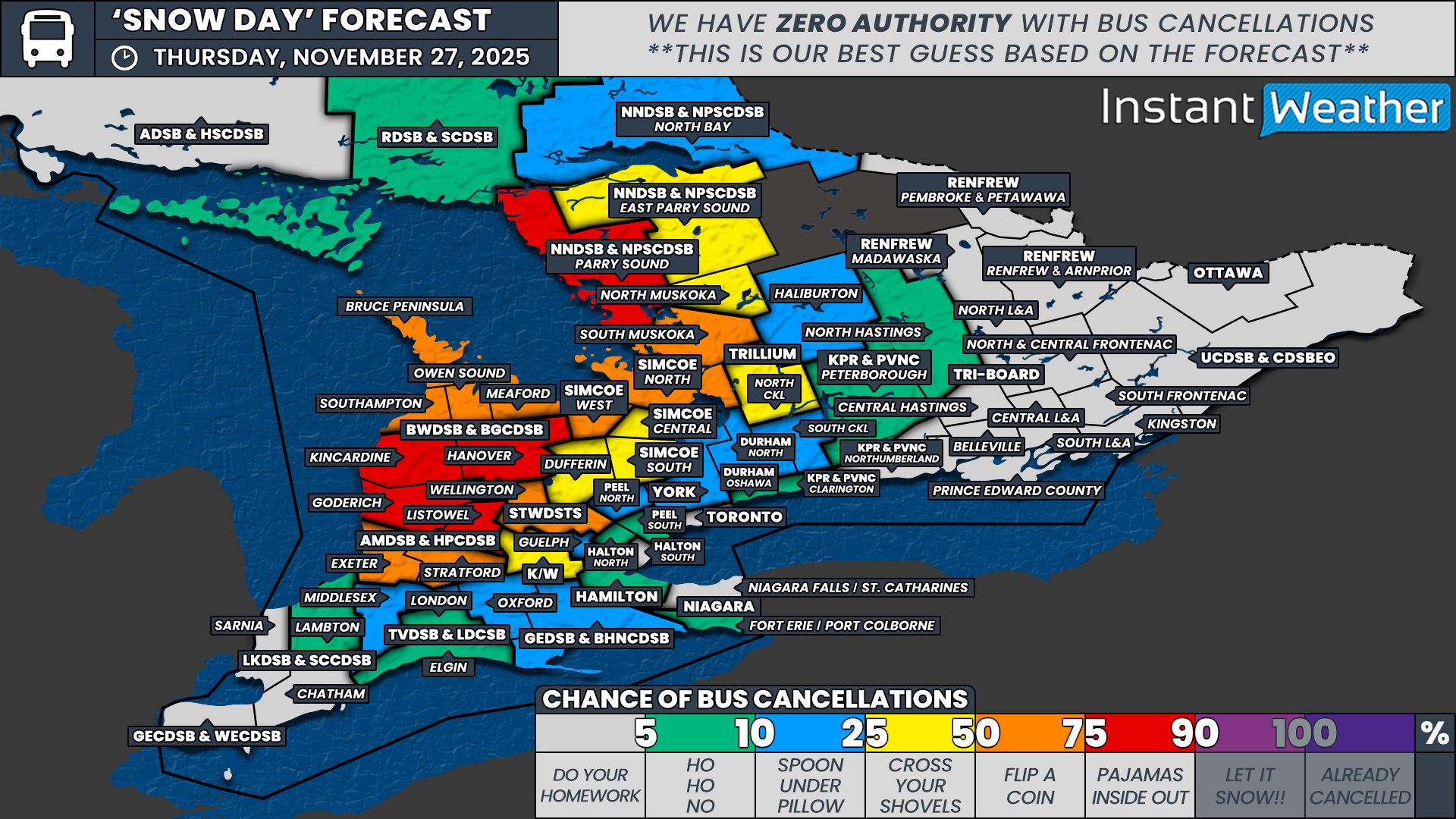
‘Snow Day’ Forecast: Intense Snow Squall Risk Could Cancel School Buses in Parts of Southern Ontario on Thursday

For an updated list of school bus cancellations & school closures, please visit our live article: https://instantweatherinc.com/article/2025/11/27/bus-cancellations

NOTE: YOU CAN CLICK ON THE MAP TO OPEN A ZOOMABLE IMAGE

Snow squalls are expected to affect areas around Lake Huron and Georgian Bay throughout the day on Thursday. Environment Canada has issued widespread snow squall watches and warnings for the regions most likely to see hazardous conditions.

This setup raises the chances of school bus cancellations, although there is still some uncertainty because the most intense activity is expected later in the day. This puts school boards in a position where they may need to make proactive decisions early Thursday morning.

The highest chances for cancellations are in Southern Grey Bruce and Northern Huron and Perth Counties. Environment Canada has issued a strongly worded snow squall warning for these zones, highlighting the risk of very low visibility and rapid snow accumulation. Because of this, we have assigned these regions a 75 percent chance of a snow day.

Near North, which includes Parry Sound, also sits at 75 percent. This is not necessarily due to extreme snowfall expectations, but rather because that school board has historically been more sensitive to weather disruptions.

Other areas closer to the snowbelt, including TLDSB, Simcoe, Northern Grey Bruce, Dufferin, Wellington and Kitchener-Waterloo, fall into the 25 to 50 percent range. Conditions here remain somewhat variable and will depend on how the bands set up through the morning. While we are leaning toward buses running in most of these regions, there is still a decent chance that a few boards will make the proactive call to cancel.

For the rest of Southern Ontario, the chance of cancellations stays below 25 percent. Limited impacts are expected outside the traditional snowbelt, so we do not anticipate widespread issues in these areas.

Looking ahead, the chances of a snow day increase significantly on Friday. A more intense round of snow squalls is expected to develop overnight Thursday into Friday morning, bringing the strongest activity of the week right when buses would be on the roads. You can expect the next update in our snow day forecast to show much higher probabilities and quite a bit more red and pink across the map.


Disclaimer: Instant Weather has zero authority when it comes to bus and school closures.

It is completely up to the school boards, bus companies, local authorities, and parents to decide what is best for their children. This is our best guess based on our forecast.

Dangerous Snow Squalls Target Southern Ontario’s Snowbelt Starting Thursday With Up to 75cm of Snow Possible

NOTE: YOU CAN CLICK ON THE MAP TO OPEN A ZOOMABLE IMAGE

Confidence continues to grow in what is shaping up to be a potentially dangerous snow squall event for regions east of Lake Huron and southeast of Georgian Bay as we wrap up the week.

Temperatures are expected to drop sharply overnight Wednesday, which will help kick the lake effect snow machine into gear as early as Thursday morning.

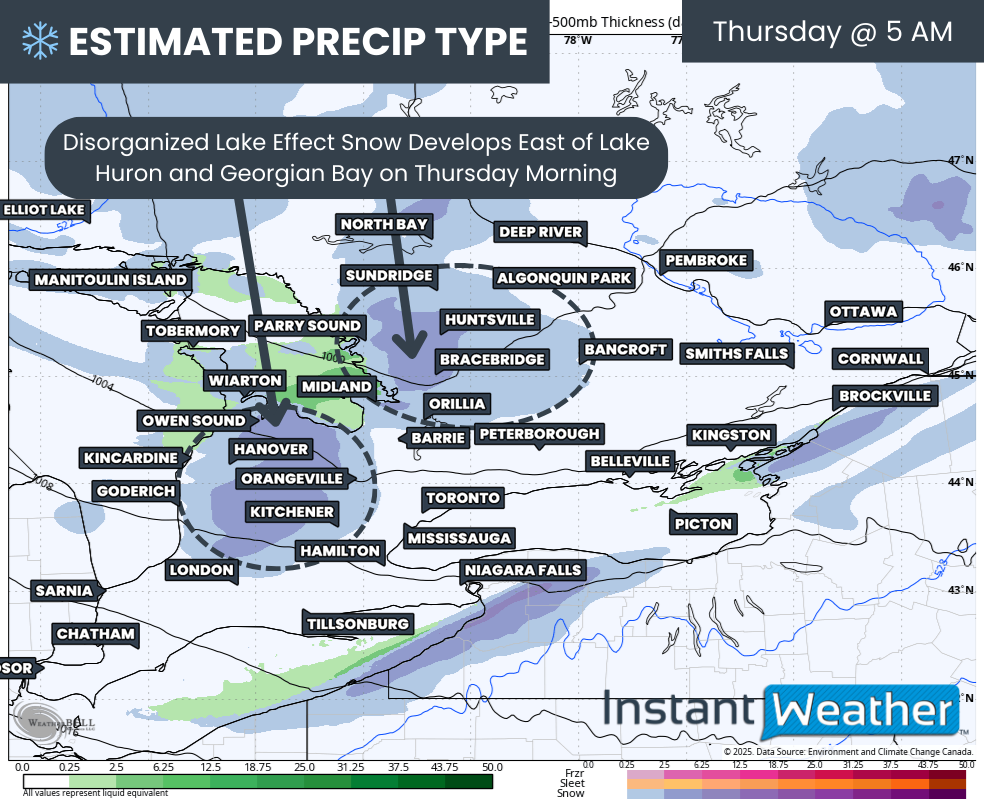
At first, the activity should be fairly limited. Scattered pockets of lake effect snow are expected to develop east of Lake Huron and Georgian Bay as a westerly wind pattern holds through the morning. Impacts will be minor at this stage, but this early activity will set the stage for a much more intense setup later in the day.

Rapid changes are expected by late Thursday morning and especially into the afternoon. This is when more organized squalls will begin to form.

The worst conditions are expected to develop late Thursday and last into Friday morning. A brisk northwesterly wind will allow narrow but powerful bands of snow to strengthen off both Lake Huron and Georgian Bay. These bands will be capable of producing snowfall rates near 5 to 10 cm per hour at times, along with near-zero visibility.

Travel will likely become extremely difficult through the hardest hit regions. Strong winds will create blowing snow and possibly even brief blizzard conditions. Road closures are possible, and anyone with non-essential travel plans should consider postponing. School bus cancellations appear likely for Friday, and there is even some potential for cancellations on Thursday, depending on how quickly conditions deteriorate.

The main snow squall activity is expected to taper off throughout the day on Friday, although some scattered bands could linger into Saturday. By the end of the day Friday, some areas east of Lake Huron, such as Goderich, Kincardine and Stratford, may be digging out from more than 40 cm of snow. Other parts of the snowbelt may see anywhere from 10 to 40 cm, depending on how close they are to the core of the activity.

PRECIP TYPE - MAP FROM WEATHERBELL

As mentioned earlier, Thursday morning will start with some light to moderate activity east of Lake Huron and Georgian Bay. This includes Grey Bruce, Parry Sound and Muskoka.

Impacts should be limited at first since the snow will be fairly light, but Environment Canada currently has a snow squall watch in effect for this entire region due to what will likely unfold later in the day.

Hourly snowfall rates (cm) - MAP FROM WEATHERBELL

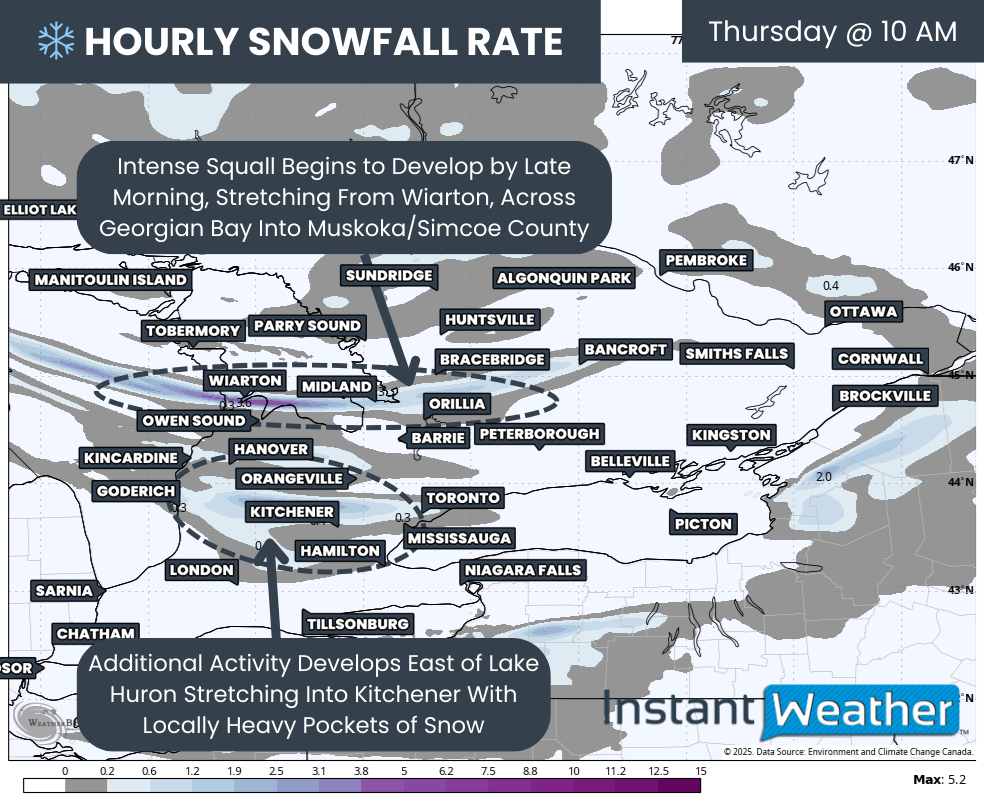
Conditions will escalate quickly heading into the late morning and afternoon as scattered flurries begin organizing into more defined bands. We expect a fairly long squall to develop over Lake Huron, cross the Bruce Peninsula and come onshore east of Georgian Bay. This could bring a few hours of heavy snow to the Muskoka region.

Additional pockets of lake effect snow may also fire up further south off Lake Huron, affecting areas like Goderich, Hanover, Stratford and Kitchener.

Hourly snowfall rates (cm) - MAP FROM WEATHERBELL

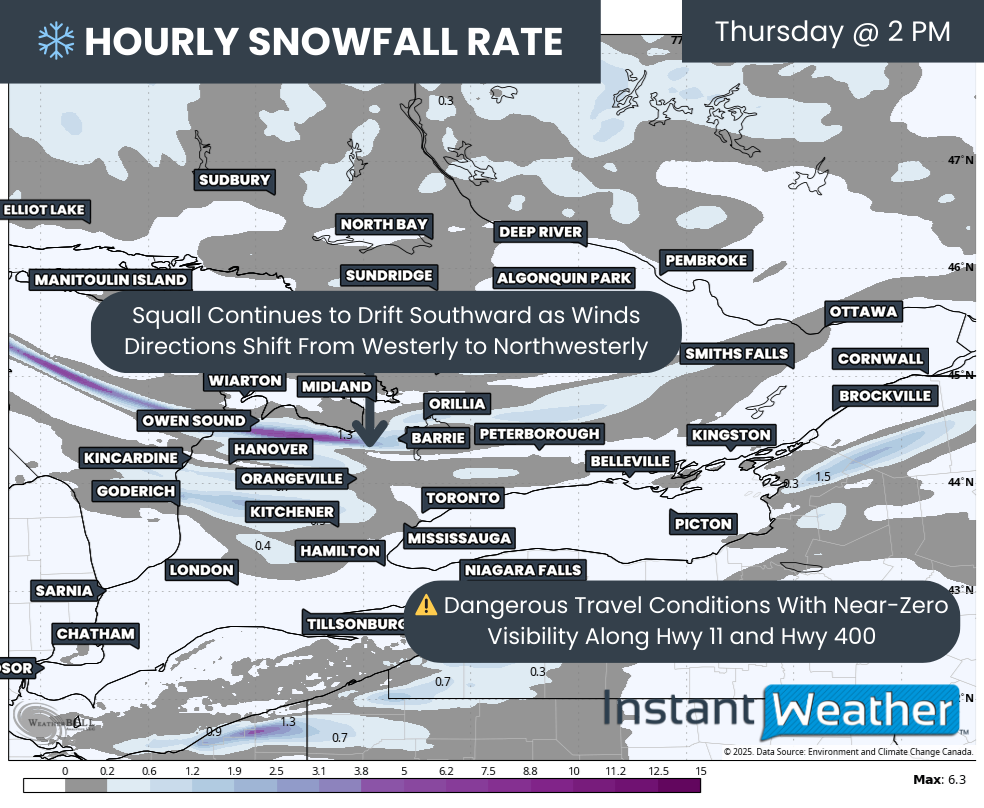
That Georgian Bay squall is expected to gradually sink southward as the wind shifts from westerly to northwesterly. This will cause a swath of intense snow to drift across the Highway 11 and 400 corridor between Bracebridge and MacTier, down toward Barrie.

A few hours of rapid whiteout conditions are possible during the afternoon. Even though temperatures may hover near the freezing mark, which slows accumulation, visibility will still be extremely poor and blowing snow will create dangerous travel conditions.

Hourly snowfall rates (cm) - MAP FROM WEATHERBELL

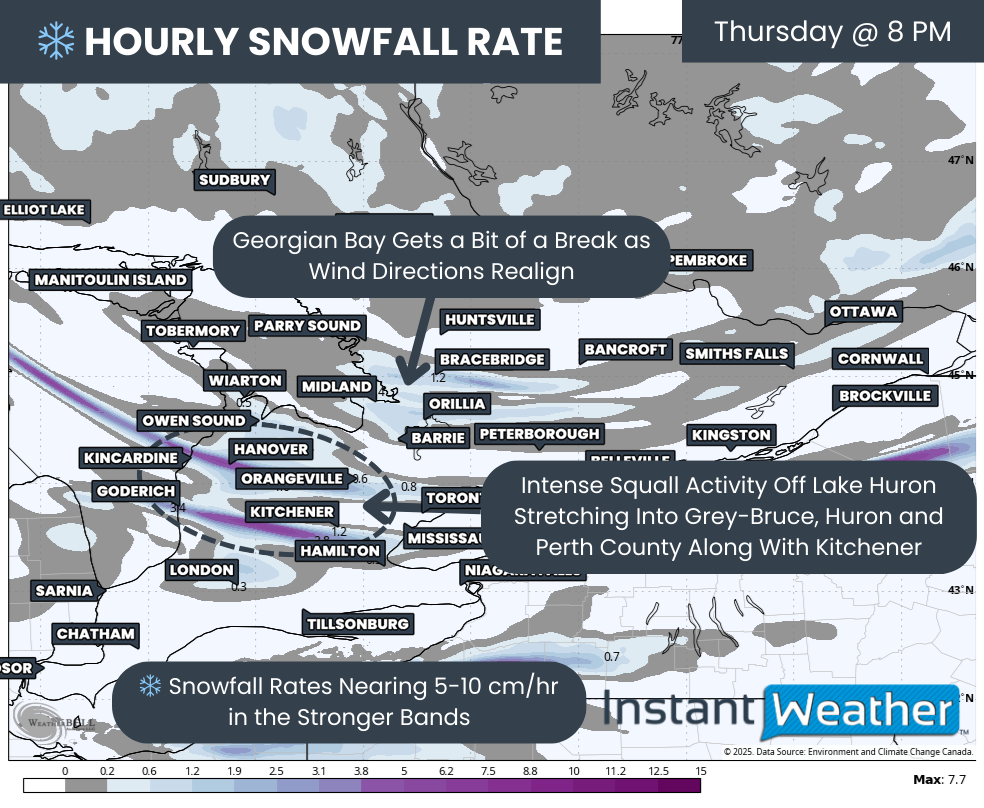
Conditions will worsen significantly into the evening as the squall drifts far enough south to draw its full moisture supply from Lake Huron instead of Georgian Bay. This new orientation will allow the band to tap into a longer stretch of open water, which increases its intensity.

At this point, several intense bands could stretch inland between Kincardine and Goderich and reach as far east as Kitchener and even the western GTA at times.

There is still some uncertainty in how these bands will align. A slight shift in wind direction can cause a squall to lock in place further north or drift south. This will dramatically affect who sees the heaviest snow. Regardless, conditions will be poor even in areas that are not directly underneath a streamer due to the blowing snow.

Within the core of the squalls, snowfall rates of 5 to 10 cm per hour will be possible. Thundersnow and lightning cannot be ruled out, given the strength of the setup.

Georgian Bay will see a brief lull with lighter pockets of snow affecting the South Muskoka to Simcoe County corridor. This break will be short-lived as winds shift yet again heading into the overnight hours.

Hourly snowfall rates (cm) - MAP FROM WEATHERBELL

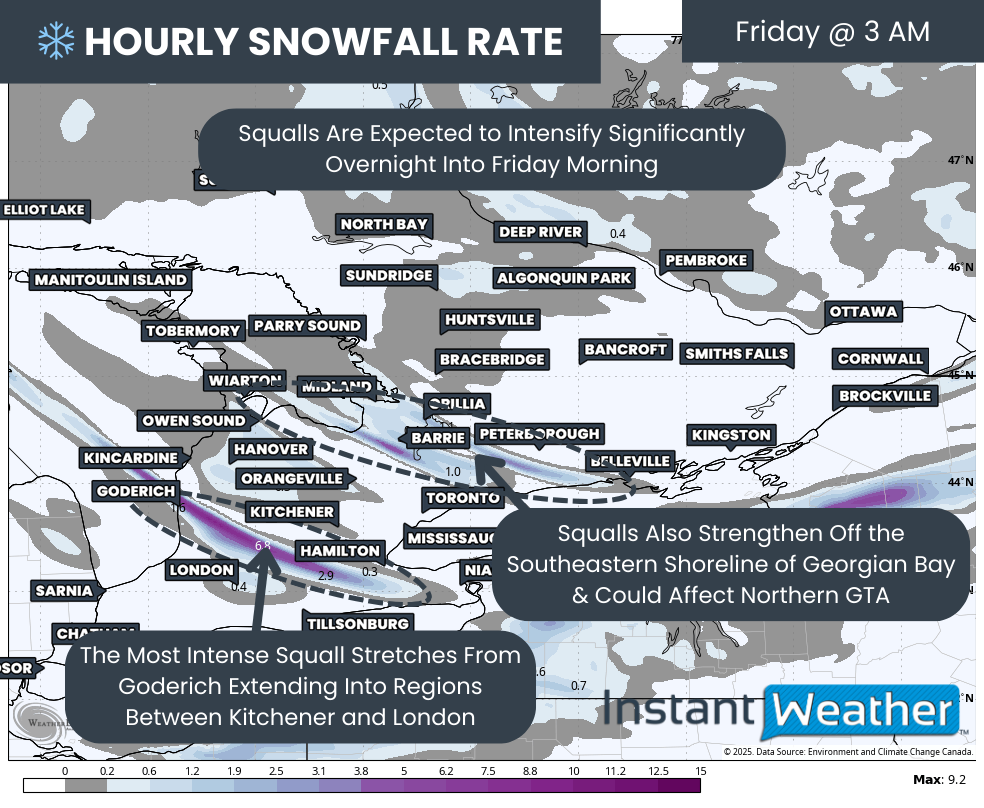
The most dangerous conditions are likely overnight Thursday into Friday morning. A very intense squall off Lake Huron is expected to set up somewhere between Goderich and Kincardine and stretch inland toward regions between Kitchener and London.

There is still uncertainty about the exact placement. Even a tiny shift in wind direction could pin this band farther north or push it farther south. At times, it may also extend into Hamilton and the Niagara region with quick bursts of heavy snow and whiteouts.

Southeast of Georgian Bay, more organized bands are likely to develop from Barrie into Kawartha Lakes. Some of this activity may also clip the northern GTA, including York and Durham. The Georgian Bay squall will likely be weaker than the Lake Huron band, but model trends have strengthened it slightly in the latest data. Peak snowfall rates will likely sit around 3 to 6 cm per hour in the strongest areas.

Temperatures will plunge well below freezing overnight which will help snow accumulate far more efficiently.

Most model data suggests that the lake effect bands will remain locked in place through Friday morning, although the intensity may gradually decrease during the afternoon as winds begin to ease. Snow squalls could continue into Saturday, but confidence drops for the weekend pattern since the bands may become more fragmented and less organized.

NOTE: YOU CAN CLICK ON THE MAP TO OPEN A ZOOMABLE IMAGE

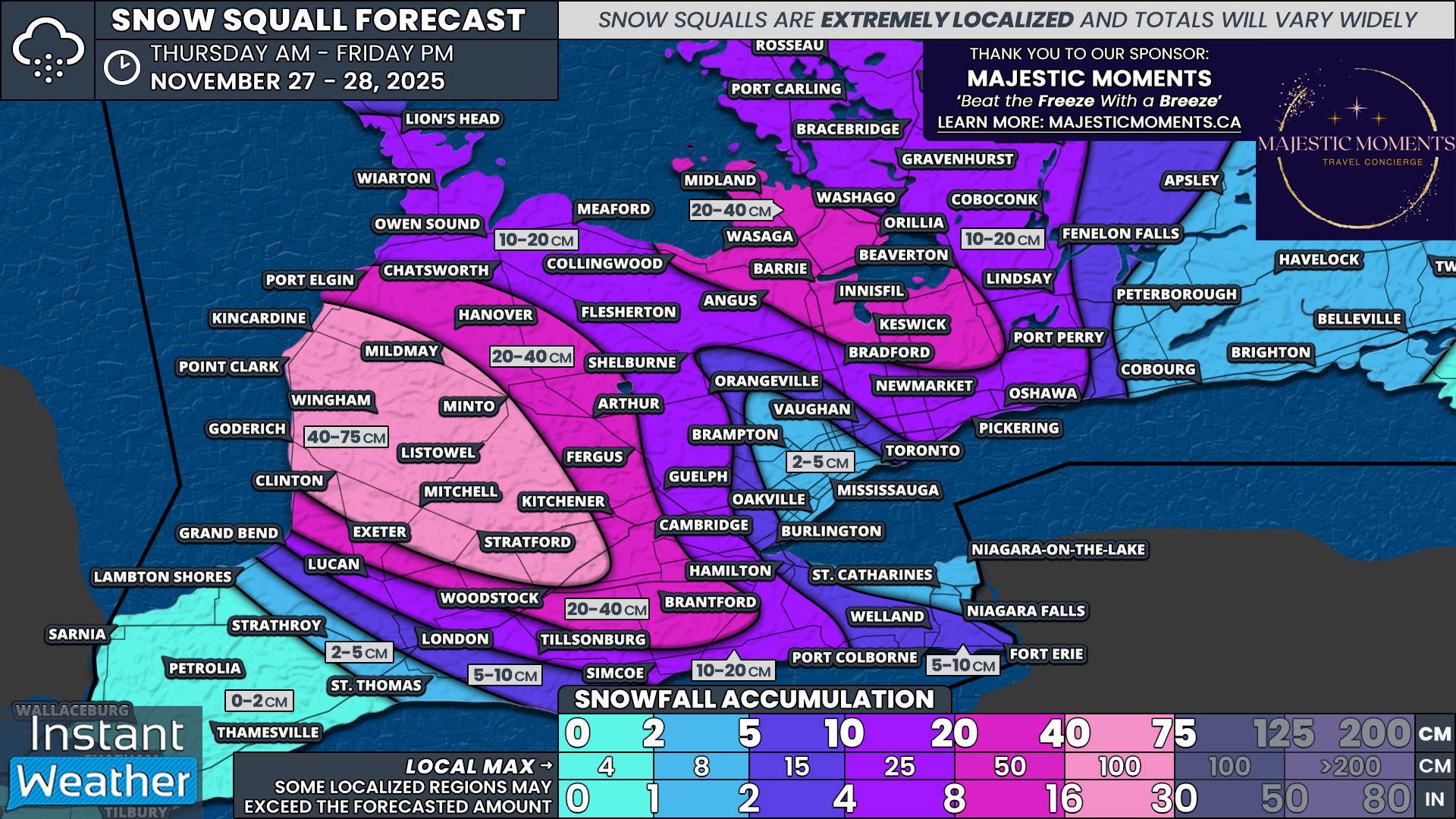
As always with lake effect snow, exact totals are extremely difficult to predict. These events can produce huge differences over very short distances. One community could pick up 50 cm while another, only a few kilometres away, sees barely any accumulation.

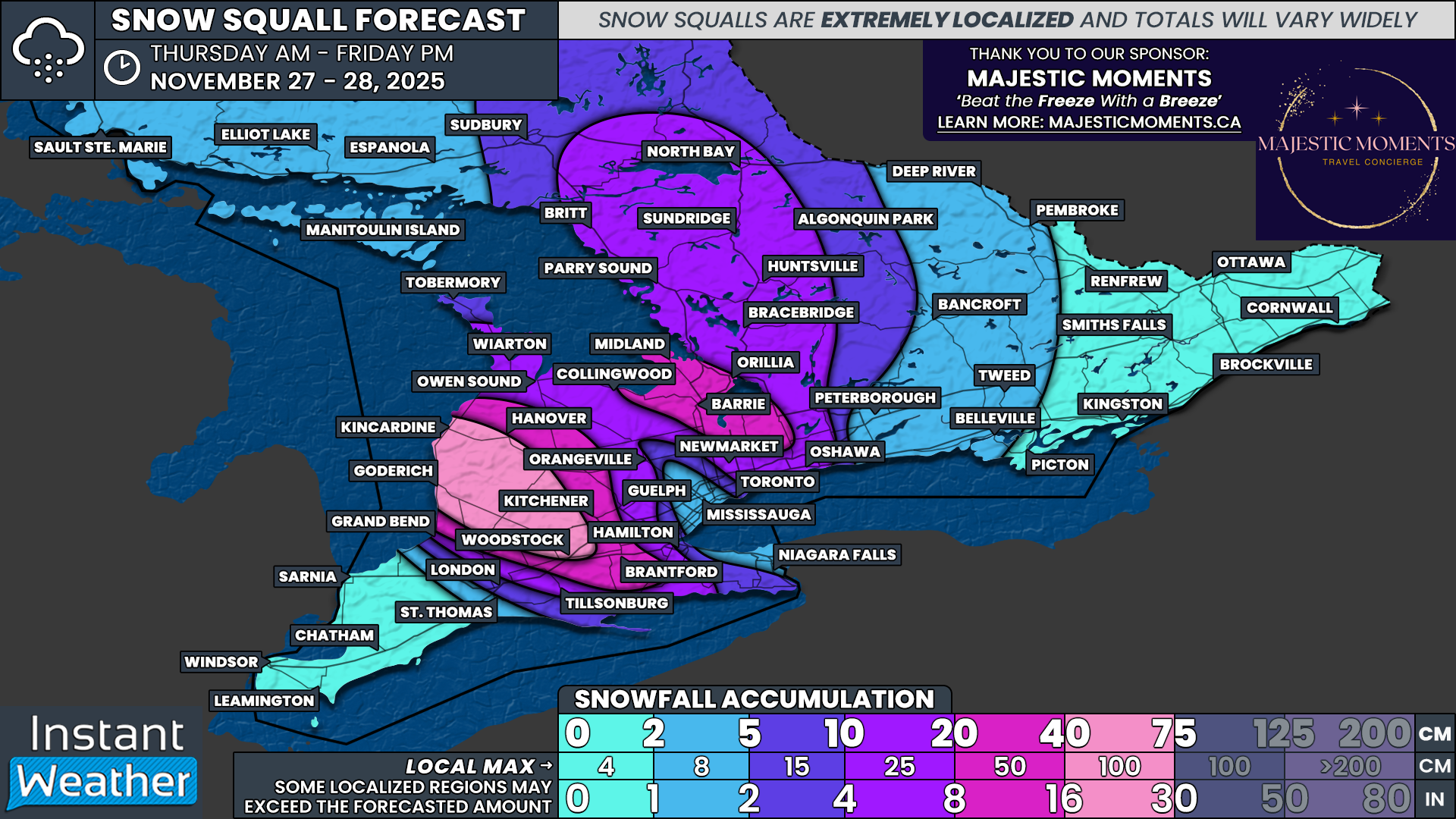
Even with this uncertainty, the most consistent model signal points toward a high-impact zone east of Lake Huron, picking up a general 40 to 75 cm of snow by Friday evening. This includes Goderich, Point Clark, Kincardine, Mildmay, Wingham, Clinton, Mitchell, Listowel and Stratford.

Localized totals near 100 cm cannot be ruled out, although these would be isolated pockets rather than widespread amounts.

A wider zone east of Lake Huron that stretches into the Kitchener area has the potential to see 20 to 40 cm of snowfall accumulation.

For Georgian Bay, the squall should be weaker than the Lake Huron band. We are going with 20 to 40 cm for regions like Collingwood, Wasaga Beach, Midland, Orillia, Barrie, Innisfil, Angus and Keswick. This may end up being a slight overestimate if the squall fails to organize as we saw in the last event, which significantly underperformed.

Muskoka, Parry Sound, Kawartha Lakes and parts of the eastern GTA may see 10 to 20 cm depending on how far the bands push inland.

Less than 10 cm is expected for the rest of Southern Ontario, including Eastern Ontario, the Golden Horseshoe and deep Southwestern Ontario, since they will be far enough removed from the main lake effect activity.

Winter Storm Targets Northern Ontario This Week as Intense Snow Squalls Line Up for Southern Ontario Starting Thursday

NOTE: YOU CAN CLICK ON THE MAP TO OPEN A ZOOMABLE IMAGE

A powerful system will sweep through the Great Lakes region this week, bringing a major winter storm to Northern Ontario and setting the stage for a significant snow squall event across Southern Ontario later in the week.

Across Northern Ontario, snowfall will begin to move into regions east of Lake Superior by late Tuesday. Light snow will start from Wawa through Timmins, gradually expanding north and west. Through the overnight hours into Wednesday morning, the system will push into Thunder Bay, Kapuskasing and surrounding communities.

The worst conditions are expected throughout the day on Wednesday. Winds will gust between 40 and 60 km/h, and when combined with heavy snowfall rates, visibility will deteriorate quickly. Blowing snow will be widespread across Northeastern Ontario and conditions may even reach blizzard levels at times.

Treacherous travel conditions will continue into Wednesday night and persist through Thursday morning as the storm deepens. Snowfall intensity will gradually ease later on Thursday, but steady snow will continue as the system stalls over Quebec. This will push long lasting bands of precipitation back into Northeastern Ontario, keeping snow going until early Friday morning.

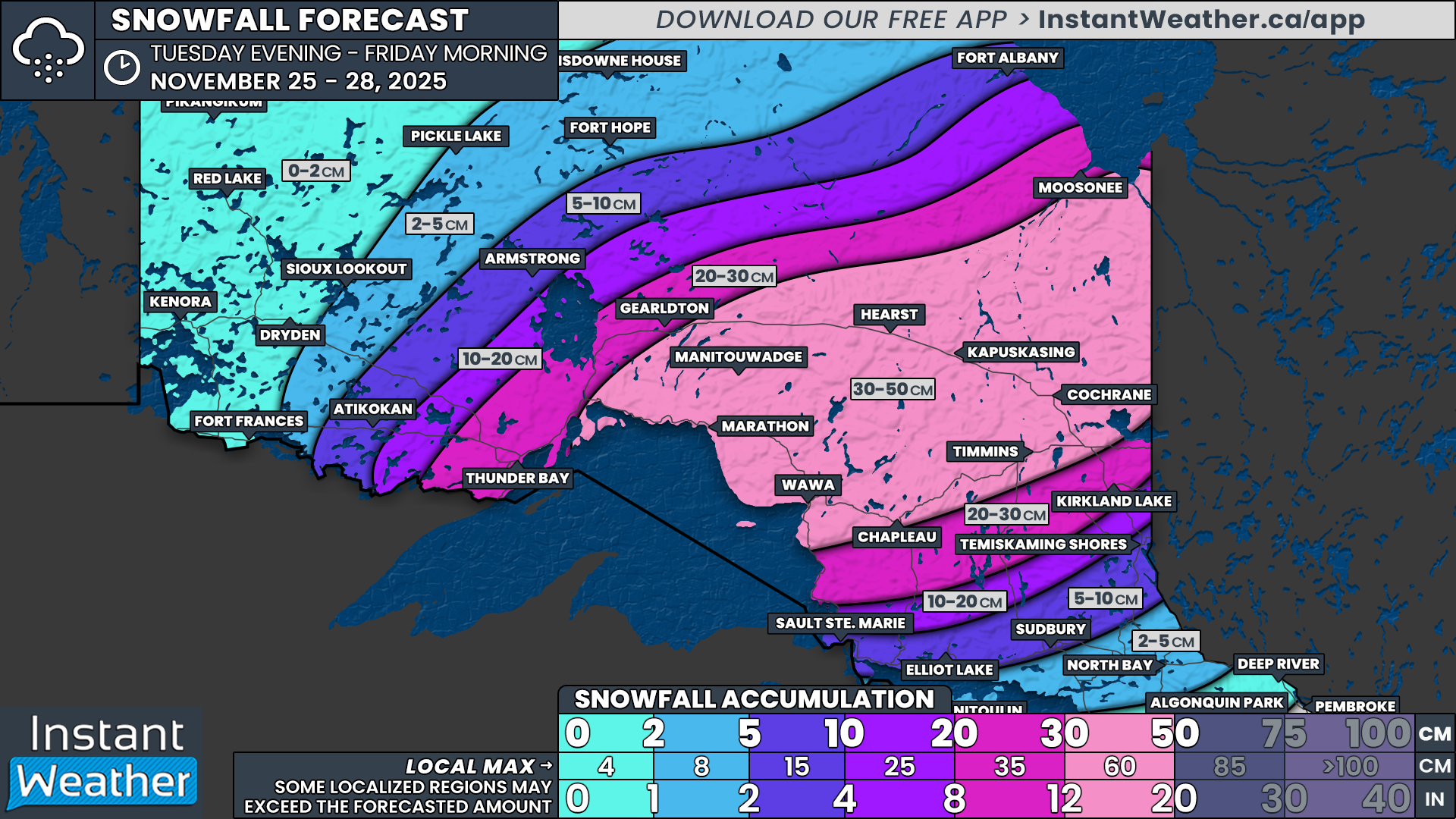
By the time the storm fully exits, a wide swath of Northeastern Ontario is expected to receive 20 to 50 cm of snow, with localized totals possibly exceeding that. The heaviest totals are expected from Marathon through Kapuskasing, Cochrane, Timmins, and Temiskaming Shores, Wawa, Hearst and Chapleau. Snowfall totals here will range from 30 to 50cm with possibly as much as 60cm in localized pockets.

While Northern Ontario deals with the winter storm, Southern Ontario will be on the warm side of the system on Tuesday and Wednesday. Many areas will flirt with the double digits, especially in Southwestern Ontario. Scattered showers will develop early Tuesday with light rainfall amounts of roughly 5 to 10 mm.

By late Wednesday, though, the pattern begins to shift as cold air wraps in behind the departing system. Temperatures will drop quickly, and any lingering precipitation will change to wet snow by Wednesday evening.

This colder air will set the stage for lake effect snow to fire up. With a westerly wind overnight on Wednesday, snow squalls may begin to develop off Lake Huron and Georgian Bay.

These early bands could bring bursts of heavy snow to Grey Bruce, Parry Sound and Muskoka through Thursday afternoon, although the exact intensity remains uncertain as the higher resolution models are just entering range and showing stronger signals than the medium range guidance.

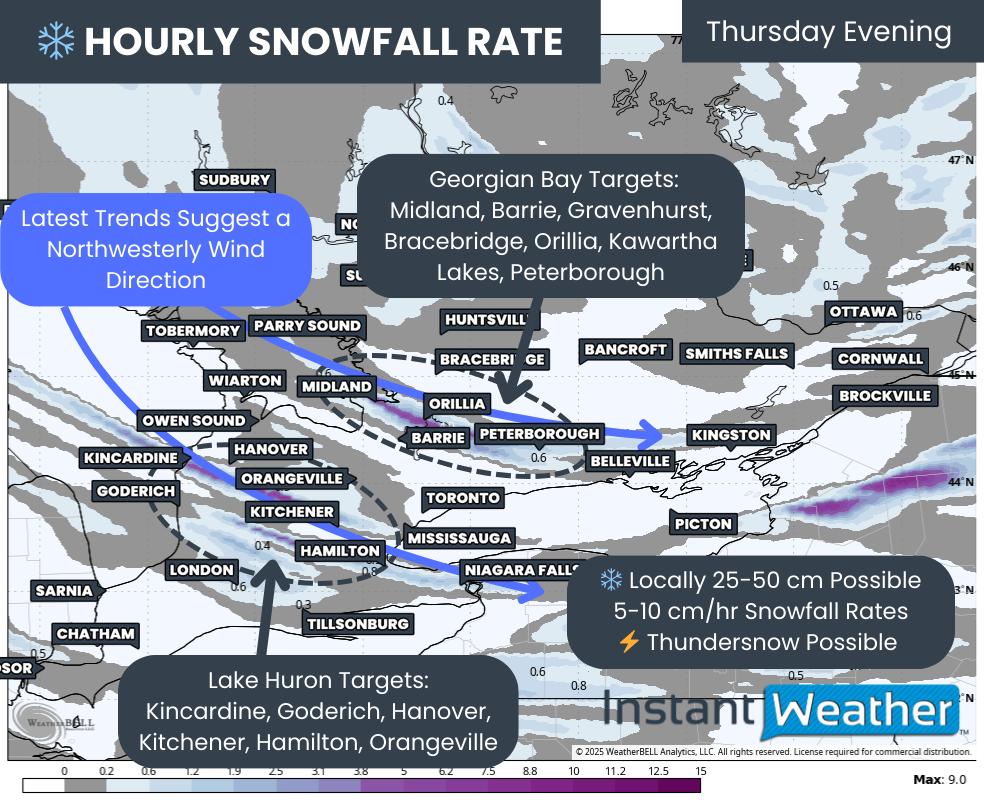
By late Thursday, winds will shift to a northwest flow. Temperatures will drop further into the negatives and this will allow squalls to strengthen. The Georgian Bay band is expected to sink south into Simcoe County and then extend into Kawartha Lakes and Peterborough.

At the same time, the Lake Huron band will slide south into Huron County and stretch toward Kitchener and the western GTA. Some early guidance even hints that this band could link up with the flow off Lake Superior, which can enhance snowfall rates.

Heading into Friday, it is still too early to give precise band placement. Current thinking suggests the northwest flow will hold through much of the day before winds start easing over the weekend. If that happens, squalls could remain active for an extended period.

While details can still shift, we are beginning to narrow down regions with the highest risk of heavy snowfall starting Thursday morning and continuing into Friday evening. Squalls will shift around at times, so snowfall will not be constant, but those under the core of the bands could see snowfall rates approaching 5 to 10 cm per hour. It will not take long for the snow to accumulate.

At this stage, exact totals are not possible to predict for Southern Ontario. However, some regions could easily see 25 to 50 cm by Friday night, with the potential for higher localized totals once high-resolution data comes into range.

For Lake Huron, our current focus areas include Kincardine, Goderich, Hanover, Kitchener, Hamilton and Orangeville.

For Georgian Bay, our primary targets include Midland, Barrie, Gravenhurst, Bracebridge, Orillia, Kawartha Lakes and Peterborough.

Anyone living in or near these regions should be prepared for dangerous travel conditions beginning Thursday. School bus cancellations are likely for some regions, and road closures are possible if squalls remain intense or stationary.

Southern Ontario: School Bus Cancellations and Closures for Friday, November 21, 2025

**Please refresh your page every few minutes to receive the latest update**

Cancellation & Closure Map (English Public and Catholic Schools)

Please note: School board boundaries are a rough estimate. Don’t use this map to determine what school board or weather zone you live in as accuracy isn’t guaranteed.

  • Green = No Cancellations

  • Red = Cancellations (Click for More Details)

  • Purple = School Closures (Click for More Details)

List of Cancellations & Closures

English Public and Catholic Schools

  • Near North Public & Nipissing-Parry Sound CathoIic: There are several routes cancelled due to inclement weather. For a full list, visit :https://geoquery.npssts.ca/Alerts

  • Tri-Board: Due to freezing rain received overnight, transportation is cancelled in Tri-Board’s North Hastings and North Lennox & Addington weather zones today.

French Schools

Southern Ontario: School Bus Cancellations and Closures for Monday, November 17, 2025

**Please refresh your page every few minutes to receive the latest update**

Cancellation & Closure Map (English Public and Catholic Schools)

Please note: School board boundaries are a rough estimate. Don’t use this map to determine what school board or weather zone you live in as accuracy isn’t guaranteed.

  • Green = No Cancellations

  • Red = Cancellations (Click for More Details)

  • Purple = School Closures (Click for More Details)

List of Cancellations & Closures

English Public and Catholic Schools

French Schools

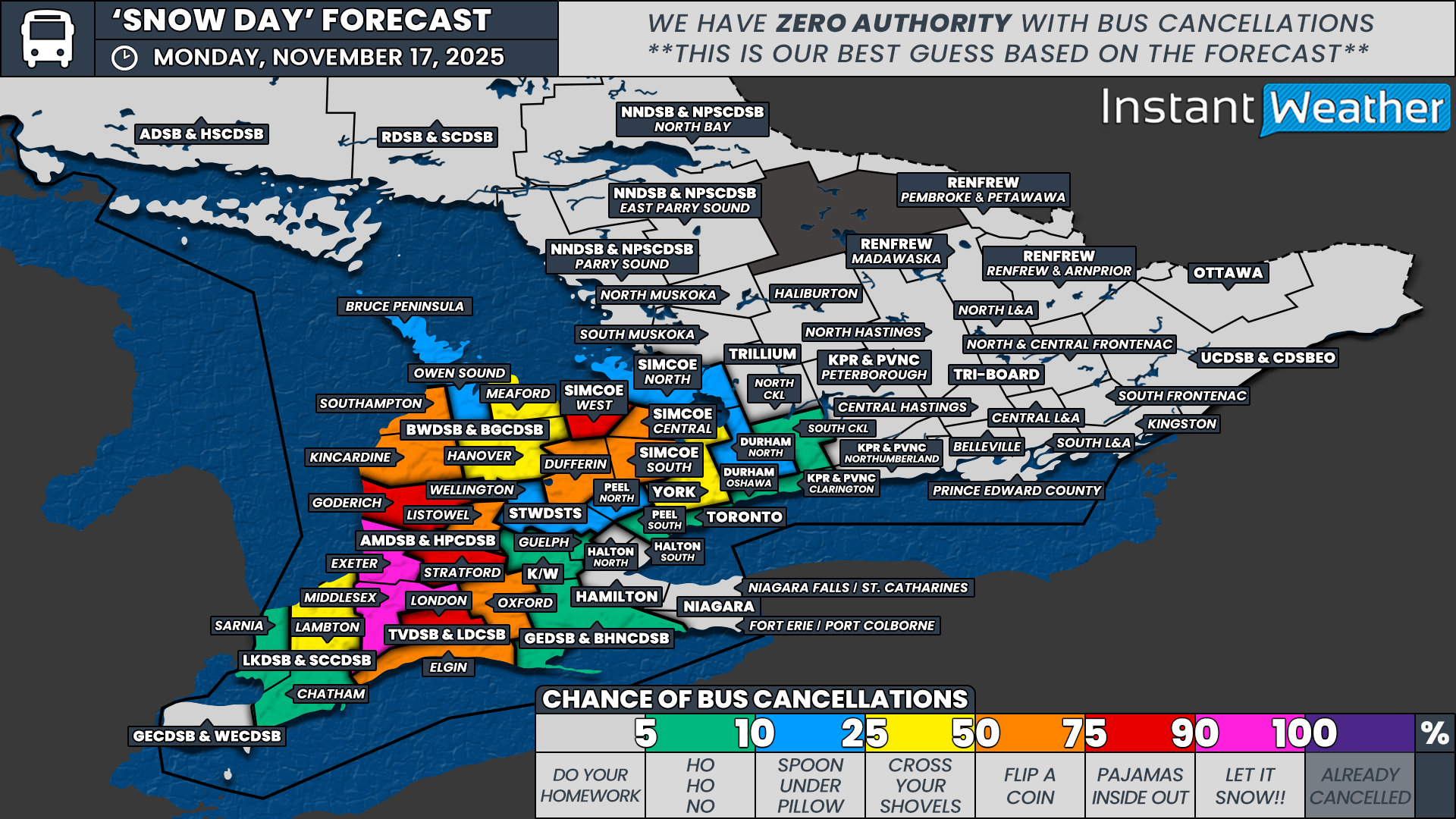
‘Snow Day’ Forecast: Possible Bus Cancellations in Southern Ontario’s Snowbelt With Squalls Continuing Into Monday

For an updated list of school bus cancellations & school closures, please visit our live article: https://instantweatherinc.com/article/2025/11/17/bus-cancellations

NOTE: YOU CAN CLICK ON THE MAP TO OPEN A ZOOMABLE IMAGE

We’ve seen snow squalls developing off the southeastern shorelines of Lake Huron and Georgian Bay as of Sunday evening. These squalls are expected to continue through the night, and there is a good chance they will intensify as colder air pours in.

Accumulation from these squalls could reach 30 to 40cm in the hardest hit areas. With Environment Canada issuing snow squall warnings for several regions, it’s looking very likely that school buses will be kept off the roads on Monday, where conditions are at their worst.

The highest level of certainty for a snow day is southeast of Lake Huron. This is where the most intense squall activity is expected to set up and persist overnight. That includes the Exeter region of AMDSB and the Middlesex area of TVDSB. We’ve given both zones a 90 percent chance of a snow day on Monday based on the current setup.

Elsewhere in AMDSB and TVDSB, the chance of bus cancellations ranges from 50 to 75 percent. The closer a region is to the heart of the snow squalls, the higher the likelihood of cancellations. Farther out, confidence drops as it becomes less clear how far inland the heavier bands will reach.

We’ve also assigned a 50 percent chance to the Kincardine and Southampton regions under BWDSB. A weather advisory is currently in place there, but confidence is lower compared to areas southeast of Lake Huron. The snowfall might still fall short of what boards in that area need to see before pulling the plug on buses.

For the Georgian Bay snow squall, the highest risk sits in Simcoe’s west zone, including Collingwood. This area sits closest to the lake and is in the best position to see the most intense and consistent snowfall overnight. Simcoe’s Central and South zones, as well as Dufferin County, are sitting at a 50 percent chance. The main challenge here is determining whether the squall will stay strong enough as it pushes inland and exactly where that band decides to park itself.

York Region has been given a 25 percent chance, mainly for its northern sections, where some of the Georgian Bay activity could drift in. However, York tends to be more urban, and school boards in these areas are usually more cautious with cancellations, which lowers the confidence.

Much of the rest of Southern Ontario is sitting at a less than 10 percent chance of a snow day on Monday. These regions are simply too far from the lake effect zones to be significantly impacted by the squalls.


Disclaimer: Instant Weather has zero authority when it comes to bus and school closures.

It is completely up to the school boards, bus companies, local authorities, and parents to decide what is best for their children. This is our best guess based on our forecast.
Snow Squalls Take Aim at London, Barrie and Northern GTA on Sunday With Up to 25-50cm of Snow Possible

NOTE: YOU CAN CLICK ON THE MAP TO OPEN A ZOOMABLE IMAGE

We enjoyed a brief break from the wintry weather on Saturday as temperatures soared into the double digits across much of Southern Ontario. The exception was Eastern Ontario, where the Ottawa Valley dealt with hours of freezing rain.

But that warm spell is going to be short-lived. Cooler air returns overnight into Sunday, and temperatures will slide back below the freezing mark. Once that happens, the lake effect snow machine will fire up again for the next couple of days.

And no, it isn’t déjà vu. The target zone for this round of squalls will look very similar to last week’s event, but the focus shifts slightly east. That puts areas like London, Barrie and even the Northern GTA, including York Region, in line to be hit hard.

By the time the squalls wind down on Monday, the hardest hit spots could be digging out from more than 25cm, with the potential for very localized pockets of 50cm.

PRECIP TYPE - MAP FROM WEATHERBELL

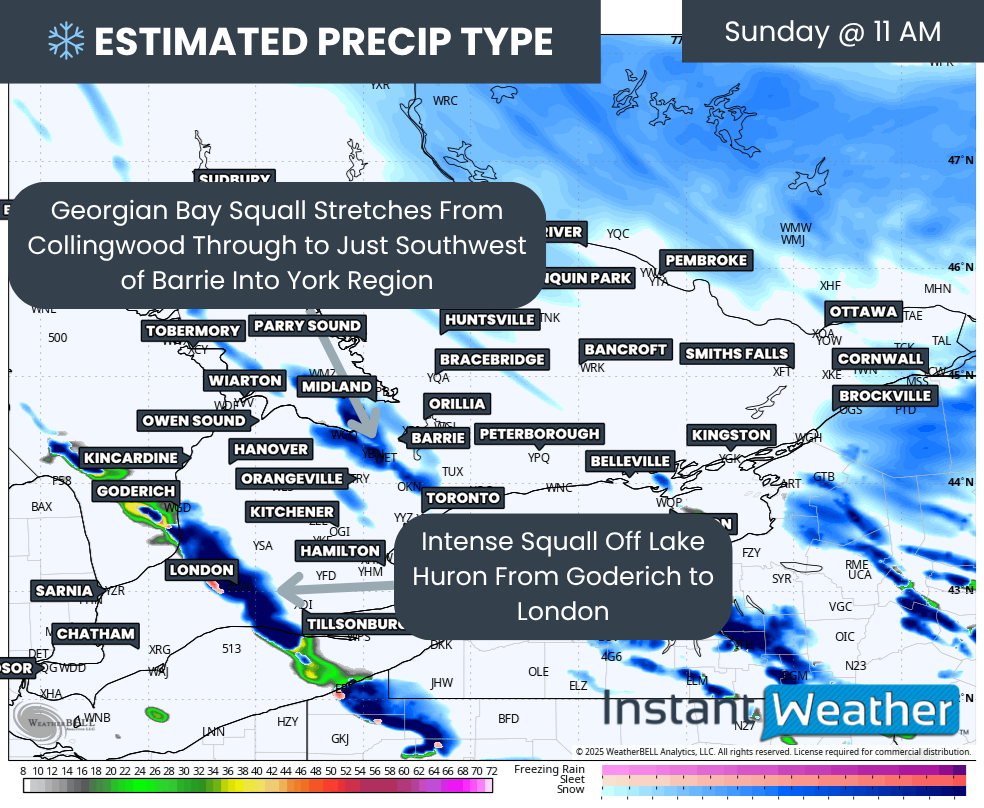
We expect the snow squall activity to begin ramping up late Sunday morning. As temperatures fall, lake effect rain bands will flip over to snow off the southeast shoreline of Lake Huron and Georgian Bay.

While the changeover happens in the morning, ground temperatures may stay just above freezing for several hours. This means the first few hours of snow could melt on contact. Accumulation will start later in the day once temperatures reach the freezing mark.

Even before the snow begins to stick, visibility will drop quickly. Those in the affected areas should expect sudden whiteouts and dangerous driving conditions.

Hourly snowfall rate (cm) - MAP FROM WEATHERBELL

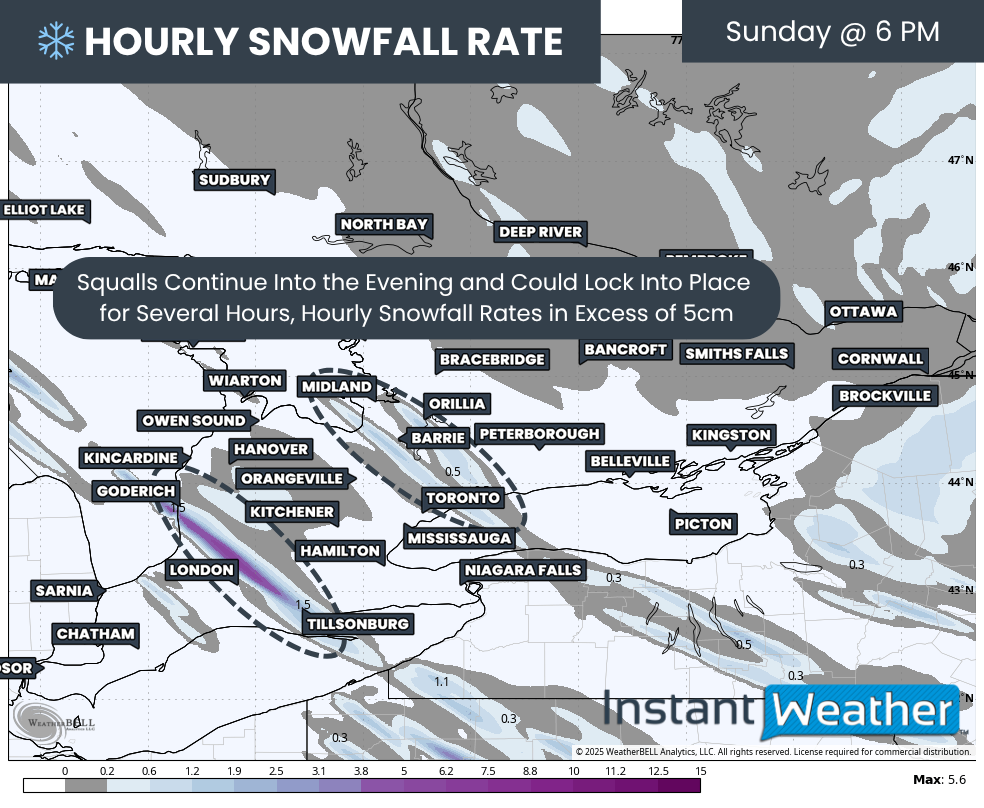
By the dinner hour, the squalls will become much more organized. Snowfall rates from the Lake Huron band could rise to 5cm per hour. This main band is expected to extend from Lake Huron through Goderich and southern Huron County into the London region.

Additional squall activity will form southeast of Georgian Bay, running from the shoreline through Barrie and Angus and into Newmarket and Durham. This band looks weaker than the Lake Huron squall at first, but could still deliver rates of 2 to 4cm per hour.

Hourly snowfall rate (cm) - MAP FROM WEATHERBELL

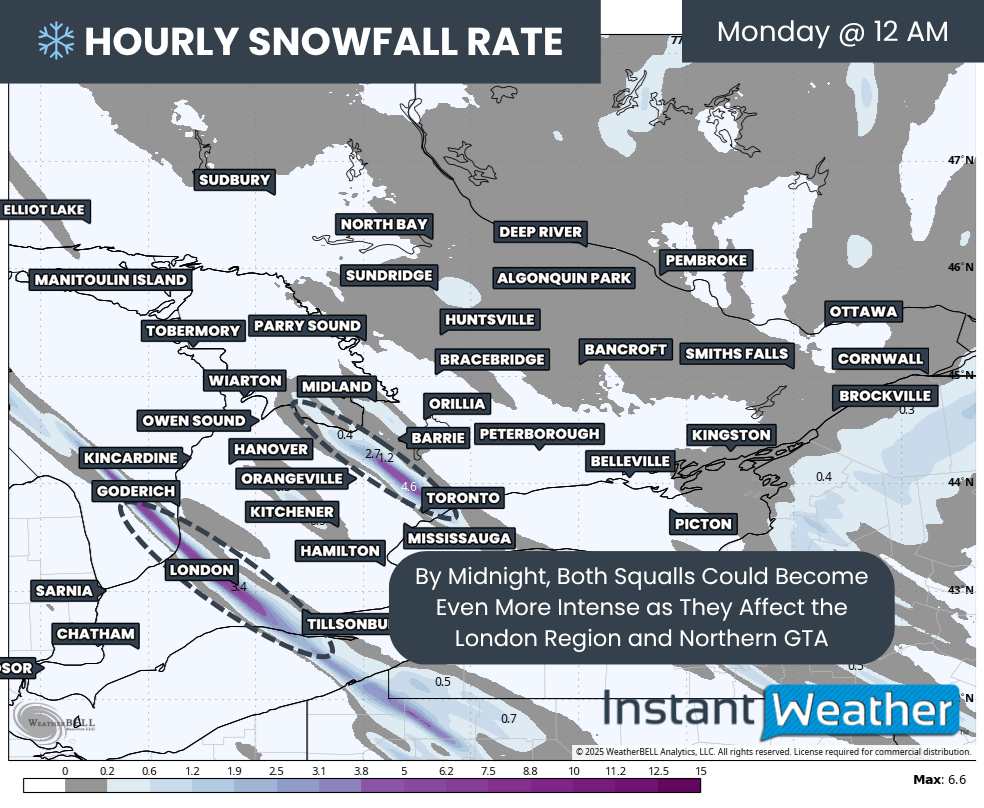
The worst conditions are likely around midnight. The Lake Huron band is expected to lock onto London, bringing intense snow and rapid accumulation of 6 to 8cm per hour.

The Georgian Bay squall will also strengthen, sliding south of Barrie and focusing on Angus, Bradford and Newmarket. Some signals show it reaching into the Eastern GTA, including Scarborough, Ajax and Oshawa.

These squalls should remain mostly stationary overnight, although minor drifting is possible. As temperatures fall several degrees below freezing, expect snow to pile up quickly.

Hourly snowfall rate (cm) - MAP FROM WEATHERBELL

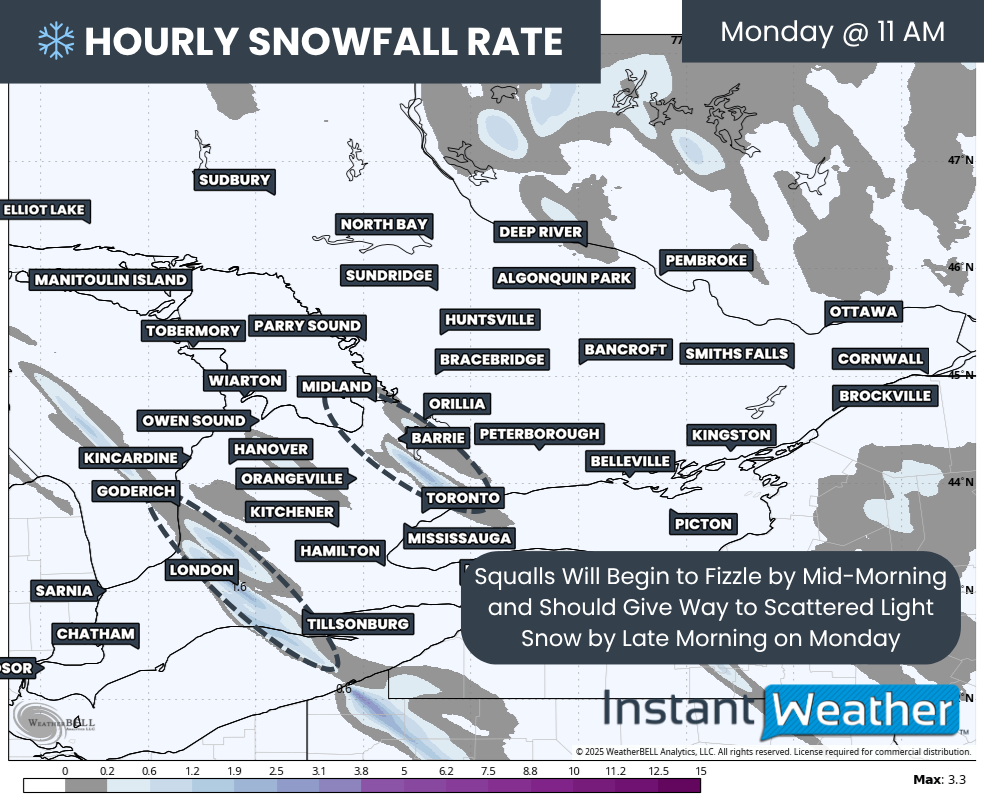
By mid-morning Monday, the bands will begin to weaken as winds shift more westerly. Some lake effect flurries could linger east of Lake Huron into Grey Bruce, but they are not expected to be very organized. Everything should taper off by late Monday.

NOTE: YOU CAN CLICK ON THE MAP TO OPEN A ZOOMABLE IMAGE

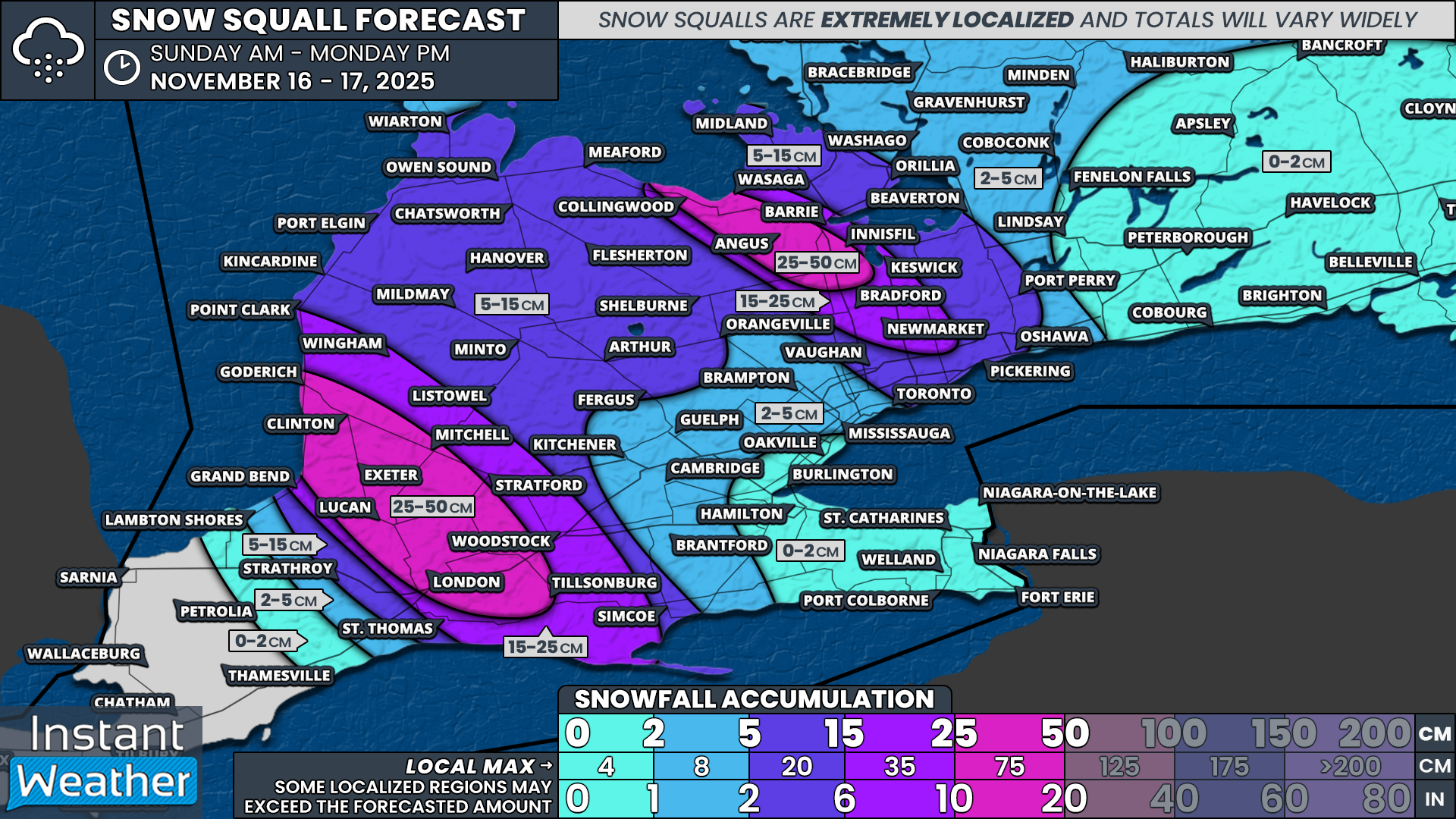
Snow squall forecasting always comes with big caveats. The bands are extremely narrow, which means the difference between 50cm and almost nothing can be only a few dozen kilometres.

This is why we provide a broad range. They help capture that uncertainty, but they are not a guarantee. With this event, the bands appear very intense but also very narrow, which means gradients will be sharp.

Based on the latest data, we expect the hardest hit areas from the Lake Huron squall to include Goderich, Clinton, Lucan, Exeter, Mitchell and London. Snowfall totals here could range from 25 to 50cm, with the chance that someone ends up over 50cm in a very localized spot.

Surrounding regions, including Grand Bend, Tillsonburg, Stratford, Wingham, and Point Clark, could see 15 to 25cm.

Further east into Grey Bruce and Dufferin County, we are expecting 5 to 15cm mainly on Monday as the lake effect shifts northward.

The Georgian Bay band looks even narrower than the Lake Huron band. A small corridor stretching from Collingwood through Angus and into Innisfil could see 25 to 35cm, with a chance of 50cm if the band really intensifies.

The City of Barrie is right on the edge. A small shift north or south would bring very different results. For now, the highest totals look likely in the south end of the city with 15 to 30cm. The north end may be closer to 10 to 20cm.

Substantial totals may also extend into the Northern GTA, including Bradford, Newmarket and Aurora. Totals along the Highway 400 and 404 corridor could range from 15 to 30cm.

Across the east end of Toronto and Durham, including Ajax, Pickering and Oshawa, occasional heavy bursts may bring 5 to 10cm.

The rest of Southern Ontario should see less than 5cm of snow by Monday from the lake effect.

All the Seasons in One Weekend for Southern Ontario as Freezing Rain, Thunderstorms and Snow Squalls Line Up

NOTE: YOU CAN CLICK ON THE MAP TO OPEN A ZOOMABLE IMAGE

There is really only one way to describe what November has been like across Southern Ontario when it comes to the weather: a roller coaster.

Last weekend brought our first widespread snowfall event of the season. That was quickly followed by intense snow squalls that buried parts of the Lake Huron shoreline with more than 50 cm of snow early this week.

That seasonal whiplash continues this weekend as a clear battle sets up between cold, wintery air and much milder fall-like conditions. Eastern Ontario, especially around the Ottawa Valley, will stay on the cold side with a risk of prolonged freezing rain throughout the day on Saturday.

Southwestern Ontario and the Golden Horseshoe will see a completely different story. Temperatures are set to rise into the double digits, and there is even a risk of thunderstorms on Saturday. Some of the warmest pockets around Windsor could briefly flirt with the 20s for a few hours.

By late Saturday, a sharp cold front will sweep through the region. This will send temperatures plunging again heading into Sunday, settling the battle in favour of the colder air. As this cold push arrives, the lake effect snow machine is expected to roar back to life over both Georgian Bay and Lake Huron.

TEMPERATURE - MAP FROM WEATHERBELL

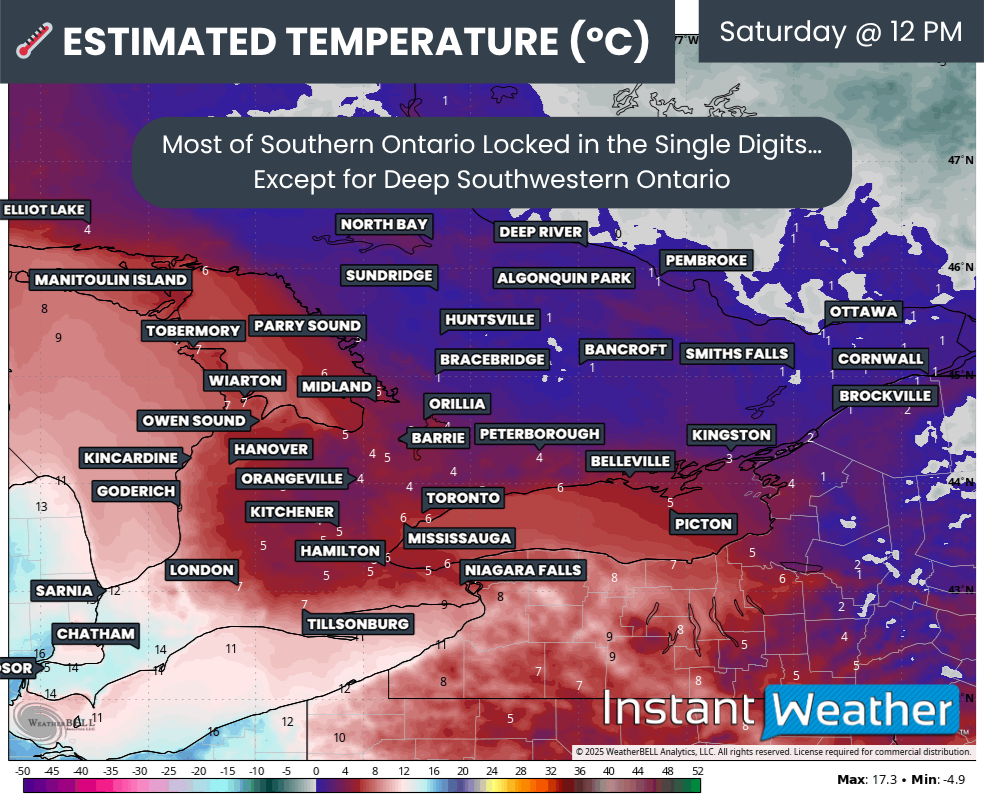
We expect a frosty start to Saturday morning for most of Southern Ontario. Deep Southwestern Ontario will be the main exception as milder air starts to slide in early. Most areas should wake up close to the freezing mark. Deep Southwestern Ontario will already be climbing through the mid single digits.

By noon, Deep Southwestern Ontario should reach the double digits. Further northeast into the rest of Southwestern Ontario, the Golden Horseshoe and parts of Central Ontario, temperatures will range from the low to mid single digits. The Ottawa Valley will remain near the freezing mark well into the afternoon as the surge of mild air stalls just to the southwest.

PRECIP TYPE - MAP FROM WEATHERBELL

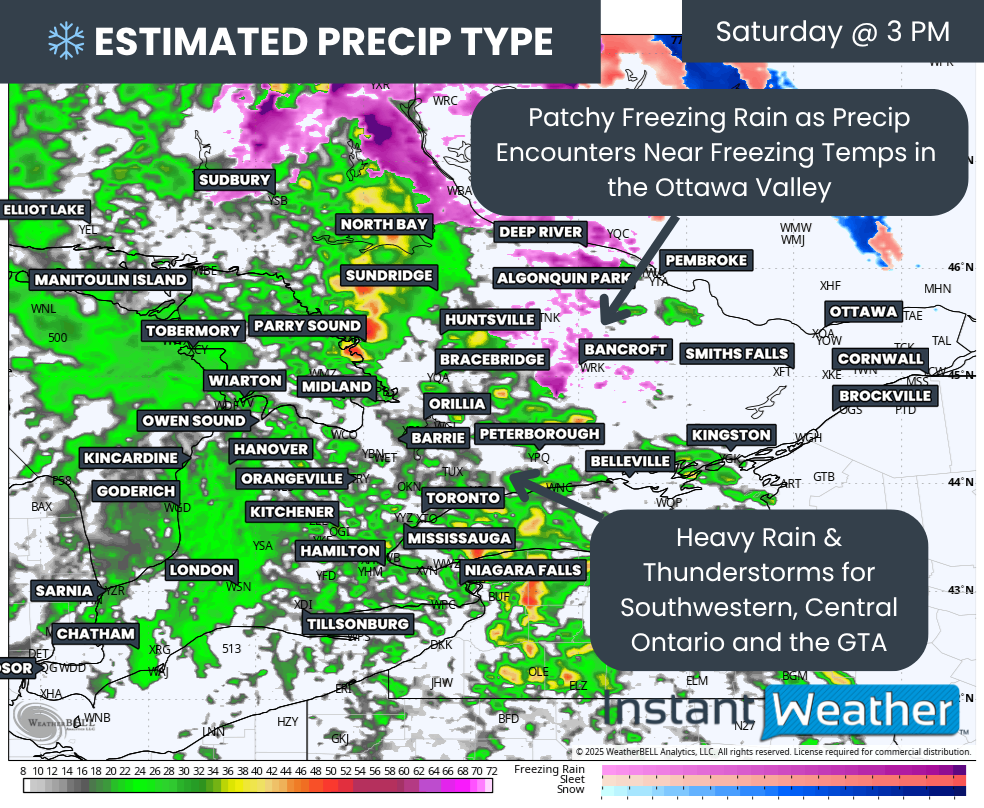
A developing system will start to spread heavy precipitation into Southern Ontario late Saturday morning or early afternoon. For most areas, temperatures will be warm enough for rain to be the dominant precipitation type. There’s even the risk of a thunderstorm!

Over the Ottawa Valley, however, we expect patchy freezing rain to form as temperatures linger stubbornly near the freezing mark.

Model guidance is not fully aligned on how warm the air will get in that region. Even a small shift of one or two degrees will change how long the freezing rain lasts and how much ice is able to accrete. This is one of the key uncertainties for Saturday.

TEMPERATURE - MAP FROM WEATHERBELL

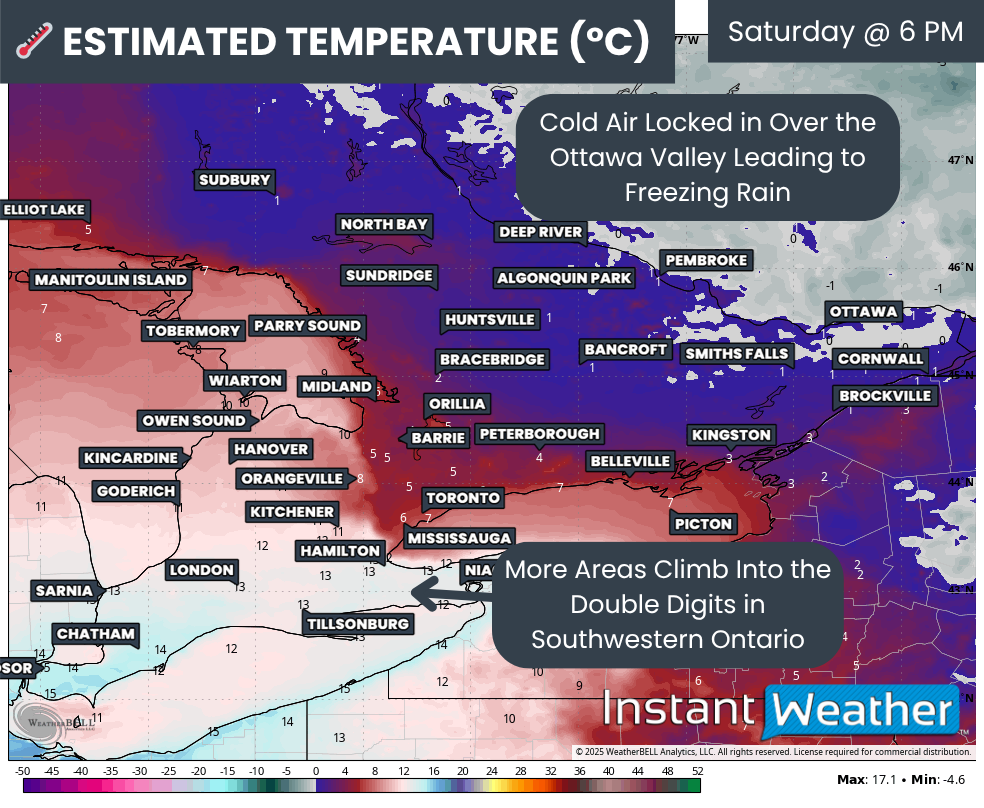
Through Saturday evening, temperatures will continue climbing across much of Southwestern Ontario. Cities like London, Kitchener and Hamilton are expected to reach the double digits.

One important note is that daytime highs in many areas will actually be reached late in the evening instead of during the normal warmest part of the day!

Meanwhile, that pocket of near-freezing air over the Ottawa Valley is expected to hold on into the evening, which could allow several more hours of freezing rain.

As the system pulls east overnight Saturday, colder air will sweep in behind it. Temperatures will tumble through Sunday morning, switching any lingering precipitation to wet flurries by the time you wake up.

Hourly snowfall rate (cm) - MAP FROM WEATHERBELL

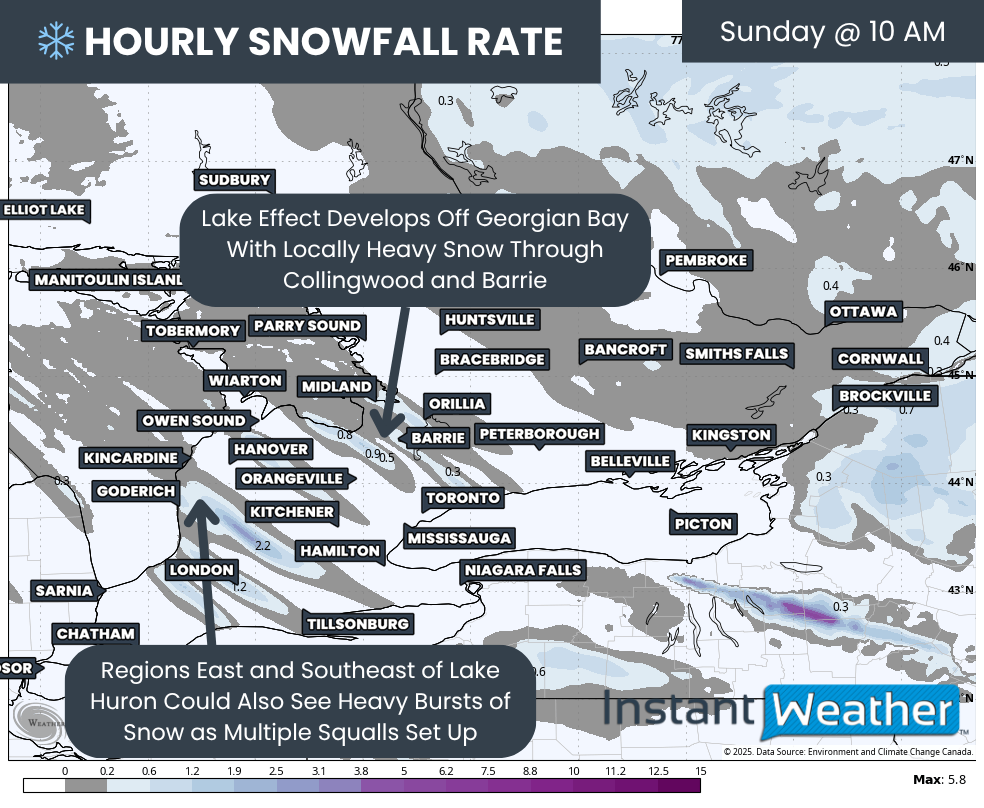
Behind the front, bands of lake effect snow will begin developing off Lake Huron and Georgian Bay early Sunday. These bands look messy and disorganized through much of the day, although localized totals of 10 to 20 cm are possible.

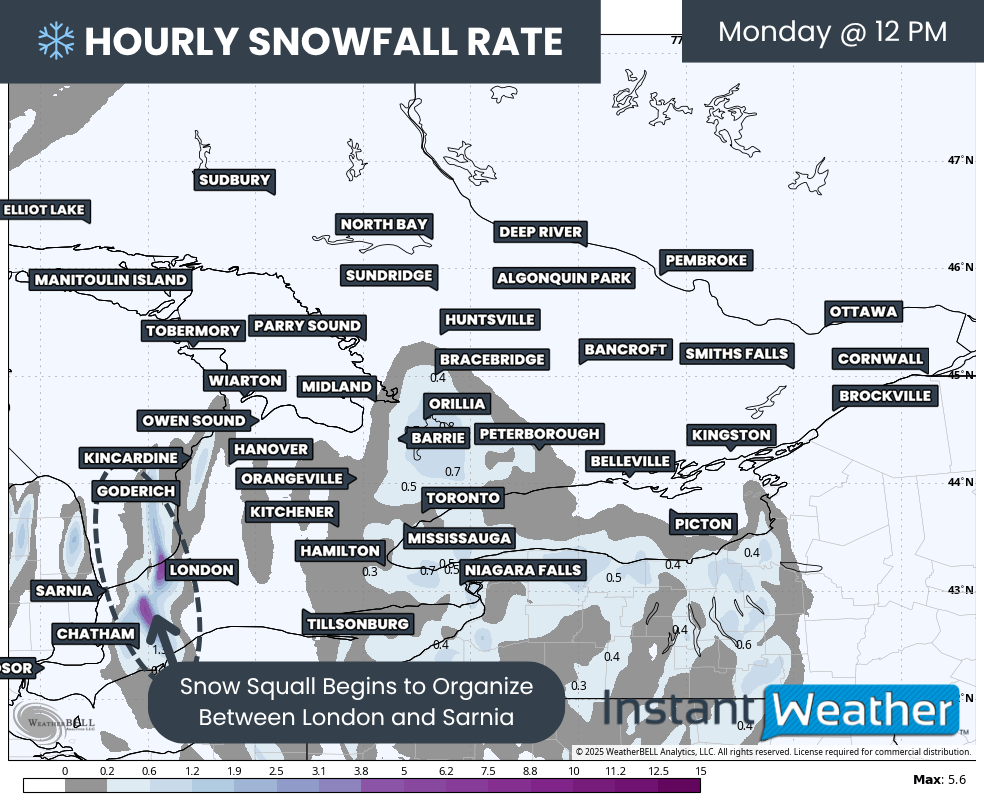
By late Sunday, more focused and intense squalls could form, especially around the London region off Lake Huron. These squalls may continue into Monday and could lead to localized 20+ cm totals.

We will have a more detailed, dedicated lake effect forecast released soon.

NOTE: YOU CAN CLICK ON THE MAP TO OPEN A ZOOMABLE IMAGE

When it comes to freezing rain accretion, there are several variables that could reduce or increase the amount of ice that actually builds up. This is a very temperature-sensitive event.

The heaviest icing is expected directly along the Quebec border and into the Hawkesbury region. Models show the potential for over 10 mm of freezing rain, but it is unclear how much of that will be able to stick. Heavy precipitation rates could limit the amount of ice that accumulates, and temperatures will sit very close to the freezing mark for much of the event.

Given all of this, we are going with a general 5 to 10 mm of icing for the hardest hit areas. If temperatures are even slightly warmer than expected, accretion could end up lower. This is certainly enough to lead to localized power outages and icy roads.

For the City of Ottawa, they sit right on the dividing line between lighter icing and heavy icing. We have placed them in the 2 to 5 mm range, but they could see locally up to 7 mm if the cold air becomes more stubborn than currently forecast.

Outside of the Ottawa Valley, expect minimal icing. Areas such as Bancroft, Cloyne, Perth, Carleton Place and Cornwall may see an hour or two of freezing rain before changing over to rain.

Southern Ontario: School Bus Cancellations and Closures for Tuesday, November 11, 2025

**Please refresh your page every few minutes to receive the latest update**

Cancellation & Closure Map (English Public and Catholic Schools)

Please note: School board boundaries are a rough estimate. Don’t use this map to determine what school board or weather zone you live in as accuracy isn’t guaranteed.

  • Green = No Cancellations

  • Red = Cancellations (Click for More Details)

  • Purple = School Closures (Click for More Details)

List of Cancellations & Closures

English Public and Catholic Schools

  • Avon MaitIand Public & Huron-Perth CathoIic: There are several cancellations, please visit this link for more details: https://hpsts.mybusplanner.ca/Alerts

  • BIuewater Public & Bruce-Grey Catholic: ALL buses CANCELLED into Meaford & Thornbury. There are several additional cancellations, please visit this link for more details: https://www.mybrucegreyschoolbus.ca/Cancellations.aspx

  • Dufferin-PeeI Catholic: Buses to St. Andrew, St. Peter, St. Benedict as well as Dufferin County buses to Robert F. Hall CSS are cancelled today

  • Lambton Kent Public & St. CIair Catholic: Buses in Zones 1 & 4 Cancelled Today

  • Thames Valley Public & London CathoIic: Busses in Middlesex and Elgin are cancelled and the schools in these regions are closed.

  • Tri-Board: Transportation is cancelled in Tri-Board’s North Hastings, North & Central Lennox & Addington, North, Central & South Frontenac weather zones today.

  • Upper Grand Public & Wellington CathoIic: All school taxis and buses in Dufferin County will not be operating today.

French Schools

  • Conseil scolaire catholique Providence: Middlesex region (rural roads): Transport is cancelled today. City of London routes are operating. Lambton Region Zones 1 & 4 are cancelled. Busses for Meaford are cancelled.

  • Conseil scolaire Viamonde: Middlesex region (rural roads): Transport is cancelled today. City of London routes are operating. Lambton Region Zones 1 & 4 are cancelled. Busses for Meaford are cancelled.

‘Snow Day’ Forecast: Snow Squalls Likely to Cancel School Buses in Southern Ontario’s Snowbelt on Tuesday

For an updated list of school bus cancellations & school closures, please visit our live article: https://instantweatherinc.com/article/2025/11/11/bus-cancellations

NOTE: YOU CAN CLICK ON THE MAP TO OPEN A ZOOMABLE IMAGE

Snow squalls continue to hammer portions of Southern Ontario tonight, particularly off the southeastern shores of Lake Huron and Georgian Bay. These squalls are producing bursts of heavy snow, whiteout conditions, and rapidly changing visibility across many areas. Travel remains extremely difficult in the hardest-hit zones, and reports continue to come in of near-zero visibility and snow quickly piling up on untreated roads.

The snow machine is far from done. These intense squalls are expected to persist through the overnight hours and into Tuesday morning. As winds shift slightly eastward, the heaviest activity may drift toward London, the southern half of Huron County, and even as far east as Barrie and northern Simcoe County.

Given these conditions, Tuesday morning is shaping up to be a challenging one for school transportation in the Lake Huron and Georgian Bay snowbelts. It’s difficult to imagine buses being able to safely operate in some of these areas with such intense, localized bursts of snow and blowing snow expected to continue right into the morning.

The highest likelihood for bus cancellations will be found in regions such as Sarnia-Lambton, Middlesex, London, Exeter, Stratford, and Listowel, extending into parts of Grey-Bruce, including Meaford and Owen Sound.

These areas fall directly under the snow squall bands and have been dealing with heavy accumulation and treacherous driving conditions since Monday. We’re assigning these regions a 75 to 90 percent chance of cancellations, depending on how the squalls align overnight.

Surrounding regions, including Chatham-Kent, Elgin, Oxford, and Simcoe Central, could go either way. These areas may see lighter snow at times, but if a squall shifts slightly in their direction early Tuesday, it could quickly turn things around. For that reason, we’ve placed them around the 50 percent mark, essentially a coin flip for a snow day.

Outside of the core snowbelt, the risk for bus cancellations drops off sharply. However, there’s still a 25 percent chance for some northern GTA communities, as the Georgian Bay squall could extend farther south or east for brief periods overnight, bringing bursts of snow to places like Newmarket or northern York Region.

The Niagara region also deserves a mention. Some lake enhancement from Lake Ontario could add to snowfall totals there, though the extent remains uncertain. For now, we’re giving Niagara a slight chance of cancellations, mainly due to potential early morning slick conditions if snow bands drift farther inland.

Elsewhere across Southern and Eastern Ontario, we’re not expecting any widespread cancellations. That said, because snow squalls are notoriously unpredictable, even areas outside the main snowbelt can occasionally see quick bursts of snow that lead to surprise disruptions. For most of the GTA, though, this is likely just a regular Tuesday, so don’t count on a snow day just yet.

All in all, the best odds of getting that coveted day off from school are in the traditional snowbelt zones near Lake Huron and Georgian Bay. For everyone else, it’s back to class, but with winter tires and a little extra caution on the morning commute.


Disclaimer: Instant Weather has zero authority when it comes to bus and school closures.

It is completely up to the school boards, bus companies, local authorities, and parents to decide what is best for their children. This is our best guess based on our forecast.
Southern Ontario: School Bus Cancellations and Closures for Monday, November 10, 2025

**Please refresh your page every few minutes to receive the latest update**

Cancellation & Closure Map (English Public and Catholic Schools)

Please note: School board boundaries are a rough estimate. Don’t use this map to determine what school board or weather zone you live in as accuracy isn’t guaranteed.

  • Green = No Cancellations

  • Red = Cancellations (Click for More Details)

  • Purple = School Closures (Click for More Details)

List of Cancellations & Closures

English Public and Catholic Schools

  • Kawartha Pine Ridge Public & Peterborough Victoria Northumberland Clarington Catholic: Due to storm aftermath and reported slippery/icy road conditions all transportation is cancelled today for Northumberland, Clarington, Peterborough City and County.

  • Renfrew County Public & Renfrew County Catholic: Zone 4 Madawaska area transportation services ONLY are cancelled due to road conditions.

  • Tri-Board: Transportation is cancelled in Tri-Board’s Lennox & Addington, Frontenac, and Kingston weather zones today.

French Schools

  • Conseil des écoles publiques de l’Est de l’Ontario (CEPEO): Transportation is cancelled for Kingston

  • Conseil des écoles catholiques de langue française du Centre-Est: Transportation is cancelled for Kingston

  • Conseil catholique MonAvenir: Busses are cancelled for Peterborough

Snow Squalls Could Bury Parts of Southern Ontario’s Snowbelt in Up to 50cm of Snow Early This Week

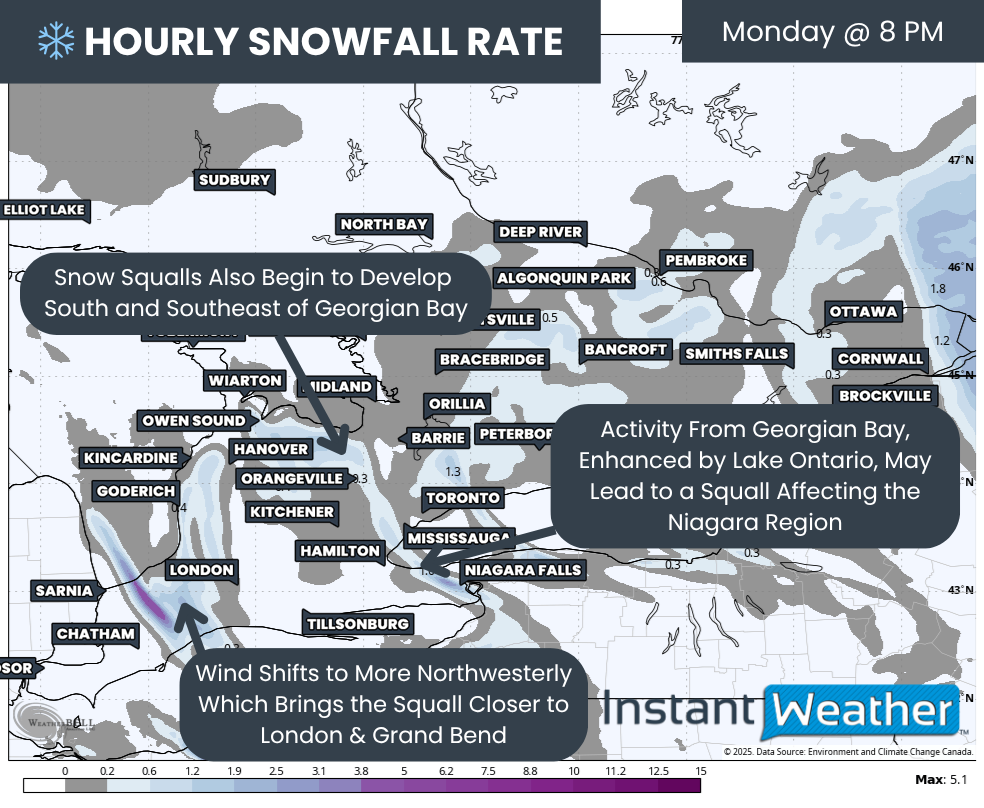
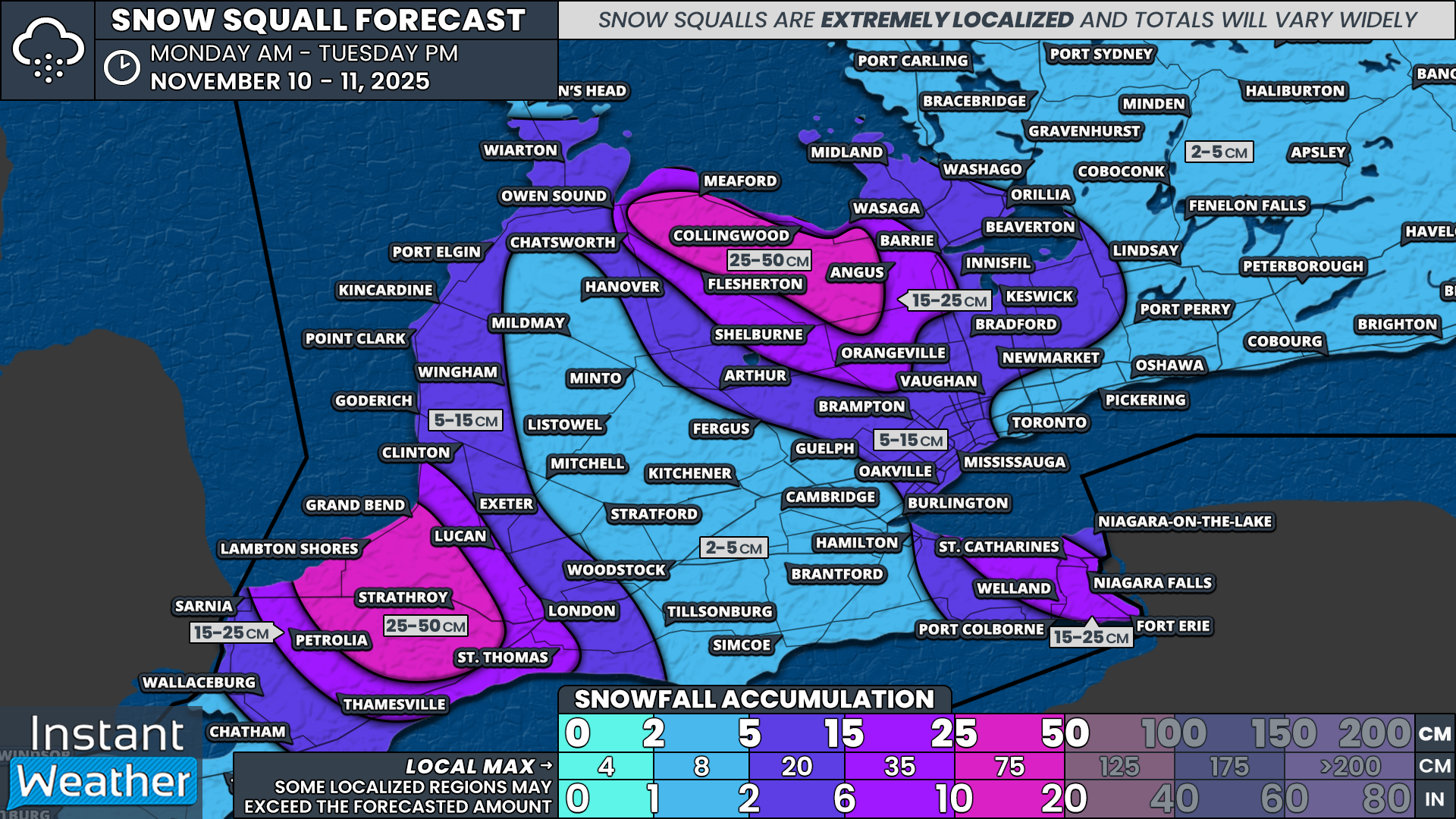
NOTE: YOU CAN CLICK ON THE MAP TO OPEN A ZOOMABLE IMAGE

As much of Southern Ontario cleans up after our first widespread snowfall of the season, Mother Nature is showing no signs of slowing down. The lake effect snow machine is roaring to life over Lake Huron and Georgian Bay as we kick off the second week of November.

Snow squalls have already developed south of Lake Huron late Sunday evening and are expected to strengthen through the night. We’re also anticipating some squall development along the southern shoreline of Georgian Bay, which should organize by Monday afternoon or evening.

Two main regions are likely to see the most intense activity. The first stretches between Sarnia and London, while the second includes areas south of Georgian Bay from Blue Mountain and Meaford toward the west of Barrie. Both zones could see heavy snow squalls lasting through to Tuesday morning.

While snowfall totals will vary significantly across short distances, confidence is increasing that the hardest hit areas could see as much as 25 to 50cm by the time the squalls taper off on Tuesday. Localized pockets may even exceed 50cm, depending on where the heaviest bands set up.

Road conditions are expected to deteriorate quickly in these regions, with road and highway closures likely late Monday and into early Tuesday when the most intense squalls occur. Travel should be avoided unless absolutely necessary, as these bands can produce sudden whiteouts, making it nearly impossible to see the road ahead.

ESTIMATED AIR TEMPS AROUND 1.5KM ABOVE GROUND - MAP FROM WEATHERBELL

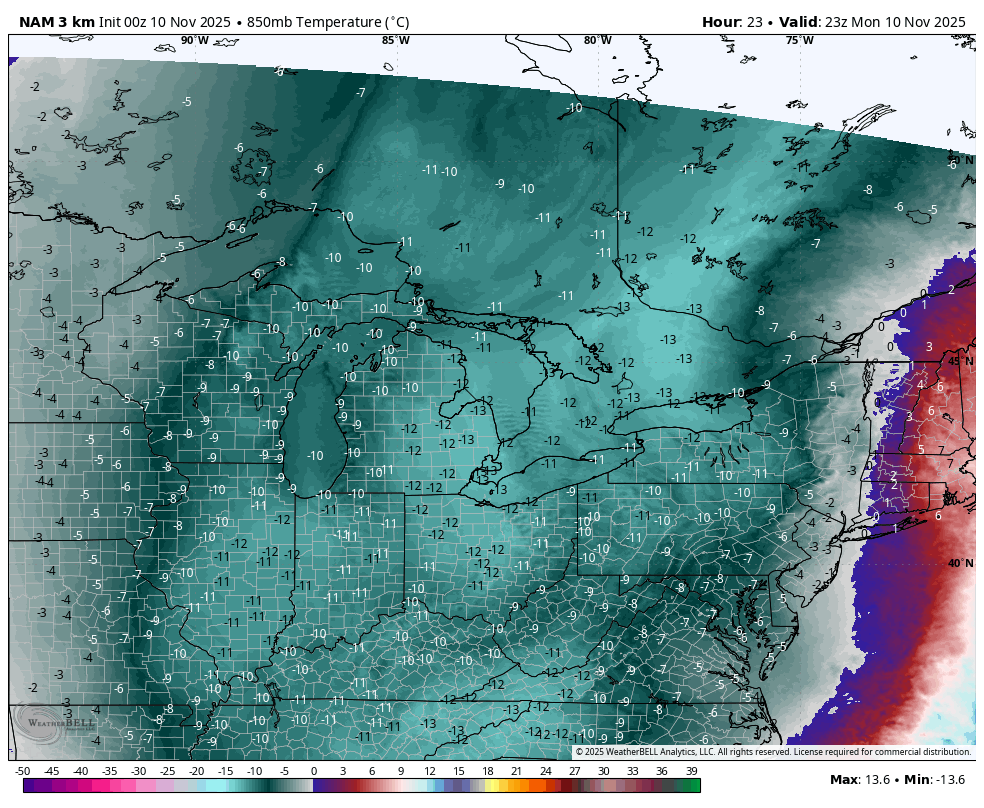
This setup is being fueled by a rare November appearance of a mini “Polar Vortex” which is pulling a blast of Arctic air into Southern Ontario. This cold air is flooding the upper levels of the atmosphere and setting the stage for intense lake effect activity.

To put it simply, when forecasters talk about 850mb temperatures, we’re referring to the air temperature roughly 1.5 kilometres above the ground. This level helps forecasters understand how cold the air mass is higher up in the atmosphere, which is critical for predicting lake effect snow.

Over the next few days, 850mb temperatures are expected to plunge into the negative teens. Lake effect snow forms when there’s a large temperature difference between the lake surface and the air above it, generally 13°C or greater. With upper air temperatures between -10°C and -15°C and lake temperatures still above 10°C, that difference is more than 20°C, creating ideal conditions for lake effect snow to thrive.

hourly snowfall rates (cm) - MAP FROM WEATHERBELL

As of midnight, snow has already developed off the southern shores of Lake Huron, impacting the Sarnia region. So far, the bands have been disorganized and spread out, but that’s expected to change by late Monday morning as a stronger, more focused squall forms somewhere between London and Sarnia.

While the exact placement remains uncertain, areas near Petrolia and Strathroy appear most likely to be in the direct path. The band will likely shift through the day as wind directions fluctuate, leading to varying snow intensities across nearby towns.

hourly snowfall rates (cm) - MAP FROM WEATHERBELL

By Monday evening, things will really start to ramp up. The main squall off Lake Huron will likely push inland, with a more northwesterly wind direction steering it toward Grand Bend, Goderich and potentially the western edges of London. It’s still unclear if the squall will reach directly into London or remain just outside the city, but if it does, the heaviest snowfall will likely fall on the west side.

Meanwhile, snow squalls are expected to organize over Georgian Bay with heavy snow bands developing between Owen Sound and Barrie. There’s still some disagreement among models, with some focusing more on Wasaga Beach and Barrie while others favour a southern shoreline setup.

An interesting twist could occur if these Georgian Bay bands extend far enough inland to be enhanced by Lake Ontario. In that case, snow could reach into the western GTA and even the Niagara region, leading to sudden bursts of heavy snow if everything aligns.

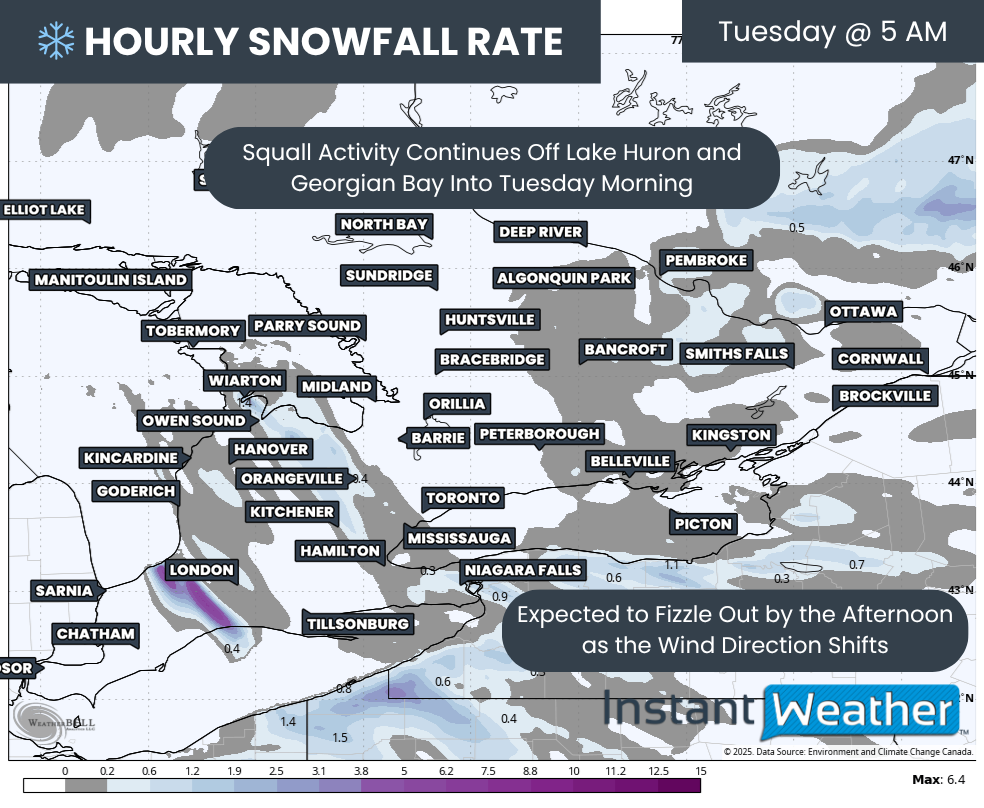
hourly snowfall rates (cm) - MAP FROM WEATHERBELL

This lake effect activity is expected to persist overnight and into Tuesday morning, though the Georgian Bay bands should weaken slightly around sunrise. West of London, however, heavy snow could continue well into Tuesday morning before breaking apart as conditions become less favourable later in the day.

As always with lake effect snow, totals are extremely difficult to pinpoint. These narrow bands can stay locked over one community for hours while completely missing another just a few kilometres away. One person may end up shovelling half a metre of snow while someone nearby barely sees a dusting.

That said, two areas consistently stand out across the latest model runs. One includes Lambton Shores, Grand Bend and Strathroy, while the other covers the southern Georgian Bay shoreline and higher terrain around Blue Mountain. These regions could see totals ranging from 25 to 50cm by Tuesday.

Surrounding communities such as Petrolia, Thamesville, St. Thomas and Lucan, along with Orangeville, Shelburne and Flesherton, are more likely to see 15 to 25cm.

Both London and Barrie sit right on the edge between lighter and heavier accumulations. We currently have them in the 5 to 15cm or 15 to 25cm zones, depending on how far east the snow squalls extend.

Finally, the Niagara region remains uncertain. If the Georgian Bay squalls stretch far enough inland and connect with Lake Ontario, parts of the region could pick up over 15cm of additional snow.

Outside of these snowbelt regions, impacts will be much less significant. A few flurries and brief bursts of snow are possible as the squalls wobble, but most areas outside the direct lake effect zones should remain relatively calm through Tuesday.

‘Snow Day’ Forecast: Southern Ontario’s First Wintery Blast May Lead to School Bus Cancellations on Monday

For an updated list of school bus cancellations & school closures, please visit our live article: https://instantweatherinc.com/article/2025/11/10/bus-cancellations

NOTE: YOU CAN CLICK ON THE MAP TO OPEN A ZOOMABLE IMAGE

A system swept through Southern Ontario on Sunday, bringing with it the first widespread accumulating snowfall of the season. For many, this was the first real taste of winter, and it certainly didn’t hold back. As the system pushes eastward, snow is beginning to taper off in most regions Sunday evening, though parts of Eastern Ontario will continue to see flakes fly past midnight before conditions gradually improve Monday morning.

While the timing of this system makes it less likely to cause major issues for the Monday morning commute, there is still a chance that some regions could see school bus cancellations. The main concern will be how quickly local and rural roads can be cleared before buses head out early in the morning. Road crews will be busy overnight, but areas that received the heaviest snow or where snow continues into the early hours may still be playing catch-up by dawn.

Adding to the challenge, lake effect snow is expected to fire up behind the main system as early as Monday morning and persist through Tuesday, particularly around Lake Huron and Georgian Bay. Environment Canada has issued snow squall watches for these areas, mentioning the potential for 15 to 30 cm of additional snow, with locally higher amounts possible under stronger squalls. This could lead to sudden drops in visibility and rapidly changing travel conditions.

Because of this, some school boards near the lakes may choose to cancel buses proactively, especially where snow squall watches remain in effect. However, confidence in widespread cancellations is lower at this stage since the heaviest lake effect snow isn’t expected to fully develop until later Monday morning or afternoon.

Based on the forecast and our past experience, the highest chance for a “snow day” is across rural Eastern Ontario, particularly the Frontenac region within the Tri-Board area. We’re giving this region around a 75% chance of cancellations. Snow is expected to linger longest here, and these rural routes are typically slower to clear. The rest of the Tri-Board area, along with the Upper Canada and Renfrew regions, could go either way, earning a 50% chance depending on how quickly road conditions improve by morning.

The City of Ottawa, on the other hand, is less likely to see a snow day. Urban areas tend to handle these events better, and the overall snowfall amounts aren’t expected to reach the threshold that usually triggers cancellations. Still, we’ve placed Ottawa at a 25% chance, since it’s the first major snowfall of the season and even modest totals can cause delays if cleanup efforts fall behind overnight.

Across Southwestern Ontario and the Lake Huron snowbelt, bus cancellations are also possible, especially as snow squalls intensify through the day. School boards such as LKDSB, TVDSB, AMDSB, and BWDSB could see anywhere from a 50% to 75% chance of cancellations, depending on where the lake effect bands set up. The heaviest and most persistent squalls are expected along and just inland from the shoreline, particularly around Grand Bend, Strathroy, and Petrolia. The Simcoe West and Meaford areas could also be affected by Georgian Bay lake effect activity, where we’ve assigned a 50% chance.

Outside of Eastern Ontario and the lake effect zones, the risk of a snow day drops off significantly. Most of the Golden Horseshoe, Niagara, and Southwestern Ontario should have more than enough time for roads to be cleared before the morning commute.

That said, temperatures will dip below freezing overnight, which could cause refreezing of slushy or untreated surfaces and create localized icy patches. Even where cancellations aren’t expected, drivers should plan for slower travel Monday morning.


Disclaimer: Instant Weather has zero authority when it comes to bus and school closures.

It is completely up to the school boards, bus companies, local authorities, and parents to decide what is best for their children. This is our best guess based on our forecast.
Snowy Sunday Sweeps Into Southern Ontario With First Widespread Snowfall of the Season

NOTE: YOU CAN CLICK ON THE MAP TO OPEN A ZOOMABLE IMAGE

While there has been a lot of uncertainty surrounding Southern Ontario’s first widespread snowfall event of the season, we’re finally starting to get a clearer picture of what will unfold on Sunday. After several model shifts over the past few days, the latest data is now coming into better alignment, giving us a more confident idea of how this system will behave.

A developing low-pressure system is expected to move in from the southwest late Saturday night, tracking across areas near Lake Erie through the day on Sunday. As it does, it will bring a broad swath of snow stretching from Windsor through the Golden Horseshoe and into Eastern Ontario. Snow is expected to last much of the day before gradually tapering off overnight.

At this stage, snowfall totals are expected to vary quite a bit across the region. The exact placement of the heaviest snow bands remains uncertain, and surface conditions will also play a big role. Since the ground is still relatively warm, some of the early snowfall may melt on contact before it can begin to accumulate, especially on roads and sidewalks.
In general, by Monday morning, snowfall totals are expected to range from around 5 to 10 cm across the Golden Horseshoe and into Eastern Ontario. Within those areas, localized pockets, particularly in Eastern Ontario, could pick up as much as 15 to 20 cm according to the latest model runs. Further north and west, across Central and Southwestern Ontario, amounts will be lower with less than 5 cm expected in most spots.

As the system departs, colder air will pour into Southern Ontario late Sunday night, sending temperatures well below freezing. Any slushy snow or water on roads, sidewalks, and driveways will freeze quickly overnight, which could create slick conditions for the Monday morning commute. Drivers should be prepared for icy patches, and there’s a decent chance of school bus cancellations in areas that see higher snowfall totals.

The colder air will also fire up the lake effect snow machine early next week. Model guidance suggests that an intense but narrow band of snow could form southeast of Lake Huron late Monday and continue into Tuesday. This could impact communities such as Grand Bend and London, where local snowfall totals could exceed 25 cm if the band remains stationary for an extended period.

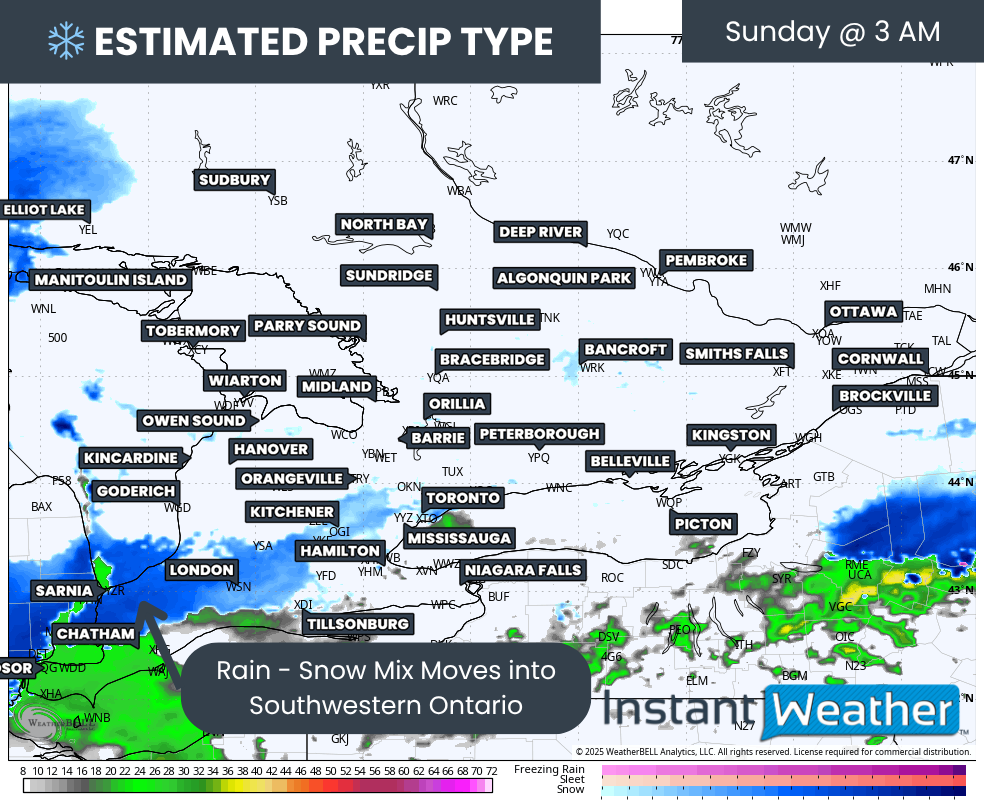
PRECIP TYPE - MAP FROM WEATHERBELL

For timing, snow is expected to begin in Deep Southwestern Ontario shortly after midnight. Around Windsor and Chatham, it may even start as rain before transitioning to snow as temperatures drop closer to dawn.

PRECIP TYPE - MAP FROM WEATHERBELL

By late Sunday morning, the snow will have spread into the Golden Horseshoe, becoming heavier through the afternoon. In Eastern Ontario, snow will likely begin around Kingston early in the morning and reach the Ottawa area by midday.

hourly snowfall rates (cm) - MAP FROM WEATHERBELL

The heaviest snowfall rates across the Golden Horseshoe are expected from early to mid-afternoon, with some models projecting bursts of 2 to 4 cm per hour at times before tapering off toward the evening.

PRECIP TYPE - MAP FROM WEATHERBELL

For Eastern Ontario, steady snow will continue through the afternoon, peaking after dinner before easing into scattered flurries overnight. With that timing, school bus cancellations are quite possible for parts of Eastern Ontario on Monday.

There are also some indications that freezing rain or ice pellets may mix in along the international border Sunday evening. Areas such as Kingston, Brockville, and Cornwall are most at risk for this brief mix, which could add an extra layer of slickness to untreated surfaces.

NOTE: YOU CAN CLICK ON THE MAP TO OPEN A ZOOMABLE IMAGE

While there is still some disagreement among the models on exactly where the heaviest snow will fall, the general expectation remains 5 to 10 cm along the Golden Horseshoe and into Eastern Ontario, with some locally higher amounts near 15 cm.

We’ve outlined portions of Eastern Ontario and the higher elevations of the Niagara region on our map with a dotted zone, representing areas that could overachieve and see closer to 20 cm. However, that outcome is far from certain.

Keep in mind that this is the first significant snowfall of the season, and with ground temperatures still above freezing, actual accumulation could vary from one street to the next. Some areas may see a quick coating, while others struggle to hold the snow through the day, especially near the lakeshores.

Elsewhere, Southwestern Ontario and much of Central Ontario should see lighter amounts, generally only a few centimetres, with some localized areas possibly reaching up to 8 cm. Regions like Grey-Bruce and the northern parts of Central Ontario will likely miss out on the heaviest snow this time, but that may not last long as lake effect activity ramps up early next week.

PRECIP TYPE - MAP FROM WEATHERBELL

As higher-resolution models continue to come into range, we’re getting a clearer idea of what the first snow squall event of the season could look like. Current projections suggest activity will develop on Monday, with a more organized squall forming by the evening.

This band may set up somewhere between Grand Bend and Kettle Point, extending inland, likely just west of the City of London. Additional bands may also develop off Georgian Bay, impacting areas around Meaford and Collingwood.

Communities caught under these narrow squalls could see impressive snowfall totals, while just a few kilometers away, grass may still be visible. We’ll continue to refine the details as the event approaches and will have a more specific forecast on who could see the most snow closer to Monday.

Overall, this marks the true start of the winter season across Southern Ontario, with several systems and lake effect events lining up behind this one. It’s a good time to check that your winter tires are ready, snow shovels are handy, and morning routines include a few extra minutes to clear off your car. Winter is here to stay.